


Hezbollah Leads Fighting in South after Lebanese, Palestinian Factions Step Back

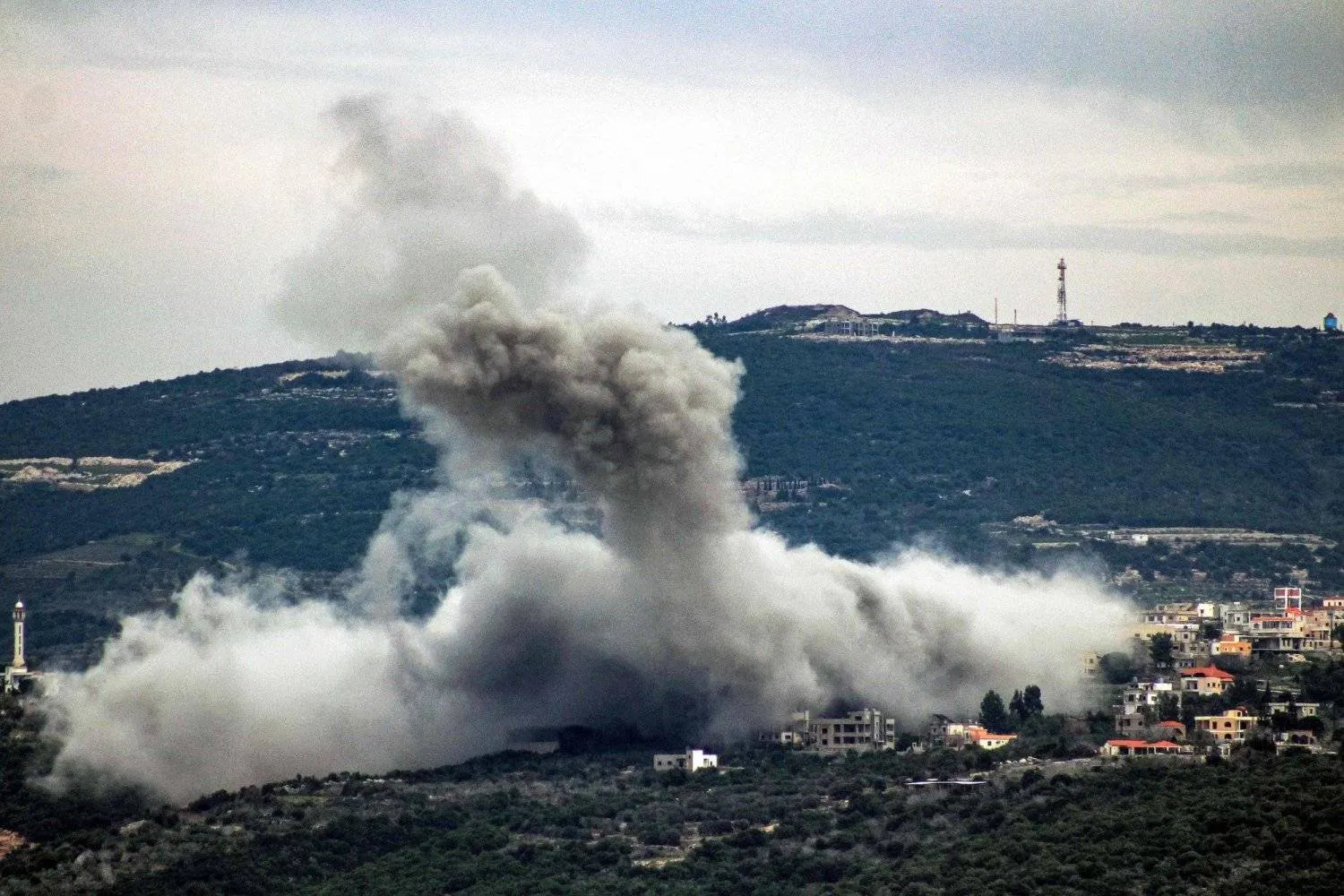
Smoke billows after an Israeli airstrike on a village in southern Lebanon. (AFP)
TT

Hezbollah Leads Fighting in South after Lebanese, Palestinian Factions Step Back

Smoke billows after an Israeli airstrike on a village in southern Lebanon. (AFP)

Attacks by Lebanese and Palestinian factions in southern Lebanon against Israel have decreased in recent weeks compared to how active they were in wake of Hamas’ October 7 assault.

The factions had been using the attacks to deliver messages to Israel and the international community.

The factions, which had initially included the al-Qassam Brigades and Saraya al-Quds, had taken part in “symbolic combat” against Israel in wake of Hamas’ attack. They launched rockets and limited incursions into northern Israel.

They were later joined by other Lebanese groups, such as the al-Fajr Forces that is affiliated with the al-Jamaa al-Islamiya, the Baath and the “Arab Current” parties.

Members of the Lebanese Amal Movement had also been deployed along the southern border, without officially declaring it was carrying out operations. The movement, headed by parliament Speaker Nabih Berri, has so far mourned eight members killed in Israeli strikes.

Hezbollah has recently sought to highlight Amal’s role in the South to underscore “Shiite unity”, as stated by party MP Mohammed Raad.

Director of the Levant Institute for Strategic Affairs Dr. Sami Nader explained that Hezbollah initially allowed attacks by factions other than itself to provide cover for the Palestinians and underline that it was not involved in Hamas’ Al-Aqsa Flood operation on October 7.

Hezbollah, however, will not relinquish control over the South, he stressed.

“Despite aligning with Hamas strategically, Hezbollah won't allow it or any other group to establish a foothold in the south,” he told Asharq Al-Awsat.

Nader also pointed out that Hezbollah’s decision to halt the other factions’ “symbolic operations” against Israel was driven by its commitment to a “certain ceiling” related to the messages exchanged between Iran and the United States and to prevent the spillover of the war on Gaza.

Hezbollah also wants to prevent Israel from using the presence of al-Qassam Brigades in the South as justification for expanding its operations.

Analyst Kassem Kassir told Asharq Al-Awsat that other groups’ involvement in military operations in the South depends on their capabilities and resources.

Professor of political science at the American University of Beirut Hilal Khashan highlighted the evolution of the resistance against Israel in Lebanon. It was initially called “national resistance” but later came to be monopolized by Hezbollah.

Khashan told Asharq Al-Awsat that Hezbollah allowed other factions to carry out limited military operations against Israel to “deliver certain messages at the time.”

“But Hezbollah doesn’t want an escalation and has since halted the other operations that were being launched from the South,” he added.

It continues to sanction some Amal activities to project the image that Shiites remain united in times of crisis.



Few People Left at Syria Camp that Held ISIS Families, Former Director Says

Children, part of a group of detainees, look through a fence at al-Hol camp after the Syrian government took control of it following the withdrawal of Syrian Democratic Forces (SDF), in Hasaka, Syria, January 21, 2026. REUTERS/Khalil Ashawi
TT

Few People Left at Syria Camp that Held ISIS Families, Former Director Says

Children, part of a group of detainees, look through a fence at al-Hol camp after the Syrian government took control of it following the withdrawal of Syrian Democratic Forces (SDF), in Hasaka, Syria, January 21, 2026. REUTERS/Khalil Ashawi

Fewer than 1,000 families remain at a camp where relatives of suspected ISIS militants had been held in Syria's northeast, the camp's former director said on Wednesday, with thousands having fled last month as government forces seized control of the area from Kurdish-led fighters.

Al-Hol, near the Iraqi border, was one of the main detention camps for relatives of suspected ISIS militants who were detained during the US-backed campaign against the terrorist group in Syria.

Control of the camp changed hands last month when government forces under President Ahmed al-Sharaa seized swathes of the northeast from the Kurdish-led Syrian Democratic Forces, including several jails holding ISIS militants. The US military said last week it had completed a mission to transfer 5,700 adult male ISIS detainees to Iraq.

Jihan Hanna, the former director who still coordinates with international agencies and the Syrian government, told Reuters the remaining families were Syrian nationals and were being transferred to a camp in Aleppo. Most of the camp’s foreign nationals had fled, she said.

The Syrian government did not immediately respond to requests for comment.

According to the latest camp data obtained by Reuters, dated January 19 - a day before the government took control of the camp - its population was 6,639 families comprising 23,407 people, mostly Syrians and Iraqis, as well as 6,280 foreigners from more than 40 nationalities.

UNHCR, the UN refugee agency, said it had observed "a significant decrease in the number of residents in al-Hol camp in recent weeks," adding in a statement to Reuters that there were no confirmed figures on the remaining population.

"Over the weekend the camp administration advised UNHCR not to enter the camp due to the unrest and anxiety in the camp," UNHCR added.

The Syrian government accused the SDF of withdrawing from al-Hol on January 20 without any coordination.

The SDF, in a statement that day, said its forces had been "compelled to withdraw from al-Hol camp and redeploy to areas surrounding cities in northern Syria that are facing increasing risks and threats."

A Syrian government security source said most people in the camp fled that day during a five-hour period when it was unguarded, and that some had left with men who came to take their relatives to unknown destinations.

The security source and a source from a non-governmental organization working there said a section of the camp that housed its most dangerous residents, known as the annex, was empty.

The security source said the escapees had spread throughout Syria and that security authorities, working in cooperation with international partners, had established a unit to "follow up on the matter and pursue those who are wanted."

Some have left Syria.

In Lebanon, the army has questioned more than a dozen Lebanese who crossed illegally from Syria after leaving al-Hol, a Lebanese security source said.

The Syrian government’s Directorate of International Cooperation said on Tuesday that hundreds of people, mostly women and children, had been transferred from al-Hol to a newly prepared camp near the town of Akhtarin in northern Aleppo.


Germany Moves Troops Out of Iraq, Citing Mideast 'Tensions'

FILE PHOTO: German Defense Minister Ursula von der Leyen visits the Transport Helicopter Regiment 30 (Transporthubschrauberregiment 30) at the Hermann-Koehl-Kaserne in Niederstetten, Germany, August 20, 2018. REUTERS/Ralph Orlowski
TT

Germany Moves Troops Out of Iraq, Citing Mideast 'Tensions'

FILE PHOTO: German Defense Minister Ursula von der Leyen visits the Transport Helicopter Regiment 30 (Transporthubschrauberregiment 30) at the Hermann-Koehl-Kaserne in Niederstetten, Germany, August 20, 2018. REUTERS/Ralph Orlowski

Germany's military has "temporarily" moved some troops out of Erbil in northern Iraq because of "escalating tensions in the Middle East," a German defense ministry spokesman told AFP on Thursday.

Dozens of German soldiers had been relocated away from the base in Erbil, capital of Iraq's autonomous Kurdistan region.

"Only the personnel necessary to maintain the operational capability of the camp in Erbil remain on site," the spokesman said.

The spokesman did not specify the source of the tensions, but US President Donald Trump has ordered a major build-up of US warships, aircraft and other weaponry in the region and threatened action against Iran.

German troops are deployed to Erbil as part of an international mission to train local Iraqi forces.

The spokesman said the German redeployment away from Erbil was "closely coordinated with our multinational partners".


UN: At Least 15 Children Killed in Sudan Drone Strike

The war in Sudan, ongoing since mid-April 2023, has caused extensive destruction across the country (AFP)
TT

UN: At Least 15 Children Killed in Sudan Drone Strike

The war in Sudan, ongoing since mid-April 2023, has caused extensive destruction across the country (AFP)

A drone strike on a displacement camp in Sudan killed at least 15 children earlier this week, the United Nations reported late on Wednesday.

"On Monday 16 February, at least 15 children were reportedly killed and 10 wounded after a drone strike on a displacement camp in Al Sunut, West Kordofan," the UN children's agency said in a statement.

Across the Kordofan region, currently the Sudan war's fiercest battlefield, "we are seeing the same disturbing patterns from Darfur -- children killed, injured, displaced and cut off from the services they need to survive," UNICEF's Executive Director Catherine Russell said.