Yemen Faces 'Environmental Disaster' as Sunken Ship Threatens Red Seahttps://english.aawsat.com/arab-world/4895146-yemen-faces-environmental-disaster-sunken-ship-threatens-red-sea
Yemen Faces 'Environmental Disaster' as Sunken Ship Threatens Red Sea
A handout photo made available by Yemeni Al-Joumhouriya TV shows the British-registered cargo vessel, Rubymar, sinking after being damaged in a missile attack by the Houthis in the Red Sea off the coast of Yemen, 26 February 2024 (issued 27 February 2024). EPA/Yemeni Al-Joumhouriya TV
Yemen Faces 'Environmental Disaster' as Sunken Ship Threatens Red Sea
A handout photo made available by Yemeni Al-Joumhouriya TV shows the British-registered cargo vessel, Rubymar, sinking after being damaged in a missile attack by the Houthis in the Red Sea off the coast of Yemen, 26 February 2024 (issued 27 February 2024). EPA/Yemeni Al-Joumhouriya TV
The sinking of a bulk carrier off Yemen after a Houthi missile attack poses grave environmental risks as thousands of tonnes of fertilizer threaten to spill into the Red Sea, officials and experts warn.
Leaking fuel and the chemical pollutant could harm marine life, including coral reefs, and impact coastal communities that rely on fishing for their livelihoods, they said.
The Belize-flagged, Lebanese-operated Rubymar sank on Saturday with 21,000 metric tonnes of ammonium phosphate sulfate fertiliser on board, according to US Central Command.
It had been taking in water since a Houthi missile strike on February 18 damaged its hull, marking the most significant impact on a commercial ship since the group started targeting vessels in November.
After already leaving a slick from leaking fuel while it was still afloat, the Rubymar now poses a new set of environmental threats under water.
Abdulsalam al-Jaabi of the Yemeni government's environmental protection agency warned of "double pollution" that could impact 78,000 fishermen and their families -- up to half a million people.
"The first pollution is oil pollution resulting from the large amount of fuel oil on board," he said, estimating the quantity to be over 200 tonnes.
The second risk is posed by the fertilizer, which is highly soluble and could harm "fish and living organisms such as coral reefs and seaweed" if released into the sea, Jaabi added.
The overall contamination could incur "significant economic costs", especially on coastal communities that depend on fishing for survival, the official warned.
The Rubymar is the first ship to sink since the Houthis started their Red Sea campaign which they say is in solidarity with Palestinians in Gaza amid the Israel-Hamas war.
UN Special Envoy Hans Grundberg said five experts from the United Nations Environment Program are due in Yemen this week to conduct an assessment in coordination with the Yemeni environment ministry.
Israel Steps up Pressure with Displacement, Strikes after Aoun Rejects Netanyahu Meetinghttps://english.aawsat.com/arab-world/5268881-israel-steps-pressure-displacement-strikes-after-aoun-rejects-netanyahu-meeting
Rescue personnel clear rubble from buildings destroyed in the Lebanese town of Habboush, following Israeli strikes, Nabatieh Governorate, Lebanon, May 2, 2026. REUTERS/Stringer
Israel Steps up Pressure with Displacement, Strikes after Aoun Rejects Netanyahu Meeting
Rescue personnel clear rubble from buildings destroyed in the Lebanese town of Habboush, following Israeli strikes, Nabatieh Governorate, Lebanon, May 2, 2026. REUTERS/Stringer
Israel has intensified pressure on Lebanon by expanding evacuation warnings and resuming deep airstrikes, now covering most towns in the Nabatieh and Tyre districts and effectively isolating the city of Nabatieh from its surroundings. The escalation follows the failure of efforts to arrange a meeting in Washington between Lebanese President Joseph Aoun and Israeli Prime Minister Benjamin Netanyahu under US auspices.
Lebanese ministerial sources told Asharq Al-Awsat that “it is far too early” for such a meeting, stressing that the priority now is to end the war, secure an Israeli withdrawal from occupied Lebanese territory, allow displaced residents to return to their areas, and begin reconstruction.
In Beirut, the Israeli escalation is seen as additional pressure on the Lebanese state and Hezbollah amid a stalled political track. The Israeli army issued new evacuation warnings for nine towns in the Nabatieh district, adding to dozens of villages and towns previously warned starting last Sunday, prompting tens of thousands of residents to flee once again.
The new warning includes Qaquaiyat al-Jisr, Adshit al-Shaqif, Jibsheet, Aba, Kfarjouz, Harouf, Doueir, Deir al-Zahrani, and Habboush. This effectively restricts access to the city of Nabatieh, north of the Litani River, from all directions, leaving it isolated.
The Israeli army called on residents to immediately evacuate their homes and move at least 1,000 meters away to open areas, warning that “anyone near Hezbollah elements, facilities, or combat assets is putting their life at risk.”
Airstrikes
Within hours of the warning, airstrikes began targeting the affected villages. The state-run National News Agency reported that Israeli warplanes struck the old Husseiniya in the town of Doueir in Nabatieh district, completely destroying it.
Nearby, a condolence hall, additional halls and ground-level rooms, and a headquarters of the Islamic Risala Scout Association were also destroyed. Graves and a martyrs’ cemetery were heavily damaged, along with several parked vehicles.
Israeli warplanes also struck Qaquaiyat al-Jisr, Safad al-Battikh, the outskirts of Braachit, Shaqra, al-Shihabiya, Zawtar al-Sharqiya, Kounine, Adshit, Majdal Zoun, al-Shaitiya, al-Samaaiya, the area between Kafra and Yater, and the Shoukin–Nabatieh road, with reports of casualties. Meanwhile, Majdal Selm and Qabrikha came under artillery fire.
Strikes were also carried out near the vocational institute building in Nabatieh and near al-Quds roundabout in the city. A vehicle on the Kfar Dajjal–Nabatieh road was targeted, resulting in two deaths. Three residents from Shoukin, one from Meifdoun, and two Syrians were also killed in air raids on Shoukin in Nabatieh district.
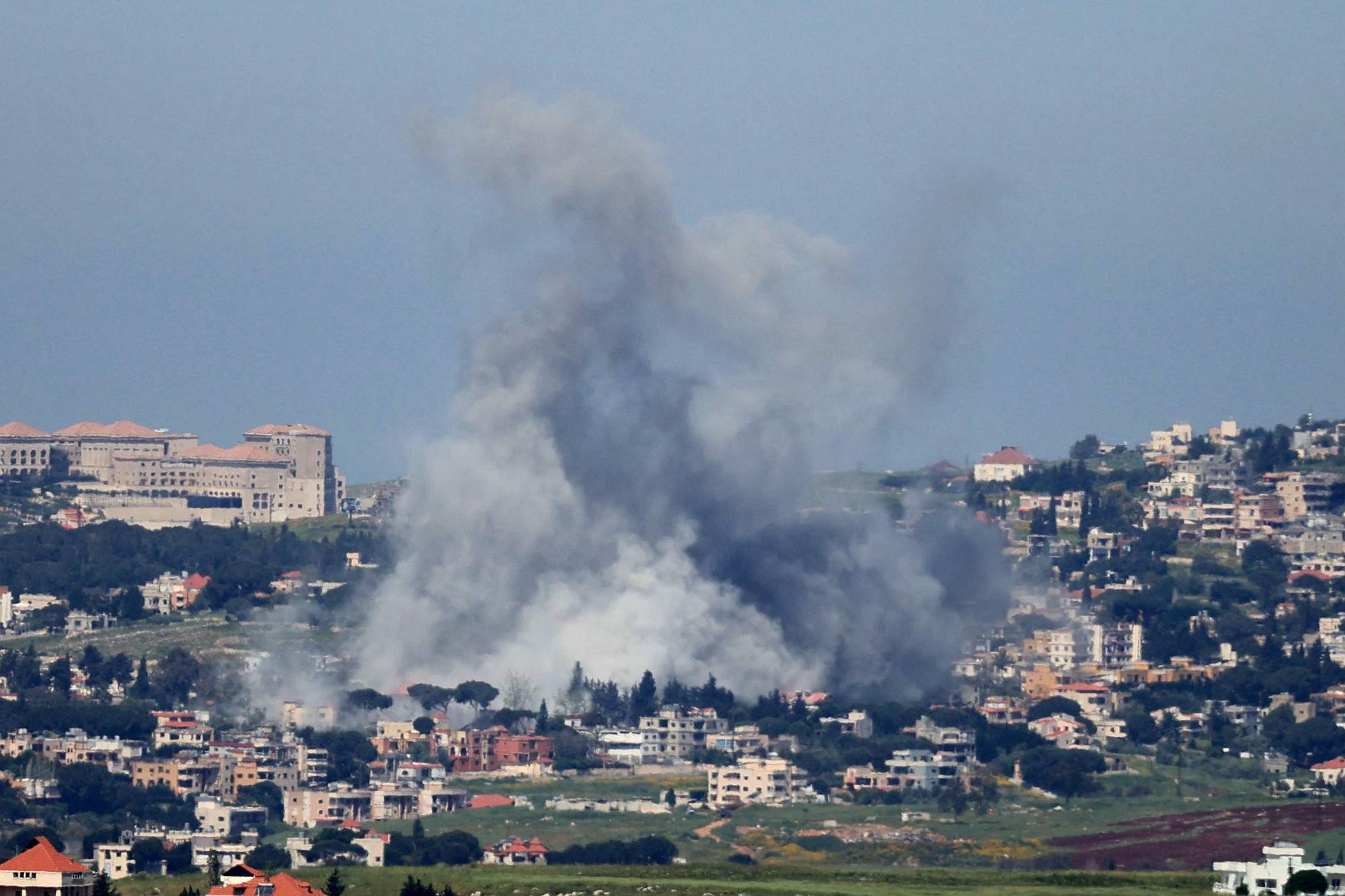
Smoke rises from the site of an Israeli airstrike that targeted the southern Lebanese village of Mayfadoun in the Nabatieh district on May 2, 2026. (Photo by AFP)
Shelling and drone attacks
Yahmar al-Shaqif was subjected to Israeli phosphorus shelling accompanied by heavy machine-gun fire near the Litani River toward the town of Taybeh. Artillery shelling also targeted Zawtar al-Sharqiya, Zawtar al-Gharbiya, Meifdoun, al-Mansouri, Majdal Zoun, Touline, and Qabrikha. An airstrike on a house in the town of al-Luweizeh in the Iqlim al-Tuffah area killed three people.
In the western sector, Israeli forces fired heavy machine guns toward the outskirts of Ramieh and Qawzah. An Israeli loitering drone targeted a motorcycle at the Deir Qanoun Ras al-Ain junction south of Tyre, killing one person and wounding another who was taken to hospitals in Tyre.
Another drone strike targeted a motorcycle on the al-Shaitiya road in Tyre district, seriously injuring the rider. Drones were also reported flying over villages in al-Zahrani.
The cumulative death toll in Lebanon since March 2 has reached 2,659 killed and 8,183 wounded, according to the Emergency Operations Center at the Ministry of Public Health.
Hezbollah
Hezbollah, for its part, continued launching suicide drones targeting Israeli soldiers and armored vehicles inside occupied Lebanese territory. In a statement, the group said its fighters targeted a gathering of Israeli forces in the town of al-Bayada with a loitering munition.
The Israeli army said its air force intercepted a rocket fired toward its forces in southern Lebanon on Saturday afternoon.
It added that Hezbollah launched rockets and explosive drones in several other incidents on Saturday, which fell near areas where Israeli forces are operating in southern Lebanon, without causing casualties.
Oil Tanker Hijacked off Yemen, Diverted Towards Somaliahttps://english.aawsat.com/arab-world/5268858-oil-tanker-hijacked-yemen-diverted-towards-somalia
Oil Tanker Hijacked off Yemen, Diverted Towards Somalia
Oil tanker (file photo – Reuters)
An oil tanker was hijacked on Saturday off the coast of Yemen in the Gulf of Aden and taken toward Somalia, the Yemeni coast guard said.
According to the agency, the tanker EUREKA was seized off Shabwa province by unknown individuals who "boarded, took control of it, then steered it... in the direction of the Somali coast".
It also said that the tanker has been located, and efforts are under way to track it and take the necessary measures in an attempt to recover it and ensure the safety of its crew, whose number and nationalities were not specified.
Lebanese Divisions over Approach to US Pressure for Aoun–Netanyahu Meetinghttps://english.aawsat.com/arab-world/5268857-lebanese-divisions-over-approach-us-pressure-aoun%E2%80%93netanyahu-meeting
A poster depicting the portrait of Lebanon's President Joseph Aoun that reads "The decision-maker, the protector of Lebanon, Lebanon first...The State always. We are with you" hangs at the entrance of a tunnel on a street in Beirut (Photo by Joseph EID / AFP)
Lebanese Divisions over Approach to US Pressure for Aoun–Netanyahu Meeting
A poster depicting the portrait of Lebanon's President Joseph Aoun that reads "The decision-maker, the protector of Lebanon, Lebanon first...The State always. We are with you" hangs at the entrance of a tunnel on a street in Beirut (Photo by Joseph EID / AFP)
Lebanese political forces are split between those supporting direct negotiations with Israel to end the ongoing war in the south and those opposing them, placing the Lebanese president in a difficult position amid internal divisions that could affect the course of the state. There are warnings that pursuing any option without consensus could have repercussions for unity and internal stability.
In a statement notable for both its timing and content, the US Embassy in Beirut on Thursday called for direct engagement between Lebanon and Israel, saying a direct meeting between Aoun and Netanyahu, mediated by the US president, could give Lebanon an opportunity to obtain tangible guarantees regarding full sovereignty, territorial integrity, secure borders, humanitarian support and reconstruction, and the full restoration of the Lebanese state’s authority over every inch of its territory, guaranteed by the United States.
Hezbollah–Amal alliance
It was not surprising that the “Shiite duo” (Hezbollah and the Amal Movement) fully opposes such a meeting, viewing it as contrary to the path of direct negotiations underway between Lebanon and Israel.
Sources close to the two parties told Asharq Al-Awsat: “There is absolutely no support for this meeting, and a scene like this cannot be accepted. It is true that US pressure is very clear, but there is also Lebanon’s interest and the position of Arab states, which advised the president not to move toward such a meeting and instead to seek, through negotiations, a security arrangement similar to the 1949 armistice agreement, even if with some amendments.”
The sources added that “President Aoun is caught between US pressure on one hand and Arab pressure on the other, and must decide where Lebanon’s interest lies and define its position, role, and future in the region.”
A woman walks past a billboard supporting Lebanese President Joseph Aoun - EPA/WAEL HAMZEH
Progressive Socialist Party
The position of the Progressive Socialist Party, expressed by MP Dr. Bilal Abdallah, is not far from that of the “duo.” Abdallah considers that “the meeting is premature, and there are many stages that must be completed before it can take place, most notably consolidating the ceasefire, halting attacks, Israeli withdrawal, and reaching a security agreement based on international agreements (a revised armistice agreement), after which each step can be addressed in due course.”
He stressed the need to respect “the Arab and international ceiling and avoid preempting developments or skipping stages, as the repercussions would be negative for national interest and internal unity.”
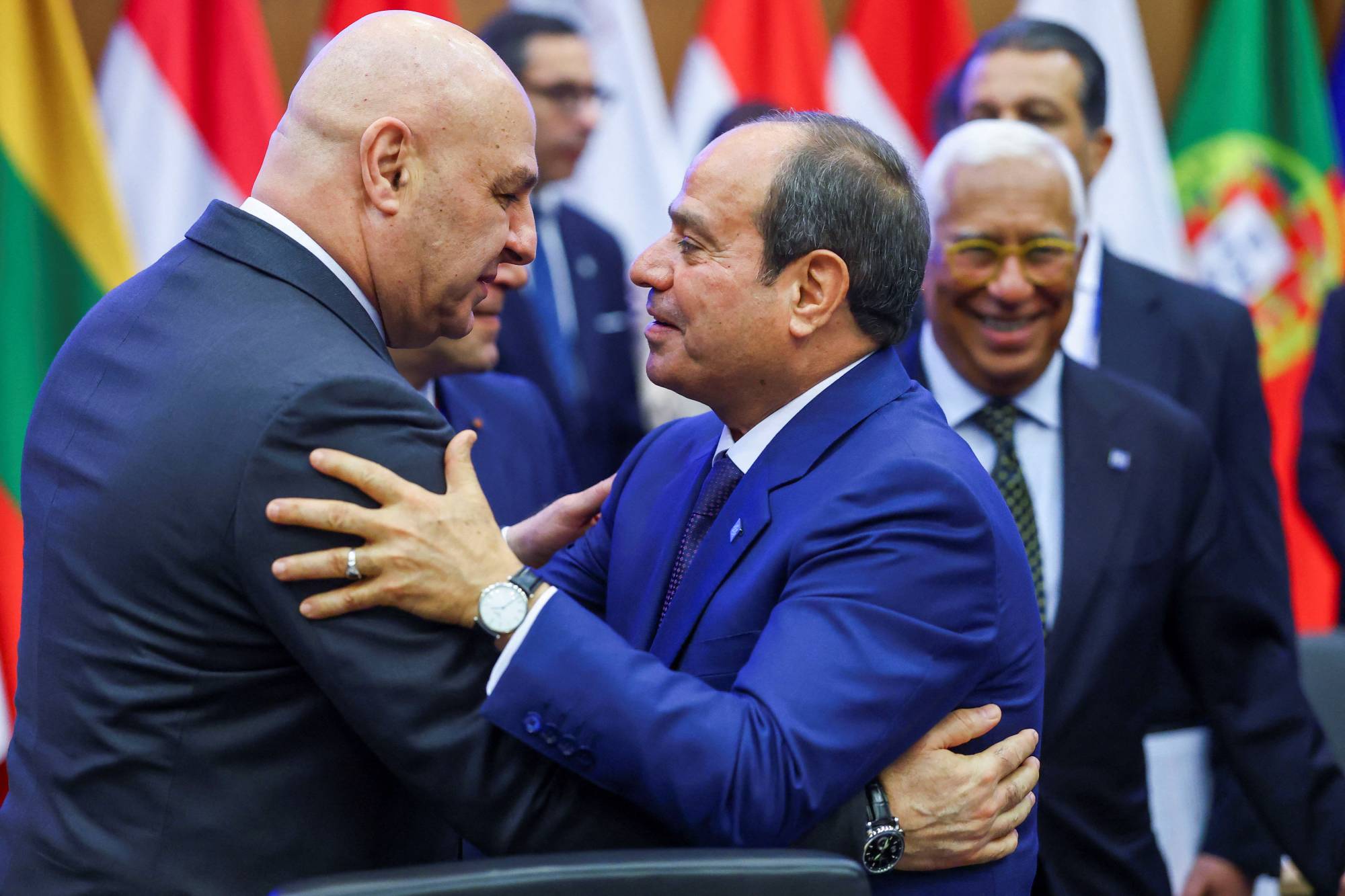
Lebanese President Joseph Aoun speaks with Egypt's President Abdel Fattah el-Sisi on the day of a summit of the European Union and regional partners' leaders in Nicosia (Lefkosia), Cyprus, April 24, 2026. REUTERS/Yves Herman
Lebanese Forces and Kataeb position
By contrast, the Lebanese Forces and Kataeb parties take a different approach. MP Ghada Ayoub of the “Strong Republic” bloc (Lebanese Forces) said her party supports “the negotiating initiative undertaken by Aoun, which falls within the core powers of the president,” leaving it to him to assess its course, including the timing of any meeting or even a potential handshake with Benjamin Netanyahu, whether it should take place now or come as the culmination of negotiations.
She told Asharq Al-Awsat: “We support the president in what he sees as appropriate to save Lebanon and extricate it from this predicament, which has imposed a heavy cost as a result of Hezbollah’s decision to draw Israel into Lebanon. Today it realizes it is unable to remove it, and that the only party capable of doing so is the United States. We saw how President Donald Trump was able to impose a ceasefire on Benjamin Netanyahu despite his team’s insistence on continuing the war.”
Ayoub stressed that “any negotiating track will be tied to clear conditions where the US position intersects with that of the Lebanese government, foremost among them disarmament, preventing Lebanese territory from being used as a launchpad for military operations against Israel, and banning the party’s security and military activities.”
Sources in the Kataeb Party, while confirming significant US pressure to arrange an Aoun–Netanyahu meeting, said such a step requires “historic courage,” adding that “what matters in the end is the outcome, which should be a roadmap for peace.”
لم تشترك بعد
انشئ حساباً خاصاً بك لتحصل على أخبار مخصصة لك ولتتمتع بخاصية حفظ المقالات وتتلقى نشراتنا البريدية المتنوعة