


Report: Israeli Tank in ‘Likely Scenario’ Fired Machine Gun at Reporters After Deadly Shelling in Lebanon 

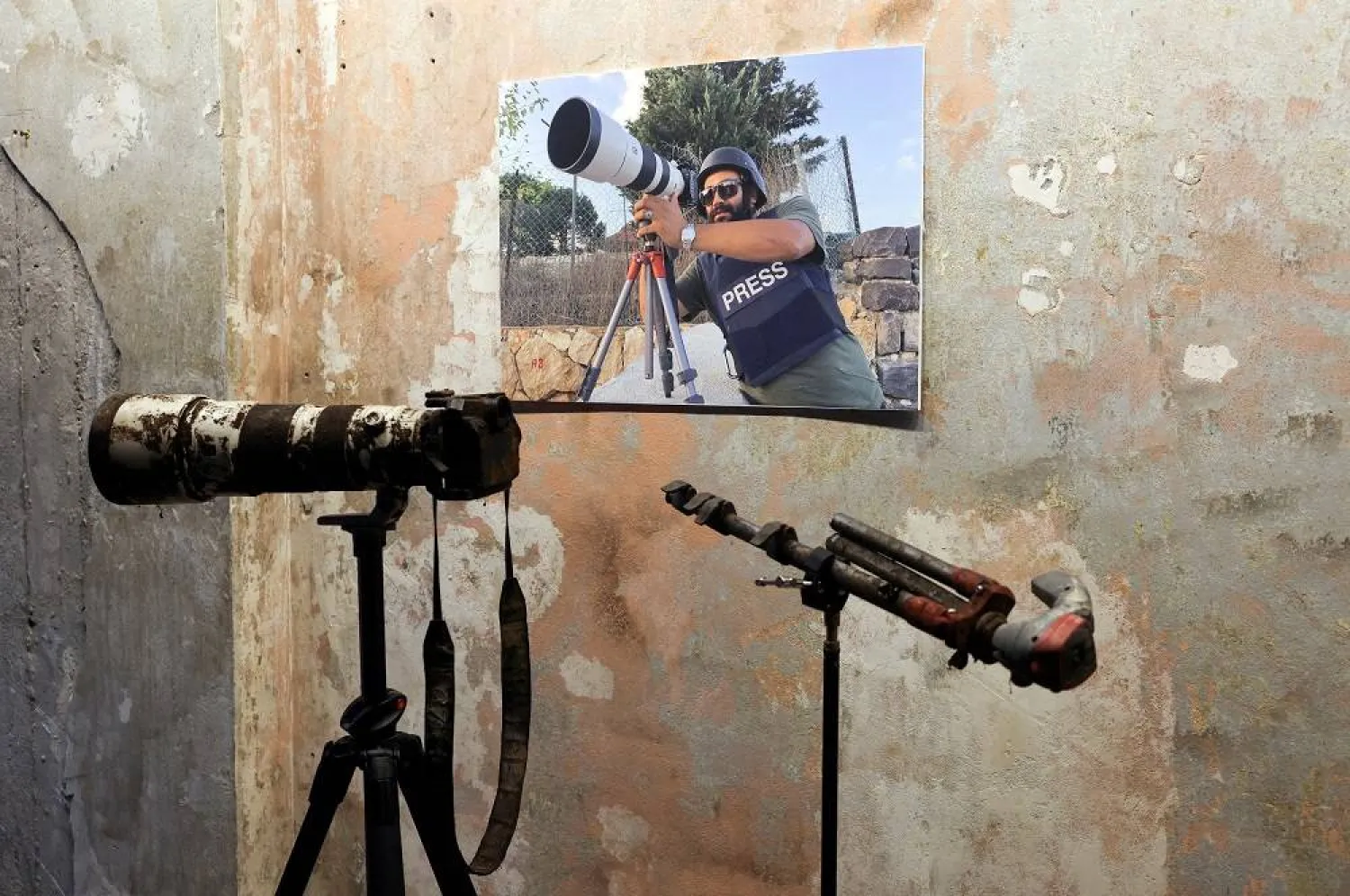
The gear that belonged to Reuters journalist Issam Abdallah who was killed on October 13 by what a Reuters investigation has found was an Israeli tank crew, is displayed during a press conference by Amnesty International and Human Rights Watch as they released findings from their investigations into the deadly October 13 strikes by Israel on southern Lebanon, in Beirut, Lebanon, December 7, 2023. (Reuters)
TT

Report: Israeli Tank in ‘Likely Scenario’ Fired Machine Gun at Reporters After Deadly Shelling in Lebanon 

The gear that belonged to Reuters journalist Issam Abdallah who was killed on October 13 by what a Reuters investigation has found was an Israeli tank crew, is displayed during a press conference by Amnesty International and Human Rights Watch as they released findings from their investigations into the deadly October 13 strikes by Israel on southern Lebanon, in Beirut, Lebanon, December 7, 2023. (Reuters)

An Israeli tank crew killed a Reuters reporter in Lebanon in October by firing two shells at a clearly identified group of journalists and then "likely" opened fire on them with a heavy machine gun in an attack that lasted 1 minute and 45 seconds, according to a report into the incident published on Thursday.

The report by the Netherlands Organization for Applied Scientific Research (TNO) - which was contracted by Reuters to analyze evidence from the Oct. 13 attack that killed visuals journalist Issam Abdallah - found that a tank 1.34 km away in Israel fired two 120 mm rounds at the reporters.

The first shell killed Abdallah, 37, and severely wounded Agence France-Presse (AFP) photographer Christina Assi, 28.

A Reuters investigation in December covered TNO's preliminary finding that a tank in Israel had fired at the journalists. In its final report on Thursday, the institute revealed that audio picked up by an Al Jazeera video camera at the scene showed the reporters also came under fire from 0.50 caliber rounds of the type used by the Browning machine guns that can be mounted on Israel's Merkava tanks.

"It is considered a likely scenario that a Merkava tank, after firing two tank rounds, also used its machine gun against the location of the journalists," TNO's report said. "The latter cannot be concluded with certainty as the direction and exact distance of (the machine gun) fire could not be established."

Reuters could not independently determine if the Israeli tank crew knew it was firing on journalists, nor whether it also shot at them with a machine gun and, if so, why.

Neither of the two surviving Reuters reporters or another AFP journalist at the scene remembered the machine gun fire. All said they were in shock at the time.

The Israel Defense Forces (IDF) did not respond to requests for comment about any aspect of the attack on journalists. Asked to comment on TNO's preliminary findings in December, the IDF said: "We don't target journalists." A day after the Reuters investigation was published, it said the incident took place in an active combat zone.

International humanitarian law bars attacks on journalists as those in the news media have the full scope of protection granted to civilians and cannot be considered military targets.

"We condemn, in the strongest terms, the attack on a clearly identifiable group of journalists, working in the open. The attack killed our colleague Issam Abdallah and injured several others. We reiterate our calls on Israel to explain how this could have happened and to hold those responsible to account," Reuters Editor-in-Chief Alessandra Galloni said.

Identified as press

AFP Global News Director Phil Chetwynd reiterated his call for a thorough and transparent investigation by the Israeli military.

"If reports of sustained machine gun fire are confirmed, this would add more weight to the theory this was a targeted and deliberate attack," he said.

Ihtisham Hibatullah, Al Jazeera's manager of international communications, urged the Israeli government to disclose the findings of its own investigation.

"This incident strongly indicates intentional targeting, as confirmed by investigations, including by TNO," he said.

Lebanon's Minister of Information did not respond to a request for comment.

To read the 70-page TNO report, which explains how the independent research institute in The Hague triangulated the firing point of the tank rounds and analyzed the audio of the machine gun fire, click here.

TNO noted that the seven journalists were wearing blue flak jackets and helmets, most with "PRESS" written on them in white letters. They had been filming cross-border shelling from a distance in an open area on a hill near the Lebanese village of Alma al-Shaab for nearly an hour before the attack.

Video footage of the aftermath of the attack also showed a black car belonging to Reuters marked "TV" in large yellow letters made out of tape on both the hood and the roof.

TNO said there was a clear line of sight from where the tank rounds were fired to the scene of the attack. In the live TV feeds ahead of the attack, one or more drones can be heard and an Israeli helicopter was also visible overhead in some footage.

The institute was able to determine exactly where the two tank rounds came from because it had video of the second round's muzzle blast and flight, in addition to audio files recorded at the scene of the incident.

TNO's analysis of the machine gun fire showed that the "only reasonable match" was for a 0.50 caliber weapon fired from 1.34 km away - the same distance as the tank rounds - but the audio recordings were not sufficient to determine the firing point.

However, the fact the bursts of bullets came so quickly after the tank rounds, coupled with the analysis, led TNO to conclude it was "likely" they came from the same place. The independent institute did not offer any other scenario for the origin of the machine gun fire.

About 30 seconds after the second tank round, there was a burst of some 25 shots from a machine gun, followed by bursts of nine and 12 shots. Just over 30 seconds later, there were three shots, then a single shot and a metallic ping, which may have been the bullet hitting a low wall near the camera, TNO said.

Reuters photographer Thaier Al-Sudani, 47 cameraman Maher Nazeh, 53, as well as two journalists from Al Jazeera and another from AFP were also wounded in the attack.

Full inquiry

Several of the experts who reviewed the TNO report at the request of Reuters expressed divergent views about whether the tank crew had deliberately targeted journalists.

"The TNO report does conclude that it was likely, in addition to the two tank rounds, that machine gun fire came from the same location, and that adds to, or compounds the, deliberateness with which they seem to have been targeted, directly," said Jessica Dorsey, an expert in international humanitarian law at Utrecht University.

"And I think that that, from a legal perspective, if this ever got to a courtroom, makes even more of a compelling argument that this was indeed a war crime," she said.

However, Nick Kaufman, a British-Israeli lawyer who served in the IDF Military Advocate General's Corps and has defended high-profile clients against war crime charges at international criminal tribunals, said it was still unclear why the tank had fired on the reporters.

"On the basis of the TNO report alone, it's not possible to conclude that this was intentional targeting of journalists as opposed to the pursuit of a legitimate military objective which went awry," he said. "One would need to have a full inquiry and understand the military intelligence which underlay the deployment of the two rounds."

The day after the attack, Israel's military said it had visuals of the incident and it was being investigated. No results have been made public.



Hamas Says Israeli Strikes on Gaza ‘Cannot Happen without American Cover’

 Palestinians inspect damaged tents at a displacement camp following an Israeli strike in Gaza City, Friday, Jan. 9, 2026. (AP)
Palestinians inspect damaged tents at a displacement camp following an Israeli strike in Gaza City, Friday, Jan. 9, 2026. (AP)
TT

Hamas Says Israeli Strikes on Gaza ‘Cannot Happen without American Cover’

 Palestinians inspect damaged tents at a displacement camp following an Israeli strike in Gaza City, Friday, Jan. 9, 2026. (AP)
Palestinians inspect damaged tents at a displacement camp following an Israeli strike in Gaza City, Friday, Jan. 9, 2026. (AP)

A Hamas official said Friday that Israeli strikes on Gaza "cannot happen without American cover", the day after Israeli attacks killed at least 13 people according to the Palestinian territory's civil defense agency.

Since October 10, a fragile US-sponsored truce in Gaza has largely halted the fighting between Israeli forces and Hamas, but both sides have alleged frequent violations.

Gaza's civil defense agency -- which operates as a rescue force under Hamas authority -- said Israeli attacks across the territory on Thursday killed at least 13 people, including five children.

In a statement on Friday morning, the Israeli military said it "precisely struck Hamas terrorists and terror infrastructure" in response to a "failed projectile" launch.

"Just yesterday, 13 people were killed in different areas of the Strip on fabricated pretexts, in addition to the hundreds of killed and wounded who preceded them after the ceasefire," Hamas political bureau member, Bassem Naim, wrote on Telegram.

"This cannot happen without American cover or a green light."

Israeli forces have killed at least 439 Palestinians in Gaza since the ceasefire took effect, according to the health ministry in the Hamas-run territory.

The Israeli military said gunmen have killed three of its soldiers during the same period.

Media restrictions in Gaza and difficulties in accessing many areas mean AFP is unable to independently verify the tolls and details provided by both sides.

Naim also accused Israeli Prime Minister Benjamin Netanyahu of "evading his commitments and escalating in order to sabotage the agreement and return to war".

He said the Palestinian movement had "complied with all its obligations under the agreement" and was "ready to engage positively and constructively with the next steps of the plan".

Israel has previously said it is awaiting the return of the last hostage body held in Gaza before beginning talks on the second phase of the ceasefire and has insisted that Hamas disarm.

Hamas officials told AFP that search operations for the remains of deceased hostage Ran Gvili resumed on Wednesday after a two-week pause due to bad weather.


Germany Calls on Israel to Halt E1 Settlement Plan

A view of Israeli settlement of Maale Adumim, in the West Bank, Sunday, June 18, 2023. (AP)
TT

Germany Calls on Israel to Halt E1 Settlement Plan

A view of Israeli settlement of Maale Adumim, in the West Bank, Sunday, June 18, 2023. (AP)

Germany calls on Israel to halt its controversial ​E1 settlement project, said a foreign ministry spokesperson in Berlin on Friday, warning that construction carries the risk of ‌creating more ‌instability in the ‌West ⁠Bank ​and ‌the region.

"The plans for the E1 settlement project, it must be said, are part of a comprehensive ⁠intensification of settlement policy in ‌the West Bank, ‍which ‍we have recently ‍observed," said the spokesperson at a regular government press conference.

"It carries the ​risk of creating even more instability, as it ⁠would further restrict the mobility of the Palestinian population in the West Bank," as well as jeopardize the prospects of a two-state solution, the spokesperson added.


Israel Army Says Struck Hezbollah Targets in ‘Several Areas’ of Lebanon

Lebanese army soldiers and paramedics inspect the wreckage of a car that was targeted in an Israeli airstrike in the town of Qanarit, near the coastal city of Sidon in southern Lebanon on January 8, 2026. (AFP)
TT

Israel Army Says Struck Hezbollah Targets in ‘Several Areas’ of Lebanon

Lebanese army soldiers and paramedics inspect the wreckage of a car that was targeted in an Israeli airstrike in the town of Qanarit, near the coastal city of Sidon in southern Lebanon on January 8, 2026. (AFP)

Israel's military said it struck Hezbollah targets in several areas of Lebanon on Friday, a day after the Lebanese army said it had completed the first phase of its plan to disarm the group in the south.

Under heavy US pressure and amid fears of expanded Israeli strikes, Lebanon has committed to disarming the Iran-backed group, which was weakened by more than a year of hostilities with Israel including two months of all-out war that ended with a November 2024 ceasefire.

Despite the truce, Israel has kept up regular strikes in Lebanon, usually saying it is targeting Hezbollah sites and operatives, and has maintained troops in five south Lebanon areas it deems strategic, accusing the group of rearming.

In a statement on Friday, the Israeli military said it struck "several areas in Lebanon", targeting "weapons storage facilities and a weapons production site that were used for the rehabilitation and military build-up of the Hezbollah terrorist organization".

"Additionally, several launch sites and rocket launchers, along with military structures, were struck," it added.

Lebanese official news agency NNA reported strikes on southern Lebanon in areas far from the border, as well as in the eastern Bekaa area where Hezbollah has a strong presence.
No casualties were immediately reported.

"The targets that were struck, and Hezbollah's reestablishment activity in these sites, constitute a violation of the understandings between Israel and Lebanon, and pose a threat to the State of Israel," the military statement said.

Lebanon's army said Thursday it had "achieved the objectives of the first phase" of its plan to disarm Hezbollah, covering the area south of the Litani River -- around 30 kilometers (20 miles) from the Israeli border -- with the intention to extend it to the rest of the country.
Israel said the efforts were encouraging but not enough.

"The ceasefire agreement... states clearly, Hezbollah must be fully disarmed," the office of Prime Minister Benjamin Netanyahu said in a statement.

"Efforts made toward this end by the Lebanese government and the Lebanese armed forces are an encouraging beginning, but they are far from sufficient," it added.

Lebanese official media said a strike on Thursday killed one person near the southern city of Sidon, as Israel's army said it targeted a Hezbollah operative.

Under the ceasefire, Hezbollah was to withdraw its forces north of the Litani River and have its military infrastructure dismantled in the evacuated areas.

The group has refused to surrender its weapons.