A picture taken from the Lebanese side of the border shows smoke rising on hills near the Israeli town of Metula as a result of a strike reportedly coming from Lebanon, on November 11, 2023. (Photo by Hassan FNEICH / AFP)
A picture taken from the Lebanese side of the border shows smoke rising on hills near the Israeli town of Metula as a result of a strike reportedly coming from Lebanon, on November 11, 2023. (Photo by Hassan FNEICH / AFP)
Israeli strikes targeted eastern Lebanon, where Hezbollah has a strong presence, at dawn on Sunday, a source close to the Iran-backed group said, but no casualties were reported.
"Israeli strikes targeted two areas in the Bekaa Valley, Janta and Sifri," the source told AFP in the Baalbek region in Lebanon's east, AFP reported.
Janta is an arid, mountainous region close to the border with Syria, while Sifri is in the centre of the Bekaa Valley.
A source in Lebanon's Civil Defense Department said there were no casualties from the strikes.
Israel and Hezbollah have exchanged near-daily cross-border fire since the Palestinian militant group Hamas carried out an unprecedented attack on southern Israel on October 7, triggering the war in Gaza.
Hezbollah targets Israeli positions close to the border, while Israel retaliates with raids that go deeper and deeper into Lebanese territory and carries out strikes against the Shiite Islamist group's officials.
The latest strikes in eastern Lebanon came after Hezbollah announced on Saturday evening it had shot down an Israeli Hermes 450 drone over Lebanese territory.
The Israeli military confirmed that "a drone operating in Lebanese airspace was shot down" by what it said was a surface-to-air missile and had fallen in Lebanese territory.
Israel launched similar strikes against Hezbollah targets in the Bekaa Valley in February after the group said it had shot down a similar type of Israeli drone.
Hezbollah leader Hassan Nasrallah said in a televised speech on Friday that his movement had not yet used its "main" weapons and reiterated that Hezbollah would cease its attacks only when the war in Gaza ends.
The cross-border hostilities have killed at least 349 people in Lebanon, mostly Hezbollah fighters, but also at least 68 civilians, according to an AFP tally.
The fighting has displaced tens of thousands of people in southern Lebanon and in northern Israel, where the military says 10 soldiers and eight civilians have been killed.
Egypt, South Korea Seek to Expand Strategic Partnershiphttps://english.aawsat.com/arab-world/5327239-egypt-south-korea-seek-expand-strategic-partnership
The Egyptian president on Wednesday stressed the importance of Korean companies considering expanding their investments (Egyptian Presidency’s Facebook page).
Egypt, South Korea Seek to Expand Strategic Partnership
The Egyptian president on Wednesday stressed the importance of Korean companies considering expanding their investments (Egyptian Presidency’s Facebook page).
Egyptian President Abdel Fattah al-Sisi’s first visit to Seoul in a decade has brought renewed commitments to strengthen bilateral ties and expand cooperation between the two countries.
On Wednesday, Sisi attended a roundtable with executives from major South Korean companies and business representatives, with 23 companies taking part, according to the Egyptian presidency.
The Egyptian president expressed his country’s determination to deepen cooperation with South Korea and take relations to more ambitious levels, highlighting Cairo’s strong political will to expand ties, particularly in investment, manufacturing, technology and the wider economy.
He also called for closer cooperation on strategically important projects and renewed his proposal to establish an integrated Korean industrial zone within the Suez Canal Economic Zone.
The proposed zone could serve as a regional production and export hub for Korean companies, supplying not only Egypt’s large domestic market but also regional and international markets through the country’s free trade agreements with African nations, the European Union and Arab states, he explained.
Sisi encouraged Korean companies to expand their investments in oil, gas and mining and explore opportunities in renewable and clean energy projects, including solar and wind power, green hydrogen, smart grids and energy storage technologies.
He also highlighted opportunities for Egyptian and Korean companies to undertake joint construction and infrastructure projects in Arab and African countries.
According to the presidency, the roundtable included discussions with South Korean business leaders on opportunities to establish sustainable strategic partnerships.
Former Egyptian Assistant Foreign Minister Mohamed Hegazy believes relations between Egypt and South Korea are poised for significant progress following the visit, which included efforts to broaden cooperation in projects and investment.
“South Korea has all the technological capabilities needed to provide what Egypt and Africa require,” Hegazy told Asharq Al-Awsat.
Amid regional instability, he expects Seoul and countries such as China, Indonesia and Malaysia to show greater interest in investing in Egypt and through it.
Sisi’s visit is part of an Asian trip that also includes Malaysia and Indonesia, according to a presidential statement issued Tuesday. It comes amid critical regional circumstances and disruptions to supply chains.
South Korean President Lee Jae Myung welcomed Sisi’s visit in a post on X.
“We are delighted to welcome the Egyptian president as an honored guest to the Republic of Korea for the first time in 10 years,” Lee wrote.
“Meeting the Egyptian president again in Seoul after our candid discussions in Cairo last year makes this encounter all the more significant and meaningful,” he added.
“I hope the Miracle on the Han River and the Miracle on the Nile will come together to further enhance the shared prosperity of our two countries.”
Hegazy described Sisi’s Asian trip as reflecting Egypt’s recognition of the importance of Asia in its foreign policy and a direct effort to put the comprehensive strategic economic partnership between the two sides into practice across several sectors.
According to Egypt’s Central Agency for Public Mobilization and Statistics (CAPMAS), trade with South Korea totaled $874 million in the first eight months of 2026, down from $920 million during the same period in 2025.
Sisi last visited South Korea in March 2016, when he held talks in Seoul with then-President Park Geun-hye.
The visit saw the signing of several agreements and memorandums of understanding, as well as the elevation of bilateral relations to a comprehensive partnership.
UN Peacekeeping Force Says Shots Fired at Post on Lebanon-Israel Borderhttps://english.aawsat.com/arab-world/5327179-un-peacekeeping-force-says-shots-fired-post-lebanon-israel-border
UNIFIL currently has 7,500 blue helmets from around 50 countries. (Reuters)
TT
TT
UN Peacekeeping Force Says Shots Fired at Post on Lebanon-Israel Border
UNIFIL currently has 7,500 blue helmets from around 50 countries. (Reuters)
The United Nations Interim Force in Lebanon said one of its posts was targeted on Wednesday near the border with Israel by small-arms fire, but there were no casualties.
"This morning, several rounds of small arms fire impacted a UNIFIL position near Kfar Shouba along the Blue Line in Sector East," the UN force said in a statement, referring to the de facto border between Lebanon and Israel.
The blue helmets described the shooting as "unacceptable".
"Such deliberate attacks gravely endanger the lives of peacekeepers," it said, adding that it was investigating the incident.
Under US pressure, the UN Security Council decided in August to fix December as the end of the mandate for UNIFIL, which has been deployed since 1978.
Last month, Lebanon's Prime Minister Nawaf Salam insisted at the UN on the need to "avert the vacuum" that would be caused by withdrawing the peacekeeping mission deployed in the country's south without a viable replacement.
UNIFIL currently has 7,500 blue helmets from around 50 countries.
Violence has decreased since a ceasefire following a memorandum of understanding in the US-Iran war struck in June, while Lebanon and Israel concluded a US-sponsored framework agreement later that month.
The Lebanon-Israel deal involves the disarmament of Hezbollah, a gradual withdrawal of Israeli forces from Lebanon's south and the deployment of the Lebanese army to the region, starting in test areas known as "pilot zones".
Israelis Mark Three Years Since October 7 as Palestinians Mourn Gaza’s Destructionhttps://english.aawsat.com/arab-world/5327168-israelis-mark-three-years-october-7-palestinians-mourn-gaza%E2%80%99s-destruction
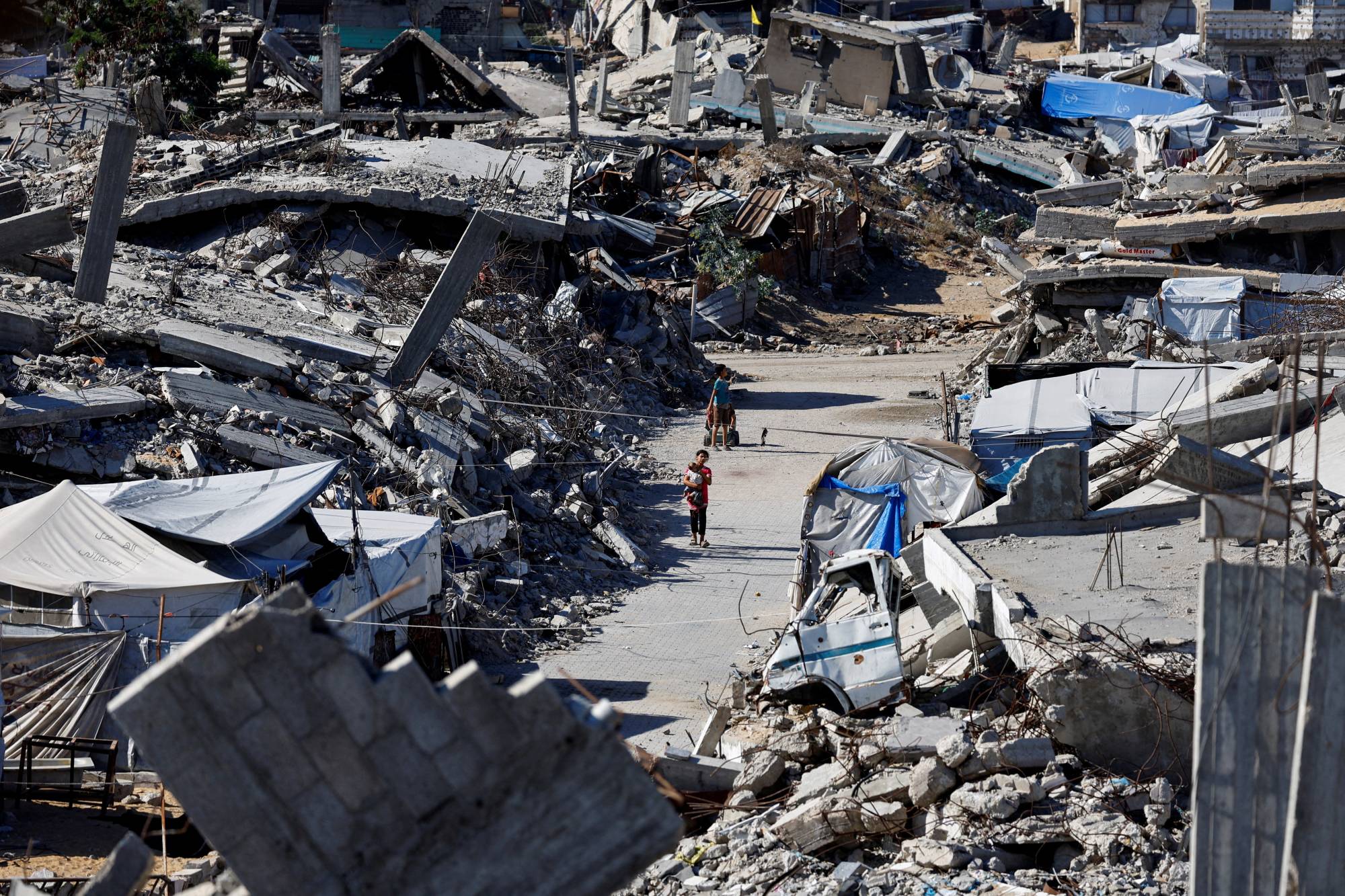
A Palestinian man works amid the rubble of a building damaged during the war, overlooking a makeshift tent camp at the Islamic University, in Gaza City, October 3, 2026. (Reuters)
TT
TT
Israelis Mark Three Years Since October 7 as Palestinians Mourn Gaza’s Destruction
A Palestinian man works amid the rubble of a building damaged during the war, overlooking a makeshift tent camp at the Islamic University, in Gaza City, October 3, 2026. (Reuters)
Israelis gathered in silence on Wednesday in a kibbutz near the Gaza border that was overrun by Hamas on October 7 three years ago, mourning victims of attacks that set off Israel's assault in Gaza and plunged the Middle East into war.
In the Gaza Strip, devastated by three years of Israeli bombardment, Palestinians sheltering among the ruins of destroyed cities recalled life before a war that displaced nearly the entire population and tore apart families.
The attacks of October 7, 2023, were the deadliest day in Israel's history. Militants led by Hamas killed 1,200 people and took 251 hostages, a cross-border incursion that traumatized Israelis who have demanded government accountability.
Israel's subsequent bombardment and ground operations in Gaza have killed more than 74,000 people, including at least 1,400 killed in the past year since a US-brokered ceasefire, which halted major fighting but has failed to stop Israeli attacks or secure the disarmament of Hamas.
Palestinian children walk amid the rubble of buildings destroyed during the war in Gaza City, October 7, 2026. (Reuters)
'A VERY DIFFICULT DAY'
In Kfar Aza, where Hamas fighters killed dozens of Israelis before taking 19 hostages back into Gaza, residents held a vigil for those killed, standing in silence as a trumpet played a solemn bugle call. A resident read out a roll call of the dead.
Zion Regev, a community leader in the kibbutz, said most residents remain displaced and have yet to return, the trauma of October 7 continuing to shape their lives.
"This is the first time we are doing all the things here in the kibbutz," Regev said of the vigil. "It's a very emotional day, it's a very difficult day for our community, three years after October 7th."
Elsewhere in Israel, protesters against what they view as a lack of accountability for the security failure gathered outside parliament in Jerusalem, blaming Prime Minister Benjamin Netanyahu for refusing an independent inquiry into the attack.
Some protesters held signs reading: "The people will remember October 7 on October 27," a reference to an Israeli general election 20 days away that is being viewed as a referendum on Netanyahu's long tenure in power.
"We need the change and we need hope and we need to know that we have a government that cares about the public and doesn't work also only for themselves," said protester Shaked Arrad.
Netanyahu has rejected blame for the security breach and resisted calls for an independent investigation. That has frustrated many in Israel, including families of those killed in the attacks, some of whom have joined the election race.
In a statement released by his office, Netanyahu said: "The nation unites on this day in the longing for our dear ones."
Referring to his country's ongoing attacks in Gaza, he added: "We will complete the mission: we have settled the score and will continue settling the score with all the murderers."
Election polls show neither Netanyahu nor his main competitors would muster enough seats in parliament to form a coalition if a vote were held today.
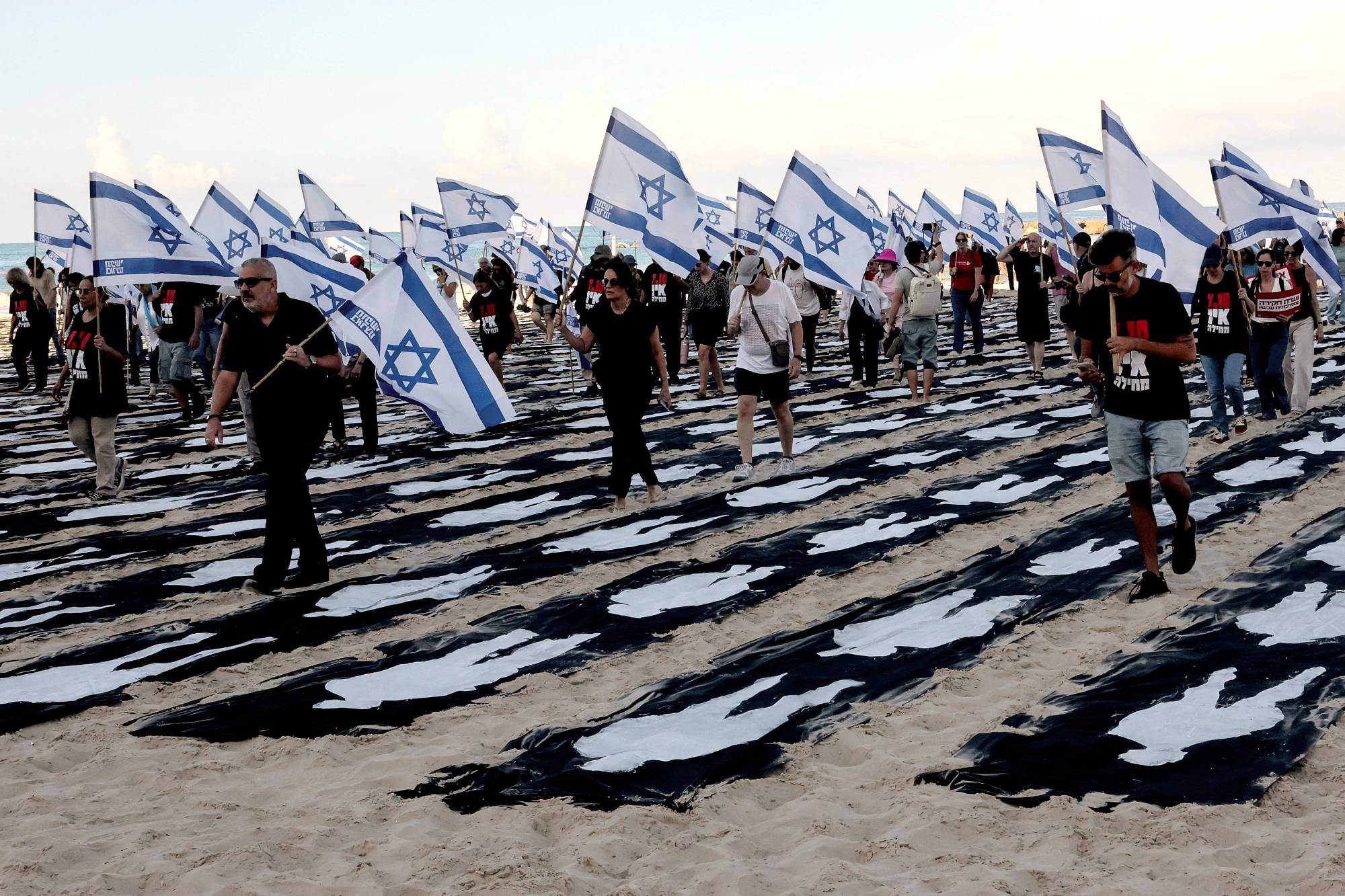
People carrying Israeli flags walk through a commemorative installation set up on the beach in Tel Aviv to mark the third anniversary of Hamas's October 7 attack on Israel, on October 7, 2026. (AFP)
DISPLACED GAZANS RECALL LIFE BEFORE ISRAELI ASSAULT
The anniversary is the first since the October 10, 2025, ceasefire deal, which has left Israel in control of around two-thirds of Gaza, where it has demolished remaining buildings and ordered residents out.
Hamas controls the remaining third of the territory, a narrow strip on the coast where the 2 million population mostly live in makeshift tents and bombed-out buildings.
In the latest violence, Gaza medics said on Wednesday Israel's military had carried out air strikes in Beit Lahia in northern Gaza and in Khan Younis in the south, killing at least two Palestinians and wounding others.
The Israeli military said it struck and killed two people it described as militants with Hamas, which did not immediately provide comment. The military did not provide comment on the strike in Khan Younis.
Umm Mohammad, a mother of five displaced from Gaza City and now living with her husband and children in a tent encampment in Deir Al-Balah, said the war had ripped her family apart.
"We were one happy family. The war displaced us. My son left Gaza, the other went to a separate tent, my daughters left with their husbands to other parts of the Strip and we rarely meet," she said.
On this day, she said, "we recall how happy, despite all problems, we were before the war broke out, destroying everything we loved."
لم تشترك بعد
انشئ حساباً خاصاً بك لتحصل على أخبار مخصصة لك ولتتمتع بخاصية حفظ المقالات وتتلقى نشراتنا البريدية المتنوعة