


Lebanon Not Bound by US Sanctions, No Action Against Officers Yet

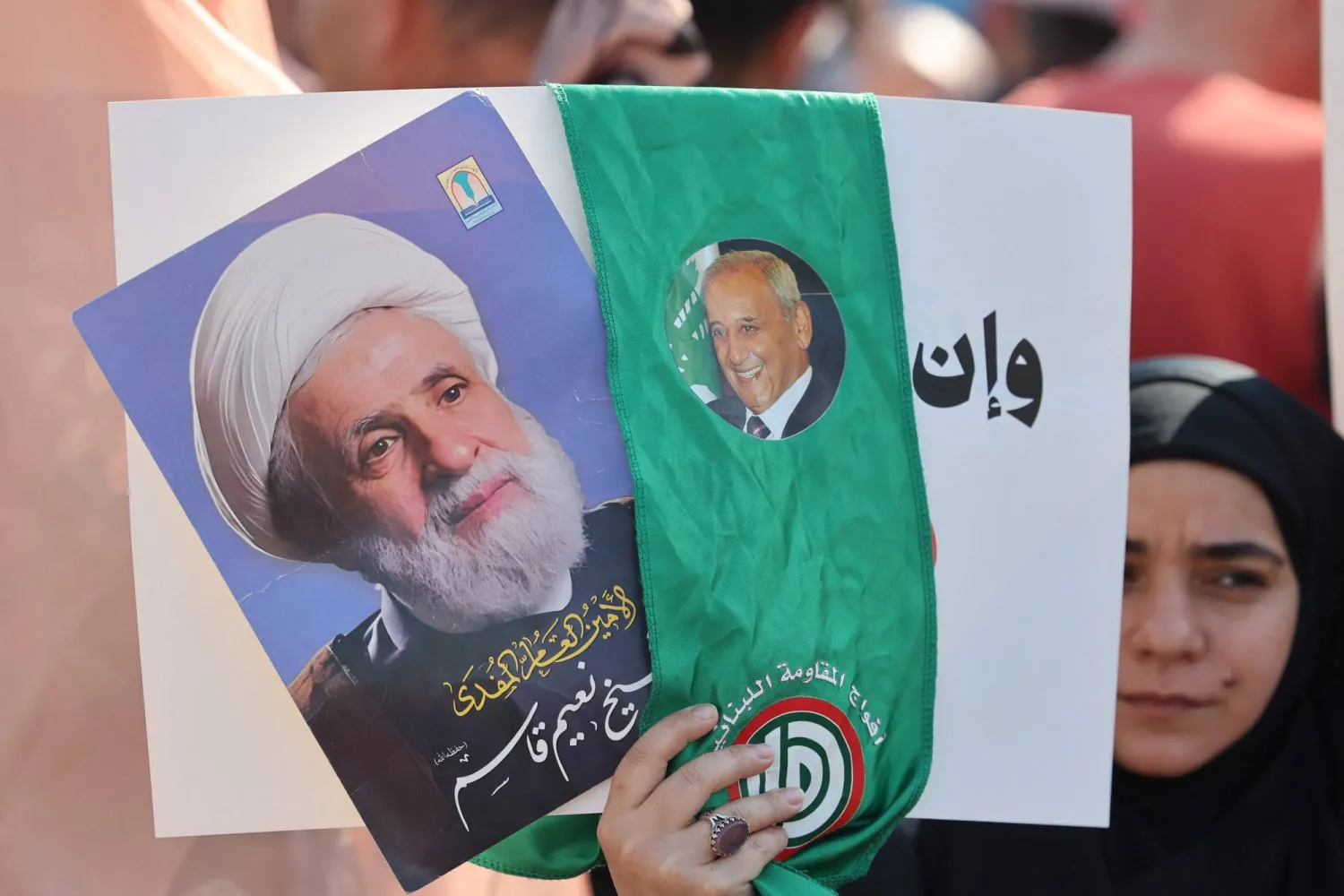
A woman holds pictures of Lebanese parliament Speaker Nabih Berri (R) and Hezbollah's leader Naim Qassem (L) while residents of the devastated southern Lebanese border villages protest against the destruction of their villages and being prevented from returning by order of the Israeli army, at Martyrs’ Square in central Beirut on April 30, 2026. (AFP)
TT

Lebanon Not Bound by US Sanctions, No Action Against Officers Yet

A woman holds pictures of Lebanese parliament Speaker Nabih Berri (R) and Hezbollah's leader Naim Qassem (L) while residents of the devastated southern Lebanese border villages protest against the destruction of their villages and being prevented from returning by order of the Israeli army, at Martyrs’ Square in central Beirut on April 30, 2026. (AFP)

Attention in Lebanon is turning to how the state will respond to unprecedented US sanctions that targeted two officers from the army and General Security, along with figures, including MPs, from Hezbollah and its ally the Amal Movement that is headed by parliament Speaker Nabih Berri.

Although Lebanon is not legally bound to comply with the decision, and no direct measures have so far been taken against the two targeted officers, Interior Minister Ahmad al-Hajjar said he had asked General Security Director General Maj. Gen. Hassan Choucair to investigate any violations, if any exist, and take the necessary measures.

No measures yet

Security sources said what was surprising was that the army and General Security had not been notified of the sanctions through official and legal channels, as both commands learned of the measures through statements and the media.

The sources asked: “As long as Col. Samir Hamadeh is the head of the Beirut southern suburbs branch at the Lebanese army’s Intelligence Directorate, who is he supposed to coordinate with on the ground in the southern suburbs?”

They explained that intelligence coordinates with other parties in other areas, while also dismissing as “misguided” claims that significant intelligence was being shared with Hezbollah.

“So far, no measures have been taken against them, and they are still carrying out their duties,” they added.

The US Treasury accuses the two officers of sharing significant intelligence with Hezbollah during the ongoing conflict over the past year.

'Political message’

Legal and constitutional expert Said Malek said the sanctions against officers were “a political message from the US Treasury Department that dealing with Hezbollah, which is internationally banned and whose military wing in Lebanon has effectively been disbanded, has become prohibited and carries consequences.”

He told Asharq Al-Awsat that “the Lebanese state, through the relevant ministries and administrations, is not obliged to comply with the decision, even if it could obstruct the payment of salaries to those targeted, their transactions, or their cooperation with local and foreign agencies.”

“The government may understand the adoption of such decisions, but they are not binding on the state. In other words, nothing requires that these individuals be held accountable or punished, as they are subject to Lebanese laws, not decisions taken by a Western administration,” Malek explained.

Who was targeted?

Among the nine figures targeted by the sanctions were four Hezbollah lawmakers:

  • MP Mohammad Fneish, whom the US Treasury said heads Hezbollah’s Executive Council and is responsible for reorganizing the party’s administrative and institutional structure to preserve its armed presence in Lebanon.
  • MP Hassan Fadlallah, whom the Treasury said helped establish Al-Nour Radio, which is designated by the United States, and served as a senior director at Al-Manar television, also designated by Washington.
  • MP Ibrahim al-Moussawi, a longtime Hezbollah official who currently heads the party’s media committee.
  • MP Hussein al-Hajj Hassan, whom the Treasury described as one of the most prominent figures opposing Hezbollah's disarmament.

In a clear message to the Amal Movement, the sanctions also included Ahmad Asaad Baalbaki and Ali Ahmad Safawi. The Treasury statement said they were security officials in Amal.

“Baalbaki serves as Amal’s security director and coordinates shows of force with Hezbollah’s leadership to intimidate political opponents in Lebanon,” said the Treasury.

“Safawi is the commander of the Amal militia in southern Lebanon. Acting as Baalbaki’s subordinate, Safawi coordinated with and took direction from Hizballah on attacks against Israel as well as leading Amal militia forces in joint Hizballah-Amal military operations against Israel.”

Notably, the sanctions also targeted Mohammad Reza Sheibani, Iran’s ambassador-designate to Lebanon, whom Lebanon’s Foreign Ministry declared persona non grata after withdrawing its approval of his accreditation and asking him to leave Beirut. Sheibani has defied the order and remained in Lebanon.

The US statement noted “Iran’s violation of diplomatic norms, as well as the practices routinely used by the ambassador in communication between the two states, was cited as the reason for Sheibani’s expulsion.”



Gazans Turn to Clay, Rubble to Build New Homes

A Palestinian boy makes his way across rubble near a displacement camp in Nuseirat, in the central Gaza Strip, on Sunday. Credit: AFP/EYAD BABA
TT

Gazans Turn to Clay, Rubble to Build New Homes

A Palestinian boy makes his way across rubble near a displacement camp in Nuseirat, in the central Gaza Strip, on Sunday. Credit: AFP/EYAD BABA

While Gaza’s housing crisis remains catastrophic with cement and steel blocked by Israel from entering the Strip, some Palestinians are turning to improvised methods and other workarounds in a bid to make their shelters safer or more habitable.

Among those Palestinians is Jaafar Atallah, a potter in Gaza, who decided to build a home from the earth. It was to be like the bread ovens his family had been making for generations, but big enough for his parents to live in, according to the Financial Times.

Atallah gathered clay from an area of Gaza a few kilometers from his tent and — with the help of about 15 people, including his father, also a potter — he set about making mud bricks.

For months, they learned as they built. Finally, they completed a domed hut, “so solid you could stand on top of it”, said Atallah, whose project was backed by pottery groups around the world after he shared videos online.

The clay structure was a relief after the flimsy protection of the tent: “You can keep your food in this room. In a tent, tomatoes and cucumbers won’t last a day and will rot. Life in the tents is so hard. There is such heat in the summer, it is torture,” Atallah said.

Atallah’s experience reflects the reality of thousands of families looking for alternatives after almost all buildings in Gaza have been destroyed by two years of bombardment amid Israel’s ban on concrete and steel imports.

Several Gazans are reusing steel reinforcing bars and concrete from the debris of buildings, scavenging for cement lying underwater in the port and resorting to mud to make bricks and mortar.

“We already have clay in our land, we don’t have to manufacture it, we don’t need things that we have to get from the crossing [with Israel], which is at the whim of the occupation,” said Atallah, who even designed a waterproof glaze for the bricks. “The occupation does not control this. It’s from our land, our soil.”

According to the UN, 1.9 million Gazans are displaced or live in tents, which lack sanitation or other utilities.

Reconstruction of Gaza remains a distant dream for its people. Israel bans building materials from entering Gaza on the grounds that the materials may be used for military purposes such as tunnel construction.

In May, teenage sisters Tala, 17, and Farah Moussa, 15, won a youth-focused award from the Swiss-based Earth Foundation for recycling cement debris into bricks.

Displaced with their family five times since the start of the war, they now live in a tent in Nuseirat in the center of the Gaza Strip. “We got the idea when our house was bombed,” said Tala. “We thought we had to do something and find a solution that comes from the problem itself, so we are using the rubble.”

Tala said, “We made five or six prototypes before we got it right. We researched on the internet and in books. Now we want to use the [$12,500] prize money to set up workshops to teach others how to make bricks.”

Using mud and stones, Gaza residents rebuild homes destroyed in months of conflict, as lack of access to construction material leaves families with few options.

Their efforts reflect the ability to adapt to the most extreme conditions to restore a normal life, even within walls built from the earth and the debris of buildings.


Yemen Seeks Resumption of US Investments in Energy Sector

Al-Alimi during his meeting with the delegation from Hunt Oil Company (Saba)
TT

Yemen Seeks Resumption of US Investments in Energy Sector

Al-Alimi during his meeting with the delegation from Hunt Oil Company (Saba)

The head of Yemen’s Presidential Leadership Council (PLC), Rashad Al-Alimi, has met with a delegation from the American Hunt Oil Company, headed by the company’s Chief Executive Officer, Hunter Hunt.

The meeting on Sunday reviewed opportunities for partnership between the Yemeni government and Hunt Oil in the exploration, production, and export of oil and gas. It also discussed prospects for the company to resume its investments in Yemen in support of the country’s economic recovery and energy security.

Al-Alimi was briefed by the delegation on the company’s current operations, future plans, and promising investment opportunities in Yemen’s oil sector, building on its long-standing partnership with the Yemeni government.

The PLC President praised Hunt Oil’s pioneering role in establishing Yemen’s petroleum sector, including the discovery of the country’s first commercially viable oil reserves, its contributions to developing oil infrastructure, training national personnel, and its role as a key partner in the Yemen LNG project.

He said these contributions would remain a source of appreciation for both the government and the Yemeni people.

Al-Alimi also outlined the economic, financial, and administrative reforms being implemented by the government, particularly in the oil and gas sector.

He highlighted efforts to improve the investment climate, strengthen transparency and governance, and provide the necessary guarantees for the return of foreign companies across various sectors.

He commended Saudi support to Yemen’s economy, describing it as a key pillar for enhancing stability, advancing economic reform, and restoring investor confidence.

The PLC President reaffirmed the state’s commitment to providing all necessary support and facilities for investors. He said the government would work with regional and international partners to secure vital infrastructure and create conditions for the resumption of production activities.

He added that improving living standards and security across the country remains a top priority for the Yemeni government.


Syria, Iraq Agree to Expand Cooperation in Energy, Security and Economy

Syrian President Ahmed al-Sharaa receives Iraqi FM Fuad Hussein in Damascus on Monday. (SANA)
TT

Syria, Iraq Agree to Expand Cooperation in Energy, Security and Economy

Syrian President Ahmed al-Sharaa receives Iraqi FM Fuad Hussein in Damascus on Monday. (SANA)

Iraqi Foreign Minister Fuad Hussein visited Damascus on Monday on his first trip since there since the ouster of Bashar al-Assad's regime in December 2024.

He held talks with President Ahmed al-Sharaa and his Syrian counterpart Asaad al-Shaibani.

The meeting with Sharaa focused on bilateral relations and ways to expand cooperation across various sectors, reported Syria’s state news agency SANA.

The two sides also discussed regional and international developments and stressed the importance of strengthening coordination and consultation between Syria and Iraq in addressing shared challenges.

Talks with Shaibani focused on practical mechanisms to strengthen bilateral relations and advance mutual cooperation across various sectors.

The FMs agreed to establish a high committee for joint coordination, co-chaired by both ministers, to ensure the consistent follow-up and execution of outcomes stemming from bilateral cooperation while streamlining joint initiatives.

The discussions also focused on energy infrastructure, specifically looking into mechanisms for oil transit and grid integration, alongside a project to rehabilitate oil pipelines extending from Iraq to Syria.

They also addressed frameworks for strategic cooperation in the sectors of water management and agriculture, which aims to boost mutual food security, stimulate economic integration, and serve shared bilateral interests.

They explored avenues to upgrade security coordination and intelligence sharing, bolstering regional stability and supporting collaborative efforts to confront mutual security challenges.