


World Bank: Yemen Among Poorest Country in the World

Millions of Yemenis suffer from economic shocks and food insecurity. (United Nations)
TT

World Bank: Yemen Among Poorest Country in the World

Millions of Yemenis suffer from economic shocks and food insecurity. (United Nations)

Yemen is one of the most food insecure, and possibly poorest countries in the world, a recent World Bank report showed.

The report, Poverty and Equity Assessment 2024, placed Yemen in the company of Afghanistan, Haiti, Somalia, South Sudan, Sudan and the Sahel countries, each among the poorest 15 percent of countries worldwide.

Yemen was a poor country before war broke out, and ten subsequent years of conflict and crisis have had dire effects on living conditions with many millions of Yemenis suffer from hunger and poverty.

But according to World Bank experts, a lack of data makes it hard to estimate exactly how many people are poor, or to analyze the main drivers of poverty.

It said Poverty Assessment synthesizes multiple novel data sources to assess how the Middle East and North Africa’s (MENA) poorest country likely became one of the most impoverished countries worldwide; and how ordinary Yemenis cope—or attempt to cope—with multiple, overlapping deprivations.

The World Bank said a decade ago, Yemen was already a low-income country and 49 percent of Yemenis lived below the national poverty line.

Given the significant deterioration in economic conditions over the course of the war, it concluded that poverty has risen in the intervening years—particularly through ten years of war.

Also, efforts to end the complex, internationalized conflict, have been repeatedly spurned.

It said cautious optimism that an informal, but enduring, truce could be converted into a permanent ceasefire in 2023 has diminished.

As the report was being completed, many World Bank observers warned that the country could be significantly impacted by the Middle East conflict and local repercussions. This is not an eventuality that ordinary Yemenis can afford.

The report found that unreliability of income, livelihoods and food on the one hand, and the vulnerability of ordinary Yemenis to the many economic shocks experienced since the start of the war have been the main drivers of poverty.

By August 2015, after just a few months of war, 48 percent of Yemenis had a poor food consumption score, a more than four-fold increase from the year before, in line with a broader collapse in economic output.

It also showed that food insecurity reached its lowest point in 2018 when the war’s physical and economic dimensions intersected.

But after improvements in 2019 and 2020, in part due to a huge influx of aid, the situation deteriorated due to several major shocks: the Houthi militias’ military campaign in Marib, the COVID-19 pandemic, the 2022 Russian invasion of Ukraine and accompanying price shocks.

The World Bank report admitted that food insecurity has improved since a truce was announced in 2022, but said that Yemen remains among the countries with the most hunger in the world, with around half of the population suffering poor or inadequate food consumption.

It said the food security crisis is fundamentally one of access—people’s ability to pay for goods in local markets—but with some caveats.

While basic food items continue to be imported and provided through humanitarian assistance, the World Bank said food prices have risen sharply over the course of the conflict and household incomes have failed to keep pace with inflation.

On the other hand, food supply has fallen over the course of the conflict, particularly as domestic agricultural productivity weakened, while Yemen’s population has grown by an estimated 18 percent since 2015.

The report said economic conflict has become an important factor in driving food insecurity.

During the first few years of the war, it said Houthi-controlled areas demonstrated the worst food security outcomes.

It added that in 2019, the Houthi ban on new banknotes drove a surge in the price of basic goods and hence food security.

In Yemen, the report said access to water, sanitation, electricity, education, and healthcare have all become much more limited since the beginning of the war, despite some gains made just before the conflict started.

In particular, access to electricity through the public network has deteriorated significantly, as 15 percent of Yemenis are connected to the grid in 2023, compared to 78 percent in 2014.

Meanwhile, the report said that given significant data-gathering constraints, the poverty estimate in Yemen cannot be considered definitive.

Data-gathering constraints make it impossible to calculate monetary poverty levels using conventional methods, the World Bank noted, warning that data gaps and a lack of reliable information from the ground are a significant barrier to poverty and other forms of economic analysis.

There have been several attempts to estimate poverty in Yemen, but these rely on outdated data and several assumptions.

For example, the report said statistical modelling conducted for the last World Bank Country Economic Memorandum for Yemen extrapolates a headcount poverty rate as high as 74 percent in 2022, which could reach between 62 and 74 percent by 2030, depending on the trajectory of the conflict and various scenarios of either continued conflict or recovery.

The report also showed that in dire humanitarian emergencies such as Yemen’s, monetary poverty often converges with measures of food access, as a greater share of available income is used to cover basic nutrition.

It added that there is also a strong and nearly universal pattern of the share of food expenditure increasing as income declines. Food security data is also among the highest-quality and most uniformly and frequently gathered in Yemen, the report noted.
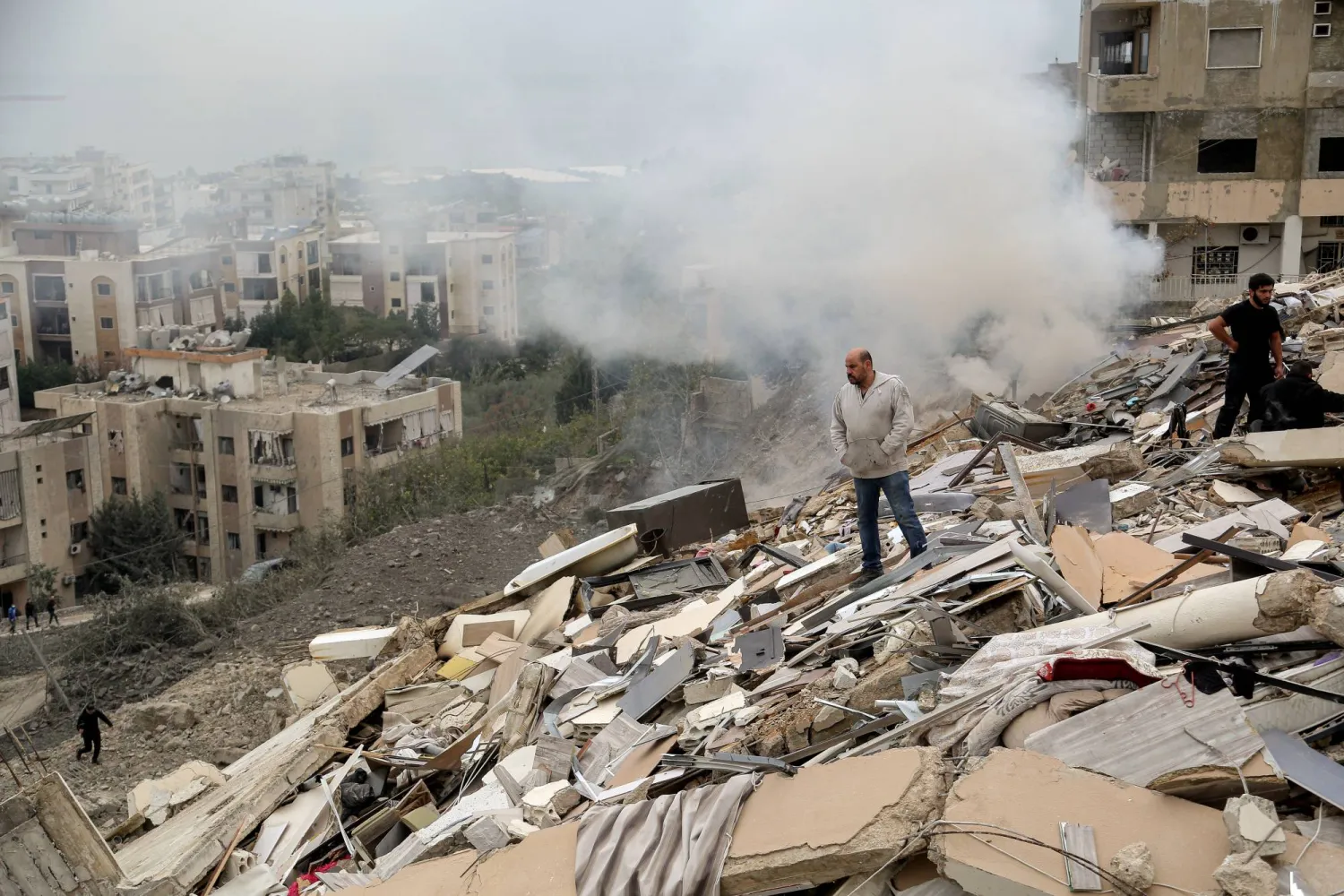



Lebanon Says Two Killed in Israeli Strike on Palestinian Refugee Camp

22 January 2026, Lebanon, Qnarit: People inspect the damage of a building that was destroyed by an Israeli air raid on the southern Lebanese village of Qnarit. (dpa)
TT

Lebanon Says Two Killed in Israeli Strike on Palestinian Refugee Camp

22 January 2026, Lebanon, Qnarit: People inspect the damage of a building that was destroyed by an Israeli air raid on the southern Lebanese village of Qnarit. (dpa)

Lebanon said an Israeli strike on the country's largest Palestinian refugee camp killed two people on Friday, with Israel's army saying it had targeted the Palestinian group Hamas. 

The official National News Agency said "an Israeli drone" targeted a neighborhood of the Ain al-Hilweh camp, which is located on the outskirts of the southern city of Sidon. 

Lebanon's health ministry said two people were killed in the raid. The NNA had earlier reported one dead and an unspecified number of wounded. 

An AFP correspondent saw smoke rising from a building in the densely populated camp as ambulances headed to the scene. 

The Israeli army said in a statement that its forces "struck a Hamas command center from which terrorists operated", calling activity there "a violation of the ceasefire understandings between Israel and Lebanon" and a threat to Israel. 

The Israeli military "is operating against the entrenchment" of the Palestinian group in Lebanon and will "continue to act decisively against Hamas terrorists wherever they operate", it added. 

Israel has kept up regular strikes on Lebanon despite a November 2024 ceasefire that sought to halt more than a year of hostilities with Hezbollah. 

Israel has also struck targets belonging to Hezbollah's Palestinian ally Hamas, including in a raid on Ain al-Hilweh last November that killed 13 people. 

The UN rights office had said 11 children were killed in that strike, which Israel said targeted a Hamas training compound, though the group denied it had military installations in Palestinian camps in Lebanon. 

In October 2023, Hezbollah began launching rockets at Israel in support of Hamas at the outset of the Gaza war, triggering hostilities that culminated in two months of all-out war between Israel and the Iran-backed Lebanese group. 

On Sunday, Lebanon said an Israeli strike near the Syrian border in the country's east killed four people, as Israel said it targeted operatives from Palestinian group Islamic Jihad. 


UN Says It Risks Halting Somalia Aid Due to Funding Cuts 

A Somali trader marks watermelons for sale at an open-air grocery market as Muslims start the fasting month of Ramadan, the holiest month in the Islamic calendar, within Bakara market in Mogadishu, Somalia, February 18, 2026. (Reuters)
TT

UN Says It Risks Halting Somalia Aid Due to Funding Cuts 

A Somali trader marks watermelons for sale at an open-air grocery market as Muslims start the fasting month of Ramadan, the holiest month in the Islamic calendar, within Bakara market in Mogadishu, Somalia, February 18, 2026. (Reuters)

The UN's World Food Program (WFP) warned Friday it would have to stop humanitarian assistance in Somalia by April if it did not receive new funding.

The Rome-based agency said it had already been forced to reduce the number of people receiving emergency food assistance from 2.2 million in early 2025 to just over 600,000 today.

"Without immediate funding, WFP will be forced to halt humanitarian assistance by April," it said in a statement.

In early January, the United States suspended aid to Somalia over reports of theft and government interference, following the destruction of a US-funded WFP warehouse in the capital Mogadishu's port.

The US announced a resumption of WFP food distribution on January 29.

However, all UN agencies have warned of serious funding shortfalls since Washington began slashing aid across the world following President Donald Trump's return to the White House last year.

"The situation is deteriorating at an alarming rate," said Ross Smith, WFP Director of Emergency Preparedness and Response, in Friday's statement.

"Families have lost everything, and many are already being pushed to the brink. Without immediate emergency food support, conditions will worsen quickly.

"We are at the cusp of a decisive moment; without urgent action, we may be unable to reach the most vulnerable in time, most of them women and children."

Some 4.4 million people in Somalia are facing crisis-levels of food insecurity, according to the WFP, the largest humanitarian agency in the country.

The Horn of Africa country has been plagued by conflict and also suffered two consecutive failed rainy seasons.


Hamas Says Path for Gaza Must Begin with End to ‘Aggression’ 

Makeshift tents of displaced Palestinian families among the ruins of their homes at sunset during the holy month of Ramadan in Jabaliya northern Gaza Strip on, 19 February 2026. (EPA)
TT

Hamas Says Path for Gaza Must Begin with End to ‘Aggression’ 

Makeshift tents of displaced Palestinian families among the ruins of their homes at sunset during the holy month of Ramadan in Jabaliya northern Gaza Strip on, 19 February 2026. (EPA)

Discussions on Gaza's future must begin with a total halt to Israeli "aggression", the Palestinian movement Hamas said after US President Donald Trump's Board of Peace met for the first time.

"Any political process or any arrangement under discussion concerning the Gaza Strip and the future of our Palestinian people must start with the total halt of aggression, the lifting of the blockade, and the guarantee of our people's legitimate national rights, first and foremost their right to freedom and self-determination," Hamas said in a statement Thursday.

Trump's board met for its inaugural session in Washington on Thursday, with a number of countries pledging money and personnel to rebuild the Palestinian territory, more than four months into a fragile ceasefire between Israel and Hamas.

Israeli Prime Minister Benjamin Netanyahu has insisted however that Hamas must disarm before any reconstruction begins.

"We agreed with our ally the US that there will be no reconstruction of Gaza before the demilitarization of Gaza," Netanyahu said.

The Israeli leader did not attend the Washington meeting but was represented by his foreign minister Gideon Saar.

Trump said several countries had pledged more than seven billion dollars to rebuild the territory.

Muslim-majority Indonesia will take a deputy commander role in a nascent International Stabilization Force, the unit's American chief Major General Jasper Jeffers said.

Trump, whose plan for Gaza was endorsed by the UN Security Council in November, also said five countries had committed to providing troops, including Morocco, Kazakhstan, Kosovo and Albania.