


French FM Arrives in Lebanon in Attempt to Broker a Halt to Hezbollah-Israel Clashes

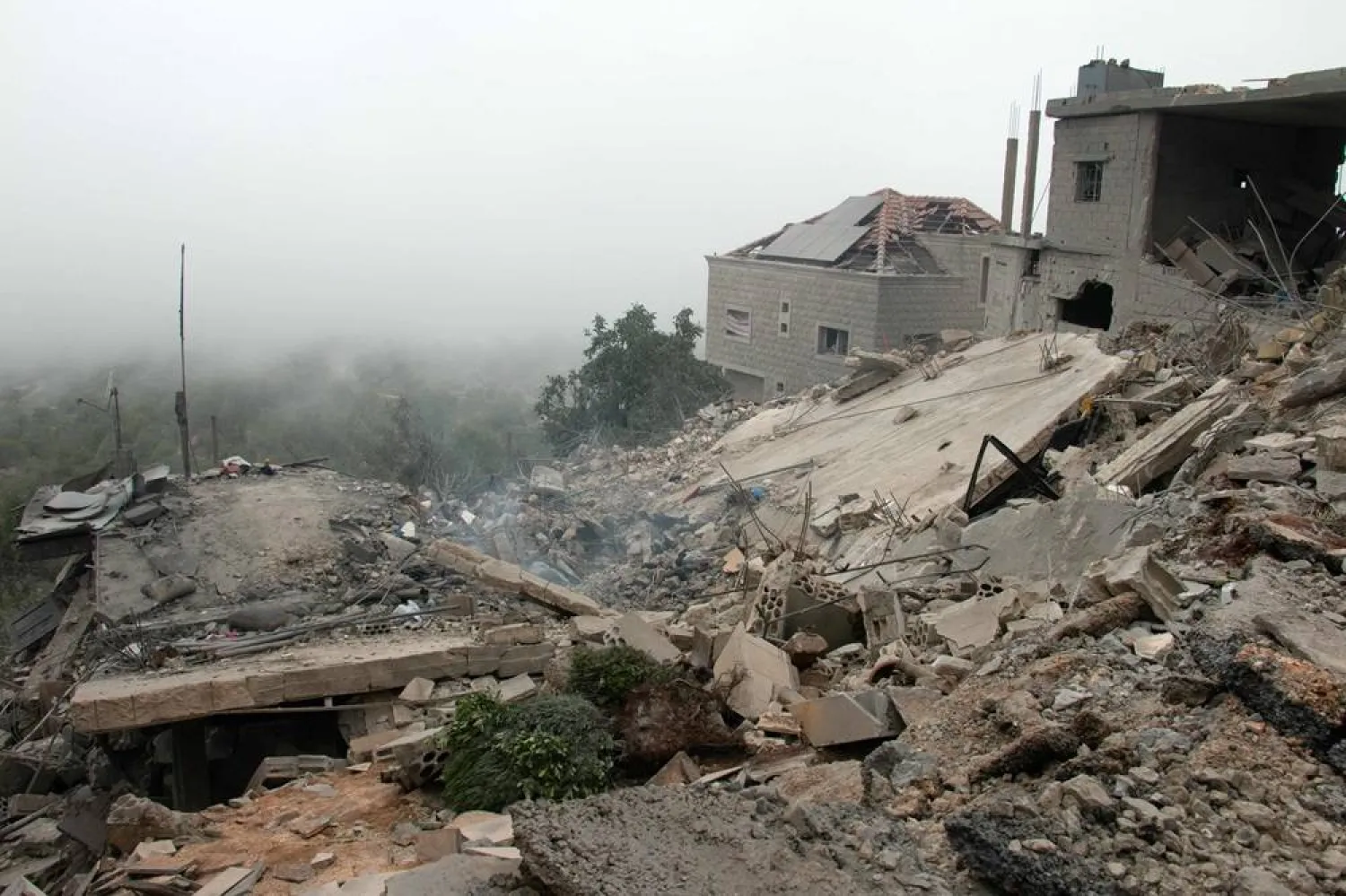
A house lies in ruins in the border village of Kfar Shouba in southern Lebanon, following an Israeli strike on April 27, 2024 , amid ongoing cross-border tensions as fighting continues between Israel and Palestinian Hamas fighters in Gaza. (AFP)
TT

French FM Arrives in Lebanon in Attempt to Broker a Halt to Hezbollah-Israel Clashes

A house lies in ruins in the border village of Kfar Shouba in southern Lebanon, following an Israeli strike on April 27, 2024 , amid ongoing cross-border tensions as fighting continues between Israel and Palestinian Hamas fighters in Gaza. (AFP)

French Foreign Minister Stéphane Séjourné arrived in Lebanon on Sunday as part of diplomatic attempts to broker a de-escalation in the conflict on the Lebanon-Israel border.

Séjourné met with United Nations peacekeeping forces in south Lebanon and with Lebanon's parliament speaker, army chief, foreign minister and caretaker prime minister.

France "is refusing to accept the worst-case scenario" of a full-scale war in Lebanon, he told journalists after the meetings.

"In southern Lebanon, the war is already here, even if it's not called by that name, and it’s the civilian population who’s paying the price," he said.

The Lebanese armed group Hezbollah has exchanged near-daily strikes with Israeli forces in the border region — and sometimes beyond — for almost seven months against the backdrop of Israel’s war against Hezbollah ally Hamas in Gaza.

Israeli strikes have killed more than 350 people in Lebanon, most of them fighters with Hezbollah and allied groups but also including more than 50 civilians. Strikes by Hezbollah have killed at least 10 civilians and 12 soldiers in Israel. Tens of thousands are displaced on each side of the border.

A French diplomatic official who spoke on condition of anonymity because they were not authorized to speak to journalists said the purpose of Séjourné’s visit was to convey France’s "fears of a war on Lebanon" and to submit an amendment to a proposal Paris had previously presented to Lebanon for a diplomatic resolution to the border conflict.

Western diplomats have brought forward a series of proposals for a cessation of hostilities between Israel and Hezbollah. Most of those would hinge on Hezbollah moving its forces several kilometers (miles) from the border, a beefed-up Lebanese army presence and negotiations for Israeli forces to withdraw from disputed points along the border where Lebanon says Israel has been occupying small patches of Lebanese territory since it withdrew from the rest of south Lebanon in 2000.

The eventual goal is full implementation of a UN resolution that brought to an end a brutal monthlong war between Israel and Hezbollah in 2006.

The previous French proposal would have involved Hezbollah withdrawing its forces 10 kilometers (6 miles) from the border.

Hezbollah has signaled willingness to entertain the proposals but has said there will be no deal in Lebanon before there is a ceasefire in Gaza. Israeli officials, meanwhile, have said that a Gaza ceasefire does not automatically mean it will halt its strikes in Lebanon, even if Hezbollah does so.

Séjourné declined to provide more details about the latest version of France’s proposal ahead of his planned trip to Israel on Tuesday. He said he will have "consultations" with Israeli authorities to move toward an agreement.

The French foreign minister also pushed for the Lebanese political factions to come to an agreement on a candidate to fill a year-and-a-half-long presidential vacuum. Séjourné said that Lebanon needs a president in place in order to be "invited to the negotiating table" and to be able to implement any agreement that might be reached on the border issue.

During the talks, Lebanese officials also raised the issue of the ongoing presence of more than 1 million Syrian refugees in Lebanon, which has become an increasingly contentious issue. Lebanese officials have increasingly called for Western countries to facilitate their return to Syria.

Séjourné acknowledged the burden placed on Lebanon by hosting such a large number of refugees, and said that "all concerned parties must work to make this return possible in a voluntary, dignified and safe manner in accordance with international law."



Palestinian Foreign Ministry Condemns US Ambassador to Israel’s Statements

The Israeli settlement of Har Homa, seen from the West Bank city of Bethlehem, Tuesday, Dec. 17, 2024. (AP)
TT

Palestinian Foreign Ministry Condemns US Ambassador to Israel’s Statements

The Israeli settlement of Har Homa, seen from the West Bank city of Bethlehem, Tuesday, Dec. 17, 2024. (AP)

The Palestinian Ministry of Foreign Affairs and Expatriates condemned statements by the US ambassador to Israel, in which he claimed that Israel has the right to exercise control over the entire Middle East.

The ministry emphasized that these provocative statements constitute a blatant call for aggression against the sovereignty of states.

It added that they support the continuation of the occupation’s war of genocide and displacement, as well as the implementation of its annexation and expansionist plans against the Palestinian people, SPA reported.

The Palestinian foreign ministry pointed out that the statements contradict religious and historical facts and international law, SPA reported.

It called on the US administration to take a clear stance regarding its ambassador to Israel’s remarks, which are completely at odds with the US president’s position rejecting the annexation of the West Bank.


Israel Carries Out More Strikes in Lebanon amid Lack of Int’l Assurances on Wider Regional Escalation

People gather near a building damaged in an Israeli strike in the village of Bednayel in eastern Lebanon, 21 February 2026. EPA/WAEL HAMZEH
TT

Israel Carries Out More Strikes in Lebanon amid Lack of Int’l Assurances on Wider Regional Escalation

People gather near a building damaged in an Israeli strike in the village of Bednayel in eastern Lebanon, 21 February 2026. EPA/WAEL HAMZEH

Lebanese officials say the country has yet to obtain firm or decisive Western guarantees that it will be spared from a larger confrontation in the region as speculation grows over a potential US strike on Iran.

Chief concerns center on whether Hezbollah would be targeted as part of any large-scale strike, or whether the group might intervene militarily alongside Tehran.

Ministerial sources said Israeli airstrikes on Hamas in the Ain al-Hilweh Palestinian refugee camp in southern Lebanon, as well as overnight raids targeting Hezbollah in the eastern Bekaa Valley fall within the pattern of ongoing military operations Lebanon, particularly targeted assassinations against figures linked to both groups.

The sources told Asharq Al-Awsat Lebanon has not received explicit Western assurances that it would not be drawn into a wider confrontation if the conflict expands.

On Hezbollah’s position, the sources noted that the group has not offered a clear position on how it would respond to potential developments.

They pointed to behind-the-scenes efforts led primarily by Parliament Speaker Nabih Berri who believes “Hezbollah will not take any step if Iran is struck.”

Although Hezbollah has previously declared it “would stand idle” in case of escalation, the sources said the party has not announced any specific military plans.

Statements made by its officials have been vague, they added, citing remarks by head of Hezbollah’s parliamentary bloc Mohammad Raad, who stressed on Friday the party’s commitment to “the security and stability of the country and the continuation of normal life.”

In Lebanon’s official response, President Joseph Aoun strongly condemned the Israeli raids carried out overnight by land and sea, which targeted the Sidon area and towns in the Bekaa.

He described the continued attacks as “blatant aggression” aimed at sabotaging Lebanon’s diplomatic efforts with brotherly and friendly nations - foremost among them the United States - to consolidate stability and halt Israeli hostilities.

Aoun said the strikes were a renewed violation of Lebanon’s sovereignty and a clear breach of international obligations, particularly United Nations Security Council Resolution 1701, which calls for a cessation of hostilities and full implementation of its provisions.

The president renewed his appeal to countries supporting regional stability to assume their responsibilities by pressing for an immediate halt to the attacks and ensuring respect for international resolutions in a way that preserves Lebanon’s sovereignty, security, and territorial integrity, and prevents further escalation.


Syrian President Confident in Implementation of SDF Agreement

Syrian President Ahmed al-Sharaa shakes hands with Mazloum Abdi, commander of the Syrian Democratic Forces, in Damascus on March 10, 2025. (SANA)
TT

Syrian President Confident in Implementation of SDF Agreement

Syrian President Ahmed al-Sharaa shakes hands with Mazloum Abdi, commander of the Syrian Democratic Forces, in Damascus on March 10, 2025. (SANA)

Syrian President Ahmed al-Sharaa is confident in both the mechanism and the pace of implementation of the agreement with the Syrian Democratic Forces (SDF), sources in the capital told Asharq Al-Awsat on Saturday.

The sources, who met al-Sharaa days earlier, said the president believes he has “a thousand solutions to every problem” related to unifying Syria “as land and people,” despite what they described as attempts by a hardline faction within the SDF to derail the process.

The government appears determined to move forward. Damascus has begun implementing what it calls an “integration” of state institutions with the Kurdish-led group’s administrative and military structures.

Political writer Ibrahim al-Jabin said al-Sharaa is also closely managing developments in Hasakah province through understandings with the international coalition and the US military, which is vacating bases and transferring them to Syria’s Ministry of Defense.

Al-Jabin, who attended a recent meeting between the president and Arab writers participating in the Damascus International Book Fair, said al-Sharaa projected assurance about the agreement’s trajectory.

He pointed to a “hardline current” within the SDF seeking to push matters toward collapse, describing recent remarks by Ilham Ahmed as efforts to provoke Damascus while containing dissatisfaction among supporters of the Kurdistan Workers’ Party (PKK), who are critical of what they see as concessions by the SDF.

At the same time, al-Jabin said a strong current within the SDF is leaning toward pragmatism and compromise, shifting from a militia mindset to a governing role. He cited Decree No. 13, which grants Syrian Kurds long-demanded rights, including citizenship for those previously denied it and recognition of Kurdish-language instruction in areas with significant Kurdish populations. These measures, he added, are proceeding in parallel with US support for Damascus’ approach.

On Friday, Ilham Ahmed, co-chair of the Autonomous Administration’s Department of Foreign Relations, told the Kurdish channel Ronahi that many provisions of the Jan. 29 agreement had yet to be implemented, warning of “the risk of a new war in Syria.”

She accused the government of resisting meaningful Kurdish participation in state institutions and said hate speech from some sectors was obstructing progress.

Kurdish political researcher Mahdi Daoud described Ahmed’s remarks as “provocative,” arguing that the Democratic Union Party (PYD) benefits from heightened tensions and feels stronger in times of instability.

Daoud said it was too early to fully assess the integration mechanism, but noted that a plane landed at Qamishli airport on Saturday without incident, a sign of relative calm.

In a related development, Syria’s General Authority of Civil Aviation formally assumed control of Qamishli airport under the January 29 agreement.

Authorities also released 51 detainees from Alaya prison, still run by the SDF, in coordination with Hasakah Governor Noureddine Ahmad and local tribal leaders, alongside a presidential amnesty issued by al-Sharaa.