Hamas Prepares Response to Gaza Truce Offer

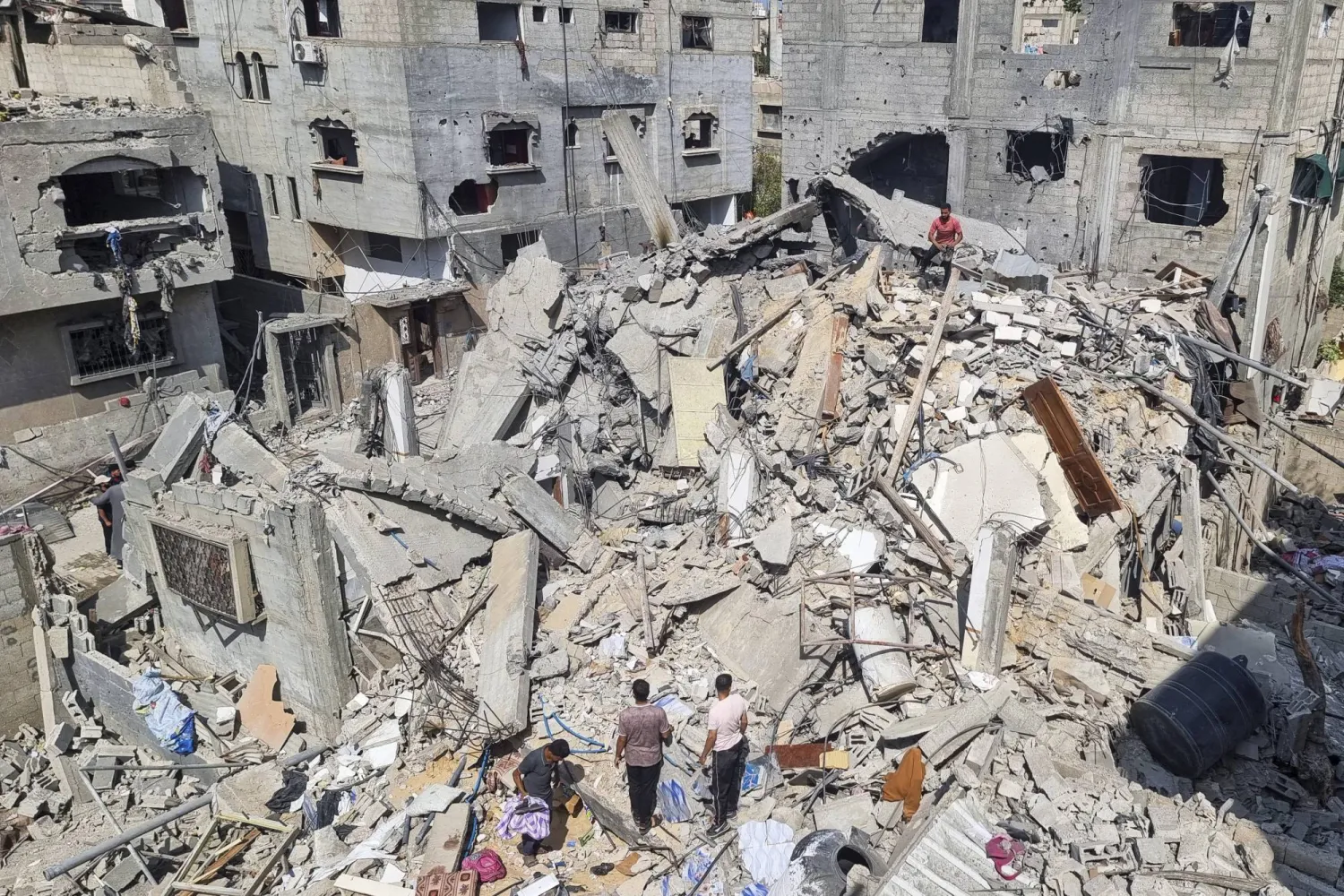
Palestinians look at the destruction after an Israeli airstrike in Rafah, Gaza Strip. Monday, April 29, 2024. (AP Photo/Mohammad Jahjouh)
TT

Hamas Prepares Response to Gaza Truce Offer

Palestinians look at the destruction after an Israeli airstrike in Rafah, Gaza Strip. Monday, April 29, 2024. (AP Photo/Mohammad Jahjouh)

Hamas was studying Tuesday Israel's offer of a 40-day truce in the war in the Gaza Strip in exchange for the release of scores of hostages held since the Palestinian group's October 7 attacks.
Returning to Qatar after the latest talks in Cairo, the Hamas delegation said it would "discuss the ideas and the proposal... we are keen to respond as quickly as possible," a Hamas source told AFP on condition of anonymity.
Egyptian sources told Al-Qahera News, a site linked to Egyptian intelligence services, that the Hamas delegation would "return with a written response".
US Secretary of State Antony Blinken described the truce terms as "extraordinarily generous", while the White House asked fellow mediators Egypt and Qatar to increase pressure on Hamas to accept the latest push to halt the nearly seven-month-old war.
According to Monday night call readouts, US President Joe Biden urged the Egyptian and Qatari leaders "to exert all efforts to secure the release of hostages held by Hamas", calling this "the only obstacle" to securing relief for civilians in the besieged strip.
For months, Egypt, Qatar and the United States have been trying to secure a new agreement between the combatants. A one-week truce in November saw 80 Israeli hostages exchanged for 240 Palestinians held in Israeli prisons.
Relentless Israeli bombardment has meanwhile devastated Hamas-run Gaza, flattening much of the territory and bringing its people to the brink of famine, while threatening to unfurl into a wider regional conflict.
In the far southern city of Rafah, Palestinians despaired over the war while searching for victims of the latest strike.
"Civilian individuals with no ties to Hamas or any other group were struck by a rocket, torn apart," Um Louay Masri said at a destroyed building where children were being pulled out from underneath the rubble. "Why did this occur?"
To global alarm, Israel has vowed to go after Hamas battalions in Rafah, where the majority of Gaza's 2.4 million people have sought refuge.
But Foreign Minister Israel Katz said over the weekend the government may "suspend" that operation if a truce is reached.
Two-state solution talks
Speaking in Riyadh on his seventh visit to the region since the start of the war in Gaza, top US diplomat Blinken underscored the need for Hamas to "decide quickly" on the truce.
He told a World Economic Forum special meeting that he was "hopeful that they will make the right decision".
At the WEF meeting, Egypt's Foreign Minister Sameh Shoukry said "the proposal has taken into account the positions of both sides".
"We are hopeful," he added.
British Foreign Secretary David Cameron said that Hamas has been offered a "sustained 40 days' ceasefire, the release of potentially thousands of Palestinian prisoners, in return for the release of these hostages".
On the sidelines of the WEF, US, European and Arab representatives met to discuss how to advance a two-state solution to the Israeli-Palestinian conflict.
Saudi Foreign Minister Prince Faisal bin Farhan told the gathering that tangible and irreversible steps towards establishing a Palestinian state would be an essential component of any durable ceasefire deal.
Israeli Prime Minister Benjamin Netanyahu is a long-standing opponent of Palestinian statehood however, and Israel has previously rejected a permanent ceasefire.
A Hamas source has told AFP the group is keen for a deal that "guarantees a permanent ceasefire, the free return of displaced people, an acceptable deal for (a prisoner-hostage) exchange and an end to the siege" in Gaza.
'Bring our people home'
Netanyahu is under tremendous pressure from the families of hostages taken by Hamas in the October 7 attack to secure their release.
On Monday, the families of two Israeli captives seen alive in a video released by Hamas last weekend called for their release.
"I demand the leaders of the free world to help us bring our people home," said Aviva Siegel, who was freed in the November truce and is the wife of captive Keith Siegel.
Israel estimates 129 hostages remain in Gaza, including 34 believed to be dead.
Hamas's attack resulted in the deaths of about 1,170 people in Israel, mostly civilians, according to an AFP tally based on Israeli official figures.
Israel's retaliatory offensive has killed at least 34,488 people in Gaza, mostly women and children, according to the health ministry in the Hamas-run territory.
That tally includes at least 34 deaths in a 24-hour window, the ministry said Monday, down from a peak this month of at least 153 deaths on April 9.
At Rafah's Al-Najjar hospital, a crowd of grief-stricken relatives jostled over the dead, shrouded in white.
"We demand the entire world to call for a lasting truce," Abu Taha said at the hospital.
Heatwave
After an Israeli drone strike in early April killed seven workers from a US-based charity, Biden suggested to Netanyahu, for the first time, that continued US support could be conditional on protection and aid for civilians.
On Sunday, the White House said Israel was letting more aid trucks into Gaza in line with "commitments" Biden asked it to meet.
The UN has, however, continued to cite "access constraints" that significantly hinder delivery.
The US military is building a pier to help boost humanitarian supplies -- an effort that the Pentagon on Monday said would cost Washington at least $320 million.
"I have sick children who cannot tolerate the heat," said Alaa al-Saleh, a Palestinian displaced to an encampment in Rafah. "We are cramped inside the tent, rarely going outside."



Hezbollah Supporters Dismayed as Leaked Videos Show Assad Mocking Party

A tattered Syrian flag and Assad poster in Aleppo on Dec. 5, 2024. (AFP via Getty Images)
TT

Hezbollah Supporters Dismayed as Leaked Videos Show Assad Mocking Party

A tattered Syrian flag and Assad poster in Aleppo on Dec. 5, 2024. (AFP via Getty Images)

Hezbollah supporters in Lebanon expressed their dismay in the leaked videos of ousted Syrian President Bashar al-Assad and his late media advisor Luna al-Shibl in which they mock supporters of the regime, including the Iran-backed party, during the 14-year Syrian civil war.

Al Arabiya released the videos that showed Assad driving a vehicle in Damascus, with Shibl in the passenger seat. A third person was filming from the back seat. The videos are undated but suspected to date back to 2018 after opposition fighters were forced out of Ghouta near Damascus.

As they drive, the trio encounter gunmen, whom Assad said were Lebanese, meaning Hezbollah fighters. Shibl then started to discuss the party and its performance during the war.

Hezbollah had sent its fighters to Syria to prop up the regime during the conflict. Its intervention helped prolong the war. Russia’s eventual intervention helped tip the balance in the regime’s favor.

In the videos, Shibl said that the “Syrian army has learned and now has experience that it can share with other armies.”

“Hezbollah in the end could not back up its claims and we never heard from it,” she added.

Commenting to Asharq Al-Awsat about the videos, Hezbollah supporters in Lebanon expressed their disappointment, saying they were a “mockery of all the sacrifices and denial of the facts on the ground.”

One supporter said Assad’s silence over Shibl’s comments “is a sign of his agreement and another insult” to the party.

Assad has no loyalty and does not appreciate the sacrifices, he stressed.

Another supporter dismissed Shibl, telling Asharq Al-Awsat that she is “delusional”, a “liar” and “flatterer”.

“She and Assad both know that were it not for Hezbollah, the opposition would have captured Damascus in winter 2012,” he remarked.

Hezbollah supporters often trade stories about their fighting in Syria. The party has also released footage of its operations in Syria, most notably in the regions of Qusayr and al-Qalamoun in spring 2013, and Aleppo, al-Zabadani and Ghouta in 2016. Those operations have become part of the party’s “lore”.

One Hezbollah fighters told Asharq Al-Awsat that the regime army “did not know how to stop attacks in southern Damascus in 2012. (...) The party had to step in and draft plans.”

The offensive launched by the opposition in Daraa at the time “was repelled by the party alone and some Syrian fighters,” he went on to say.

In eastern Ghouta, he recalled how the regime forces were retreating, “leaving Hezbollah members to fight alone for two hours” before regrouping.

“Shibl should have spoken about who devised the plans to capture al-Qalamoun and al-Zabadani and who fought there” before she doubted the party’s capabilities, the fighter told Asharq Al-Awsat.

The disappointment in the videos also played out on social media, with supporters recalling that before they were allied during the war, Hezbollah and the regime had a rivalry that dates back to Lebanon’s 1975-90 civil war.

The rivalry was patched up because the regime needed the party, said one social media user.

Another said the videos were a message to those who still defended Assad.

Ties between Hezbollah and Assad were strained before his ouster in December 2024. Some Hezbollah leaders accused Assad of abandoning the party during the “support war” it had launched from Lebanon in solidarity with Hamas in Gaza in October 2023.

It has since been revealed that Assad barred Hezbollah from using Syrian territory to launch rockets at Israel during the “support war”. The regime also restricted the delivery of weapons to the party through Syria during the conflict.


Assad Curses Ghouta, Mocks Syrian Troops in Leaked Videos

Bashar al-Assad was overthrown after 24 years in power. (EPA)
TT

Assad Curses Ghouta, Mocks Syrian Troops in Leaked Videos

Bashar al-Assad was overthrown after 24 years in power. (EPA)

As Syrians gear up to mark the one-year anniversary of the ouster of President Bashar al-Assad's regime on Monday, Al Arabiya television released videos of the toppled leader recorded a few years ago showing him cursing the region of al-Ghouta and mocking his own troops even amid the civil war.

The videos released on Saturday showed Assad as he was driving his car through Damascus with his late media advisor Luna al-Shibl. The videos are undated but suspected to have been recorded around 2018 after opposition fighters were forced out of Ghouta. They were filmed by a third person in the vehicle with Assad and Shibl.

In one video, Assad is heard cursing Ghouta, saying: “To hell with it.” Other shots showed him mocking his own soldiers when they would kiss the president’s hands in a show of loyalty.

At one point, Shibl asked Assad how he feels about seeing posters of himself on the streets of Syria, to which he replied that he feels “nothing” about them.

On the situation in war-torn Syria, Assad said he was “not only ashamed but disgusted.”

Assad at one point mocks even his family name, which translates to “lion” in Arabic, saying maybe he should change it to “some other animal.”

Assad and Shibl even mocked Lebanon's Hezbollah that had sent its fighters to Syria to prop up the regime.

Commenting on the leaks, Syrians dismissed them, while other said they were further evidence of his lack of loyalty to forces that had stood by him during the war.

Journalist Wael Youssef said he did not care about the leaks, saying Assad and Shibl were now part of the past.

He added that he was disturbed even hearing their voices. “Personally, I could never listen to Bashar when he was delivering an allegedly important speech. If it was really important, I would get a copy of it to read. Today they are now behind us, thank God.”

Assad's late media advisor Luna al-Shibl.

Radwan, a resident of Damascus’ Jobar neighborhood that was destroyed by regime forces during the war, described Assad as an “idiot, which is why we rose up against him”.

“When he would bomb us with planes, we would often wonder how he could possibly call himself Syrian because he has an unnatural animosity to Syria and its people,” he said. “The videos are evidence of this.”

Lawyer Nibal Hamdoun said she was not surprised by Assad’s comments in the leaks. “We had experienced his sentiments during 14 years of killing and destruction during the war,” she remarked.

“If he believes Syria is disgusting, then it is because of his corrupt rule and the corruption of his father (late President Hafez al-Assad),” she stressed, adding that he should be ashamed of himself.

Another Syrian, Badr Rahmeh said he was curious to learn how Assad feels in his Moscow exile as he watches Syria prepare to celebrate a year since his ouster.

“Will he watch as we trample posters of his image that he allegedly didn’t like to see on the streets where we were forced to hang them?” he wondered.

“I want to know how the supporters Shibl had called on to persevere during the war now feel as they watch these videos that mock their loyalty,” he went on to say.

Shibl had died in mysterious circumstance in 2024. The official story was that she died in a car accident, while skeptics say that the accident was deliberate and staged by the regime after she had fallen afoul of it.

She had worked for years as the director of the presidency media office before being promoted to Assad’s media advisor.


Abbas Calls on Hamas to Disarm, Israel to Withdraw from Gaza

Palestinian President Mahmoud Abbas. (dpa)
TT

Abbas Calls on Hamas to Disarm, Israel to Withdraw from Gaza

Palestinian President Mahmoud Abbas. (dpa)

Palestinian President Mahmoud Abbas said on Saturday that the second phase of US President Donald Trump’s ceasefire plan in Gaza demands Israel’s withdrawal from the enclave and for Hamas and other armed groups to turn over their weapons to his Palestinian Authority.

Speaking during a telephone call with German Chancellor Friedrich Merz, Abbas added that his priority now lies in implementing Trump’s plan to end the war, stop the bloodshed and ease the suffering of the Palestinian people in Gaza and prevent their displacement.

The implementation of the second phase will pave the way for the deployment of Palestinian police and the international stabilization force in Gaza and the launch of the reconstruction phase in an organized and effective manner, he explained.

Parallel steps must be carried out in the occupied West Bank to put an end to Israeli measures that are undermining the two-state solution, Abbas continued.

He demanded an end to Israeli settler violence against the Palestinian people, an end to settlement expansion and annexation policies, and an end to Israeli policies that are harming the Palestinian economy and government’s ability to meet its commitments to the people.

Abbas reiterated his condemnation of Hamas’ October 7, 2023 attack, saying the movement “must end its rule in Gaza and hand over its weapons.”

He renewed Palestine’s commitment to recognize Israel and the two-state solution, “so that an independent Palestinian state can coexist side by side by Israel in peace and security.”

Abbas and Merz held their call hours before the German leader arrived in Israel on an official visit.