


Netanyahu Vows to Invade Rafah ‘with or without a Deal’ as Ceasefire Talks with Hamas Continue

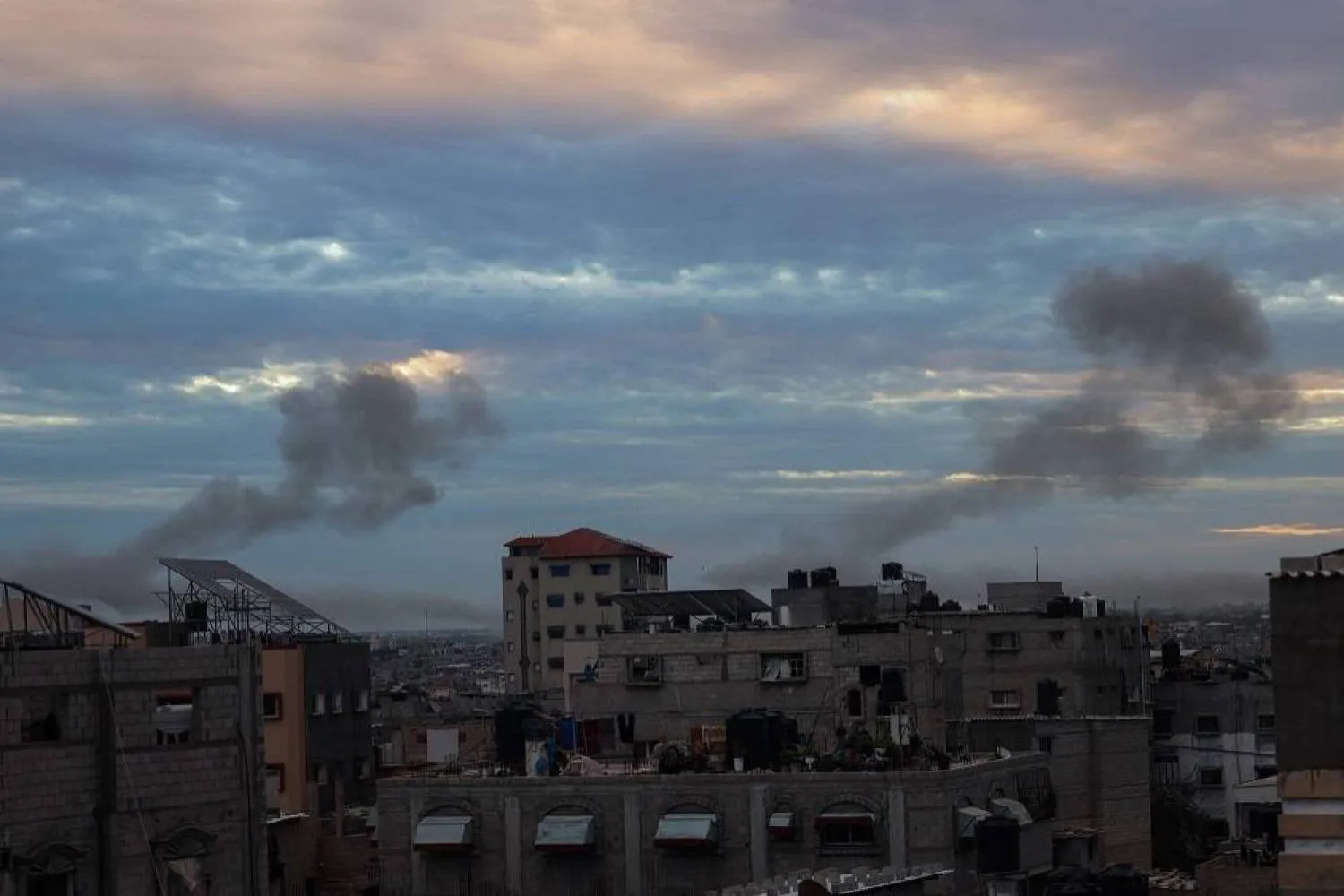
Smoke billows during Israeli bombardment over Rafah in the southern Gaza Strip on February 13, 2024 amid the ongoing conflict between Israel and the Palestinian Hamas militant group. (AFP)
TT

Netanyahu Vows to Invade Rafah ‘with or without a Deal’ as Ceasefire Talks with Hamas Continue

Smoke billows during Israeli bombardment over Rafah in the southern Gaza Strip on February 13, 2024 amid the ongoing conflict between Israel and the Palestinian Hamas militant group. (AFP)

Israeli Prime Minister Benjamin Netanyahu pledged Tuesday to launch an incursion into the southern Gaza city of Rafah, where hundreds of thousands of Palestinians are sheltering from the almost seven-month-long war, just as ceasefire negotiations between Israel and Hamas appear to be gaining steam.

Netanyahu's comments came hours before US Secretary of State Antony Blinken was to arrive in Israel to advance the truce talks — which appear to be one of the most serious rounds of negotiations between Israel and Hamas since the war began. The deal is meant to free hostages, bring some relief to the population and avert an Israeli offensive into Rafah and the potential harm to civilians there.

Netanyahu said Israel would enter Rafah, which Israel says is Hamas' last stronghold, regardless of whether a truce-for-hostages deal is struck. His comments appeared to be meant to appease his nationalist governing partners, but it was not clear whether they would have any bearing on any emerging deal with Hamas.

"The idea that we will stop the war before achieving all of its goals is out of the question," Netanyahu said, according to a statement from his office. "We will enter Rafah and we will eliminate Hamas' battalions there — with or without a deal, to achieve the total victory."

The US has repeatedly said it opposes the Rafah operation until Israel presents a credible plan for evacuating and protecting the estimated 1.5 million people seeking shelter there.

Blinken, speaking in Jordan before flying to Israel, said the "focus" right now is on improving the humanitarian situation and reaching a ceasefire deal that brings Israeli hostages home. He said Israel has offered a "strong proposal" and called on Hamas to respond.

"No more delays. No more excuses. The time to act is now," he said. "We want to see in the coming days this agreement coming together."

Netanyahu has faced pressure from his governing partners not to proceed with a deal that might prevent Israel from invading Rafah. His government could be threatened if he agrees to a deal because hardline Cabinet members have demanded an attack on Rafah.

Netanyahu met on Tuesday with one of those partners, National Security Minister Itamar Ben-Gvir, according to the minister's office, who said Netanyahu promised him that "Israel will enter Rafah, promised that we are not stopping the war and promised that there won't be a reckless deal."

With more than half of Gaza's 2.3 million people sheltering in Rafah, the international community, including Israel's top ally, the United States, has warned Israel against any offensive that puts civilians at risk.

Netanyahu on Tuesday was addressing the Tikva Forum, a small group of families of hostages that's distinct from the main group representing the families of captive Israelis. The forum has indicated that it prefers to see Hamas crushed over the freedom of their loved ones. Most families and their supporters have demonstrated in the thousands every week for a deal that would bring the hostages home, saying it should take precedence over military action.

Netanyahu's coalition is made up of ultranationalist and conservative religious parties, and critics of the Israeli leader say his decision-making during the war has been driven by political considerations rather than national interests, a charge Netanyahu denies.  

His government could collapse if one of the parties opposed to a deal pulls out, a scenario Netanyahu would try to avoid considering his support has plummeted in opinion polls since the war began, although it has seen a slight gradual uptick.

Finance Minister Bezalel Smotrich, who heads the ultranationalist Religious Zionist party, said Monday that he was seeking "total annihilation" of Israel's enemies, appearing to refer to Hamas, in a recorded portion of his remarks at an event marking the end of the Passover holiday which were aired in Israeli media.

"You can't do half a job," he said.

The current deal being discussed, brokered by the US, Egypt and Qatar, would see the release of dozens of hostages in exchange for a six-week halt in fighting as part of an initial phase, according to an Egyptian official and Israeli media. Hundreds of Palestinian prisoners held by Israel would also be released, including some serving long sentences.

Blinken, who was meeting with regional leaders in Saudi Arabia and Jordan before landing in Tel Aviv later Tuesday, urged Hamas on Monday to accept the latest proposal, calling it "extraordinarily generous" on Israel’s part.

But a sticking point remains over what happens next. Hamas has demanded assurances that an eventual release of all hostages will bring a complete end to Israel’s assault in Gaza and a withdrawal of its troops from the devastated territory. Israel has offered only an extended pause, vowing to resume its offensive once the first phase of the deal is over. The issue has repeatedly obstructed efforts by the mediators during months of talks.

The Israel-Hamas war was sparked by the unprecedented Oct. 7 raid into southern Israel in which militants killed around 1,200 people, mostly civilians, and abducted around 250 hostages. Israel says the fighters are still holding around 100 hostages and the remains of more than 30 others.

The war in Gaza has killed more than 34,000 Palestinians, according to local health officials. The war has driven around 80% of Gaza’s population of 2.3 million from their homes, caused vast destruction in several towns and cities and pushed northern Gaza to the brink of famine.



How Gaza Armed Gangs Recruit New Members

Security personnel guard trucks carrying aid as they arrive in Rafah, amid the ongoing conflict between Israel and the Palestinian Islamist group Hamas, in the southern Gaza Strip January 17, 2024. (Reuters)
TT

How Gaza Armed Gangs Recruit New Members

Security personnel guard trucks carrying aid as they arrive in Rafah, amid the ongoing conflict between Israel and the Palestinian Islamist group Hamas, in the southern Gaza Strip January 17, 2024. (Reuters)

As Hamas moves to strike armed gangs operating in areas of the Gaza Strip under Israeli army control, the groups are responding with defiance, stepping up efforts to recruit young men and expand their ranks.

Videos posted on social media show training exercises and other activities, signaling that the gangs remain active despite pressure from Hamas security services.

Platforms affiliated with Hamas security say some members have recently turned themselves in following mediation by families, clans and community leaders. The gangs have not responded to those statements. Instead, they occasionally broadcast footage announcing new recruits.

Among the most prominent was Hamza Mahra, a Hamas activist who appeared weeks ago in a video released by the Shawqi Abu Nasira gang, which operates north of Khan Younis and east of Deir al-Balah.

Mahra’s appearance has raised questions about how these groups recruit members inside the enclave.

Field sources and others within the security apparatus of a Palestinian armed faction in Gaza told Asharq Al-Awsat that Mahra’s case may be an exception. They described him as a Hamas activist with no major role, despite his grandfather being among the founders of Hamas in Jabalia.

His decision to join the gang was driven by personal reasons linked to a family dispute, they said, not by organizational considerations.

The sources said the gangs exploit severe economic hardship, luring some young men with money, cigarettes and other incentives. Some recruits were heavily indebted and fled to gang-controlled areas to avoid repaying creditors.

Others joined in search of narcotic pills, the sources said, noting that some had previously been detained by Hamas-run security forces on similar charges. Economic hardship and the need for cigarettes and drugs were among the main drivers of recruitment, they added, saying the gangs, with Israeli backing, provide such supplies.

Resentment toward Hamas has also played a role, particularly among those previously arrested on criminal or security grounds and subjected to what the sources described as limited torture during interrogations under established procedures.

According to the sources, some founders or current leaders of the gangs previously served in the Palestinian Authority security services.

They cited Shawqi Abu Nasira, a senior police officer; Hussam al-Astal, an officer in the Preventive Security Service; and Rami Helles and Ashraf al-Mansi, both former officers in the Palestinian Presidential Guard.

These figures, the sources said, approach young men in need and at times succeed in recruiting them by promising help in settling debts and providing cigarettes. They also tell recruits that joining will secure them a future role in security forces that would later govern Gaza.

The sources described the case of a young man who surrendered to Gaza security services last week. He said he had been pressured after a phone call with a woman who threatened to publish the recording unless he joined one of the gangs.

He later received assurances from another contact that he would help repay some of his debts and ultimately agreed to enlist.

During questioning, he said the leader of the gang he joined east of Gaza City repeatedly assured recruits they would be “part of the structure of any Palestinian security force that will rule the sector.”

The young man told investigators he was unconvinced by those assurances, as were dozens of others in the same group.

Investigations of several individuals who surrendered, along with field data, indicate the gangs have carried out armed missions on behalf of the Israeli army, including locating tunnels. That has led to ambushes by Palestinian factions.

In the past week, clashes in the Zaytoun neighborhood south of Gaza City and near al-Masdar east of Deir al-Balah left gang members dead and wounded.

Some investigations also found that the gangs recruited young men previously involved in looting humanitarian aid.


Meta's Zuckerberg Faces Questioning at Youth Addiction Trial

REUTERS/Francis Mascarenhas Purchase Licensing Rights
TT

Meta's Zuckerberg Faces Questioning at Youth Addiction Trial

REUTERS/Francis Mascarenhas Purchase Licensing Rights

Meta Platforms CEO and billionaire Facebook founder Mark Zuckerberg is set to be questioned for the first time in a US court on Wednesday about Instagram's effect on the mental health of young users, as a landmark trial over youth social media addiction continues. While Zuckerberg has previously testified on the subject before Congress, the stakes are higher at the jury trial in Los Angeles, California. Meta may have to pay damages if it loses the case, and the verdict could erode Big Tech's longstanding legal defense against claims of user harm, Reuters reported.

The lawsuit and others like it are part of a global backlash against social media platforms over children's mental health. Australia has prohibited access to social media platforms for users under age 16, and other countries including Spain are considering similar curbs. In the US, Florida has prohibited companies from allowing users under age 14. Tech industry trade groups are challenging the law in court. The case involves a California woman who started using Meta's Instagram and Google's YouTube as a child. She alleges the companies sought to profit by hooking kids on their services despite knowing social media could harm their mental health. She alleges the apps fueled her depression and suicidal thoughts and is seeking to hold the companies liable.

Meta and Google have denied the allegations, and pointed to their work to add features that keep users safe. Meta has often pointed to a National Academies of Sciences finding that research does not show social media changes kids' mental health.

The lawsuit serves as a test case for similar claims in a larger group of cases against Meta, Alphabet's Google, Snap and TikTok. Families, school districts and states have filed thousands of lawsuits in the US accusing the companies of fueling a youth mental health crisis.

Zuckerberg is expected to be questioned on Meta's internal studies and discussions of how Instagram use affects younger users.

Over the years, investigative reporting has unearthed internal Meta documents showing the company was aware of potential harm. Meta researchers found that teens who report that Instagram regularly made them feel bad about their bodies saw significantly more “eating disorder adjacent content” than those who did not,

Reuters reported

in October. Adam Mosseri, head of Instagram, testified last week that he was unaware of a recent Meta study showing no link between parental supervision and teens' attentiveness to their own social media use. Teens with difficult life circumstances more often said they used Instagram habitually or unintentionally, according to the document shown at trial.

Meta's lawyer told jurors at the trial that the woman's health records show her issues stem from a troubled childhood, and that social media was a creative outlet for her.


Israel Permits 10,000 West Bank Palestinians for Friday Prayers at Al Aqsa

Palestinians attend Friday prayers in a mosque following an attack that local Palestinians said was carried out by Israeli settlers, in the village of Deir Istiya near Salfit in the Israeli-occupied West Bank November 14, 2025. REUTERS/Sinan Abu Mayzer
TT

Israel Permits 10,000 West Bank Palestinians for Friday Prayers at Al Aqsa

Palestinians attend Friday prayers in a mosque following an attack that local Palestinians said was carried out by Israeli settlers, in the village of Deir Istiya near Salfit in the Israeli-occupied West Bank November 14, 2025. REUTERS/Sinan Abu Mayzer

Israel announced that it will cap the number of Palestinian worshippers from the occupied West Bank attending weekly Friday prayers at the Al-Aqsa Mosque in east Jerusalem at 10,000 during the holy month of Ramadan, which began Wednesday.

Israeli authorities also imposed age restrictions on West Bank Palestinians, permitting entry only to men aged 55 and older, women aged 50 and older, and children up to age 12.

"Ten thousand Palestinian worshippers will be permitted to enter the Temple Mount for Friday prayers throughout the month of Ramadan, subject to obtaining a dedicated daily permit in advance," COGAT, the Israeli defense ministry agency in charge of civilian matters in the Palestinian territories, said in a statement, AFP reported.

"Entry for men will be permitted from age 55, for women from age 50, and for children up to age 12 when accompanied by a first-degree relative."

COGAT told AFP that the restrictions apply only to Palestinians travelling from the West Bank, which Israel has occupied since the 1967 Arab-Israeli war.

"It is emphasised that all permits are conditional upon prior security approval by the relevant security authorities," COGAT said.

"In addition, residents travelling to prayers at the Temple Mount will be required to undergo digital documentation at the crossings upon their return to the areas of Judea and Samaria at the conclusion of the prayer day," it said, using the Biblical term for the West Bank.

During Ramadan, hundreds of thousands of Palestinians traditionally attend prayers at Al-Aqsa, Islam's third holiest site, located in east Jerusalem, which Israel captured in 1967 and later annexed in a move that is not internationally recognized.

Since the war in Gaza broke out in October 2023, the attendance of worshippers has declined due to security concerns and Israeli restrictions.

The Palestinian Jerusalem Governorate said this week that Israeli authorities had prevented the Islamic Waqf -- the Jordanian-run body that administers the site -- from carrying out routine preparations ahead of Ramadan, including installing shade structures and setting up temporary medical clinics.

A senior imam of the Al-Aqsa Mosque, Sheikh Muhammad al-Abbasi, told AFP that he, too, had been barred from entering the compound.

"I have been barred from the mosque for a week, and the order can be renewed," he said.

Abbasi said he was not informed of the reason for the ban, which came into effect on Monday.

Under longstanding arrangements, Jews may visit the Al-Aqsa compound -- which they revere as the site of the first and second Jewish temples -- but they are not permitted to pray there.

Israel says it is committed to upholding this status quo, though Palestinians fear it is being eroded.

In recent years, a growing number of Jewish ultranationalists have challenged the prayer ban, including far-right politician Itamar Ben Gvir, who prayed at the site while serving as national security minister in 2024 and 2025.