


Blinken Urges Israel and Hamas to Move Ahead with a Ceasefire Deal, Says ‘Time Is Now’

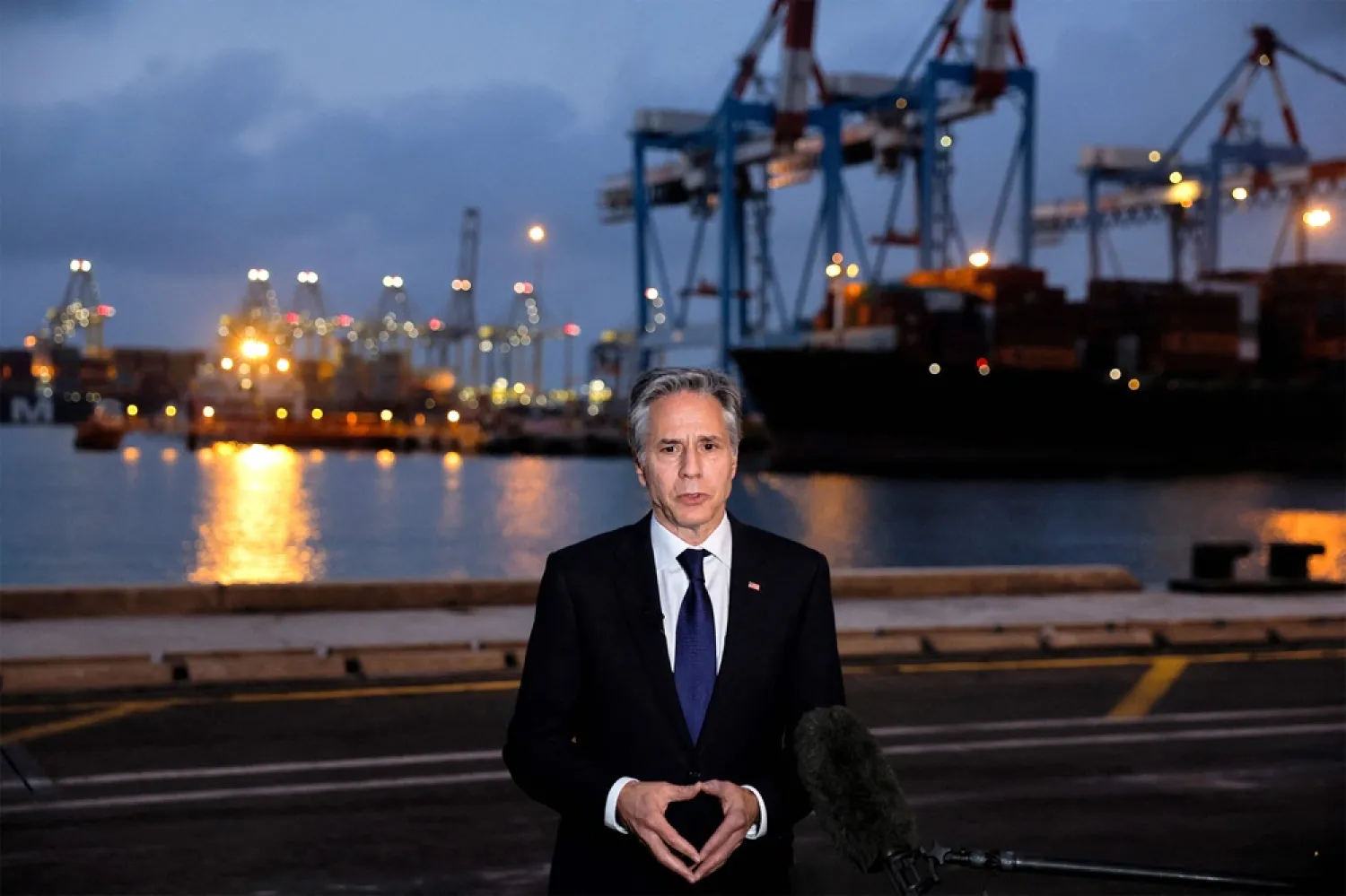
US Secretary of State Antony Blinken speaks to the press at the port of Ashdod in southern Israel on May 1, 2024. (AFP)
TT

Blinken Urges Israel and Hamas to Move Ahead with a Ceasefire Deal, Says ‘Time Is Now’

US Secretary of State Antony Blinken speaks to the press at the port of Ashdod in southern Israel on May 1, 2024. (AFP)

US Secretary of State Antony Blinken met with Israeli leaders Wednesday in his push for a ceasefire deal between Israel and Hamas, saying "the time is now" for an agreement that would free hostages and bring a pause in the nearly seven months of war in Gaza.

Blinken is on his seventh visit to the region since the war erupted in October, aiming to secure what’s been an elusive deal between Israel and Hamas that could avert an Israeli incursion into the southern Gaza town of Rafah, where some 1.4 million Palestinians are sheltering.

The current round of talks appears to be serious, but the sides remain far apart on one key issue — whether the war should end as part of an emerging deal.

Before agreeing to an initial, short-term ceasefire and partial hostage release, Hamas wants assurances that the eventual freeing of all the hostages will bring the end of Israel’s offensive and its full withdrawal from Gaza.  

Israel has offered only a pause after which it would resume its offensives until Hamas is destroyed. Israeli Prime Minister Benjamin Netanyahu repeated his determination to attack Rafah in talks with Blinken on Wednesday.

Blinken put pressure on Hamas, saying it would bear the blame for any failure to get a deal. Hamas said in a statement it would likely reply to the latest proposal on Thursday.

"We are determined to get a ceasefire that brings the hostages home and to get it now, and the only reason that that wouldn’t be achieved is because of Hamas," Blinken told Israel’s ceremonial President Isaac Herzog at a meeting in Tel Aviv.

"There is a proposal on the table, and as we’ve said, no delays, no excuses. The time is now," he said.

Blinken said the deal would also allow much needed food, medicine and water to get into Gaza, where the war has sparked a humanitarian crisis and displaced much of the territory’s population.

Still, Netanyahu's vow to carry out a military operation in Rafah, which Israel says is the last major Hamas stronghold showed the remaining challenges in the talks.

"The operation in Rafah doesn’t depend on anything. The prime minister made this clear to Secretary Blinken," Netanyahu’s office said after the two met Wednesday. A day earlier, Netanyahu pledged to move on Rafah "with or without" a ceasefire deal.

The United States has staunchly supported Israel’s campaign of bombardment and ground offensives in Gaza since Hamas’ unprecedented attack on Oct. 7 into southern Israel. But it has grown increasingly critical of the staggering toll borne by Palestinian civilians and has been outspoken against an assault on Rafah, where more than half of Gaza's population of 2.3 million has packed in and around the town after fleeing fighting elsewhere in the territory.

Washington says it opposes a major offensive but that if Israel conducts one it must first evacuate civilians.

In Rafah, Palestinians terrified of a potential Israeli invasion clung to hope that, after months of reported near-deals, this time a ceasefire would be sealed. Hundreds of thousands are living in vast tent camps filling the once empty areas around Rafah

Salwa Abu Hatab, a woman who fled Khan Younis, said she wants to go home. "Do you think we like life in tents? We are tired and suffering," she said. "Every day they say there is a truce and negotiations, and in the end it fails. We hope they will succeed this time."

"If the invasion happens, we do not know where to go," said Enas Syam, a woman from Gaza City carrying her child in the camp. "There is no safe place left."

In his talks with Netanyahu, Blinken urged him to build on what he said has been the "improvement" in the delivery of aid to Gaza over the past month. Bowing to US pressure to increase aid deliveries, Israel re-opened its Erez crossing into the northern Gaza Strip on Wednesday for the first time since it was damaged in Hamas’ Oct. 7 attack.

Throughout his regional visit, with previous stops in Saudi Arabia and Jordan, Blinken urged Hamas to accept the latest ceasefire proposal, calling it "extraordinarily generous" on Israel’s part.

The proposal — brokered by the US, Egypt and Qatar — would put a full Israeli withdrawal from Gaza up for discussion, according to leaked details confirmed by an Egyptian official and a Hamas official.

The proposal lays out three stages of six to seven weeks each with a detailed timetable of steps. The first phase would bring a pause during which Hamas would release some hostages, particularly civilian women, in exchange for the release of Palestinian prisoners in Israeli jails.

Israeli troops would withdraw from a coastal road in Gaza to facilitate passage of aid and the return of displaced people to the north, then the troops would withdraw from central Gaza. In the meantime, talks would start on restoring "a permanent calm," the Egyptian official said, speaking on condition of anonymity to discuss the internal negotiations.

The next stage would bring implementation of the calm, including Hamas’ release of all remaining hostages – soldiers and civilians – and a withdrawal of Israeli forces out of Gaza.

The last stage would see the release of bodies of dead hostages and the start of a five-year reconstruction plan. The plan says that Hamas would agree not to rebuild its military arsenal. The details were first reported in the Lebanese newspaper Al-Akhbar, which is close to Hamas and the Lebanese Hezbollah armed group.

The Egyptian official said Hamas wanted the language of the second phase to be strengthened to specify a "complete Israeli withdrawal from the entire Gaza Strip" to avoid different interpretations. It also wants clearer terms for the unconditional return of displaced people to the north of Gaza, since the current outline didn’t fully explain who would be allowed back, the official said.

Meanwhile, Israeli airstrikes in Gaza continued. Late Tuesday, a strike hit a house in Rafah — where strikes have been continual despite the masses of Palestinians taking refuge there — killing at least two children, according to hospital authorities. An Associated Press journalist saw the children’s bodies at Abu Yousef al-Najjar hospital as their relatives mourned the deaths.

On Wednesday, Israel’s military said it was operating in central Gaza, where it said jets struck militants, including one said to be setting up explosives.

The Israel-Hamas war was sparked by the unprecedented Oct. 7 raid into southern Israel in which gunmen killed around 1,200 people, mostly civilians, and abducted around 250 hostages. Israel says the fighters are still holding around 100 hostages and the remains of more than 30 others.

The war in Gaza has killed more than 34,000 Palestinians, according to local health officials. The war has driven around 80% of Gaza’s population of 2.3 million from their homes, caused vast destruction in several towns and cities and pushed northern Gaza to the brink of famine.



Lebanon Says One Killed in Israeli Strike on Palestinian Refugee Camp

22 January 2026, Lebanon, Qnarit: People inspect the damage of a building that was destroyed by an Israeli air raid on the southern Lebanese village of Qnarit. (dpa)
TT

Lebanon Says One Killed in Israeli Strike on Palestinian Refugee Camp

22 January 2026, Lebanon, Qnarit: People inspect the damage of a building that was destroyed by an Israeli air raid on the southern Lebanese village of Qnarit. (dpa)

An Israeli strike on Lebanon's largest Palestinian refugee camp killed one person on Friday, state media reported, with the Israeli army saying it had targeted the Palestinian group Hamas.

The official National News Agency said "an Israeli drone" targeted a neighborhood of the Ain al-Hilweh camp, which is located on the outskirts of the southern city of Sidon.

It reported that one person was killed and an unspecified number wounded.

An AFP correspondent saw smoke rising from a building in the densely populated camp as ambulances headed to the scene.

The Israeli army said in a statement that its forces "struck a Hamas command center from which terrorists operated".

Israel has kept up regular strikes on Lebanon despite a November 2024 ceasefire that sought to halt more than a year of hostilities with Hezbollah.

Israel has also struck targets belonging to Hezbollah's Palestinian ally Hamas, including in a raid on Ain al-Hilweh last November that killed 13 people.

The UN rights office had said 11 children were killed in that strike, which Israel said targeted a Hamas training compound, though the group denied it had military installations in Palestinian camps in Lebanon.

In October 2023, Hezbollah began launching rockets at Israel in support of Hamas at the outset of the Gaza war, triggering months of exchanges that culminated in two months of all-out war in Lebanon.

On Sunday, Lebanon said an Israeli strike near the Syrian border in the country's east killed four people, as Israel said it targeted operatives from Palestinian group Islamic Jihad.


UN Says It Risks Halting Somalia Aid Due to Funding Cuts 

A Somali trader marks watermelons for sale at an open-air grocery market as Muslims start the fasting month of Ramadan, the holiest month in the Islamic calendar, within Bakara market in Mogadishu, Somalia, February 18, 2026. (Reuters)
TT

UN Says It Risks Halting Somalia Aid Due to Funding Cuts 

A Somali trader marks watermelons for sale at an open-air grocery market as Muslims start the fasting month of Ramadan, the holiest month in the Islamic calendar, within Bakara market in Mogadishu, Somalia, February 18, 2026. (Reuters)

The UN's World Food Program (WFP) warned Friday it would have to stop humanitarian assistance in Somalia by April if it did not receive new funding.

The Rome-based agency said it had already been forced to reduce the number of people receiving emergency food assistance from 2.2 million in early 2025 to just over 600,000 today.

"Without immediate funding, WFP will be forced to halt humanitarian assistance by April," it said in a statement.

In early January, the United States suspended aid to Somalia over reports of theft and government interference, following the destruction of a US-funded WFP warehouse in the capital Mogadishu's port.

The US announced a resumption of WFP food distribution on January 29.

However, all UN agencies have warned of serious funding shortfalls since Washington began slashing aid across the world following President Donald Trump's return to the White House last year.

"The situation is deteriorating at an alarming rate," said Ross Smith, WFP Director of Emergency Preparedness and Response, in Friday's statement.

"Families have lost everything, and many are already being pushed to the brink. Without immediate emergency food support, conditions will worsen quickly.

"We are at the cusp of a decisive moment; without urgent action, we may be unable to reach the most vulnerable in time, most of them women and children."

Some 4.4 million people in Somalia are facing crisis-levels of food insecurity, according to the WFP, the largest humanitarian agency in the country.

The Horn of Africa country has been plagued by conflict and also suffered two consecutive failed rainy seasons.


Hamas Says Path for Gaza Must Begin with End to ‘Aggression’ 

Makeshift tents of displaced Palestinian families among the ruins of their homes at sunset during the holy month of Ramadan in Jabaliya northern Gaza Strip on, 19 February 2026. (EPA)
TT

Hamas Says Path for Gaza Must Begin with End to ‘Aggression’ 

Makeshift tents of displaced Palestinian families among the ruins of their homes at sunset during the holy month of Ramadan in Jabaliya northern Gaza Strip on, 19 February 2026. (EPA)

Discussions on Gaza's future must begin with a total halt to Israeli "aggression", the Palestinian movement Hamas said after US President Donald Trump's Board of Peace met for the first time.

"Any political process or any arrangement under discussion concerning the Gaza Strip and the future of our Palestinian people must start with the total halt of aggression, the lifting of the blockade, and the guarantee of our people's legitimate national rights, first and foremost their right to freedom and self-determination," Hamas said in a statement Thursday.

Trump's board met for its inaugural session in Washington on Thursday, with a number of countries pledging money and personnel to rebuild the Palestinian territory, more than four months into a fragile ceasefire between Israel and Hamas.

Israeli Prime Minister Benjamin Netanyahu has insisted however that Hamas must disarm before any reconstruction begins.

"We agreed with our ally the US that there will be no reconstruction of Gaza before the demilitarization of Gaza," Netanyahu said.

The Israeli leader did not attend the Washington meeting but was represented by his foreign minister Gideon Saar.

Trump said several countries had pledged more than seven billion dollars to rebuild the territory.

Muslim-majority Indonesia will take a deputy commander role in a nascent International Stabilization Force, the unit's American chief Major General Jasper Jeffers said.

Trump, whose plan for Gaza was endorsed by the UN Security Council in November, also said five countries had committed to providing troops, including Morocco, Kazakhstan, Kosovo and Albania.