


Pentagon Chief Confirms US Has Paused Bomb Shipment to Israel to Signal Concerns over Rafah Invasion

Smoke rises following an Israeli airstrike on buildings near the separating wall between Egypt and Rafah, southern Gaza Strip, Tuesday, May 7, 2024. (AP)
TT

Pentagon Chief Confirms US Has Paused Bomb Shipment to Israel to Signal Concerns over Rafah Invasion

Smoke rises following an Israeli airstrike on buildings near the separating wall between Egypt and Rafah, southern Gaza Strip, Tuesday, May 7, 2024. (AP)

The US paused a shipment of bombs to Israel last week over concerns that the country was approaching a decision on launching a full-scale assault on the southern Gaza city of Rafah against the wishes of the US, Defense Secretary Lloyd Austin said Wednesday.

The shipment was supposed to consist of 1,800 2,000-pound (900-kilogram) bombs and 1,700 500-pound (225-kilogram) bombs, according to the official who spoke on the condition of anonymity. The focus of US concern was the larger explosives and how they could be used in a dense urban setting like Rafa where more than 1 million civilians are sheltering after evacuating other parts of Gaza amid Israel’s war on Hamas, which came after the militant group’s deadly attack on Israel on Oct. 7.

Austin confirmed the weapons delay, telling the Senate Appropriations Defense subcommittee that the US paused “one shipment of high payload munitions.”

“We’re going to continue to do what’s necessary to ensure that Israel has the means to defend itself,” Austin said. “But that said, we are currently reviewing some near-term security assistance shipments in the context of unfolding events in Rafah.”

The US has historically provided enormous amounts of military aid to Israel. That has only accelerated in the aftermath of Hamas’ Oct. 7 attack that killed some 1,200 in Israel and led to about 250 being taken captive by fighters.  

The pausing of the aid shipment is the most striking manifestation of the growing daylight between Israel Prime Minister Benjamin Netanyahu’s government and the administration of President Joe Biden, which has called on Israel to do far more to protect the lives of innocent civilians in Gaza.

It also comes as the Biden administration is due to deliver a first-of-its-kind formal verdict this week on whether the airstrikes on Gaza and restrictions on delivery of aid have violated international and US laws designed to spare civilians from the worst horrors of war. A decision against Israel would further add to pressure on Biden to curb the flow of weapons and money to Israel’s military.

Biden signed off on the pause in an order conveyed last week to the Pentagon, according to US officials who were not authorized to comment on the matter. The White House National Security Council sought to keep the decision out of the public eye for several days until it had a better understanding of the scope of Israel’s intensified military operations in Rafah and until Biden could deliver a long-planned speech on Tuesday to mark Holocaust Remembrance Day.

Biden’s administration in April began reviewing future transfers of military assistance as Netanyahu’s government appeared to move closer toward an invasion of Rafah, despite months of opposition from the White House. The official said the decision to pause the shipment was made last week and no final decision had been made yet on whether to proceed with the shipment at a later date.

US officials had declined for days to comment on the halted transfer, word of which came as Biden on Tuesday described US support for Israel as “ironclad, even when we disagree.”

Press secretary Karine Jean-Pierre declined to square the arms holdup with Biden’s rhetoric in support of Israel, saying only, “Two things could be true.”

Israeli troops on Tuesday seized control of Gaza’s vital Rafah border crossing in what the White House described as a limited operation that stopped short of the full-on Israeli invasion of the city that Biden has repeatedly warned against on humanitarian grounds, most recently in a Monday call with Netanyahu.

Israel has ordered the evacuation of 100,000 Palestinians from the city. Israeli forces have also carried out what it describes as “targeted strikes” on the eastern part of Rafah and captured the Rafah crossing, a critical conduit for the flow of humanitarian aid along the Gaza-Egypt border.

Privately, concern has mounted inside the White House about what’s unfolding in Rafah, but publicly administration officials have stressed that they did not think the operations had defied Biden’s warnings against a widescale operation in the city.

White House National Security Council spokesman John Kirby said Israel described the operation along the Gaza-Egypt border in eastern Rafah as “an operation of limited scale and duration” aimed at cutting off Hamas arms smuggling, but also said the US would monitor the fighting.

Just last month, Congress passed a $95 billion national security bill that included funding for Ukraine, Israel and other allies. The package included more than $14 billion in military aid for Israel, though the stalled transfer was not related to that measure.

The State Department is separately considering whether to approve the continued transfer of Joint Direct Attack Munition kits, which place precision guidance systems onto bombs, to Israel, but the review didn’t pertain to imminent shipments.

The US dropped the 2,000-pound bomb sparingly in its long war against the ISIS group. Israel, by contrast, has used the bomb frequently in the seven-month Gaza war. Experts say the use of the weapon, in part, has helped drive the enormous Palestinian casualty count that the Hamas-run health ministry puts at more than 34,000 dead, though it doesn’t distinguish between militants and civilians.

The US-Israel relationship has been close through both Democratic and Republican administrations. But there have been other moments of deep tension since Israel's founding in which US leaders have threatened to hold up aid in attempt to sway Israeli leadership.

President Dwight Eisenhower pressured Israel with the threat of sanctions into withdrawing from the Sinai in 1957 in the midst of the Suez Crisis. Ronald Reagan delayed the delivery of F16 fighter jets to Israel at a time of escalating violence in the Middle East. President George H.W. Bush held up $10 billion in loan guarantees to force the cessation of Israeli settlement activity in the occupied territories.
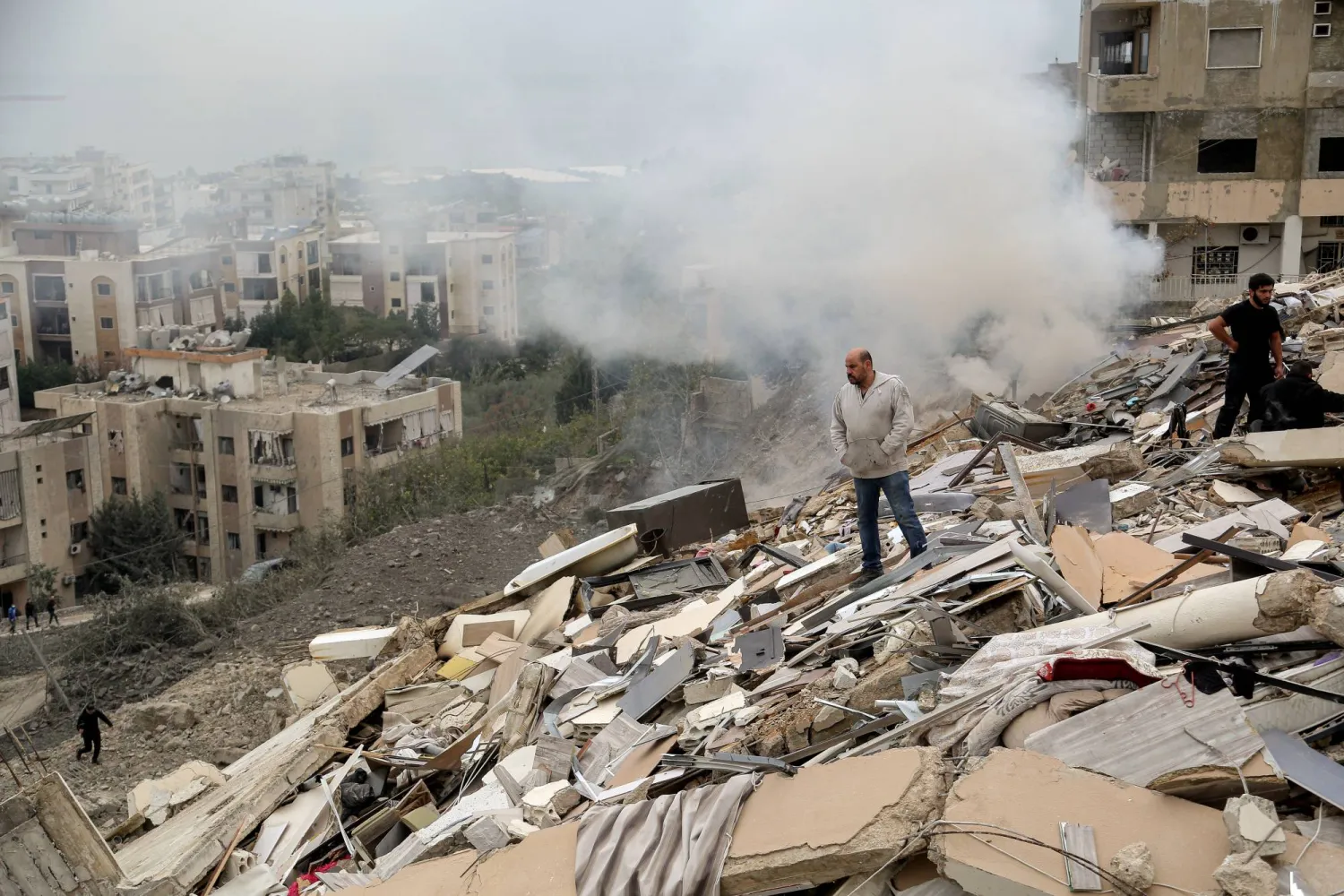



Lebanon Says Two Killed in Israeli Strike on Palestinian Refugee Camp

22 January 2026, Lebanon, Qnarit: People inspect the damage of a building that was destroyed by an Israeli air raid on the southern Lebanese village of Qnarit. (dpa)
TT

Lebanon Says Two Killed in Israeli Strike on Palestinian Refugee Camp

22 January 2026, Lebanon, Qnarit: People inspect the damage of a building that was destroyed by an Israeli air raid on the southern Lebanese village of Qnarit. (dpa)

Lebanon said an Israeli strike on the country's largest Palestinian refugee camp killed two people on Friday, with Israel's army saying it had targeted the Palestinian group Hamas. 

The official National News Agency said "an Israeli drone" targeted a neighborhood of the Ain al-Hilweh camp, which is located on the outskirts of the southern city of Sidon. 

Lebanon's health ministry said two people were killed in the raid. The NNA had earlier reported one dead and an unspecified number of wounded. 

An AFP correspondent saw smoke rising from a building in the densely populated camp as ambulances headed to the scene. 

The Israeli army said in a statement that its forces "struck a Hamas command center from which terrorists operated", calling activity there "a violation of the ceasefire understandings between Israel and Lebanon" and a threat to Israel. 

The Israeli military "is operating against the entrenchment" of the Palestinian group in Lebanon and will "continue to act decisively against Hamas terrorists wherever they operate", it added. 

Israel has kept up regular strikes on Lebanon despite a November 2024 ceasefire that sought to halt more than a year of hostilities with Hezbollah. 

Israel has also struck targets belonging to Hezbollah's Palestinian ally Hamas, including in a raid on Ain al-Hilweh last November that killed 13 people. 

The UN rights office had said 11 children were killed in that strike, which Israel said targeted a Hamas training compound, though the group denied it had military installations in Palestinian camps in Lebanon. 

In October 2023, Hezbollah began launching rockets at Israel in support of Hamas at the outset of the Gaza war, triggering hostilities that culminated in two months of all-out war between Israel and the Iran-backed Lebanese group. 

On Sunday, Lebanon said an Israeli strike near the Syrian border in the country's east killed four people, as Israel said it targeted operatives from Palestinian group Islamic Jihad. 


UN Says It Risks Halting Somalia Aid Due to Funding Cuts 

A Somali trader marks watermelons for sale at an open-air grocery market as Muslims start the fasting month of Ramadan, the holiest month in the Islamic calendar, within Bakara market in Mogadishu, Somalia, February 18, 2026. (Reuters)
TT

UN Says It Risks Halting Somalia Aid Due to Funding Cuts 

A Somali trader marks watermelons for sale at an open-air grocery market as Muslims start the fasting month of Ramadan, the holiest month in the Islamic calendar, within Bakara market in Mogadishu, Somalia, February 18, 2026. (Reuters)

The UN's World Food Program (WFP) warned Friday it would have to stop humanitarian assistance in Somalia by April if it did not receive new funding.

The Rome-based agency said it had already been forced to reduce the number of people receiving emergency food assistance from 2.2 million in early 2025 to just over 600,000 today.

"Without immediate funding, WFP will be forced to halt humanitarian assistance by April," it said in a statement.

In early January, the United States suspended aid to Somalia over reports of theft and government interference, following the destruction of a US-funded WFP warehouse in the capital Mogadishu's port.

The US announced a resumption of WFP food distribution on January 29.

However, all UN agencies have warned of serious funding shortfalls since Washington began slashing aid across the world following President Donald Trump's return to the White House last year.

"The situation is deteriorating at an alarming rate," said Ross Smith, WFP Director of Emergency Preparedness and Response, in Friday's statement.

"Families have lost everything, and many are already being pushed to the brink. Without immediate emergency food support, conditions will worsen quickly.

"We are at the cusp of a decisive moment; without urgent action, we may be unable to reach the most vulnerable in time, most of them women and children."

Some 4.4 million people in Somalia are facing crisis-levels of food insecurity, according to the WFP, the largest humanitarian agency in the country.

The Horn of Africa country has been plagued by conflict and also suffered two consecutive failed rainy seasons.


Hamas Says Path for Gaza Must Begin with End to ‘Aggression’ 

Makeshift tents of displaced Palestinian families among the ruins of their homes at sunset during the holy month of Ramadan in Jabaliya northern Gaza Strip on, 19 February 2026. (EPA)
TT

Hamas Says Path for Gaza Must Begin with End to ‘Aggression’ 

Makeshift tents of displaced Palestinian families among the ruins of their homes at sunset during the holy month of Ramadan in Jabaliya northern Gaza Strip on, 19 February 2026. (EPA)

Discussions on Gaza's future must begin with a total halt to Israeli "aggression", the Palestinian movement Hamas said after US President Donald Trump's Board of Peace met for the first time.

"Any political process or any arrangement under discussion concerning the Gaza Strip and the future of our Palestinian people must start with the total halt of aggression, the lifting of the blockade, and the guarantee of our people's legitimate national rights, first and foremost their right to freedom and self-determination," Hamas said in a statement Thursday.

Trump's board met for its inaugural session in Washington on Thursday, with a number of countries pledging money and personnel to rebuild the Palestinian territory, more than four months into a fragile ceasefire between Israel and Hamas.

Israeli Prime Minister Benjamin Netanyahu has insisted however that Hamas must disarm before any reconstruction begins.

"We agreed with our ally the US that there will be no reconstruction of Gaza before the demilitarization of Gaza," Netanyahu said.

The Israeli leader did not attend the Washington meeting but was represented by his foreign minister Gideon Saar.

Trump said several countries had pledged more than seven billion dollars to rebuild the territory.

Muslim-majority Indonesia will take a deputy commander role in a nascent International Stabilization Force, the unit's American chief Major General Jasper Jeffers said.

Trump, whose plan for Gaza was endorsed by the UN Security Council in November, also said five countries had committed to providing troops, including Morocco, Kazakhstan, Kosovo and Albania.