


Fierce Fighting in Northern Gaza, as Aid Starts to Roll off US-Built Pier

Smoke rises in northern Gaza, amid the ongoing conflict between Israel and the Palestinian group Hamas, as seen from Israel, May 17, 2024. (Reuters)
TT

Fierce Fighting in Northern Gaza, as Aid Starts to Roll off US-Built Pier

Smoke rises in northern Gaza, amid the ongoing conflict between Israel and the Palestinian group Hamas, as seen from Israel, May 17, 2024. (Reuters)

Israeli forces battled Hamas fighters in the narrow alleyways of Jabalia in northern Gaza on Friday in some of the fiercest engagements since they returned to the area a week ago, while in the south gunmen attacked tanks massing around Rafah.

Residents said Israeli armor had thrust as far as the market at the heart of Jabalia, the largest of Gaza's eight historic refugee camps, and that bulldozers were demolishing homes and shops in the path of the advance.

As fighting raged in the north and south of the territory, the US military said trucks had started moving aid ashore from a temporary pier built off Gaza.

"Israel's focus is Jabalia now, tanks and planes are wiping out residential districts and markets, shops, restaurants, everything. It is all happening before the one-eyed world," said Ayman Rajab, a resident of western Jabalia.

"Shame on the world. Meanwhile, the Americans are going to get us some food," Rajab, a father-of-four, told Reuters via a chat app. "We want no food, we want this war to end and then we can manage our lives on our own."

Israel had said its forces had cleared Jabalia months earlier in the Gaza war, triggered by the deadly Hamas-led attacks on southern Israel on Oct. 7, but said last week it was returning to prevent the group re-establishing itself there.

The fighting has coincided with an assault on Rafah at the southern edge of the strip bordering Egypt sending hundreds of thousands of people fleeing from both ends of the territory at once. Thick smoke could be seen rising over Rafah on Friday.

The aid being delivered via the floating pier, built by the US military in the Israel port of Ashdod and towed into place off Gaza this week, is the first to reach the besieged enclave by sea in weeks.

The United Nations said it was finalizing plans to distribute aid delivered via the route, through it reiterated that truck convoys by land - disrupted this month by the assault on Rafah - were the most efficient way of getting aid in.

"To stave off the horrors of famine, we must use the fastest and most obvious route to reach the people of Gaza – and for that, we need access by land now," deputy UN spokesperson Farhan Haq said.

HUMANITARIAN FEARS

The Israeli Defense Forces (IDF) said in a statement troops had killed more than 60 militants in recent days and located a weapons warehouse close to a shelter complex in what it described as a "divisional-level offensive" in Jabalia.

A divisional operation would typically involve multiple brigades of thousands of troops each, making it one of the biggest of the war.

"Even now, the soldiers are exchanging fire with terrorist cells in the area," the IDF said. "The 7th Brigade's fire control center directed dozens of airstrikes, eliminated terrorists and destroyed terrorist infrastructure."

At least 35,303 Palestinians have now been killed in the war, according to figures from the enclave's health ministry, while aid agencies have warned repeatedly of widespread hunger and the threat of disease.

Doctors complain they have to perform surgery, including amputations, with no anesthetics or painkillers as the medical system in the territory has virtually collapsed.

Israel says it must complete its objective of destroying Hamas for its own safety after the deaths of 1,200 people on Oct. 7, and to free the 128 hostages still held out of 253 abducted by the gunmen, according to its tallies.

To achieve that, it says it must capture Rafah, where around half of the territory's 2.3 million people had sought shelter from the fighting further north.

Israel's operation against Rafah, which began in early May but has yet to escalate to an all-out assault, has ignited one of the biggest rifts in generations with its main ally, the United States. Washington held up a weapons shipment over fears of civilian casualties.

Underlining concerns among other Western nations that have generally backed Israel, a letter seen by Reuters on Friday and signed by more than a dozen democracies, including all members of the G7 apart from the US, urged Israel to comply with international humanitarian law in Gaza.

'TRAGIC WAR'

Israeli tanks and warplanes bombarded parts of Rafah on Friday, while the armed wings of Hamas and Islamic Jihad said they were firing anti-tank missiles and mortars at forces massing to the east, southeast and inside the Rafah border crossing with Egypt.

The UNRWA, the main UN aid agency for Palestinians, said that since the military offensive on Rafah started on May 6, more than 630,000 people have been forced to flee Rafah.

"Many have sought refuge in Deir al-Balah, which is now unbearably overcrowded with dire conditions," it added. Deir al-Balah, up the coast from Rafah to the north, is the only other city in Gaza yet to be assaulted by Israeli forces.

At the International Court of Justice, or World Court, in The Hague, where South Africa has accused Israel of violating the Genocide Convention, Israeli Justice Ministry official Gilad Noam defended the operation.

Noam said Israel was fighting a war of self-defense and that the military operation in Rafah was not aimed at civilians but at dismantling the last Hamas stronghold.

"There is a tragic war going on, but there is no genocide" in Gaza, Noam said.

The South African legal team, which set out its case for fresh emergency measures the previous day, framed the Israeli military operation as part of a genocidal plan aimed at bringing about the destruction of the Palestinian people.

Israelis Mark Three Years Since October 7 as Palestinians Mourn Gaza’s Destruction

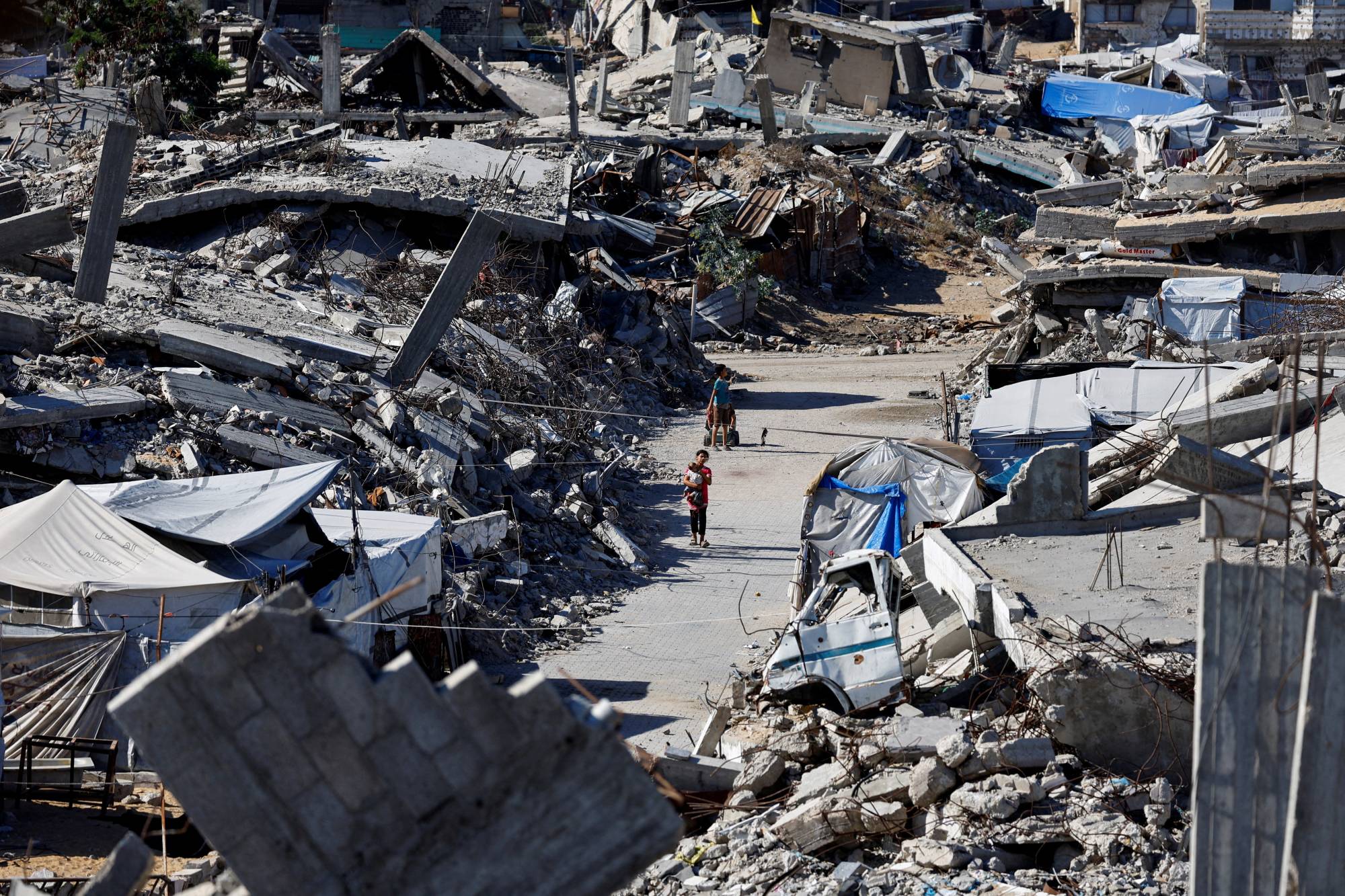
A Palestinian man works amid the rubble of a building damaged during the war, overlooking a makeshift tent camp at the Islamic University, in Gaza City, October 3, 2026. (Reuters)
TT

Israelis Mark Three Years Since October 7 as Palestinians Mourn Gaza’s Destruction

A Palestinian man works amid the rubble of a building damaged during the war, overlooking a makeshift tent camp at the Islamic University, in Gaza City, October 3, 2026. (Reuters)

Israelis gathered in silence on Wednesday in a kibbutz near the Gaza border that was overrun by Hamas on October 7 three years ago, mourning victims of attacks that set off Israel's assault in Gaza and plunged the Middle East into war.

In the Gaza Strip, devastated by three years of Israeli bombardment, Palestinians sheltering among the ruins of destroyed cities recalled life before a war that displaced nearly the entire population and tore apart families.

The attacks of October 7, 2023, were the deadliest day in Israel's history. Militants led by Hamas killed 1,200 people and took 251 hostages, a cross-border incursion that traumatized Israelis who have demanded government accountability.

Israel's subsequent bombardment and ground operations in Gaza have killed more than 74,000 people, including at least 1,400 killed in the past year since a US-brokered ceasefire, which halted major fighting but has failed to stop Israeli attacks or secure the disarmament of Hamas.

Palestinian children walk amid the rubble of buildings destroyed during the war in Gaza City, October 7, 2026. (Reuters)

'A ‌VERY DIFFICULT DAY'

In ‌Kfar Aza, where Hamas fighters killed dozens of Israelis before taking 19 hostages back into Gaza, ‌residents ⁠held a vigil for ⁠those killed, standing in silence as a trumpet played a solemn bugle call. A resident read out a roll call of the dead.

Zion Regev, a community leader in the kibbutz, said most residents remain displaced and have yet to return, the trauma of October 7 continuing to shape their lives.

"This is the first time we are doing all the things here in the kibbutz," Regev said of the vigil. "It's a very emotional day, it's a very difficult day for our community, three years after October 7th."

Elsewhere in Israel, protesters against what they view as a lack of accountability for the security failure gathered outside parliament in Jerusalem, blaming Prime Minister Benjamin Netanyahu for refusing an independent inquiry into the attack.

Some protesters held ⁠signs reading: "The people will remember October 7 on October 27," a reference to an Israeli general election ‌20 days away that is being viewed as a referendum on Netanyahu's long tenure ‌in power.

"We need the change and we need hope and we need to know that we have a government that cares about the public ‌and doesn't work also only for themselves," said protester Shaked Arrad.

Netanyahu has rejected blame for the security breach and resisted calls for an independent ‌investigation. That has frustrated many in Israel, including families of those killed in the attacks, some of whom have joined the election race.

In a statement released by his office, Netanyahu said: "The nation unites on this day in the longing for our dear ones."

Referring to his country's ongoing attacks in Gaza, he added: "We will complete the mission: we have settled the score and will continue settling the score with all the murderers."

Election polls show neither Netanyahu nor ‌his main competitors would muster enough seats in parliament to form a coalition if a vote were held today.

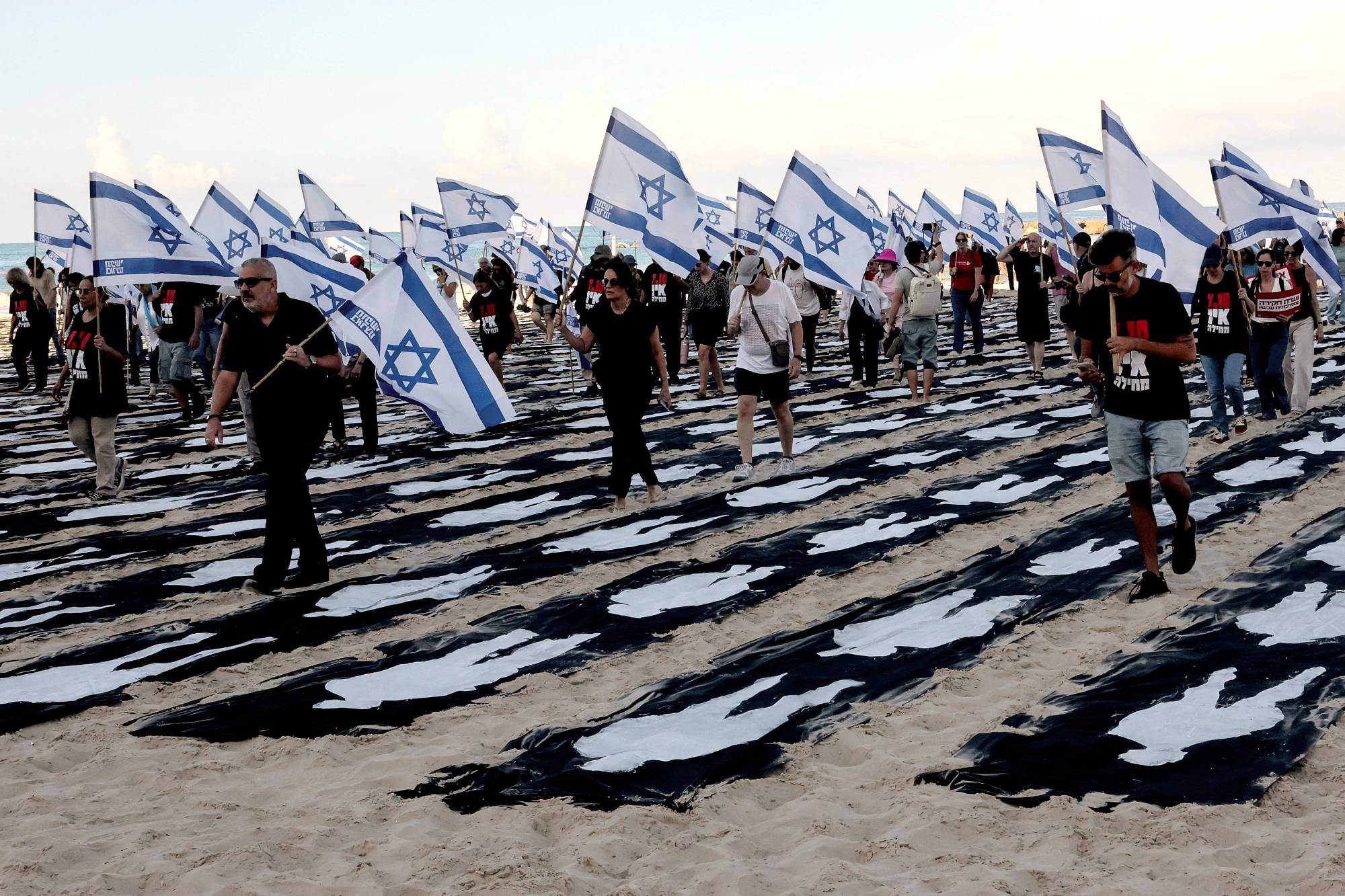
People carrying Israeli flags walk through a commemorative installation set up on the beach in Tel Aviv to mark the third anniversary of Hamas's October 7 attack on Israel, on October 7, 2026. (AFP)

DISPLACED GAZANS RECALL LIFE BEFORE ISRAELI ASSAULT

The anniversary is the first since the ⁠October 10, 2025, ceasefire deal, which has ⁠left Israel in control of around two-thirds of Gaza, where it has demolished remaining buildings and ordered residents out.

Hamas controls the remaining third of the territory, a narrow strip on the coast where the 2 million population mostly live in makeshift tents and bombed-out buildings.

In the latest violence, Gaza medics said on Wednesday Israel's military had carried out air strikes in Beit Lahia in northern Gaza and in Khan Younis in the south, killing at least two Palestinians and wounding others.

The Israeli military said it struck and killed two people it described as militants with Hamas, which did not immediately provide comment. The military did not provide comment on the strike in Khan Younis.

Umm Mohammad, a mother of five displaced from Gaza City and now living with her husband and children in a tent encampment in Deir Al-Balah, said the war had ripped her family apart.

"We were one happy family. The war displaced us. My son left Gaza, the other went to a separate tent, my daughters left with their husbands to other parts of the Strip and we rarely meet," she said.

On this day, she said, "we recall how happy, despite all problems, we were before the war broke out, destroying everything we loved."


Syria Says Northeast Pipeline Damaged in Sabotage Attack

Security forces in Syria. (SANA file)
TT

Syria Says Northeast Pipeline Damaged in Sabotage Attack

Security forces in Syria. (SANA file)

Syria's state petroleum company said on Wednesday that an oil pipeline in the country's northeast was damaged in a "sabotage attack", the third such incident in recent weeks.

Years of civil war before the fall of longtime ruler Bashar al-Assad in late 2024 devastated Syria's oil, gas and electricity sectors, with the country becoming heavily reliant on imports to meet its needs.

In a statement, the Syrian Petroleum Company said the pipeline near "the Tal Hamis area in Al-Hasakeh Governorate was subjected to a sabotage attack at 6:00 am on Wednesday, October 7, resulting in damage to the pipeline".

It added that maintenance crews were working to "isolate the damaged section and begin repair and maintenance work".

The company said authorities arrested the alleged perpetrators and referred them to the judiciary.

On September 29, sabotage targeting a gas pipeline in eastern Syria caused an explosion, according to state news agency SANA.

In early October, an explosion at a gas pipeline near the capital Damascus took three power stations offline.

The incidents come after demonstrations last month over rising fuel prices, which authorities linked to price hikes caused by the Middle East war.


IMF Announces Policy Advisory Program for War-Ravaged Yemen

An internally displaced Yemeni woman cooks a meal for her children at a makeshift camp for the internally displaced who fled their homes due to renewed clashes between Yemen's government forces and the Houthi militants in the northern Hajjah governorate on October 7, 2026. (AFP)
TT

IMF Announces Policy Advisory Program for War-Ravaged Yemen

An internally displaced Yemeni woman cooks a meal for her children at a makeshift camp for the internally displaced who fled their homes due to renewed clashes between Yemen's government forces and the Houthi militants in the northern Hajjah governorate on October 7, 2026. (AFP)

The International Monetary Fund said Wednesday it had approved an 18-month program to help war-ravaged Yemen achieve economic stabilization and strengthen its macroeconomic frameworks, even as its war rages on.

The IMF's "Staff-Monitored Program" offers technical assistance but does not have a financial component.

Yemen is among the poorest countries in the world and has been combatting a Houthi coup for years. The war has caused a humanitarian crisis that has left most of the population dependent on aid to survive.

The Iran-backed Houthis, who control most of northwest Yemen, captured swathes of coastal land from Yemen's pro-government forces in September after the war reignited in July.

The new fighting has displaced more than 200,000 people within the country, the United Nations said Wednesday. In total, the country has more than 5.2 million internally displaced people, with nearly two-thirds of the total population in need of humanitarian aid.

Yemen's legitimate government says it is aiming to retake all Houthi-controlled territory.

The IMF noted that Yemen's economic outlook was "challenging," after five straight years of contraction.

Real GDP contracted by 1.5 percent in 2026 "amid deteriorating terms of trade linked to the conflict in the Middle East, persistent energy shortages, and weak domestic demand," the Fund said in its statement.

The IMF noted that the country remained heavily dependent on remittances and donor assistance to finance its humanitarian-driven import bill.

The country's reserves are slated to remain below adequate levels, even with Saudi budgetary support.

The Fund said the new program aims to "strengthen public finances" in the next year, focusing on increasing domestic revenue mobilization and rationalizing government spending.

Even before the latest round of violence and displacement, Yemeni faced one of the most serious humanitarian crises in the world, according to the UN.

More than 18 million people nationwide face acute food insecurity, with around 2.2 million children under five classified as acutely malnourished, as per World Food Program figures.

The WFP warned on Friday of an "absolutely devastating" food crisis and said it needed $109 million to provide emergency food and nutrition assistance for up to 1.5 million people affected by the escalation.
