


Sudan Doctors’ Union: War Death Toll Tops 40,000

A displaced Sudanese child from Darfur receives treatment at a refugee hospital in eastern Chad. (EPA)
TT

Sudan Doctors’ Union: War Death Toll Tops 40,000

A displaced Sudanese child from Darfur receives treatment at a refugee hospital in eastern Chad. (EPA)

Over 40,000 people have died in Sudan’s ongoing conflict between the army and Rapid Support Forces (RSF) since April last year, according to Ahmed Abbas, spokesperson for the independent Sudan Doctors’ Union.

Abbas believes the actual number could be higher, as many deaths go unreported and bodies remain unaccounted for.

Accurate casualty counts are challenging, but UN and human rights estimates suggest around 12,000 deaths by late December.

Speaking to Asharq Al-Awsat, Abbas broke down the numbers: 20,000 killed in direct clashes, 16,000 due to lack of medical care and starvation, and around 4,000 in El Fasher, North Darfur.

A UN report from January estimated 10,000 to 15,000 deaths in Geneina, West Darfur.

Abbas described Sudan’s health system as “collapsed,” worsening with the rainy season and outbreaks of malaria, dengue, measles and other diseases.

He noted that “80% of health services are non-functional, and the rest lack essential supplies and medications amid ongoing water and electricity outages.”

The ongoing conflict in Sudan has completely destroyed 28 hospitals and health centers, and forced the evacuation of 22 medical facilities, some now occupied by warring forces, according to Abbas.

Abbas described the health situation in El Fasher and nearby areas as “extremely critical” due to a siege by the RSF. He warned that more civilians will die without urgent help.

Since fighting began in El Fasher in May, over 4,000 people have been killed and more than 5,000 injured, he revealed, adding that the actual toll is likely higher.

Last week, 13,000 civilians fled El Fasher due to violence, including killings, rapes, and looting. Abbas said the overall situation in Darfur is now worse than during the 2003 crisis, with a full-scale humanitarian disaster developing.

Abbas also reported hundreds of rapes of women and girls, noting that many survivors have not come forward due to fear, social stigma, or lack of treatment centers.

Salima Ishaq, director of Sudan's Combating Violence Against Women Unit, documented 191 cases of sexual violence since the war began, with the highest rates in RSF-controlled areas.

Abbas revealed that over 58 doctors have been killed in the conflict, with many others arrested, tortured, or interrogated.

Attacks on medical workers in conflict-ridden Sudan have forced some aid organizations to leave or stop operations in regions like Gezira and El Fasher, he added.

Médecins Sans Frontières (Doctors Without Borders) is among those affected.

The RSF has blocked humanitarian aid from reaching civilians in some areas under its control, while a d arriving via Port Sudan has not been distributed to those in need and instead ended up on the black market, Abbas added.

He called on the international and regional communities to coordinate aid distribution with medical organizations and local service committees, and to establish aid centers in neighboring countries to ensure help reaches those who need it most.


Asharq Al-Awsat Publishes Hamas Letter to Mediators as Cairo Meeting Looms

A Palestinian inspects the site of an Israeli strike in Khan Younis, southern Gaza Strip, Friday, May 29, 2026. (AP)
TT

Asharq Al-Awsat Publishes Hamas Letter to Mediators as Cairo Meeting Looms

A Palestinian inspects the site of an Israeli strike in Khan Younis, southern Gaza Strip, Friday, May 29, 2026. (AP)

Asharq Al-Awsat has obtained a document recently sent by Hamas to mediators regarding the ceasefire agreement in the Gaza Strip, where escalating Israeli violations have killed more than 930 Palestinians since the deal took effect on October 10.

Israel’s Channel 13 reported on Thursday evening, citing a regional diplomat who recently met Hamas leaders, that the Palestinian group would not accept disarmament and believed the United States would prevent Israel from carrying out any major military action in Gaza.

The report said Hamas had grown stronger, gained confidence, and was tightening its control over the enclave, especially after the withdrawal of Israeli forces.

A senior Hamas source told Asharq Al-Awsat that the reports were completely baseless.

The source said the movement had recently sent mediators a document on Israeli violations and its position on the political deadlock, in light of the negative stance of Prime Minister Benjamin Netanyahu’s government toward recent proposals by the mediators, as well as the roadmap put forward by the Board of Peace through its High Representative for Gaza, Nickolay Mladenov.

They also said Hamas had not recently held meetings with diplomatic officials in the region, apart from meetings held as part of negotiation rounds, with the participation of Mladenov and figures representing the US administration and the Board of Peace.

The source said the negotiation round, expected to take place before Eid al-Adha, had been postponed until after the holiday that started on Wednesday.

They said no specific date had been set for the round, but a delegation from the movement’s leadership was preparing to visit Cairo at Egypt’s invitation in the coming days, once the necessary arrangements were completed.

The source said messages of protest had been sent in the past period over Israel's continued escalation in killings and the targeting of people, adding that there had been no new positions.

Hamas sent the document to mediators in Egypt and sent copies to Qatar and Türkiye. Through those countries, it was relayed to other parties, including the Board of Peace and the US administration.

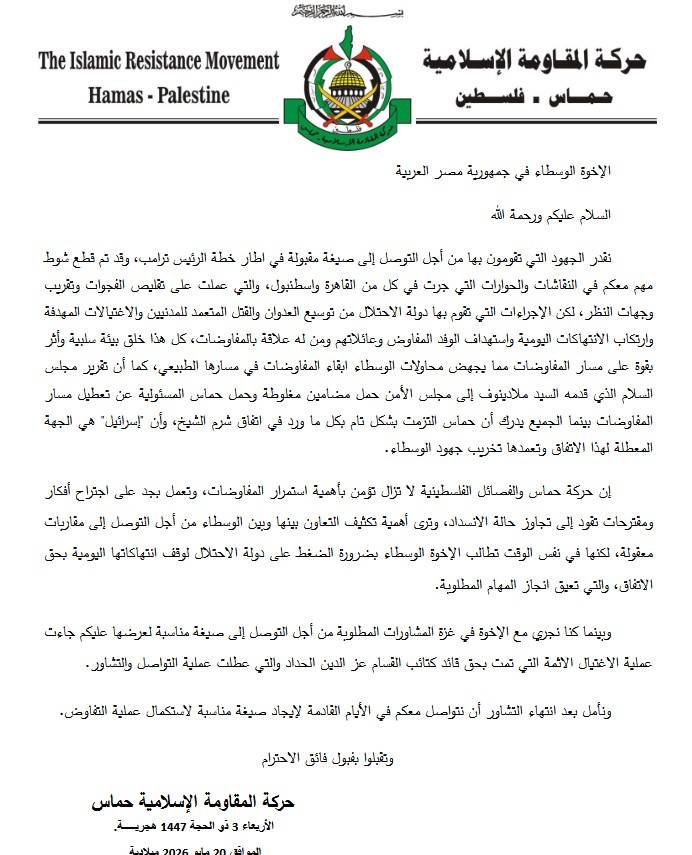
The Hamas document obtained by Asharq Al-Awsat.

The message

At the beginning of the document, dated May 20, Hamas referred to efforts made by mediators to bridge differences during the latest negotiation rounds in Cairo and Istanbul, which it said had succeeded in narrowing gaps.

The document said Israel’s measures, the expansion of its aggression, assassinations, and the targeting of Palestinians, the negotiating delegation, their families, and those connected to the negotiations had created a negative environment and strongly affected the course of talks, undermining mediators’ efforts to keep negotiations on their normal track.

The document criticized Mladenov’s recent briefing to the UN Security Council, saying it contained inaccurate points and held Hamas responsible for obstructing the negotiation process.

It said everyone knew the movement was fully committed to all provisions of the Sharm el-Sheikh agreement and that Israel was the party obstructing the deal and deliberately sabotaging mediators’ efforts.

The document affirmed Hamas and the Palestinian factions' commitment to the negotiation track and its importance. It said they were working seriously to develop ideas to help overcome the deadlock and saw the need to intensify cooperation with mediators to reach reasonable approaches.

Hamas urged mediators to pressure Israel to stop its daily violations of the agreement, which were obstructing the completion of the required tasks.

The document said that while consultations were underway to reach a suitable formula to present to mediators, Israel assassinated Ezzedine al-Haddad, the commander of the Qassam Brigades, Hamas’ armed wing. It said the killing disrupted communication and consultation.

Hamas hoped that once consultations were completed, it would communicate with mediators in the coming days to find a suitable formula to resume the negotiation process.

More than a month ago, Asharq Al-Awsat revealed the full details of the proposal, which was classified as a roadmap and aimed to complete what remained of the first phase while negotiating the provisions of the second phase.

Conditions set by Hamas and Israel obstructed the implementation of the roadmap. The two sides exchanged responses through mediators amid attempts to bridge their differences, and progress was later made.

But Netanyahu’s government’s demand to obtain a signed document on disarming Gaza before moving ahead with any steps stalled progress on the agreement again, especially as Israel also refrained from allowing the Gaza administration committee to enter the enclave and assume its duties.


Eleven Children Killed, Injured Every 24 Hours in Lebanon, UN Says

 Rubble lies around damaged building at the site of an Israeli strike in Tyre, Lebanon, May 28, 2026. (Reuters)
Rubble lies around damaged building at the site of an Israeli strike in Tyre, Lebanon, May 28, 2026. (Reuters)
TT

Eleven Children Killed, Injured Every 24 Hours in Lebanon, UN Says

 Rubble lies around damaged building at the site of an Israeli strike in Tyre, Lebanon, May 28, 2026. (Reuters)
Rubble lies around damaged building at the site of an Israeli strike in Tyre, Lebanon, May 28, 2026. (Reuters)

Eleven children have been killed or injured on average every 24 hours in Lebanon over the last week, the UN's children's agency said on Friday, as Israel has expanded strikes across the country despite a ceasefire.

Heavy Israeli strikes hit towns and villages in southern Lebanon overnight on Wednesday and into ‌Thursday, after Israel declared ‌a new swathe of the ‌area ⁠a combat zone. ⁠It also struck a building in the southern suburbs of Beirut on Thursday.

A total of 77 children have been killed or injured in the last seven days, UNICEF said, citing figures provided by Lebanon's Ministry of Public ⁠Health. Since the ceasefire began on April ‌16, 55 children ‌have been killed and 212 injured, according to the ‌agency.

UNICEF spokesperson Ricardo Pires called for all ‌parties to fully respect the ceasefire.

"Under international humanitarian law, children and civilian infrastructure must be protected," he said.

The ceasefire announced by Washington was meant to ‌halt the fighting that has raged between Israeli troops and Iran-backed Hezbollah since ⁠March 2.

The ⁠UN's World Health Organization also said on Friday that the threat from the expansion of military activities raised grave health concerns for the Lebanese population.

Since the ceasefire took effect, a total of 27 attacks on healthcare facilities in Lebanon have been reported, resulting in 25 deaths and 42 injuries, according to the WHO. A total of 16 hospitals and 13 primary healthcare centers have been damaged in attacks, it added.


Israel Plan to Seize More of Gaza Means ‘More Children Will Suffer’, Says UN

 Palestinian women inspect the rubble of a building destroyed in an Israeli airstrike in Deir al-Balah, in the central Gaza Strip, Friday, May 29, 2026. (AP)
Palestinian women inspect the rubble of a building destroyed in an Israeli airstrike in Deir al-Balah, in the central Gaza Strip, Friday, May 29, 2026. (AP)
TT

Israel Plan to Seize More of Gaza Means ‘More Children Will Suffer’, Says UN

 Palestinian women inspect the rubble of a building destroyed in an Israeli airstrike in Deir al-Balah, in the central Gaza Strip, Friday, May 29, 2026. (AP)
Palestinian women inspect the rubble of a building destroyed in an Israeli airstrike in Deir al-Balah, in the central Gaza Strip, Friday, May 29, 2026. (AP)

The UN warned on Friday that an Israeli plan to take control of 70 percent of Gaza is sure to increase suffering among children already hit by the impacts of severe overcrowding.

Israeli Prime Minister Benjamin Netanyahu said on Thursday that he had ordered the military to take control of more territory in the Gaza Strip, in defiance of the terms of a fragile ceasefire that took effect in October.

He said the military had controlled 50 percent of the territory under the terms of the ceasefire, then advanced to take over 60 percent.

"My directive is to move to... 70 percent," he said.

But the United Nations children's agency warned that such a move would deepen the health crisis among children in the war-ravaged Palestinian territory, already suffering from a lack of food, water and access to hygiene.

Even before Hamas's October 7, 2023 attacks on Israel triggered the war in Gaza, it was "already one of the most densely populated places in the world", UNICEF spokesman Salim Oweis told reporters in Geneva, speaking from Gaza.

Today, "people have been crammed into around 40 percent of the space left to them, sheltering among broken buildings, rubble and mounting solid waste", he said, adding "there is no accessible space left to clear" the waste.

"The effects of this are now widely apparent: children with respiratory infections, acute watery diarrhea, and more than half of all households reporting skin diseases."

- Rats biting children -

"Fleas, lice and scabies are commonplace," Oweis said, also pointing to numerous cases of rats biting young children and even babies after getting into tents and other shelters for Gaza's hundreds of thousands of displaced people.

Oweis told the story of a woman named Hind, who "hasn't slept since her four-year-old daughter, Masa, was bitten by a rat during the night".

"Like many families, they sheltered wherever they could, in their case, the second floor of a building block where sewage water leaks through the ceilings, and rodents crawl through the cracks in the building and climb the exposed pipes," he said.

"Increasing numbers of children are requiring hospitalization, all without a single fully functioning hospital across Gaza."

Oweis described the situation as "dire", noting the overcrowding was "creating more spread of diseases, straining the systems and of course cutting... services".

If Israel takes control of even more land, that "means that we will lose access to some of the service points, but also (to) some hard to reach places (where) children and families are living," he said.

"This will just mean that more children will suffer.

"Honestly, we can't afford that at the moment."

Despite an October 10 ceasefire, Gaza remains gripped by daily violence.

Israel has killed more than 900 people in the territory since the ceasefire, according to Gaza's health ministry, which operates under Hamas authority and whose figures are considered reliable by the United Nations.
