


Asharq Al-Awsat Publishes Hamas Letter to Mediators as Cairo Meeting Looms

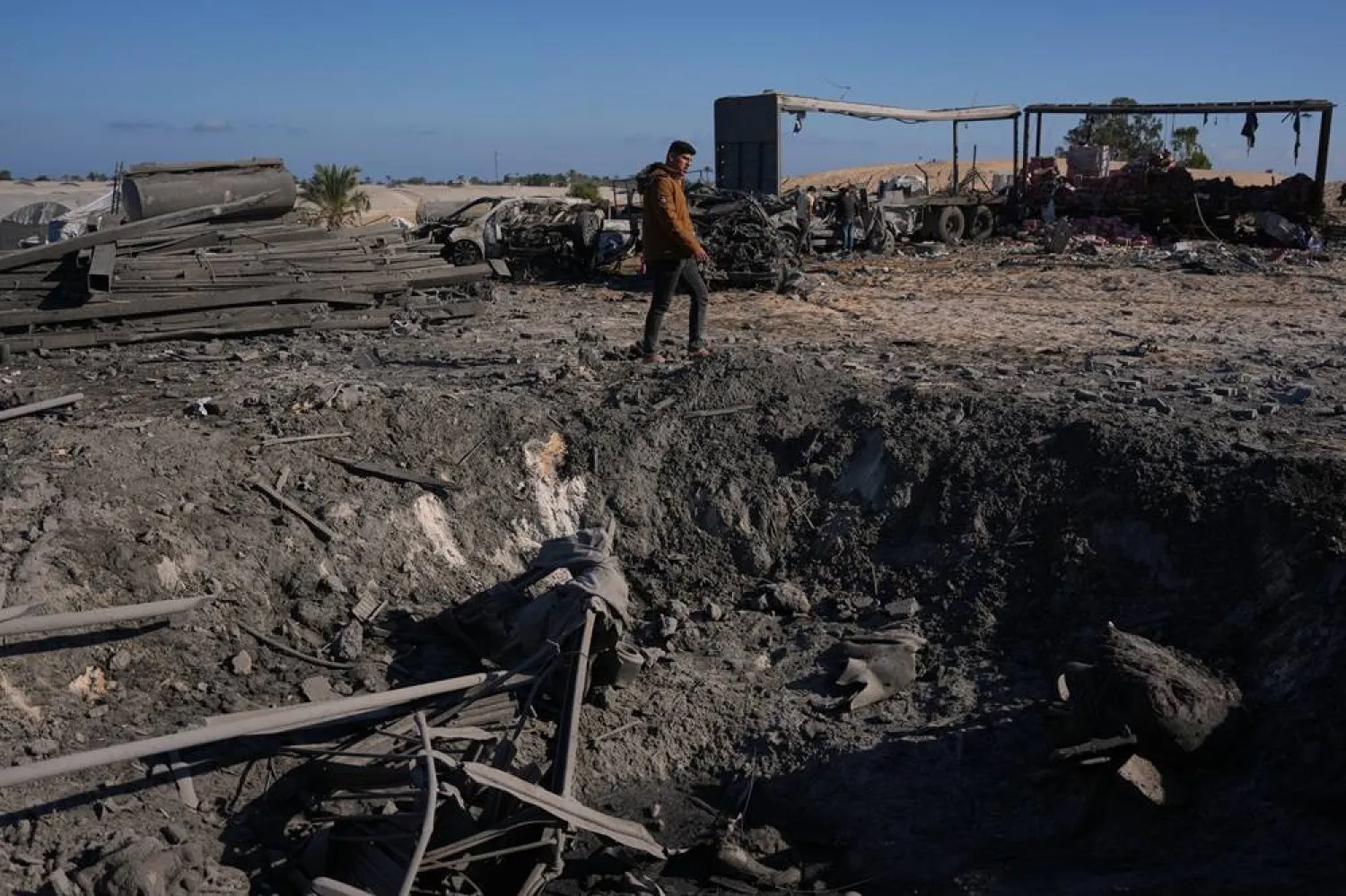
A Palestinian inspects the site of an Israeli strike in Khan Younis, southern Gaza Strip, Friday, May 29, 2026. (AP)
TT

Asharq Al-Awsat Publishes Hamas Letter to Mediators as Cairo Meeting Looms

A Palestinian inspects the site of an Israeli strike in Khan Younis, southern Gaza Strip, Friday, May 29, 2026. (AP)

Asharq Al-Awsat has obtained a document recently sent by Hamas to mediators regarding the ceasefire agreement in the Gaza Strip, where escalating Israeli violations have killed more than 930 Palestinians since the deal took effect on October 10.

Israel’s Channel 13 reported on Thursday evening, citing a regional diplomat who recently met Hamas leaders, that the Palestinian group would not accept disarmament and believed the United States would prevent Israel from carrying out any major military action in Gaza.

The report said Hamas had grown stronger, gained confidence, and was tightening its control over the enclave, especially after the withdrawal of Israeli forces.

A senior Hamas source told Asharq Al-Awsat that the reports were completely baseless.

The source said the movement had recently sent mediators a document on Israeli violations and its position on the political deadlock, in light of the negative stance of Prime Minister Benjamin Netanyahu’s government toward recent proposals by the mediators, as well as the roadmap put forward by the Board of Peace through its High Representative for Gaza, Nickolay Mladenov.

They also said Hamas had not recently held meetings with diplomatic officials in the region, apart from meetings held as part of negotiation rounds, with the participation of Mladenov and figures representing the US administration and the Board of Peace.

The source said the negotiation round, expected to take place before Eid al-Adha, had been postponed until after the holiday that started on Wednesday.

They said no specific date had been set for the round, but a delegation from the movement’s leadership was preparing to visit Cairo at Egypt’s invitation in the coming days, once the necessary arrangements were completed.

The source said messages of protest had been sent in the past period over Israel's continued escalation in killings and the targeting of people, adding that there had been no new positions.

Hamas sent the document to mediators in Egypt and sent copies to Qatar and Türkiye. Through those countries, it was relayed to other parties, including the Board of Peace and the US administration.
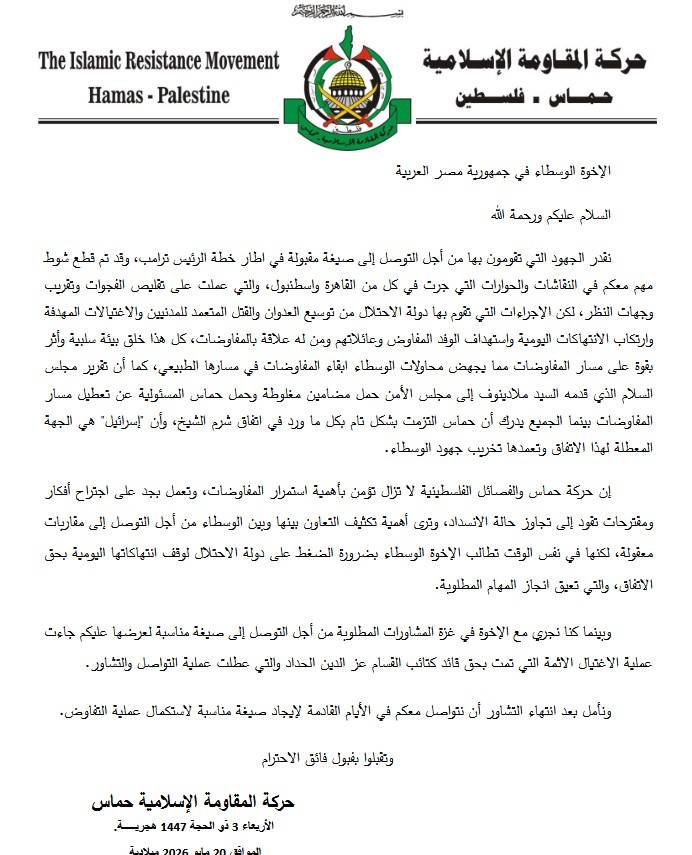
The Hamas document obtained by Asharq Al-Awsat.

The message

At the beginning of the document, dated May 20, Hamas referred to efforts made by mediators to bridge differences during the latest negotiation rounds in Cairo and Istanbul, which it said had succeeded in narrowing gaps.

The document said Israel’s measures, the expansion of its aggression, assassinations, and the targeting of Palestinians, the negotiating delegation, their families, and those connected to the negotiations had created a negative environment and strongly affected the course of talks, undermining mediators’ efforts to keep negotiations on their normal track.

The document criticized Mladenov’s recent briefing to the UN Security Council, saying it contained inaccurate points and held Hamas responsible for obstructing the negotiation process.

It said everyone knew the movement was fully committed to all provisions of the Sharm el-Sheikh agreement and that Israel was the party obstructing the deal and deliberately sabotaging mediators’ efforts.

The document affirmed Hamas and the Palestinian factions' commitment to the negotiation track and its importance. It said they were working seriously to develop ideas to help overcome the deadlock and saw the need to intensify cooperation with mediators to reach reasonable approaches.

Hamas urged mediators to pressure Israel to stop its daily violations of the agreement, which were obstructing the completion of the required tasks.

The document said that while consultations were underway to reach a suitable formula to present to mediators, Israel assassinated Ezzedine al-Haddad, the commander of the Qassam Brigades, Hamas’ armed wing. It said the killing disrupted communication and consultation.

Hamas hoped that once consultations were completed, it would communicate with mediators in the coming days to find a suitable formula to resume the negotiation process.

More than a month ago, Asharq Al-Awsat revealed the full details of the proposal, which was classified as a roadmap and aimed to complete what remained of the first phase while negotiating the provisions of the second phase.

Conditions set by Hamas and Israel obstructed the implementation of the roadmap. The two sides exchanged responses through mediators amid attempts to bridge their differences, and progress was later made.

But Netanyahu’s government’s demand to obtain a signed document on disarming Gaza before moving ahead with any steps stalled progress on the agreement again, especially as Israel also refrained from allowing the Gaza administration committee to enter the enclave and assume its duties.



Macron Seeks New Int’l Force for South Lebanon After UNIFIL Mandate Ends

This picture taken from a position in northern Israel, near the border with Lebanon shows a United Nations Interim Force in Lebanon (UNIFIL) armored vehicle driving past destroyed buildings in southern Lebanon on June 22, 2026. (AFP)
TT

Macron Seeks New Int’l Force for South Lebanon After UNIFIL Mandate Ends

This picture taken from a position in northern Israel, near the border with Lebanon shows a United Nations Interim Force in Lebanon (UNIFIL) armored vehicle driving past destroyed buildings in southern Lebanon on June 22, 2026. (AFP)

French President Emmanuel Macron pressed ahead with efforts to shape a new international force for southern Lebanon after the mandate of the United Nations Interim Force in Lebanon (UNIFIL) expires at the end of this year.

Macron spoke by phone on Tuesday with Lebanese President Joseph Aoun and Prime Minister Nawaf Salam, discussing developments in Lebanon and the region in light of the US-Iran negotiations in Switzerland. They also tackled the situation in southern Lebanon amid the ceasefire between Israel and Hezbollah, the future of international forces operating in the south, and international efforts to support Lebanon.

In his call with Aoun, talks focused on “the situation in the south and the next steps after the announcement of the ceasefire.”

They reviewed the outcome of last week’s G7 summit in the French city of Evian, according to a statement from the Lebanese presidency. Aoun thanked Macron for the position issued by the summit on Lebanon.

UNIFIL’s future took up a central part of the discussion. The two leaders examined the period after its mission ends, especially given the willingness of several European countries, with Lebanon’s backing, to keep forces inside the international area of operations.

Macron told Aoun he would contact several countries to clarify their positions, particularly as UNIFIL’s withdrawal from Lebanon is set to begin at the start of 2027.

The call also covered Lebanese-Syrian relations and coordination between the two countries. Aoun welcomed remarks by Syrian President Ahmed al-Sharaa in his latest television interview, in which he stressed Syria’s commitment to Lebanon’s sovereignty, independence and territorial integrity.

Sharaa said Syria did not intend to intervene militarily in Lebanon, despite comments by US President Donald Trump.

France's President Emmanuel Macron, left, and Lebanon's Prime Minister Nawaf Salam visit the Vivatech fair in Paris, Thursday, June 18, 2026. (AP)

Sharaa stressed that any Syrian role would go exclusively through the Lebanese state and not through other parties, and that Damascus wanted to bolster Lebanon’s stability and strengthen its official institutions.

During Macron’s call with Salam, the two leaders “continued discussions on the results of Salam’s recent visit to Paris, as well as an assessment of the negotiations that began in Switzerland and their repercussions for the region and Lebanon.”

They discussed efforts to secure the necessary conditions for two planned conferences, one to support the army and security forces and another to support reconstruction in wake of the war between Israel and Hezbollah.

The calls come as the future of the international forces in southern Lebanon emerges as one of the most prominent issues under global discussion. At the G7 summit, leaders devoted a significant part of their talks to Lebanon, focusing on the need to find an alternative to UNIFIL once its mandate ends.

According to diplomatic information, discussions are moving toward the creation of a multinational force in which France and other European countries, including Germany, Spain and Italy, have shown readiness to participate.

Its core mission would be to support and train the Lebanese army, equipping it with the capabilities needed to expand its deployment and extend state authority, thereby reinforcing stability and implementing security arrangements in southern Lebanon.


Egypt-Syria Meetings Give Rapprochement New Momentum

Egyptian Foreign Minister Badr Abdelatty and Syrian Foreign Minister Asaad al-Shaibani meet in Jordan on Monday evening. (Egyptian Foreign Ministry)
TT

Egypt-Syria Meetings Give Rapprochement New Momentum

Egyptian Foreign Minister Badr Abdelatty and Syrian Foreign Minister Asaad al-Shaibani meet in Jordan on Monday evening. (Egyptian Foreign Ministry)

A series of recent meetings between Egyptian and Syrian officials has given momentum to rapprochement between the two countries, observers said, particularly after a dispute over Syria’s diplomatic mission in Cairo was resolved.

Egyptian Foreign Minister Badr Abdelatty met his Syrian counterpart Asaad al-Shaibani on Monday on the sidelines of an Arab League meeting in the Jordanian capital, Amman.

In a statement on Tuesday, Egypt’s foreign ministry said the two ministers had affirmed “the depth of the historic ties between Egypt and Syria ... and the importance of building on the visit made by the Syrian foreign minister to Cairo in early May.”

They welcomed plans to hold the second Egyptian-Syrian government meeting at the senior official level, with ministries and agencies responsible for trade and investment in both countries participating, to discuss practical steps to boost economic cooperation.

“Relations with Egypt are moving along their natural path, and Syria is keen to develop them,” Mohammad Taha al-Ahmad, Director of the Arab and Regional Affairs Department at Syria’s foreign ministry, told Asharq Al-Awsat.

The two countries had held talks in recent weeks after Egypt raised reservations over names proposed by Syria to represent its diplomatic mission in Cairo, delaying arrangements for the mission’s arrival.

The issue was resolved after Syria put forward another nominee, Yahya Diab, to lead its mission in Egypt.

Amr al-Shobaki, an Egyptian political analyst at Al-Ahram Center for Political and Strategic Studies, said regional challenges made it necessary to develop Egyptian-Syrian ties.

He said cultural, social and political links between the two peoples were strong, adding that Egyptian authorities “had concerns more than disagreements with the new governing system in Syria, given Egypt’s well-known experience with political Islam.”

“Those concerns are being gradually overcome according to two basic principles: respect for each country’s experience and political model, and non-interference in the affairs of the other,” he added. He said Egypt had already established those principles in its relationship with Türkiye.

“The successive Egyptian-Syrian meetings point to an improvement in relations according to the same two principles,” he said.

In late April, Egyptian President Abdel Fattah al-Sisi met his Syrian counterpart Ahmed al-Sharaa on the sidelines of the Arab-European Consultative Summit held in Cyprus.

Media outlets in Cairo and Damascus said at the time that the two had held “friendly” discussions on regional developments and ways to strengthen cooperation.

Damascus hosted the first Egyptian-Syrian economic and investment forum in January, with the participation of leaders and business figures from the Egyptian Chamber of Commerce. The forum aimed to build active partnerships between the two countries and explore cooperation in trade, industry, services, infrastructure and reconstruction.


Seven European Countries Urge ‘Immediate Halt’ to Sudan Violence

People fill water containers at a free distribution point amid water outages in Khartoum, Sudan, May 18, 2026. (AP)
TT

Seven European Countries Urge ‘Immediate Halt’ to Sudan Violence

People fill water containers at a free distribution point amid water outages in Khartoum, Sudan, May 18, 2026. (AP)

Britain and six European allies Tuesday called for an immediate halt to violence targeting the Sudanese city of El-Obeid encircled by paramilitary forces, a statement issued by the UK Foreign Office said.

"There are now credible signs of an imminent offensive. This is a critical moment, and the international community must act," a joint statement signed by Britain, France, Germany, Ireland, Italy, the Netherlands and Norway said.

"We call on the RSF (Rapid Support Forces) to halt its attack immediately," it added.

The joint statement said repeated drone strikes over recent weeks had "killed civilians and driven acute shortages of fuel, food and water" with aid workers providing life-saving assistance also being "deliberately targeted".

"Civilians must be able to leave safely, and all parties must ensure rapid, safe and unhindered humanitarian access," the statement said.

Those attacking the city and their allies should "de-escalate, uphold international humanitarian law", it added.

UK Foreign Minister Yvette Cooper said there must not be a repeat of atrocities seen in the city of al-Fashir in 2025.

"Last year, the world watched in horror as the Rapid Support Forces raped, pillaged, and murdered their way through al-Fashir - leaving nothing but devastation and death in their wake. This cannot be repeated.

"El-Obeid is on the precipice of an atrocity that will deepen the wounds already inflicted on Sudan in El Fasher," she said in a statement.

The United States on Monday warned of the danger of "mass atrocities" in El-Obeid.

The city, in the Kordofan region of Sudan has been under siege for several months by RSF, which has been at war with the regular army since April 2023.

The UN Security Council on Saturday expressed the same concerns and called on paramilitary forces encircling El-Obeid to back down.

The conflict in Sudan has killed tens of thousands of people and forced more than 11 million from their homes, creating what the UN describes as the world's largest displacement and hunger crises.