Yemen Accuses Iran’s Revolutionary Guard of Managing Houthi Military, Security Units

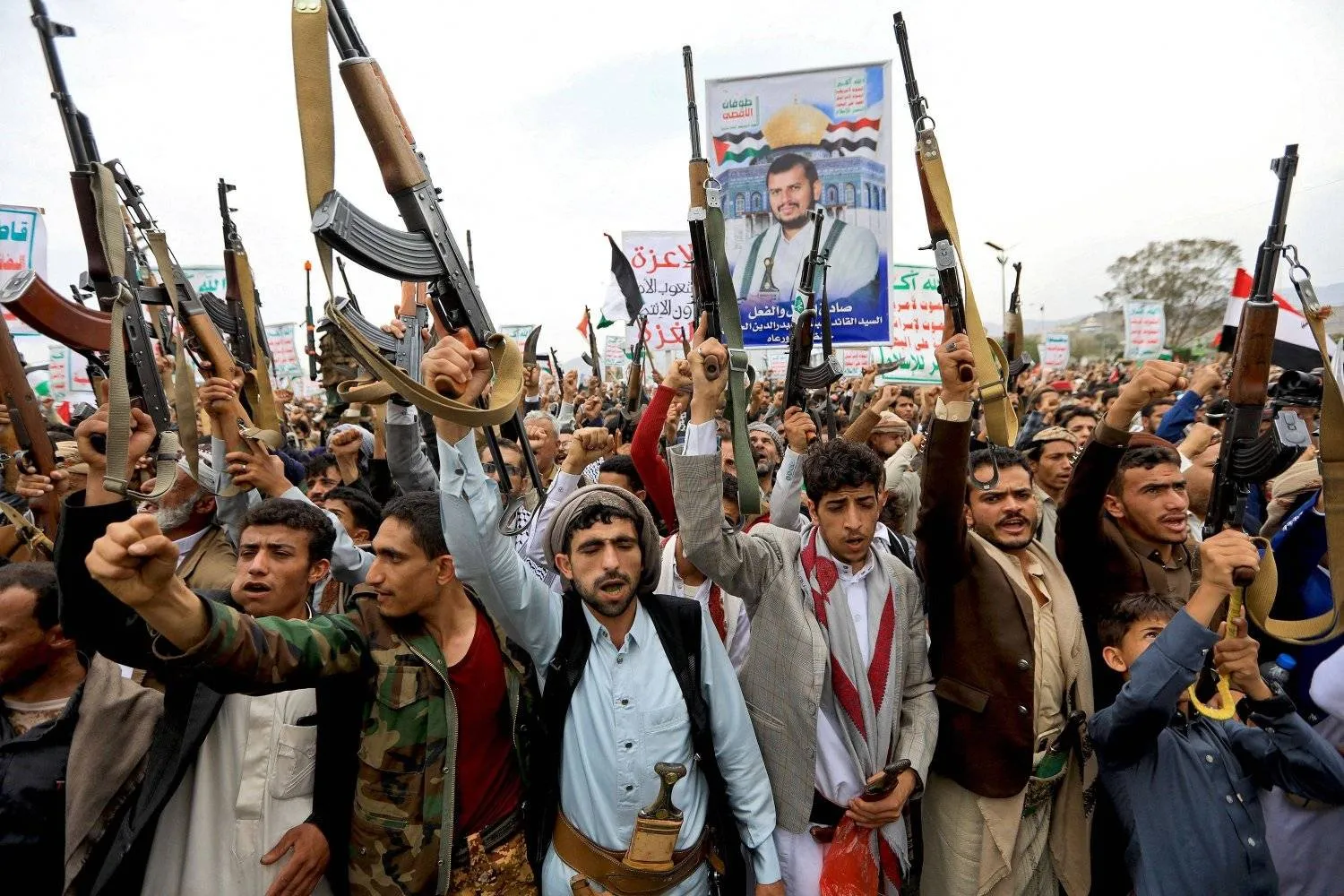
The Houthis exploited the war in Gaza to recruit tens of thousands of fighters (AFP)
TT

Yemen Accuses Iran’s Revolutionary Guard of Managing Houthi Military, Security Units

The Houthis exploited the war in Gaza to recruit tens of thousands of fighters (AFP)

Sources familiar with the situation in the Houthi-run Yemeni capital, Sanaa, report that Iranian Revolutionary Guard representatives have strengthened their control over all Houthi military and intelligence units, now exercising authority over all decisions.
Concurrently, they are forming sectarian-aligned combat units similar to those found in Iran.
Speaking to Asharq Al-Awsat under conditions of anonymity, the sources clarified that recent arrest operations by Houthis were supervised by Revolutionary Guard elements.
The recent wave of arrests targeted numerous UN and international humanitarian staff, along with former US embassy employees.
It also marked the first time that members from the Houthi group itself were included.
Sources indicate a purge within Houthi intelligence, known as the “Security and Intelligence Apparatus,” and the internal “Preventive Security,” aiming to remove disloyal or ideologically questionable individuals from key administrative, security, and military positions, even within the Houthi ranks.
During the takeover of Sanaa, Houthis enlisted non-ideological personnel who had previously worked in government institutions or local and international organizations.
However, sources confirm that their role is now obsolete.
According to sources, some Houthi members who had served the insurgency for years are now being excluded.
Reasons cited include not being from Saada province or being deemed disloyal to Abdul-Malik al-Houthi’s leadership or suspicious of their sectarian beliefs.
Yemeni sources also revealed that Iranian Revolutionary Guard units, who previously controlled military operations, especially regarding ballistic missiles and drone production facilities, have recently expanded their influence to dominate the entire Houthi security scene.
These units allegedly exploited the Israeli conflict in Gaza to instruct the Houthis to recruit thousands of teenagers from summer camps and sectarian schools, along with graduates of cultural programs.
They were misled into believing they were being trained to fight in Palestine.
According to sources, the purpose of this operation is to create military units modeled after Iran’s Revolutionary Guard. These units would swear absolute loyalty to the Houthi leader, viewing him as the chosen ruler by divine mandate.



Parliamentary Elections Preparations Kick off in Lebanon Despite Doubts They Will Be Held

Head of the Lebanese Forces Samir Geagea announces the launch of its electoral campaign in Bcharre. (National News Agency)
TT

Parliamentary Elections Preparations Kick off in Lebanon Despite Doubts They Will Be Held

Head of the Lebanese Forces Samir Geagea announces the launch of its electoral campaign in Bcharre. (National News Agency)

Political forces in Lebanon have kicked off their preparations for the upcoming parliamentary elections in May despite doubts that they may not be held. No more than ten candidates have so far submitted their nominations as the political powers work on postponing the elections while still preparing to run in them.

Shiite duo

Parliament Speaker Nabih Berri has repeatedly said that the elections will be held on time.

He received on Friday a delegation from Hezbollah’s Loyalty to the Resistance bloc headed by MP Mohammed Raad. Talks focused on political developments and the elections.

Berri’s Amal movement and Hezbollah are allies that form the so-called “Shiite duo”.

Following the meeting, Raad said both sides share the same views and that their alliance still stands.

“Together, they will form national unity against all challenges,” he declared. “We will run in the elections together.”

It remains to be seen what other alliances the Shiite duo will manage to forge.

The Free Patriotic Movement (FPM), headed by MP Jebran Bassil, had previously ended its alliance with Hezbollah, but reports have said the two sides may hold negotiations related to the elections.

Geagea: Elections are critical

Samir Geagea’s Lebanese Forces launched on Friday the party’s electoral campaign from Bcharre, announcing the nomination of MP Setrida Tawk Geagea and former MP Joseph Ishak, who will both run in the province.

More candidates will be announced within a week, leading LF sources told Asharq Al-Awsat.

Samir Geagea described the elections as a “pivotal juncture in reclaiming the state and consolidating its sovereignty,” calling for a large turnout.

Sources from the LF acknowledged that the elections may be postponed, but until that happens, the party will operate as though they are going to be held on time.

The FPM had last week cited “negative” signals that may impede the elections given the ongoing dispute over the voting of expatriates and other differences.

The LF sources told Asharq Al-Awsat that preparations for the elections are taking place “on all levels” and “covering all of their aspects.”

The remaining candidates will be announced within days, they revealed.

“For us, the main question is why and how will the current parliament’s term be extended and who will dare to even suggest it?” they said.

“We are therefore convinced that the elections will be held. We are making our preparations based on the firm conviction that the elections need to be held. There really is no reason to delay them, and we will stand against anyone who tries to do so,” they added.

The Interior Ministry had announced that candidates have between February 10 and March 10 to submit their nominations.


US Makes Plans to Reopen Embassy in Syria after 14 Years

This handout picture released by the Syrian Presidency's Telegram page, shows Syria's President Ahmed al-Sharaa (R) shaking hands with US envoy Tom Barrack at the Presidential Palace in Damascus on January 18, 2026. (Photo by Handout / Syrian Presidency Telegram Page / AFP)
TT

US Makes Plans to Reopen Embassy in Syria after 14 Years

This handout picture released by the Syrian Presidency's Telegram page, shows Syria's President Ahmed al-Sharaa (R) shaking hands with US envoy Tom Barrack at the Presidential Palace in Damascus on January 18, 2026. (Photo by Handout / Syrian Presidency Telegram Page / AFP)

The Trump administration has informed Congress that it intends to proceed with planning for a potential re-opening of the US Embassy in Damascus, Syria, which was shuttered in 2012 during the country’s civil war.

A notice to congressional committees earlier this month, which was obtained by The Associated Press, informed lawmakers of the State Department’s “intent to implement a phased approach to potentially resume embassy operations in Syria.”

The Feb. 10 notification said that spending on the plans would begin in 15 days, or next week, although there was no timeline offered for when they would be complete or when US personnel might return to Damascus on a full-time basis.

The administration has been considering re-opening the embassy since last year, shortly after longtime strongman Bashar Assad was ousted in December 2024, and it has been a priority for President Donald Trump's ambassador to Türkiye and special envoy for Syria, Tom Barrack.

Barrack has pushed for a deep rapprochement with Syria and its new leadership under Ahmad al-Sharaa and has successfully advocated for the lifting of US sanctions and a reintegration of Syria into the regional and international communities. Last May, Barrack visited Damascus and raised the US flag at the embassy compound, although the embassy was not yet re-opened.

The same day the congressional notification was sent, Barrack lauded Syria's decision to participate in the coalition that is combating the ISIS militant group, even as the US military has withdrawn from a small, but important, base in the southeast and there remain significant issues between the government and the Kurdish minority.

“Regional solutions, shared responsibility. Syria’s participation in the D-ISIS Coalition meeting in Riyadh marks a new chapter in collective security,” Barrack said.

The embassy re-opening plans are classified and the State Department declined to comment on details beyond confirming that the congressional notification was sent.

However, the department has taken a similar “phased” approach in its plans to re-open the US Embassy in Caracas, Venezuela, following the US military operation that ousted former President Nicolás Maduro in January, with the deployment of temporary staffers who would live in and work out of interim facilities.


Israeli Druze Leader Says Syrian Community 'Besieged' Months after Clashes

Sheikh Mowafaq Tarif, the spiritual leader of the Druze community in Israel, during an interview in the village of Julis on February 15, 2026 (AFP)
TT

Israeli Druze Leader Says Syrian Community 'Besieged' Months after Clashes

Sheikh Mowafaq Tarif, the spiritual leader of the Druze community in Israel, during an interview in the village of Julis on February 15, 2026 (AFP)

Seven months after deadly clashes between Syria's Druze minority and government-backed forces, the spiritual leader of Druze in neighboring Israel said members of the community across the border remained in peril.

"They're still besieged -- completely encircled. They aren't allowed to bring in any humanitarian aid, including the aid we're trying to deliver," Sheikh Mowafaq Tarif told AFP in an interview this week.

The cleric spoke in Julis, a quiet Druze village in northern Israel, where the community has set up an "emergency room" to coordinate aid efforts for Druze in Syria.

Israeli and Druze flags hang on the walls of the room, alongside posters in Hebrew and Arabic calling for an end to the killing of Syrian Druze.

The Druze spread across parts of Syria, Israel, Lebanon and the Israeli-occupied Golan Heights.

Clashes erupted last July in southern Syria between Druze fighters and Bedouin tribes.

The Syrian authorities said their forces intervened to stop the clashes.

Israel bombed Syria during the violence, saying it was acting to defend the minority group.

The UN Office for the Coordination of Humanitarian Affairs estimated that some 187,000 people were displaced by the violence.

- 'Why not let them return?' -

"There are still more than 120,000 people displaced from their homes," Sheikh Tarif said.

"Thirty-eight villages have been captured, and residents aren't allowed to return. There are more than 300 captives, including children and women."

AFP was unable to verify those claims.

Although a ceasefire was reached in July, access to Sweida remains difficult.

Residents accuse the government of imposing a blockade on the province, which Damascus denies. Several aid convoys have entered since then.

"Why not let them return to their villages? We're in the depths of winter and that is a mountainous area. It's very cold," Tarif said.

With Syria's government and Kurdish-led forces agreeing last month to integrate Kurdish fighters and civil institutions into state structures, Sweida is the last major area outside Damascus's control.

Tarif said the community did not need government security forces in the region.

"The Druze have forces capable of defending themselves and maintaining order," he said.

Nevertheless, Israel and Syria, which have no official diplomatic ties, have held several rounds of direct talks in recent months.

Following negotiations in January, and under US pressure, both sides agreed to set up an intelligence-sharing mechanism as they moved toward a security agreement.

One issue under discussion is the possibility of Syrian Druze working in Israel.

Sheikh Tarif confirmed "that is something we have heard" and added that he wished any Syrian could come to work as a daily laborer "because the (economic) situation in Syria is very difficult".

He also called for Druze across the Middle East to be able to visit their religious sites in neighboring countries, "just as our Christian and Muslim brothers visit their holy places" in states with which they may not have diplomatic relations.

"The Druze also deserve to access and pray at our holy sites in Syria and Lebanon and for them to come visit our holy places" in Israel, he said.