


Algeria: Tebboune, Three Candidates to Submit Presidential Bids

Algerian President Abdelmadjid Tebboune (Algerian Presidency)
TT

Algeria: Tebboune, Three Candidates to Submit Presidential Bids

Algerian President Abdelmadjid Tebboune (Algerian Presidency)

Algerian President Abdelmadjid Tebboune will submit on Thursday his candidacy for the presidential election on September 7 at the Electoral Monitoring Authority.

Supporters of Tebboune have announced he will personally submit his candidacy at the Authority’s headquarters, accompanied by his influential inner circle’s legal and judicial affairs adviser, Boualem Boualem.

Boualem is expected to manage Tebboune’s campaign due to their close working relationship.

There is also talk that Prime Minister Nadhir Arbaoui might take on the campaign manager role.

Both Boualem and Arbaoui would need to resign from their government positions to avoid conflicts of interest.

Historically, the late president Abdelaziz Bouteflika chose Abdelmalek Sellal as his campaign manager for the 2009 and 2014 elections.

Sellal, a former Minister and Prime Minister, resigned before each election and returned to his post after Bouteflika’s victory. Sellal is currently serving a 12-year prison sentence for corruption.

An anonymous senior member of the pro-Tebboune Karamah Party told Asharq Al-Awsat that the distribution of signature collection forms to party activists is being coordinated directly with Boualem.

Sources from the Movement of Society for Peace told Asharq Al-Awsat that members of the party’s executive office will accompany their leader, Abdelali Hassani Cherif, when he submits his candidacy to the Electoral Authority, headed by former Justice Minister Mohamed Charfi.

Additionally, Youssef Aouchiche, the First Secretary of the Socialist Forces Front, and Saida Neghza, a businesswoman and President of the National Confederation of Employers, have scheduled appointments at the Authority on Thursday to submit their candidacies.

This indicates they have met the candidacy requirements, pending final approval from the Constitutional Court, which handles appeals if a candidate’s submission is rejected by the Authority.



Syria Needs EU Support to Ensure Stability, Kallas Says

High Representative of the European Union for Foreign Affairs Kaja Kallas speaks prior to the Foreign Affairs Council meeting in Brussels, Belgium, 16 November 2026. (EPA)
TT

Syria Needs EU Support to Ensure Stability, Kallas Says

High Representative of the European Union for Foreign Affairs Kaja Kallas speaks prior to the Foreign Affairs Council meeting in Brussels, Belgium, 16 November 2026. (EPA)

European Union foreign ministers will discuss on Monday elevating their relationship with Syria as the war-torn country needs urgent support to ensure stability amid ‌escalating tensions ‌in the ‌region, ⁠the bloc's foreign policy ⁠chief said.

"We really see that Syria needs a lot of investments, to build ⁠up institutions and ‌its ‌reforms," Kaja Kallas ‌told reporters ahead of ‌a monthly foreign ministers meeting in Brussels.

"On the European side we ‌want to see Syrian refugees return but ⁠they ⁠need conditions to return. There's a lot we can do together because the stability of Syria is in our interest and the interest of region."


Jordan Bans Telegram App Over ‘Radicalization’ Claims

Jordanian military police stand guard outside Jordan's State Security Court in Amman, Jordan, November 15, 2026. (Reuters)
TT

Jordan Bans Telegram App Over ‘Radicalization’ Claims

Jordanian military police stand guard outside Jordan's State Security Court in Amman, Jordan, November 15, 2026. (Reuters)

Jordan announced a ban on the Telegram messaging app on Monday, citing concerns that it was being used to spread extremism, weeks after a deadly attack on a church.

"We announce the blocking of the Telegram app in Jordan, in the framework of efforts aiming to bolster digital security and protect users," the Jordanian security directorate said.

It said the move came "in the context of the commitment to protecting society and countering any uses that could contribute to and facilitate committing cyber crimes, threats, blackmail or spreading illegal content".

It also said it sought to counter "attempt to spread radicalization and extremism which affects national security".

The ban comes after the October 23 attack on a church in the southern Karak governorate that killed nine people and wounded dozens of others.

On Sunday, a court sentenced three men to death by hanging over the attack. Authorities described them as followers of a hardline extremist ideology.


Confrontation between Iraqi PM, Kataib Hezbollah Intensifies

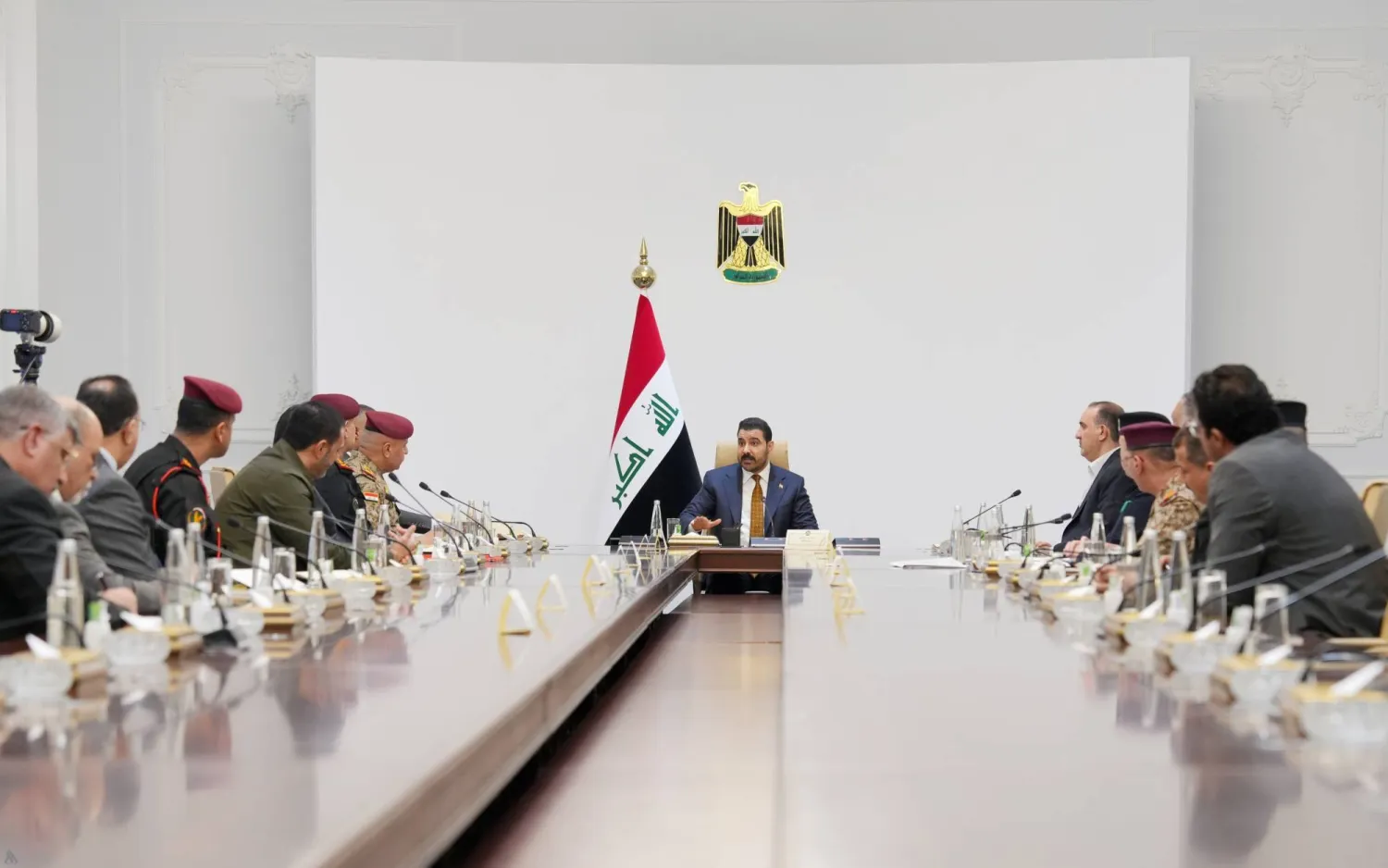
Iraqi PM Ali al-Zaidi chairs a security meeting on Sunday on oil smuggling in Jurf al-Sakhar. (INA)
TT

Confrontation between Iraqi PM, Kataib Hezbollah Intensifies

Iraqi PM Ali al-Zaidi chairs a security meeting on Sunday on oil smuggling in Jurf al-Sakhar. (INA)

Iraqi Prime Minister Ali al-Zaidi has won half the battle against armed factions by referring dozens of security and military officials across Babil province’s operational sectors to the judiciary for failing to halt oil smuggling in Jurf al-Sakhar, an area that has been held by the Kataib Hezbollah faction.

The government has made strides in its efforts to impose state monopoly over arms, including by offering government positions as incentives to several armed groups.

A number of those factions, including Kataib Hezbollah and Harakat al-Nujaba, have however refused to surrender their arms, arguing that they are “ideological” and tied to what is known as the “unity of arenas”, as promoted by Iran.

However, the sudden revelation that the armed faction, which has controlled Jurf al-Sakhar for years, was involved in smuggling oil passing near the area by puncturing pipelines has largely changed the equation.

The revelation was made after the security-political committee formed by al-Zaidi managed to enter the previously off-limits area to the authorities. There, it uncovered oil smuggling operations involving tanker trucks.

The development prompted al-Zaidi, who is also Commander-in-Chief of the Armed Forces, to issue several decisions viewed by experts as paving the way, for the first time, for a real confrontation with the armed factions to allow military units to enter the area.

According to a statement from the Office of the Commander-in-Chief of the Armed Forces, al-Zaidi chaired an emergency security meeting on Saturday evening to review the findings of a committee investigating oil smuggling in Jurf al-Sakhar.

The committee confirmed the accuracy of Federal Intelligence and Investigations Agency reports detailing oil smuggling operations, unauthorized refineries, and administrative irregularities.

“In light of the investigation’s findings, the Commander-in-Chief of the Armed Forces directed that all suspects involved in the oil smuggling operations be referred to the judiciary and that legal measures be taken against them,” it added.

He also decided to relieve the following officials in Babil of their duties: the police chief, the director of northern Babil police, the director of Babil intelligence and counterterrorism at the Ministry of Interior, the director of national security in Babil, the director of intelligence and security for Babil province at the Ministry of Defense, the director of Babil intelligence, the commander of the Popular Mobilization Forces (PMF) in Babil, the commander of the Energy Police’s Sixth Brigade at the Ministry of Interior, and the director of the Oil Pipelines Company at the Ministry of Oil.

“The Commander-in-Chief directed that operations commanders, provincial police chiefs, and directors of security and intelligence agencies bear full responsibility for any oil smuggling incidents occurring within their sectors of responsibility.”

He stressed the need to tighten oversight and security measures to prevent these practices and hold those negligent accountable, stressing that “not a single inch of Iraq, from Zakho to Basra, will remain a place where smuggling is practiced.”

Legal expert Ali al-Tamimi told Asharq Al-Awsat that “Iraq today faces the most dangerous threat to its sovereignty: weapons outside state control.”

He said the PM’s measures in Jurf al-Sakhar sparked widespread legal debate even though the moves align with the constitution.

“These referrals and dismissals are grounded in Article 78, which designates the prime minister as the direct executive responsible for the state's general policy and commander-in-chief of the armed forces,” he remarked.

He added: “Individuals who sabotage oil infrastructure are prosecuted as terrorists under the Anti-Terrorism Law and could gave penalties up to the death penalty.”