


Israeli Army’s Plan to Flood Hamas Tunnels Fails

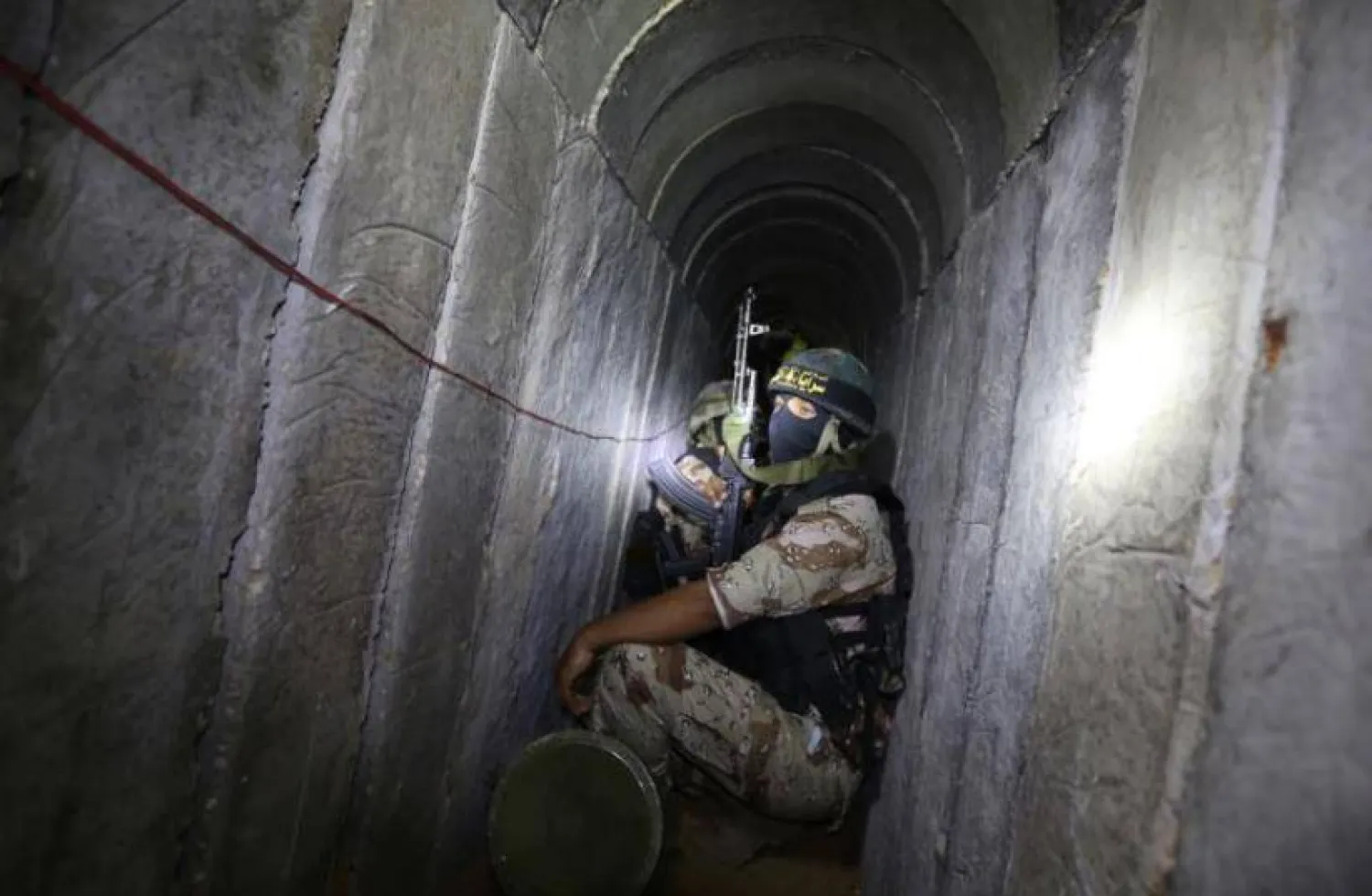
A Palestinian fighter from the Islamic Jihad's armed wing, the Al-Quds Brigades, is seen in a tunnel in the south of the Gaza Strip (AFP)
TT

Israeli Army’s Plan to Flood Hamas Tunnels Fails

A Palestinian fighter from the Islamic Jihad's armed wing, the Al-Quds Brigades, is seen in a tunnel in the south of the Gaza Strip (AFP)

The Israeli media on Saturday renewed talk about the Atlantis system, a significant engineering and technological breakthrough that was supposed to take out the Hamas tunnels and to kill senior Hamas officials, by pumping in seawater at high intensity.

The system was supposed to be the game changer, a new, relatively quick and lethal solution to one of the more complex fronts in the Gaza Strip.

But Israel started by adopting an old and unsuitable plan, continued by ignoring professional advice and the possible danger to the abductees – and ended quietly a few months later, anyone saying whether it achieved anything at all.

Haaretz surveys profiled the Atlantis project – a predictable military failure which no one stopped until it was too late.

“But about half a year after this system was revealed to the public, it turns out that Atlantis is lost; it's no longer in use, and nobody in the army can say what benefit, if any, was gained from this expensive project,” the newspaper wrote.

A Haaretz investigation – based on discussions with a series of different sources, who are closely involved in the development and operation of the system, as well as documents and minutes from closed discussions, in which senior officers and professionals participated– reveals a large number of screw-ups in the way it was handled by the army, and provides a profile of a failure foretold.

For example, it turns out that the system started to operate even before the necessary opinions requested by the army were given; that behind the accelerated activity there was a great deal of pressure imposed from above by the head of Southern Command, Maj. Gen. Yaron Finkelman; and that it was activated while possibly endangering Israelis who were alive when abducted to the Strip.
“The system was activated in at least one central Hamas tunnel that was clearly used by the organization during various stages of the war,” said a defense source who was deeply involved in project Atlantis. “And it's very likely that there were hostages there who served as a human shield.”

The question of how it happened that a project described by the Israeli Army as a “tie breaker” turned into a steadily growing failure has a complex answer.

One of the main causes is the backdrop, Haaretz said. During the first days of the war, says a defense source, “The achievements on the ground against Hamas officials were insignificant. Most of the Hamas forces, mainly the military arm, entered the tunnels and that created pressure on the senior Israeli Army command.”

That's why, says another source who spoke to Haaretz, Finkelman demanded solutions; ways of striking at Hamas activists in the tunnels. “There was frustration because during those stages the forces didn't really think that we'd start to enter all the tunnels,” recalls the source.

“They also began to realize the dimensions of the tunnels that Military Intelligence didn't know about.”

At that time, the Israeli Army was still learning about the tunnels they encountered in the Strip and their scope hundreds of kilometers.

“The army,” he adds, “found itself on the ground realizing that Hamas was below the ground and it had no solution for removing them from there.”

It was actually the renewal of a contingency plan that was proposed in the ground forces years before Finkelman assumed his position.

At the time the purpose was to deal with a different type of tunnel. Its chances of success in dealing with the tunnels that the army found in the Strip beginning on October 7 were low.

But according to defense sources who spoke to Haaretz, Finkelman gave a green light to taking the old plan and adapting it to the new situation.
After the plan received the necessary permits, the Army turned to the Israel Water Authority for assistance.

The authority hastened to mobilize for the mission and formed two groups of civilian experts in several fields. One group was placed in charge of pumping the water into the tunnels, the second was asked to study the subject of water loss through the walls of a tunnel. Both groups got started.
But the Israeli Army didn't wait for the conclusions, and already at this point they embarked on the next stage.

The Southern Command's 162nd division was chosen as the contractor of the operation, and infrastructure work was assigned to the fighters of the Shayetet 13 naval commandos, which for several weeks became a pipeline unit.

The main goal: joining pipes and deploying them in the combat area.

“For a month and a half the Israeli army neutralized an entire division,” says one of the commanders who took part in the project. “It assigned combat soldiers to plumbing jobs and guarding pipes, throughout the Strip, when it had no idea whether the project had any operational feasibility.”

He said, “The Army had no way of knowing whether the system was working, what had happened in the tunnels, what the situation was of the terrorists inside and whether there were hostages who were harmed as a result of the water. To this moment it isn't clear what damage was caused in the tunnels, if any. They simply don't know anything.”

According to a document issued by the experts on the subject, about three weeks after Atlantis began to operate, “The activation wasn't carried out according to the recommendations of the professionals. The pumping wasn't done according to the combat theory that was developed, no findings were gathered and they didn't take the measurements that were described.”

The experts were angry throughout the period. “There was a disconnect between the sources in the field and the accompanying unit on the one hand and the experts who planned the method of operation on the other,” they said.

And in fact, at that time, say professionals, the military lacked the requisite information and data about the tunnels, certainly not how to flood them in a way that would harm those inside or cause them to flee to the surface.

In the course of the project, the Water Authority investigators had a chance to be exposed to the study prepared by a Hamas activist who served in the tunnel system in the past 10 years. Along with his statement that the tunnels became the main system prepared by the organization for a military confrontation with Israel, he described how they were constructed and the logic behind them.



Egyptian-Turkish Military Talks Focus on Strengthening Partnership

The Commander of the Egyptian Air Force during his meeting with the Turkish Air Force chief in Cairo on Wednesday (Egyptian military spokesperson)
TT

Egyptian-Turkish Military Talks Focus on Strengthening Partnership

The Commander of the Egyptian Air Force during his meeting with the Turkish Air Force chief in Cairo on Wednesday (Egyptian military spokesperson)

Senior Egyptian and Turkish air force commanders met in Cairo on Wednesday for talks focused on strengthening military partnership and expanding bilateral cooperation, in the latest sign of warming defense ties between the two countries.

The meeting brought together the Commander of the Egyptian Air Force, Lt. Gen. Amr Saqr, and his Turkish counterpart, Gen. Ziya Cemal Kadioglu, to review a range of issues of mutual interest amid growing cooperation between the two air forces.

Egypt’s military spokesperson said the talks reflect the Armed Forces’ commitment to deepening military collaboration with friendly and partner nations.

Earlier this month, Egypt and Türkiye signed a military cooperation agreement during talks in Cairo between Egyptian President Abdel Fattah el-Sisi and his Turkish counterpart, President Recep Tayyip Erdogan.

Sisi highlighted similar viewpoints on regional and international issues, while Erdogan noted that enhanced cooperation and forthcoming joint steps would help support regional peace.

Cairo and Ankara also signed an agreement last August on the joint production of vertical take-off and landing (VTOL) drones. Production of unmanned ground vehicles has also begun under a partnership between the Turkish firm HAVELSAN and Egypt’s Kader Factory.

During the talks, Saqr underscored the importance of coordinating efforts to advance shared interests and expressed hope for closer ties that would benefit both air forces.

Kadioglu, for his part, stressed the depth of bilateral partnership and the strong foundations of cooperation between the two countries’ air forces.

According to the military spokesperson, Kadioglu also toured several Egyptian Air Force units to review the latest training and armament systems introduced in recent years.

Military cooperation between Egypt and Türkiye has gained momentum since 2023, following the restoration of full diplomatic relations and reciprocal presidential visits that reflected positively on the defense sector.

In September last year, the joint naval exercise “Sea of Friendship 2025” was held in Turkish territorial waters, aimed at enhancing joint capabilities and exchanging expertise against a range of threats.


UN Says Israeli Actions Raising 'Ethnic Cleansing' Fears in West Bank, Gaza

A member of the Salhab family weeps as he sits on the on the rubble of apartment building after it was demolished by Israeli bulldozers near the Israeli settlement of Hagai, south of the occupied West Bank city of Hebron, on February 18, 2026. (Photo by HAZEM BADER / AFP)
TT

UN Says Israeli Actions Raising 'Ethnic Cleansing' Fears in West Bank, Gaza

A member of the Salhab family weeps as he sits on the on the rubble of apartment building after it was demolished by Israeli bulldozers near the Israeli settlement of Hagai, south of the occupied West Bank city of Hebron, on February 18, 2026. (Photo by HAZEM BADER / AFP)

Israel's increased attacks and forcible transfers of Palestinians "raise concerns over ethnic cleansing" in the Gaza Strip and the West Bank, the United Nations said Thursday.

The UN human rights office said the cumulative impact of Israel's military conduct during the war in Gaza, plus its blockade of the territory, had inflicted living conditions "increasingly incompatible with Palestinians' continued existence as a group in Gaza".

"Intensified attacks, the methodical destruction of entire neighborhoods and the denial of humanitarian assistance appeared to aim at a permanent demographic shift in Gaza", the office said in a report.

"This, together with forcible transfers, which appear to aim at a permanent displacement, raise concerns over ethnic cleansing in Gaza and the West Bank."

The report looked at November 1, 2024 to October 31, 2025.

In the occupied West Bank and annexed East Jerusalem, the report said the "systematic use of unlawful force" by Israeli security forces, "widespread" arbitrary detention and the "extensive unlawful demolition" of Palestinian homes was being carried out to "systematically discriminate, oppress, control and dominate the Palestinian people".

"These violations were "altering the character, status and demographic composition of the occupied West Bank, raising serious concerns of ethnic cleansing", it said.

- 'Inhumane choice' -

In Gaza, the report condemned the continued killing and maiming of "unprecedented numbers of civilians", the spread of famine, and destruction of the "remaining civilian infrastructure".

During the 12 months covered in the report, at least 463 Palestinians, including 157 children, starved to death in Gaza, it said.

"Palestinians faced the inhumane choice of either starving to death or risking being killed while trying to get food," said the report.

"The situation of famine and malnutrition was the direct result of actions taken by the Israeli government," with the deaths and suffering from hunger "foreseeable and repeatedly foretold".

Across the reporting period, Hamas and other Palestinian armed groups continued to hold Israeli and foreign hostages seized on October 7, 2023 -- dead or alive -- as "bargaining tools".

The rights office said the hostages' treatment amounted to war crimes.

"Israeli forces, Hamas, and other Palestinian armed groups committed serious violations of international humanitarian law in Gaza, gross violations and abuses of international human rights law, and atrocity crimes," the report concluded.

- Impunity 'kills' -

Last week, UN rights chief Volker Turk warned that the world was witnessing "rapid steps to change permanently the demography of the occupied Palestinian territory".

On Tuesday, Israel's far-right Finance Minister Bezalel Smotrich vowed to encourage "emigration" from the Palestinian territories.

And on Wednesday, UN Under-Secretary-General Rosemary DiCarlo warned the Security Council that steps by Israel to tighten control of areas of the West Bank administered by the Palestinian Authority amount to "gradual de facto annexation".

Thursday's rights office report concluded that considered together, Israeli practices "indicated a concerted and accelerating effort to consolidate annexation of large parts of the Occupied Palestinian Territory and to deny Palestinians' right to self-determination".

The report said there was a pervasive climate of impunity for serious violations of international law by the Israeli authorities in the Palestinian territories.

"Impunity is not abstract -- it kills. Accountability is indispensable. It is the prerequisite for a just and durable peace in Palestine and Israel," Turk said in a statement.


UN Probe: RSF Actions in Sudan's el-Fasher Point to Genocide

Forces affiliated with the Rapid Support Forces in the city of el-Fasher, Darfur region (AFP)
TT

UN Probe: RSF Actions in Sudan's el-Fasher Point to Genocide

Forces affiliated with the Rapid Support Forces in the city of el-Fasher, Darfur region (AFP)

Mass killings of non-Arab communities when the Rapid Support Forces captured the Sudanese city of el-Fasher bears hallmarks that point to genocide, an independent UN probe said in a new report on Thursday.

At the end of October last year, the RSF took over the city - which had been the last remaining stronghold of the Sudanese Armed Forces (SAF) in the Darfur region in the west of the country - with thousands of people killed and raped during three days of horror, the UN Independent International Fact-Finding Mission for Sudan said.

It followed an 18-month siege where the RSF imposed conditions of life calculated to bring about the physical destruction of non-Arab communities, in particular the Zaghawa and the Fur, ‌the report stated.

The ‌UN mission said it found evidence that the RSF carried out a pattern ‌of ⁠coordinated and repeated ⁠targeting of individuals based on ethnicity, gender and perceived political affiliation, including mass killings, rape and torture, as well as inflicting conditions of life calculated to bring about the group’s physical destruction - core elements of the crime of genocide under international law.

The final draft of the report was shared with the Government of Sudan but no response was received, while the RSF did not respond to the UN mission's request to meet with its leadership, the report stated. The RSF and SAF did not immediately respond to requests from Reuters for comment.

In the past, the RSF has ⁠denied such abuses - saying the accounts have been manufactured by its enemies and ‌making counter-accusations against them.

"The scale, coordination, and public endorsement of the operation ‌by senior RSF leadership demonstrate that the crimes committed in and around el-Fasher were not random excesses of war" said Mohamad ‌Chande Othman, Chair of the Fact-Finding Mission on Sudan.

"They formed part of a planned and organized operation ‌that bears the defining characteristics of genocide," he added.

Before its takeover el-Fasher's population mainly consisted of the Zaghawa, a non-Arab community, while displacement camps around the area were comprised of the Fur community, as well as Berti, Masalit and Tama, the report said.

"Survivors describe explicit threats to 'clean' the city," the report stated. Alongside attacking displacement camps, communal kitchens and medical centers ‌with drones and heavy weapons, the RSF also carried out killings, looting, beatings and sexual violence in el-Fasher, the report stated.

The RSF's "exterminatory rhetoric" and other violations indicated ⁠its intent to destroy ⁠the Zaghawa and Fur communities in whole or in part, the report said.

"Witnesses heard the Rapid Support Forces saying, 'Is there anyone Zaghawa among you? If we find Zaghawa, we will kill them all'," the report said.

Survivors recounted point-blank executions of civilians, as well as bodies of men, women and children filling roads, the report stated.

Women and girls aged 7 to 70 years old from non-Arab communities, particularly the Zaghawa were raped and subject to other acts of sexual violence, including whipping and forced nudity, the report stated.

British Foreign Secretary Yvette Cooper said the international response to the report and the situation in Sudan had to be emphatic and urged for a ceasefire.

"The findings of this UN report are truly horrific - atrocities including systematic starvation, torture, killings, rape and deliberate ethnic targeting used on the most horrendous scale during the Rapid Support Forces siege of el-Fasher," she said in a statement.

The UN mission was mandated by members of the Human Rights Council, following backing from countries that included Britain, to urgently investigate violations and abuses under international law in and around el-Fasher.