


Lice, Scabies, Rashes Plague Palestinian Children as Skin Disease Runs Rampant in Gaza’s Tent Camps 

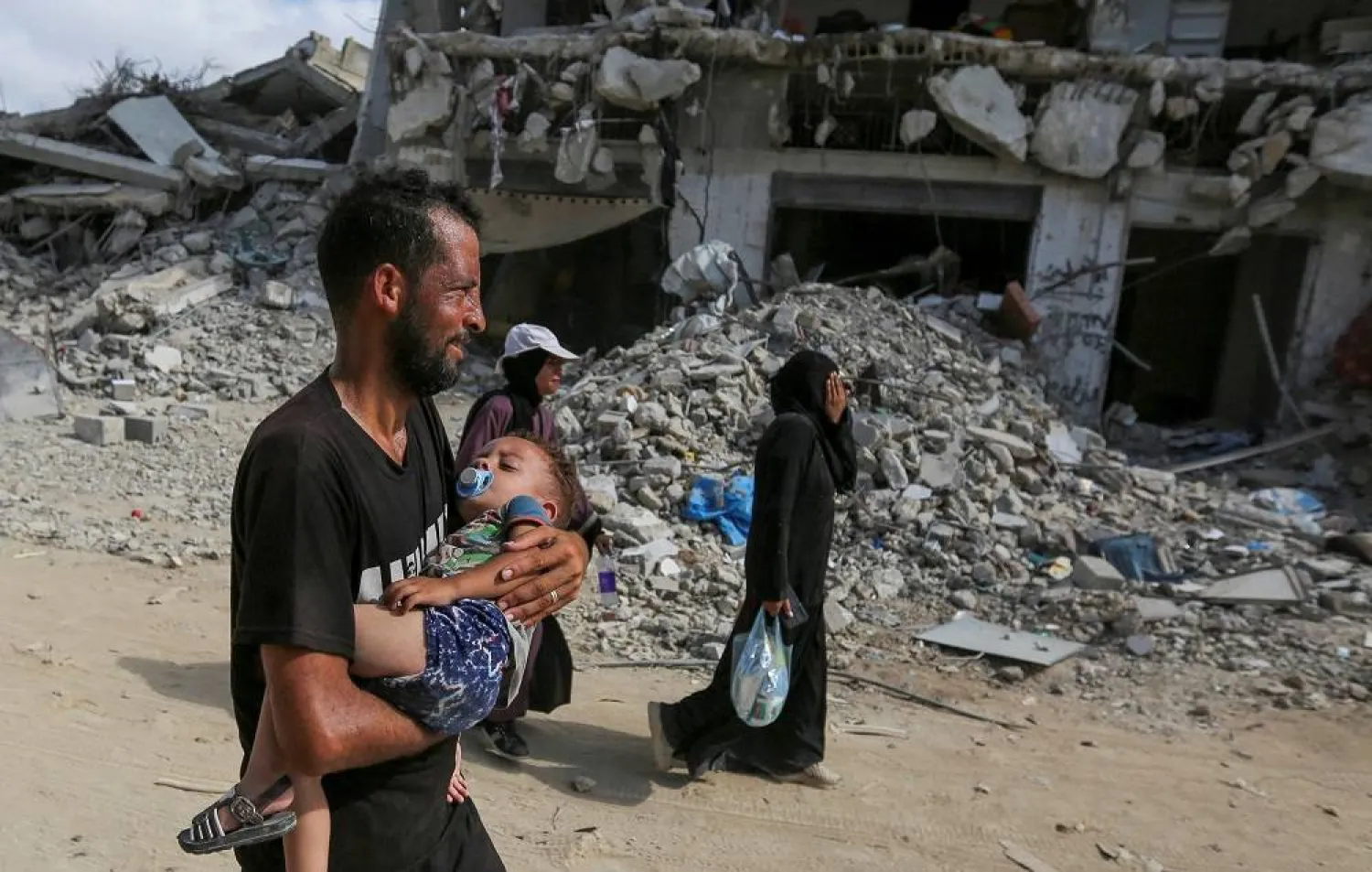
A Palestinian man carries a child, as Palestinians make their way to return to the eastern side of Khan Younis after Israeli forces pulled out from the area following a raid, amid the Israel-Hamas conflict, in Khan Younis, in the southern Gaza Strip July 30, 2024. (Reuters)
TT

Lice, Scabies, Rashes Plague Palestinian Children as Skin Disease Runs Rampant in Gaza’s Tent Camps 

A Palestinian man carries a child, as Palestinians make their way to return to the eastern side of Khan Younis after Israeli forces pulled out from the area following a raid, amid the Israel-Hamas conflict, in Khan Younis, in the southern Gaza Strip July 30, 2024. (Reuters)

A steady stream of miserable children and worried parents flowed into the dermatology office at Nasser Hospital in central Gaza.

A toddler with a blue hair bow sobbed as her mother showed how the red and white spots covering her face have spread to her neck and chest. Another woman lifted her little boy's clothes to reveal the rashes on his back, butt, thighs and stomach. On his wrists, he had open sores from scratching. A father stood his daughter on the desk so the doctor could examine the lesions on her calves.

Skin diseases are running rampant in Gaza, health officials say. The cause, they say, is the appalling conditions in overcrowded tent camps housing hundreds of thousands of Palestinians driven from their homes, along with the summer heat and the collapse of sanitation that has left pools of open sewage amid 10 months of Israel's bombardment and offensives in the territory.

Doctors are wrestling with more than 103,000 cases of lice and scabies and 65,000 cases of skin rashes, according to the World Health Organization. In Gaza's population of some 2.3 million, more than 1 million cases of acute respiratory infections have been recorded since the war began, along with more than half a million of acute diarrhea and more than 100,000 cases of jaundice, according to the United Nations Development Program.

Cleanliness is impossible in the ramshackle tents, basically wood frames hung with blankets or plastic sheets, crammed side by side over wide stretches, Palestinians say.

"There's no shampoo, no soap," said Munira al-Nahhal, living in a tent in the dunes outside the southern city of Khan Younis. "The water is dirty. Everything is sand and insects and garbage."

Her family's tent was crammed with her grandchildren, many of whom had rashes. One little boy stood scratching the red patches on his belly. "One child gets it, and it spreads to all of them," al-Nahhal said.

Palestinians in the camp said clean water was almost impossible to get. Some wash their children in salt water from the nearby Mediterranean. People have to wear the same clothes day after day until they're able to wash them, then they wear them again immediately. Flies are everywhere. Children play in garbage-strewn sand.

"First it was spots on her face. Then it spread to her stomach and arms, all over her forehead. And it hurts. It itches. And there's no treatment. Or if there is we can't afford it," said Shaima Marshoud, sitting next to her little daughter in a cinder block structure they'd settled in among the tents.

More than 1.8 million of Gaza's 2.3 million people have been driven from their homes, often moving multiple times over the past months to get away from Israeli ground assaults or bombardment. The vast majority are now crowded into a 50-square-kilometer (20-square-mile) area of dunes and fields on the coast with almost no sewage system and little water.

The distribution of humanitarian supplies, including soap, shampoo and medicines, has slowed to a trickle, UN officials say, because Israeli military operations and general lawlessness in Gaza make it too dangerous for relief trucks to move.

Israel launched its campaign vowing to destroy Hamas after its Oct. 7 attack on southern Israel, in which some 1,200 people were killed and 350 abducted. Israel's assault has killed more than 39,000 people, according to Gaza health authorities.

"The solid waste management system has collapsed," said Chitose Noguchi, the deputy special representative of the UN Development Program's Program of Assistance to the Palestinian People.

In a report released Tuesday, the UNDP said Gaza's two pre-war landfills were unreachable amid the fighting and it had set up 10 temporary sites. But Noguchi said there were more than 140 informal dumping sites that have cropped up. Some of them are giant pools of human waste and garbage.

"People are having tents and living next to dumping sites, which is really, really critical situation in terms of the health crisis," Noguchi said.

Nassim Basala, a dermatologist at Nasser Hospital, said they get 300 to 500 people a day coming in with skin diseases. After the most recent Israeli evacuation orders, more people have crowded into agricultural fields outside the city of Khan Younis, where insects are rife in the summer.

Scabies and lice are at epidemic proportions, he said, but other fungal, bacterial and viral infections and parasites are also running wild.

With the flood of patients, even simple cases can because dangerous.

For example, Basala said, impetigo is a simple bacterial infection treatable with creams. But sometimes by the time the patient gets to a doctor, "the bacteria have spread and affected the kidneys," he said. "We've had cases of kidney failure" as a result. Scratched rashes get infected in the pervasive dirt.

He said creams and ointments were in short supply at the hospital.

Children are the most affected. But adults suffer as well. At the hospital's dermatology office, one man untied his dirt-covered shoes to show the painful looking sores on the tops of his feet and ankles where his rash had rubbed open. A woman held up her hands, chapped raw and red.

Mohammed al-Rayan, several of whose children in a tent outside Khan Younis, have rashes or spots, said he has taken them to doctors.

"They give us creams, but it's no use when you don't have anything to wash with," he said. "You put a cream and it gets better but then the next day it's back the same."

Parents are left struggling to comfort children with painful conditions that won't go away.

Manar al-Hessi's toddler cried as she spread cream on her forehead and chest, covered in scabs, sores and spots.

"It's horrible," al-Hessi said. "There are always flies on her face. She goes in the toilet or the garbage, and it gets in her hands. The filth is huge."



Egypt Urges Int’l Support for Lebanese Army to Ensure State Exclusivity over Arms

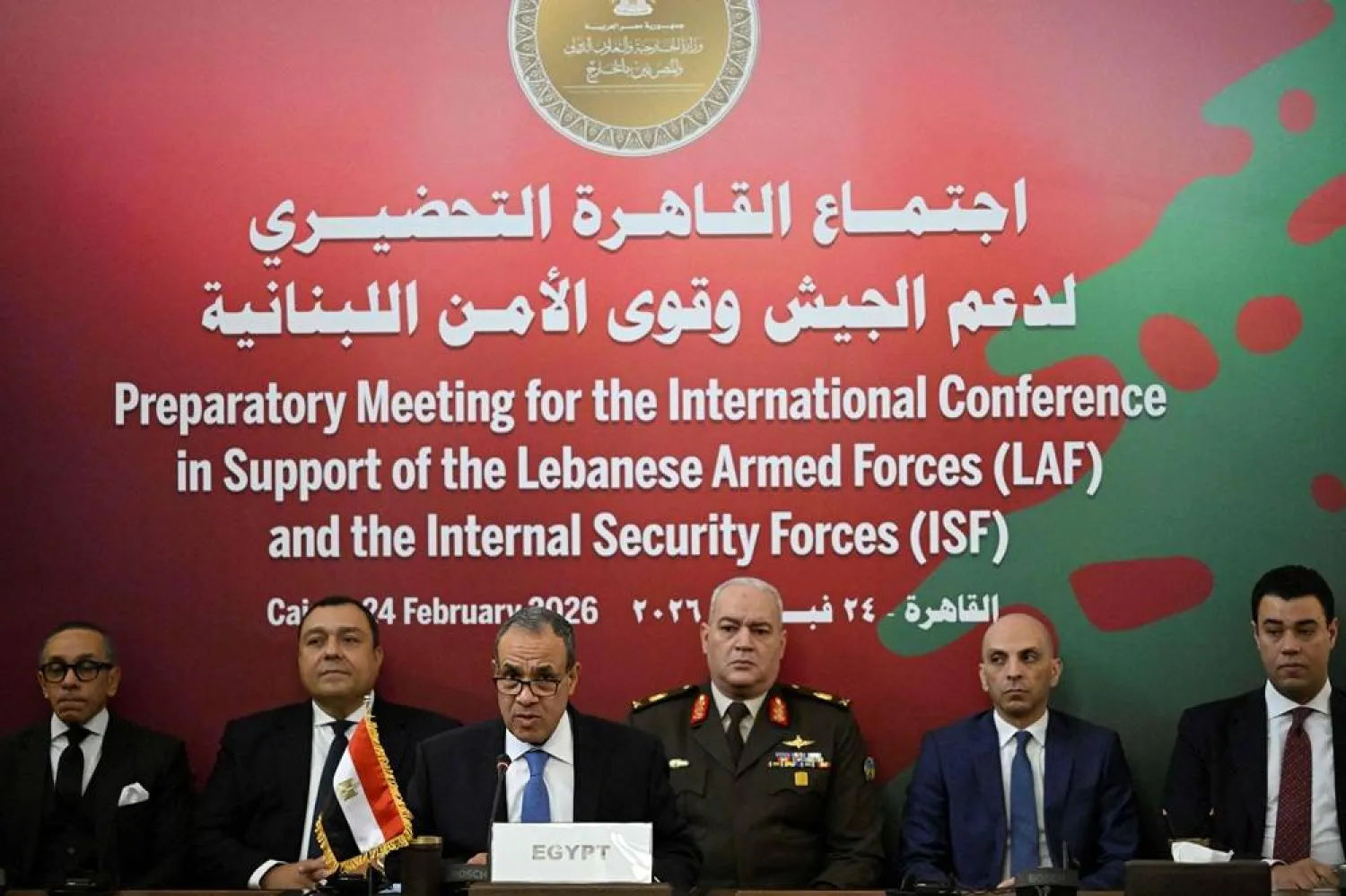
Egyptian Foreign Minister Badr Abdelatty (3rd L) speaks before representatives of participating countries during the preparatory meeting for the international conference in support of the Lebanese Armed Forces (LAF) and the Internal Security Forces (ISF) in Cairo on February 24, 2026. (AFP)
TT

Egypt Urges Int’l Support for Lebanese Army to Ensure State Exclusivity over Arms

Egyptian Foreign Minister Badr Abdelatty (3rd L) speaks before representatives of participating countries during the preparatory meeting for the international conference in support of the Lebanese Armed Forces (LAF) and the Internal Security Forces (ISF) in Cairo on February 24, 2026. (AFP)

Egypt on Tuesday urged the international community to better support Lebanon's armed forces as the country moves forward with a plan to disarm Hezbollah and bring all weapons under state control. 

Speaking at a preparatory meeting in Cairo ahead of next month's Paris conference in support of the Lebanese army, Egypt's Foreign Minister Badr Abdelatty praised "the success of the Lebanese army in completing the first phase of the plan". 

"This achievement reflects the efficiency of the military institution and requires intensifying international support to complete the remaining phases of the plan," Abdelatty said. 

Lebanon's government last year committed to disarming Hezbollah, which was badly weakened in a recent war with Israel, and tasked the army with drawing up a plan to do so. 

Lebanon has since received promises of support, amid a shortage of equipment, personnel and technical capabilities needed to carry out the army's mission. 

Though its capabilities are limited, the military has worked to dismantle Hezbollah facilities and tunnels and confiscate weapons in the last few months. 

It declared in January the completion of the first phase of its plan, which tackled the area south of the Litani river, located around 30 kilometers (20 miles) north of Israel. 

Lebanon's military now intends to tackle the area north of the river as the second phase of its plan, having said last week that it would need at least four months to finish the job. 

Abdelatty said Tuesday's meeting aimed "to enable the Lebanese state to ensure that all weapons are held exclusively by the state". 

The meeting brought together Lebanon's top security chiefs, including Army Commander General Rodolphe Haykal and Internal Security Forces Director-General Major General Raed Abdallah. 

They were joined by representatives of the Quintet Committee on Lebanon, among them Qatar's state minister for foreign affairs Mohammed bin Abdulaziz al-Khulaifi, French envoy Jean-Yves Le Drian and Saudi Arabia's envoy to Beirut Prince Yazid bin Farhan, along with senior officials from the United States. 

At a separate meeting with Le Drian, Abdelatty stressed the need for what he described as a comprehensive international approach to the crisis in Lebanon. 

"There is no path to restoring stability except by obliging Israel to immediately halt its aggression" and "fully withdraw from occupied Lebanese territories," he said. 

Israel, which accuses Hezbollah of rearming, has criticized the army's progress as insufficient, and has kept up regular strikes on Lebanon despite a November 2024 ceasefire that sought to end more than a year of hostilities with the group. 


About 6.5 Million People in Somalia Face Acute Hunger Due to Drought, Govt and UN Say

 Lime is displayed for sale at an open-air grocery market as Muslims start the fasting month of Ramadan within Bakara market in Mogadishu, Somalia February 18, 2026. (Reuters)
Lime is displayed for sale at an open-air grocery market as Muslims start the fasting month of Ramadan within Bakara market in Mogadishu, Somalia February 18, 2026. (Reuters)
TT

About 6.5 Million People in Somalia Face Acute Hunger Due to Drought, Govt and UN Say

 Lime is displayed for sale at an open-air grocery market as Muslims start the fasting month of Ramadan within Bakara market in Mogadishu, Somalia February 18, 2026. (Reuters)
Lime is displayed for sale at an open-air grocery market as Muslims start the fasting month of Ramadan within Bakara market in Mogadishu, Somalia February 18, 2026. (Reuters)

About 6.5 million people in Somalia ‌face acute hunger due to drought, the government and the United Nations said on Tuesday, sounding the alarm days after the UN's food agency warned that food aid could grind to a halt by April without new funding.

Somalia declared a national drought emergency in November after years of failed rains, and other countries in the region have also been hit.

More than a third of those facing acute malnutrition are children, Somalia's government and the United Nations Somalia said in a joint statement. The crisis has forced tens of thousands of ‌people to ‌flee their homes, with many crowding into camps ‌in ⁠Mogadishu and other ⁠cities.

"The drought ... has deepened alarmingly, with soaring water prices, limited food supplies, dying livestock, and very little humanitarian funding," George Conway, the UN's Humanitarian Coordinator for Somalia, said in a statement.

Hawo Abdi said she lost two children to illness after the drought laid waste to her homeland in Somalia's Bay region.

"When I saw that the suffering ⁠was getting worse, I fled my home and ‌came to ... Mogadishu," she told Reuters ‌from her shelter on the outskirts of the capital.

Last week, the UN World Food Program put the number of those facing acute hunger ‌at 4.4 million, and said it had already cut back its assistance to just over 600,000 people from 2.2 million earlier this year.

It was not clear whether the new figure reflected a sharp increase in those ‌at risk or different counting methods.

The government and United Nations figures tally with those also released on ⁠Tuesday by ⁠the Integrated Food Security Phase Classification (IPC), which sets the global standard for determining the severity of a food crisis.

While rainfall in the April to June season could offer some relief, some 5.5 million people were expected to remain in the crisis level or worse, with 1.6 million people in the emergency level, the statement said.

Abdiyo Ali was forced to abandon her farm in the Lower Shabelle region.

"Our farms were destroyed, our livestock died, and water sources became too far away. We have nothing left to bring with us," Ali told Reuters last week while preparing her food in a displaced people's camp outside Mogadishu.


Lebanon Fears Israeli Strikes if Iran Situation Escalates

 Lebanese Foreign Minister Youssef Raggi addresses the Human Rights Council in Geneva, Switzerland, Tuesday, Feb. 24, 2026. (AP)
Lebanese Foreign Minister Youssef Raggi addresses the Human Rights Council in Geneva, Switzerland, Tuesday, Feb. 24, 2026. (AP)
TT

Lebanon Fears Israeli Strikes if Iran Situation Escalates

 Lebanese Foreign Minister Youssef Raggi addresses the Human Rights Council in Geneva, Switzerland, Tuesday, Feb. 24, 2026. (AP)
Lebanese Foreign Minister Youssef Raggi addresses the Human Rights Council in Geneva, Switzerland, Tuesday, Feb. 24, 2026. (AP)

Lebanon's foreign minister said Tuesday his country feared its infrastructure could be hit by Israeli strikes if the situation with Iran escalates, as Israel has intensified its attacks on Tehran-backed Hezbollah.

Also on Tuesday, Lebanon's army accused the Israeli military of firing near a position it was setting up in the country's south, saying it had instructed troops to return fire.

"There are signs that the Israelis could strike very hard in the event of an escalation, potentially including strategic infrastructure such as the airport," foreign minister Youssef Raggi told reporters in Geneva.

His comments came amid a massive US military buildup in the Middle East that suggested Washington was prepared to wage a potentially sustained campaign against Iran.

Iran vowed on Monday to retaliate "ferociously" against any attack from the United States, and repeated its warning of a regional conflagration in response to President Donald Trump's latest threat of strikes.

"We are currently conducting diplomatic efforts to request that, even in the event of retaliation, Lebanese civilian infrastructure not be targeted," Raggi said.

He stressed that his country's leadership had been very clear: "This war does not concern us."

A Lebanese official who requested anonymity said "what the Lebanese fear is a chain reaction: an American strike against Iran, a Hezbollah retaliatory strike against Israel, followed by a massive Israeli response."

- Israeli strikes -

Israel has kept up regular strikes on Lebanon despite a November 2024 ceasefire that sought to halt more than a year of hostilities with Iran-backed Hezbollah, usually saying it was targeting the group.

Last Friday, Israel carried out deadly strikes on what it called Hezbollah positions in eastern Lebanon and targets linked to the Palestinian group Hamas in the south.

Hezbollah said Saturday that eight of its fighters had been killed, and vowed "resistance".

Its leader Sheikh Naim Qassem stated last month that any attack on Tehran would also be an attack on Hezbollah.

On Monday, Washington ordered non-emergency personnel to leave its embassy in Lebanon's capital Beirut as anticipation rose of a possible conflict with Iran.

On Tuesday, Lebanon's army said it was "establishing a new observation post on the southern border" when "the area surrounding the post was subjected to gunfire from the Israeli side".

"The army command issued orders to reinforce the post, remain there, and return fire."

On the same day in Cairo, a preparatory meeting was held ahead of a conference in Paris next month to back Lebanon's army, which is facing heavy pressure from Washington and Israel to disarm Hezbollah.

Egyptian Foreign Minister Badr Abdelatty said that Tuesday's meeting aimed "to enable the Lebanese state to ensure that all weapons are held exclusively by the state".

Lebanon's government last year committed to disarming Hezbollah, which was badly weakened in a recent war with Israel, and tasked the army with drawing up a plan to do so.

The army, which has limited capabilities, declared in January the completion of the first phase of its plan near the border with Israel.

It said last week it would need at least four months to complete the second phase.

Israel, which accuses Hezbollah of rearming, has criticized the army's progress as insufficient.