


Top Hamas Official Says Group Is Losing Faith in US as Mediator in Gaza Ceasefire Talks

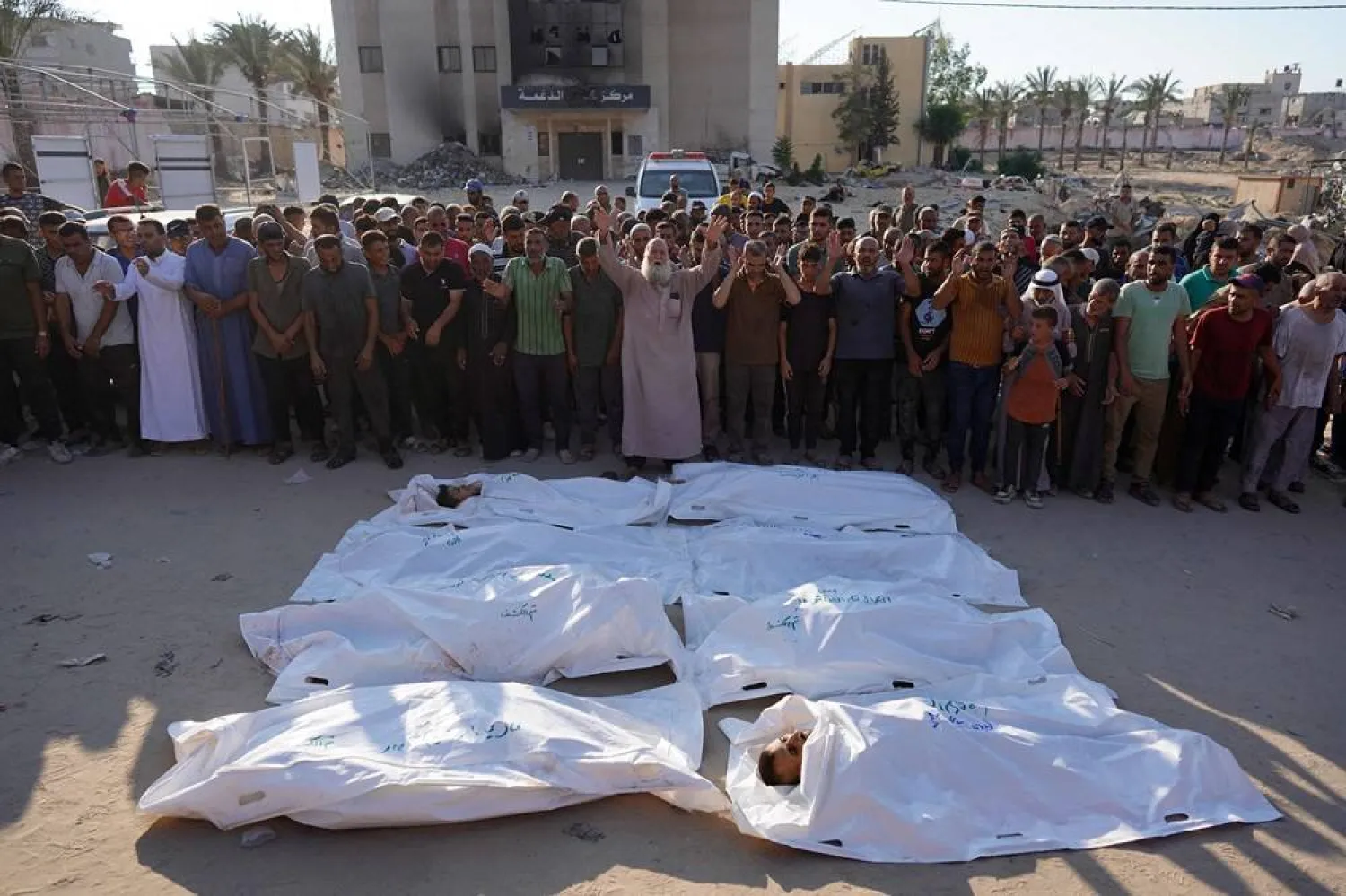
 Palestinians recite a prayer over the bodies of people killed in Israeli bombardment, at the Nasser hospital in Khan Younis in the southern Gaza Strip on August 14, 2024, amid the ongoing conflict between Israel and the Hamas group. (AFP)
Palestinians recite a prayer over the bodies of people killed in Israeli bombardment, at the Nasser hospital in Khan Younis in the southern Gaza Strip on August 14, 2024, amid the ongoing conflict between Israel and the Hamas group. (AFP)
TT

Top Hamas Official Says Group Is Losing Faith in US as Mediator in Gaza Ceasefire Talks

 Palestinians recite a prayer over the bodies of people killed in Israeli bombardment, at the Nasser hospital in Khan Younis in the southern Gaza Strip on August 14, 2024, amid the ongoing conflict between Israel and the Hamas group. (AFP)
Palestinians recite a prayer over the bodies of people killed in Israeli bombardment, at the Nasser hospital in Khan Younis in the southern Gaza Strip on August 14, 2024, amid the ongoing conflict between Israel and the Hamas group. (AFP)

A top Hamas official said the Palestinian armed group is losing faith in the United States’ ability to mediate a ceasefire in Gaza ahead of a new round of talks scheduled for this week amid mounting pressure to bring an end to the 10-month-old war with Israel.

Osama Hamdan told The Associated Press in an interview Tuesday that Hamas will only participate if the talks focus on implementing a proposal detailed by US President Joe Biden in May and endorsed internationally.

The US referred to it as an Israeli proposal and Hamas agreed to it in principle, but Israel said that Biden’s speech was not entirely consistent with the proposal itself. Both sides later proposed changes, leading each to accuse the other of obstructing a deal.

Hamas is especially resistant to Israel’s demand that it maintain a lasting military presence in two strategic areas of Gaza after any ceasefire, conditions that were only made public in recent weeks.

"We have informed the mediators that ... any meeting should be based on talking about implementation mechanisms and setting deadlines rather than negotiating something new," said Hamdan, who is a member of Hamas' Political Bureau, which includes the group's top political leaders and sets its policies. "Otherwise, Hamas finds no reason to participate."

It was not clear late Wednesday if Hamas would attend the talks beginning Thursday.

Hamdan spoke amid a new push for an end to the war, sparked by the Oct. 7 attack on Israel in which Hamas-led fighters killed 1,200 people and dragged about 250 hostages into Gaza. Israel responded with a devastating bombardment and ground invasion that has killed nearly 40,000 Palestinians and decimated wide swaths of the territory.

There are now fears that the conflict could ignite a wider conflagration.

In an hourlong interview, Hamdan accused Israel of not engaging in good faith and said the group does not believe the US can or will apply pressure on Israel to seal a deal.

Hamdan claimed Israel has "either sent a non-voting delegation (to the negotiations) or changed delegations from one round to another, so we would start again, or it has imposed new conditions."

Israeli officials had no immediate comment on the claim, but Israel has denied sabotaging talks and accuses Hamas of doing so.

During the interview, Hamdan provided copies of several iterations of the ceasefire proposal and the group’s written responses. A regional official familiar with the talks verified the documents were genuine. The official offered the assessment on condition of anonymity in order to share information not made public.

The documents show that at several points Hamas attempted to add additional guarantors —including Russia, Türkiye and the United Nations — but Israel’s responses always included only the existing mediators, the US, Egypt and Qatar.

In a statement Tuesday, the Israeli prime minister’s office said some changes it has asked for were merely "clarifications" that added details, such as to clauses that dealt with how Palestinians will return to northern Gaza, how many hostages will be released during specific phases and whether Israel can veto which Palestinian prisoners will be released in exchange for Israeli hostages. It accused Hamas of asking for 29 changes to the proposal.

"The fact is that it is Hamas which is preventing the release of our hostages, and which continues to oppose the outline," Israeli Prime Minister Benjamin Netanyahu said earlier this month.

Hamdan, however, claimed that more than once Hamas accepted in whole or in large part a proposal put to them by the mediators only to have Israel reject it out of hand, ignore it, or launch major new military operations in the days that followed.

On one occasion, one day after Hamas accepted a ceasefire proposal, Israel launched a new operation in Rafah in southern Gaza. Israel said the proposal remained far from its demands.

Hamdan said that CIA director William Burns told Hamas via mediators at the time that Israel would agree to the deal.

But, he said, "the Americans were unable to convince the Israelis. I think they did not pressure the Israelis."

US State Department spokesperson Vedant Patel told reporters Tuesday that Washington is making great efforts to prevent an escalation of violence and end suffering in the region.

"We are working around the clock every day," he said. "Everyone in the region should understand that further attacks only perpetuate conflict and instability and insecurity for everyone."

Negotiations have taken on new urgency as the war has threatened to ignite a regional conflict.

Iran and the Lebanese armed group Hezbollah are mulling retaliatory strikes against Israel after the killings of Hamas' political leader, Ismail Haniyeh, in Tehran and of top Hezbollah commander Fouad Shukr in Beirut. Israel claimed the latter strike, but has neither confirmed nor denied its role in the blast that killed Haniyeh.

After a brief truce in November that saw the release of more than 100 Israeli hostages, multiple rounds of ceasefire talks have fallen apart. Around 110 people taken captive remain in Gaza, about a third of them believed to be dead.

Hamdan accused Israel of stepping up its attacks on Hamas leaders after the group agreed in principle to the latest proposal put forward by mediators.

Israel said that a July 13 operation in Gaza killed Mohammed Deif, the shadowy leader of Hamas’ military wing. More than 90 other people also died, according to local health officials.

Hamdan insisted Deif is alive.

Two weeks later, Haniyeh was killed, with Hamas and Iran blaming Israel. Hamas then named Yahya al-Sinwar, its Gaza chief seen as responsible for the Oct. 7 attack, to replace Haniyeh — who had been considered a more moderate figure.

Hamdan acknowledged there are "some difficulties" and delays in communicating with Sinwar, who is believed to be hiding deep in the network of tunnels in the Gaza Strip. But Hamdan insisted that this does not pose a major barrier to the negotiations.

The most intractable sticking point in the talks remains whether and how a temporary ceasefire would become permanent.

Israel has been wary of proposals that the initial truce would be extended as long as negotiations continue over a permanent deal. Israel seems concerned that Hamas would drag on endlessly with fruitless negotiations.

Hamas has said it is concerned Israel will resume the war once its most vulnerable hostages are returned, a scenario reflected in some of Netanyahu’s recent comments.

All versions of the ceasefire proposal shared by Hamdan stipulated that the Israeli forces will withdraw completely from Gaza in the deal's second phase.

Recently, however, officials with knowledge of the negotiations told the AP that Israel had introduced new demands to maintain a presence in a strip of land on the Gaza-Egypt border known as the Philadelphi corridor, as well as along a highway running across the breadth of the strip, separating Gaza’s south and north. Hamas has insisted on a full withdrawal of Israeli forces.

Hamdan said the group had not yet received in writing the new conditions.

Hamdan acknowledged that Palestinians have suffered immensely in the war and are yearning for a ceasefire, but insisted that the group couldn't simply give up its demands.

"A ceasefire is one thing," he said, "and surrender is something else."


Rafah Crossing Traffic Lags Two Weeks after Reopening

Humanitarian and relief aid crosses Rafah Crossing (Egyptian Red Crescent)
TT

Rafah Crossing Traffic Lags Two Weeks after Reopening

Humanitarian and relief aid crosses Rafah Crossing (Egyptian Red Crescent)

Despite nearly two weeks since the reopening of the Rafah crossing in both directions, the number of people and humanitarian aid entering the Gaza Strip falls short of what was agreed under the “Gaza ceasefire agreement,” according to an official from the Egyptian Red Crescent in North Sinai.

The daily movement of individuals to and from Gaza does not exceed 50 people, Khaled Zayed, head of the Egyptian Red Crescent in North Sinai, told Asharq Al-Awsat. He said this figure represents only one-third of what was agreed upon in the ceasefire deal.

He added that truck traffic stands at about 100 per day, despite Gaza’s population requiring the entry of around 600 trucks daily.

On Feb. 2, Israel reopened the Rafah crossing on the Palestinian side for individual travel, allowing Palestinians to leave and return to the enclave. Indicators show that most of those departing Gaza are patients and wounded individuals, who are being received at Egyptian hospitals.

This comes as Egyptian Foreign Minister Badr Abdelatty stressed the need to “ensure the unhindered delivery of humanitarian aid and not obstruct movement through the Rafah crossing.”

In his remarks during a ministerial Security Council session on developments in the Middle East on Wednesday, he underscored the importance of “halting all measures aimed at displacing residents or altering the demographic character of the occupied Palestinian territories.”

Israel took control of the Rafah border crossing in May 2024, about nine months after the outbreak of the war in Gaza. The reopening of the crossing was part of the first phase of the ceasefire agreement that entered into force last October, though the deal remains fragile.

The Egyptian Red Crescent announced the departure of the 14th group of wounded, sick, and injured Palestinians arriving and leaving through the crossing.

In a statement on Thursday, it said humanitarian efforts to receive and see off Palestinians include a comprehensive package of relief services, psychological support for children, distribution of suhoor and iftar meals, and heavy clothing, in addition to providing “return bags” for those heading back to Gaza.

At the same time, the Red Crescent dispatched the 142nd “Zad Al-Ezza” convoy, which includes 197,000 food parcels and more than 235 tons of flour as part of the “Iftar for One Million Fasters” campaign in Gaza.

The convoy also carries more than 390 tons of medicines, relief, and personal care supplies, as well as about 760 tons of fuel, according to the organization’s statement.

Zayed said the daily number of individuals crossing through Rafah over the past two weeks does not compare with what was stipulated in the ceasefire agreement.

With the reopening of the Rafah crossing on the Palestinian side, Israel’s Arabic-language public broadcaster Makan reported that 150 people were expected to leave Gaza, including 50 patients, while 50 people would be allowed to enter the enclave.

Despite what he described as Israeli obstacles, Zayed said allowing the movement of individuals and the wounded represents “an unsatisfactory breakthrough in the humanitarian situation in Gaza,” stressing the need to fulfill the ceasefire’s obligations and advance early recovery efforts inside the territory.

The total number of Palestinians who have left through the Rafah crossing since it reopened on both sides does not exceed 1,000, according to Salah Abdel Ati, head of the International Commission to Support Palestinian Rights.

He said around 20,000 wounded and sick Palestinians require urgent evacuation, and that Israeli restrictions are hindering access to medical care, adding that the humanitarian situation requires continued pressure by mediators on Israel.

Abdelatty told Asharq Al-Awsat he was counting on the outcome of the first meeting of the Board of Peace to adopt easing measures, including lifting Israeli restrictions and establishing guarantees for the ceasefire in the Palestinian territories, as well as securing the funding needed for Gaza’s early recovery, in line with US President Donald Trump’s peace plan for the enclave.

According to a statement by the Egyptian Red Crescent, Egypt continues relief efforts at all logistical hubs to facilitate the entry of humanitarian aid, which has exceeded 800,000 tons, with the participation of more than 65,000 volunteers from the Egyptian Red Crescent.


US Slaps Sanctions on Sudan’s RSF Commanders over El-Fasher Killings

FILE - A Sudanese child, who fled el-Fasher city with family after Sudan's RSF attacked the western Darfur region, receives treatment at a camp in Tawila, Sudan, Nov. 2, 2025. (AP Photo/Mohammed Abaker, File)
TT

US Slaps Sanctions on Sudan’s RSF Commanders over El-Fasher Killings

FILE - A Sudanese child, who fled el-Fasher city with family after Sudan's RSF attacked the western Darfur region, receives treatment at a camp in Tawila, Sudan, Nov. 2, 2025. (AP Photo/Mohammed Abaker, File)

The United States announced sanctions on Thursday on three Sudanese Rapid Support Forces (RSF) commanders over their roles in the "horrific campaign" of the siege and capture of El-Fasher.

The US Treasury said the RSF carried out "ethnic killings, torture, starvation, and sexual violence" in the operation.

Earlier Thursday, the UN's independent fact-finding mission on Sudan said the siege and seizure of the city in Darfur bore "the hallmarks of genocide."

Its investigation concluded that the seizure last October had inflicted "three days of absolute horror," and called for those responsible to be brought to justice.

"The United States calls on the Rapid Support Forces to commit to a humanitarian ceasefire immediately," US Treasury Secretary Scott Bessent said in a statement.

"We will not tolerate this ongoing campaign of terror and senseless killing in Sudan."

The Treasury noted that the three sanctioned individuals were part of the RSF's 18-month siege of and eventual capture of El-Fasher.

They are RSF Brigadier General Elfateh Abdullah Idris Adam, Major General Gedo Hamdan Ahmed Mohamed and field commander Tijani Ibrahim Moussa Mohamed.

Bessent warned that Sudan's civil war risks further destabilizing the region, "creating conditions for terrorist groups to grow and threaten the safety and interests of the United States."

The UN probe into the takeover of El-Fasher -- after the 18-month siege -- concluded that thousands of people, particularly from the Zaghawa ethnic group, "were killed, raped or disappeared."


Israel's Netanyahu Says No Reconstruction of Gaza before Demilitarization

Israel’s Prime Minister Benjamin Netanyahu - File Photo/AFP
TT

Israel's Netanyahu Says No Reconstruction of Gaza before Demilitarization

Israel’s Prime Minister Benjamin Netanyahu - File Photo/AFP

Israeli Prime Minister Benjamin Netanyahu said on Thursday there would be no reconstruction of war-shattered Gaza before the disarmament of Hamas, as the "Board of Peace" convened for its inaugural meeting in Washington.

Around two dozen world leaders and senior officials met for the first meeting of the board, which was set up after the United States, Qatar and Egypt negotiated a ceasefire in October to halt two years of war in the Gaza Strip.

"We agreed with our ally the US there will be no reconstruction of Gaza before the demilitarization of Gaza," Netanyahu said during a televised speech at a military ceremony on Thursday, AFP reported.

The meeting in Washington will also look at how to launch the International Stabilization Force (ISF) that will ensure security in Gaza.

One of the most sensitive issues before the board is the future of the Islamist movement Hamas, which fought the war with Israel and still exerts influence in the territory.

Disarmament of the group is a central Israeli demand and a key point in negotiations over the ceasefire's next stage.

US officials including Steve Witkoff, Trump's friend and roving negotiator, have insisted that solid progress is being made and that Hamas is feeling pressure to give up weapons.

Israel has suggested sweeping restrictions including seizing small personal rifles from Hamas.

It remains unclear whether, or how, the Palestinian technocratic committee formed to handle day-to-day governance of Gaza will address the issue of demilitarization.

The 15-member National Committee for the Administration of Gaza (NCAG) will operate under the supervision of the "Board of Peace", and its head, Ali Shaath, is attending the meeting in Washington on Thursday.
