


More than 40,000 Palestinians Have Been Killed in Gaza, Territory’s Health Ministry Says

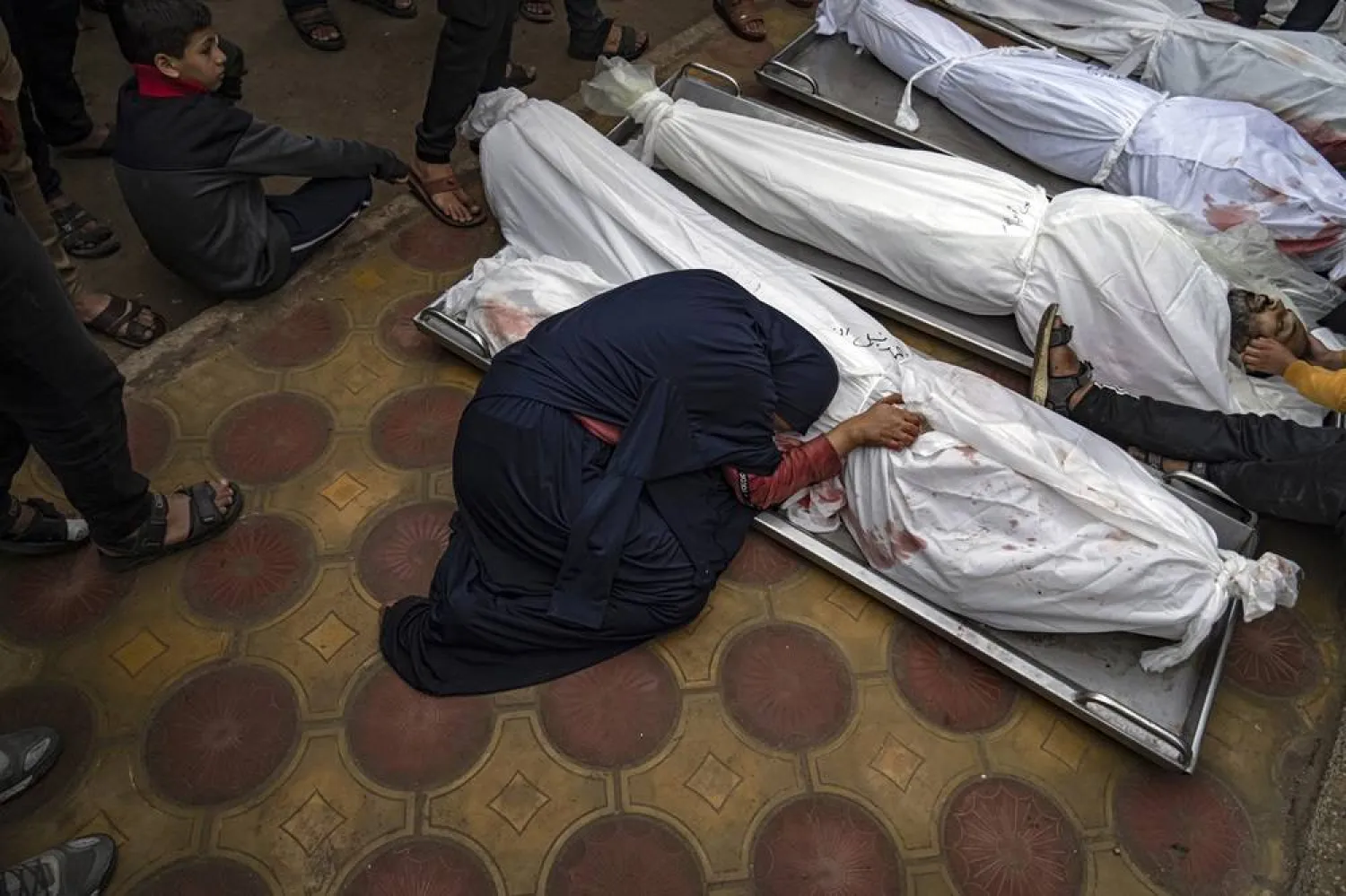
A woman mourns the covered bodies of her child and her husband killed in an Israeli army bombardment of the Gaza Strip, in the hospital in Khan Younis, Tuesday Dec. 5, 2023. (AP)
TT

More than 40,000 Palestinians Have Been Killed in Gaza, Territory’s Health Ministry Says

A woman mourns the covered bodies of her child and her husband killed in an Israeli army bombardment of the Gaza Strip, in the hospital in Khan Younis, Tuesday Dec. 5, 2023. (AP)

More than 40,000 Palestinians have been killed in the Israel-Hamas war in Gaza, the territory’s Health Ministry said Thursday.

Israel’s offensive has also wounded 92,401 people and displaced over 85% of the population from their homes, the ministry in Hamas-run Gaza said. It does not distinguish between civilians and militants in its toll.

The announcement came during yet another push from international mediators to broker a ceasefire in the war, now in its 11th month.

The conflict began Oct. 7 after Hamas-led fighters attacked southern Israel, killing some 1,200 people — most of them civilians — and dragging roughly 250 hostages to Gaza.

Israel says 111 of the captives have not been released, including the bodies of 39. The hostages include 15 women and two children under the age of 5.

In Gaza, health officials have struggled to fully identify the dead as bodies stream into overwhelmed hospitals and morgues where they say the count is compiled amid the chaos of war and displacement.

In its most recent detailed report on the dead, issued Thursday, the ministry said 40,005 people have been killed. Health officials and civil defense workers say the true toll is likely thousands higher, since many bodies remain buried under the rubble of buildings destroyed in airstrikes.

Israel’s air and ground offensive in Gaza has been one of the most devastating military campaigns in recent history.

The bombardment and shelling have killed entire Palestinian families. With cemeteries often unreachable, families fleeing Israeli airstrikes bury their dead wherever possible — in backyards, along roadsides and under the staircases of their homes.

Israel says it aims to eliminate Hamas. It blames Hamas for civilian deaths because fighters operate in civilian areas and have built extensive tunnel networks underneath them. Israeli forces have regularly targeted mosques, schools, hospitals and cemeteries where it claims fighters or tunnels are located, often causing civilian casualties.

The fighting has also killed 329 Israeli soldiers. The Israeli military claims around 15,000 Hamas fighters are among those killed in Gaza but has not provided evidence.

Nearly 85% of Gaza’s 2.3 million people have been driven from their homes, fleeing multiple times across the territory to escape ground offensives. During the war, thousands within Israel and in southern Lebanon have also been displaced.

The assault has created a massive humanitarian crisis in Gaza. The entire territory is at high risk of famine and over 495,000 people — more than a fifth of the population — are expected to experience the most severe level of hunger in the next months, according to the latest report by the leading authority on measuring hunger.

Sanitation systems have been destroyed, leaving pools of sewage and towers of garbage in tent camps packed with displaced families.

The offensive likely either damaged or destroyed 59% of all structures in Gaza by July 3, including 70% of buildings in north Gaza, according to an analysis of satellite data by Corey Scher and Jamon Van Den Hoek, experts in mapping damage during war.

The conflict has sparked fears of a wider regional war, with Lebanon’s Hezbollah and the Israeli military trading fire almost daily over their countries’ border.

More than 500 people have been killed on the Lebanese side, including some 350 Hezbollah members and 50 fighters from other armed groups, with the rest civilians. In Israel, 22 soldiers and 24 civilians have been killed.



Germany’s Merz Urges Netanyahu to End Lebanon Fighting

 German Chancellor and leader of Germany's Christian Democratic Union (CDU) Friedrich Merz attends the CDU's leadership meeting at the party's headquarters in Berlin, on April 13, 2026. (AFP)
German Chancellor and leader of Germany's Christian Democratic Union (CDU) Friedrich Merz attends the CDU's leadership meeting at the party's headquarters in Berlin, on April 13, 2026. (AFP)
TT

Germany’s Merz Urges Netanyahu to End Lebanon Fighting

 German Chancellor and leader of Germany's Christian Democratic Union (CDU) Friedrich Merz attends the CDU's leadership meeting at the party's headquarters in Berlin, on April 13, 2026. (AFP)
German Chancellor and leader of Germany's Christian Democratic Union (CDU) Friedrich Merz attends the CDU's leadership meeting at the party's headquarters in Berlin, on April 13, 2026. (AFP)

German Chancellor Friedrich Merz urged Israeli Prime Minister Benjamin Netanyahu on Monday to end fighting in southern Lebanon and engage in direct peace talks with the Lebanese government, a spokesman said.

Merz also expressed his "grave concern" about developments in the Palestinian territories in a telephone conversation with Netanyahu and demanded that there "must be no de facto partial annexation of the West Bank", the German government spokesman said.

The spokesman said Merz offered Germany's continuing support for efforts "to reach a diplomatic understanding between the United States and Iran" in the war launched by Israel and the US on February 28.

Merz initially welcomed the US-Israeli attacks, but has shifted to alarm as the potential global economic fallout became more serious and Iranian retaliatory strikes against Gulf states threatened to turn the conflict into a regional war.

On Monday, Merz told Netanyahu that "Germany is prepared to contribute to ensuring freedom of navigation in the Strait of Hormuz" -- but only following the "cessation of hostilities" and "provided the necessary conditions are met", according to the spokesman's summary of the conversation.

Shipping through the Strait of Hormuz -- a crucial waterway for about 20 percent of the world's oil supplies before the war -- has been largely halted by Iranian threats to strike tankers.

US President Donald Trump has declared a partial naval blockade of the strait after negotiations with Iran over the weekend broke down.


Hezbollah Leader Asks Lebanon to Cancel Tuesday Meeting with Israel

Israeli army excavators demolish buildings in the southern Lebanese village of Mais al-Jabal, as seen from the Israeli side of the border, 13 April 2026. (EPA)
TT

Hezbollah Leader Asks Lebanon to Cancel Tuesday Meeting with Israel

Israeli army excavators demolish buildings in the southern Lebanese village of Mais al-Jabal, as seen from the Israeli side of the border, 13 April 2026. (EPA)

Hezbollah leader Naim Qassem urged Lebanon to cancel a planned meeting with Israel in Washington on Tuesday, reiterating his group's rejection of direct negotiations with its foe.

Israeli strikes have killed more than 2,000 people in Lebanon and displaced more than a million since the Iran-backed group Hezbollah drew the country into the Middle East war.

The Lebanese and Israeli ambassadors to the United States are scheduled to meet in Washington on Tuesday to discuss holding direct negotiations between the two countries.

Lebanese authorities have stressed that Beirut first wants to secure a ceasefire in the Israel-Hezbollah war, but Israel has dismissed that prospect, saying it prefers instead to focus on formal peace talks with Lebanon itself, with which it has technically been at war for decades.

"We reject negotiations with the usurping Israeli entity," Hezbollah's Qassem, whose group has been at war with Israel since March 2, said in a televised address on Monday.

"We call for a historic and heroic stance by cancelling this negotiating meeting."

- 'Dismantle Hezbollah' -

Israeli Prime Minister Benjamin Netanyahu said Saturday that "we want the dismantling of Hezbollah's weapons, and we want a real peace agreement that will last for generations".

Qassem, however, said "these negotiations are futile and require a Lebanese agreement and consensus".

Hundreds of Hezbollah supporters protested on Friday and Saturday against the planned talks, accusing Lebanese Prime Minister Nawaf Salam of being a "Zionist".

"We will not surrender, we will remain in the field until our last breath," Qassem said as his fighters faced off with advancing Israeli troops seeking to create a "security zone" in southern Lebanon.

The Israeli army said on Monday that its troops had completely surrounded the key southern town of Bint Jbeil, while Hezbollah continued to claim attacks against Israeli forces there.

The Israeli military said Tuesday a soldier had been killed in southern Lebanon -- the first since a US-Iran temporary truce came into force that Israel insisted does not include the country.

Qassem said northern Israeli localities "will not be safe, even if the Israelis were to enter any area of Lebanon".

He also accused Beirut of "backstabbing" his group by declaring its military activities illegal at the start of the war.

"Israel and the US clearly said they want to strengthen the Lebanese army to disarm and fight Hezbollah... but the army cannot do that," Qassem added.


French Cement Maker Lafarge Found Guilty of Financing Extremists in Syria

13 July 1995, Saxony-Anhalt, Karsdorf: French cement manufacturer Lafarge logo pictured in Karsdorf on railroad containers. (dpa)
TT

French Cement Maker Lafarge Found Guilty of Financing Extremists in Syria

13 July 1995, Saxony-Anhalt, Karsdorf: French cement manufacturer Lafarge logo pictured in Karsdorf on railroad containers. (dpa)

A Paris court on Monday found cement maker Holcim's Lafarge unit guilty of charges that its Syrian subsidiary financed terrorism and breached European sanctions to keep a plant operating in northern Syria during the country's civil war.

The case was the first time a company has been tried in France for financing terrorism. Sherpa and ECCHR, two organizations that filed the initial lawsuit, in a joint statement called it "a historic decision in the fight against multinational corporations' impunity".

Eight former Lafarge employees were found guilty, including former CEO Bruno Lafont, who was sentenced to six years in jail. His lawyer told Reuters he would appeal.

A lawyer for Christian Herrault, the former deputy managing director of the Lafarge group who was sentenced to five ‌years in jail, said ‌Herrault would also appeal.

Judges determined that Lafarge in total paid 5.59 ‌million euros ($6.54 ⁠million) to extremist ⁠groups including ISIS and the al-Qaeda-affiliated Nusra Front, both designated as terrorists by the European Union, between 2013 and September 2014.

The presiding judge, Isabelle Prevost-Desprez, said the payments made by Lafarge helped to strengthen extremist groups that carried out deadly attacks in Syria and beyond.

'COMMERCIAL PARTNERSHIP' WITH ISIS

"It is clear to the court that the sole purpose of the funding of a terrorist organization was to keep the Syrian plant running for economic reasons. Payments to terrorist entities enabled Lafarge to continue its operations," Prevost-Desprez said.

"These ⁠payments took the form of a genuine commercial partnership with the ‌ISIS," she added.

The cement maker was ordered to pay a ‌1.125 million euro ($1.32 million) fine, the maximum penalty available for a company, as prosecutors had requested.

"Lafarge SA ‌acknowledges the court's finding, which concerns a legacy matter involving conduct that occurred more than a decade ‌ago and was in flagrant violation of Lafarge's Code of Conduct," the company said in a statement.

"The decision is an important milestone in Lafarge SA’s actions to address this legacy matter responsibly and the company is reviewing the court’s reasoning."

Holcim did not immediately respond to a request for comment.

It was not immediately clear whether ‌the other former employees found guilty would also appeal. They were handed sentences ranging from one to seven years, as well as fines.

The Jalabiya ⁠plant, located in northern ⁠Syria and bought by Lafarge in 2008 for $680 million, began operating in 2010, months before the beginning of the Syrian uprising in early 2011.

Employees were housed in the nearby town of Manbij and needed to cross the Euphrates River to access the plant. Among the payments, the court found more than 800,000 euros were paid to secure safe passage.

Another 1.6 million euros were used to purchase source materials from quarries that were under ISIS control, the court said.

Lafarge became part of Switzerland-listed Holcim in 2015.

In a separate case in the United States, Lafarge admitted in 2022 that its Syrian subsidiary paid $6 million to ISIS and the Nusra Front to allow employees, customers and suppliers to pass through checkpoints after civil conflict broke out in Syria.

The group paid $778 million in forfeiture and fines as part of its US plea agreement.

Lafarge is also under investigation in France for complicity in crimes against humanity over how the company kept its factory running in Syria.