


Blinken Says Israel Agrees to a US-Backed Proposal for a Ceasefire, Calls on Hamas to Do Same

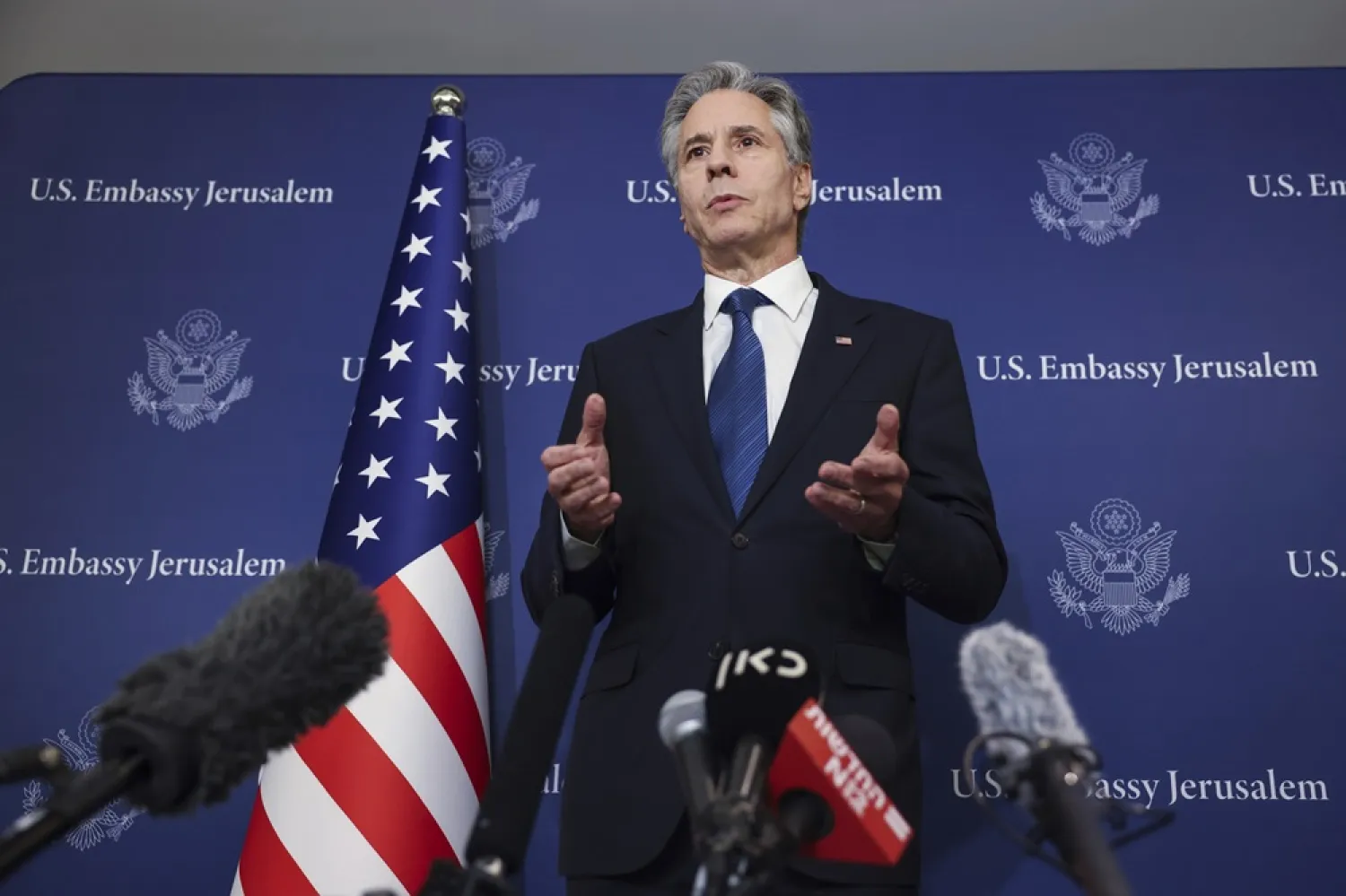
US Secretary of State Antony Blinken speaks to media at the David Kempinski Hotel in Tel Aviv, Israel, Monday, Aug. 19, 2024. (AP)
TT

Blinken Says Israel Agrees to a US-Backed Proposal for a Ceasefire, Calls on Hamas to Do Same

US Secretary of State Antony Blinken speaks to media at the David Kempinski Hotel in Tel Aviv, Israel, Monday, Aug. 19, 2024. (AP)

US Secretary of State Antony Blinken said Monday that Israel has accepted a proposal to bridge differences holding up a ceasefire and hostage release in Gaza, and he called on Hamas to do the same, without saying whether it had addressed concerns cited by the militant group.

Blinken spoke after holding a two-and-a-half hour meeting with Israeli Prime Minister Benjamin Netanyahu earlier in the day, and was expected to travel to Egypt on Tuesday. The United States, Egypt and Qatar have spent months trying to broker an agreement, with the talks repeatedly stalling.

He did not say whether the so-called bridging proposal addressed Israel's demands for control over two strategic corridors inside Gaza, which Hamas has said is a nonstarter, or other issues that have long bedeviled the negotiations.

"In a very constructive meeting with Prime Minister Netanyahu today, he confirmed to me that Israel supports the bridging proposal," Blinken told reporters. "The next important step is for Hamas to say ‘yes.’"

Blinken had earlier said the time is now to conclude a Gaza ceasefire agreement that would return hostages held by Hamas and bring relief to Palestinian suffering after more than 10 months of devastating fighting in Gaza.

Blinken's ninth mission to the Middle East since the conflict began came days after mediators, including the United States, expressed renewed optimism that a deal was near. But Hamas has expressed deep dissatisfaction with the latest proposal, and Israel has said there were points on which it was unwilling to compromise.

The trip, days before new talks expected this week in Egypt, came amid fears that the conflict could widen into a deeper regional war following the targeted killing of two top militants in Lebanon and Iran that were attributed to Israel.

"This is a decisive moment, probably the best, maybe the last, opportunity to get the hostages home, to get a ceasefire and to put everyone on a better path to enduring peace and security," Blinken said as he opened talks with Israeli President Isaac Herzog in Tel Aviv.

"It’s also time to make sure that no one takes any steps that could derail this process," he said in a veiled reference to Iran. "And so, we’re working to make sure that there is no escalation, that there are no provocations, that there are no actions that in any way move us away from getting this deal over the line, or for that matter, escalating the conflict to other places and to greater intensity."

Herzog thanked Blinken for the Biden administration's support for Israel and lamented a spate of recent attacks against Israelis in the past 24 hours.

"This is the way we are living these days," Herzog said. "We are surrounded by terrorism from all four corners of the earth and we are fighting back as a resilient and strong nation."

Mediators will meet again this week in Cairo to try to cement a ceasefire. Blinken will travel to Egypt on Tuesday for meetings in the Mediterranean city of el-Alamein after he wraps up his Israel stop.

He met one-on-one with Netanyahu on Monday and with Defense Minister Yoav Gallant later in the day.

The war began on Oct. 7 when Hamas-led fighters broke into Israel, killing around 1,200 people, mostly civilians, and abducting around 250 others. Of those, about 110 are still believed to be in Gaza, though Israeli authorities say around a third are dead. More than 100 hostages were released in November during a weeklong ceasefire.

Israel's counterattack in Gaza has killed more than 40,000 Palestinians, according to local health authorities, and devastated much of the territory.

Late last week, the three countries mediating the proposed ceasefire — Egypt, Qatar and the US —reported progress on a deal under which Israel would halt most military operations in Gaza and release a number of Palestinian prisoners in exchange for the release of hostages.

Shortly before Blinken arrived in Tel Aviv on Sunday, Netanyahu told a Cabinet meeting there are areas where Israel can be flexible and unspecified areas where it won’t be.

"We are conducting negotiations and not a scenario in which we just give and give," he said.

The evolving proposal calls for a three-phase process in which Hamas would release all hostages abducted during its Oct. 7 attack. In exchange, Israel would withdraw its forces from Gaza and release Palestinian prisoners.

Hamas accuses Israel of adding new demands that it maintain a military presence along the Gaza-Egypt border to prevent arms smuggling and along a line bisecting the territory so it can search Palestinians returning to their homes in the north. Israel said those weren't new demands, but clarifications of a previous proposal.

Officials said the US has presented proposals to bridge all the gaps remaining between the Israeli and Hamas positions. Formal responses to the US outline are expected this week and could lead to a ceasefire declaration unless the talks stall, as has happened with multiple previous efforts.

Late Sunday, Hamas said in a statement that Netanyahu has continued to set obstacles to a deal by demanding new conditions, accusing him of wanting to prolong the war. It said the mediators’ latest offer was a capitulation to Israel.

"The new proposal responds to Netanyahu’s conditions," Hamas said.

Blinken said Monday both sides should take this opportunity to reach a deal.

"It is time for everyone to get to ‘yes’ and to not look for any excuses to say ‘no,’" he said.

An Israeli delegation held talks with Egyptian officials as part of the truce efforts, an Egyptian official said Monday.

The hourslong meeting Sunday focused on the Philadelphi corridor along the Gaza-Egypt border, but didn’t achieve a breakthrough, according to the official, who spoke on condition of anonymity to discuss the ongoing negotiations.

The official said that Israel still insists on keeping control of the border and the east-west route that bisects Gaza. He said that the delegation didn’t offer anything new in their meeting.



Egypt Urges Int’l Support for Lebanese Army to Ensure State Exclusivity over Arms

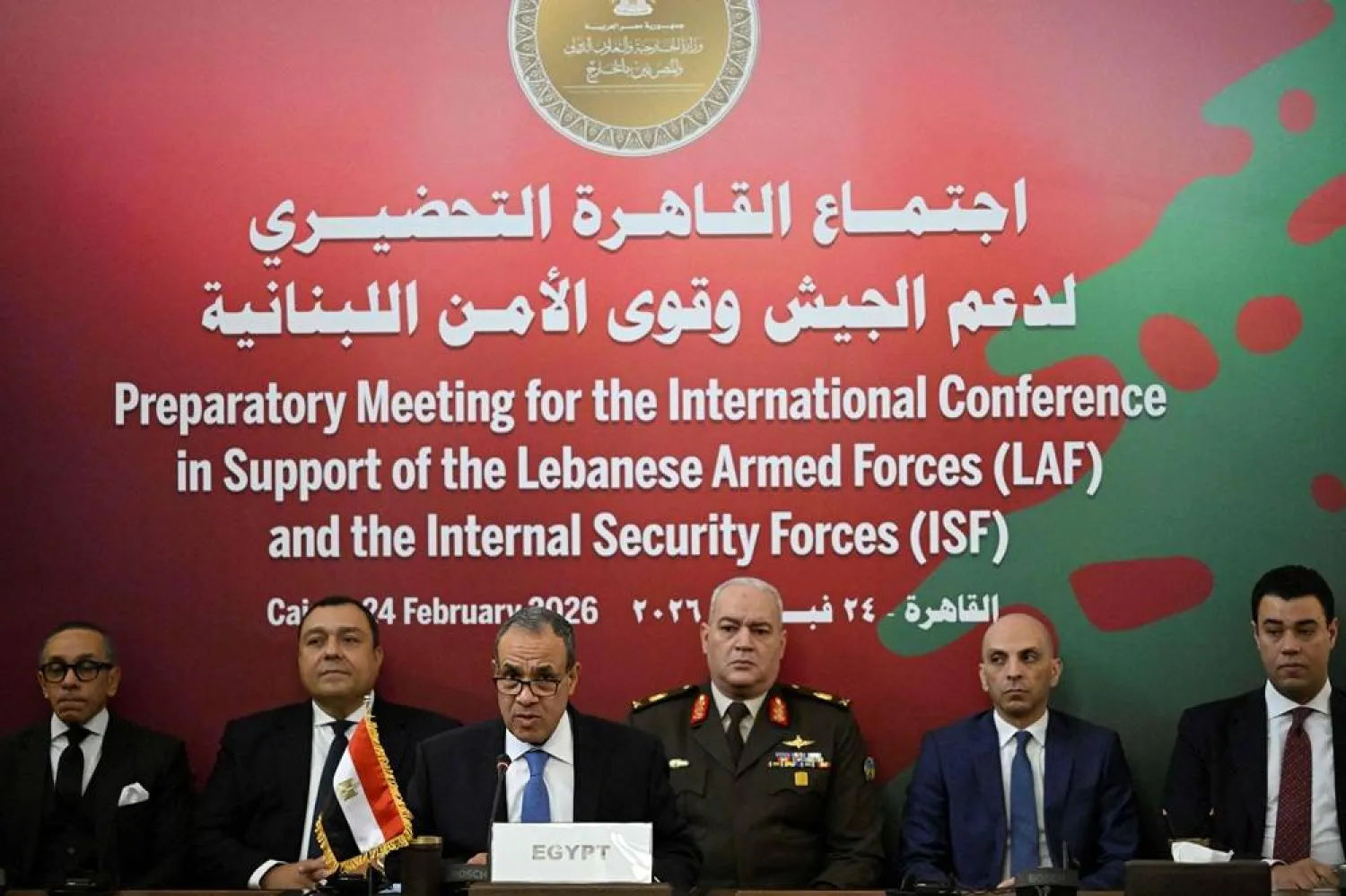
Egyptian Foreign Minister Badr Abdelatty (3rd L) speaks before representatives of participating countries during the preparatory meeting for the international conference in support of the Lebanese Armed Forces (LAF) and the Internal Security Forces (ISF) in Cairo on February 24, 2026. (AFP)
TT

Egypt Urges Int’l Support for Lebanese Army to Ensure State Exclusivity over Arms

Egyptian Foreign Minister Badr Abdelatty (3rd L) speaks before representatives of participating countries during the preparatory meeting for the international conference in support of the Lebanese Armed Forces (LAF) and the Internal Security Forces (ISF) in Cairo on February 24, 2026. (AFP)

Egypt on Tuesday urged the international community to better support Lebanon's armed forces as the country moves forward with a plan to disarm Hezbollah and bring all weapons under state control. 

Speaking at a preparatory meeting in Cairo ahead of next month's Paris conference in support of the Lebanese army, Egypt's Foreign Minister Badr Abdelatty praised "the success of the Lebanese army in completing the first phase of the plan". 

"This achievement reflects the efficiency of the military institution and requires intensifying international support to complete the remaining phases of the plan," Abdelatty said. 

Lebanon's government last year committed to disarming Hezbollah, which was badly weakened in a recent war with Israel, and tasked the army with drawing up a plan to do so. 

Lebanon has since received promises of support, amid a shortage of equipment, personnel and technical capabilities needed to carry out the army's mission. 

Though its capabilities are limited, the military has worked to dismantle Hezbollah facilities and tunnels and confiscate weapons in the last few months. 

It declared in January the completion of the first phase of its plan, which tackled the area south of the Litani river, located around 30 kilometers (20 miles) north of Israel. 

Lebanon's military now intends to tackle the area north of the river as the second phase of its plan, having said last week that it would need at least four months to finish the job. 

Abdelatty said Tuesday's meeting aimed "to enable the Lebanese state to ensure that all weapons are held exclusively by the state". 

The meeting brought together Lebanon's top security chiefs, including Army Commander General Rodolphe Haykal and Internal Security Forces Director-General Major General Raed Abdallah. 

They were joined by representatives of the Quintet Committee on Lebanon, among them Qatar's state minister for foreign affairs Mohammed bin Abdulaziz al-Khulaifi, French envoy Jean-Yves Le Drian and Saudi Arabia's envoy to Beirut Prince Yazid bin Farhan, along with senior officials from the United States. 

At a separate meeting with Le Drian, Abdelatty stressed the need for what he described as a comprehensive international approach to the crisis in Lebanon. 

"There is no path to restoring stability except by obliging Israel to immediately halt its aggression" and "fully withdraw from occupied Lebanese territories," he said. 

Israel, which accuses Hezbollah of rearming, has criticized the army's progress as insufficient, and has kept up regular strikes on Lebanon despite a November 2024 ceasefire that sought to end more than a year of hostilities with the group. 


About 6.5 Million People in Somalia Face Acute Hunger Due to Drought, Govt and UN Say

 Lime is displayed for sale at an open-air grocery market as Muslims start the fasting month of Ramadan within Bakara market in Mogadishu, Somalia February 18, 2026. (Reuters)
Lime is displayed for sale at an open-air grocery market as Muslims start the fasting month of Ramadan within Bakara market in Mogadishu, Somalia February 18, 2026. (Reuters)
TT

About 6.5 Million People in Somalia Face Acute Hunger Due to Drought, Govt and UN Say

 Lime is displayed for sale at an open-air grocery market as Muslims start the fasting month of Ramadan within Bakara market in Mogadishu, Somalia February 18, 2026. (Reuters)
Lime is displayed for sale at an open-air grocery market as Muslims start the fasting month of Ramadan within Bakara market in Mogadishu, Somalia February 18, 2026. (Reuters)

About 6.5 million people in Somalia ‌face acute hunger due to drought, the government and the United Nations said on Tuesday, sounding the alarm days after the UN's food agency warned that food aid could grind to a halt by April without new funding.

Somalia declared a national drought emergency in November after years of failed rains, and other countries in the region have also been hit.

More than a third of those facing acute malnutrition are children, Somalia's government and the United Nations Somalia said in a joint statement. The crisis has forced tens of thousands of ‌people to ‌flee their homes, with many crowding into camps ‌in ⁠Mogadishu and other ⁠cities.

"The drought ... has deepened alarmingly, with soaring water prices, limited food supplies, dying livestock, and very little humanitarian funding," George Conway, the UN's Humanitarian Coordinator for Somalia, said in a statement.

Hawo Abdi said she lost two children to illness after the drought laid waste to her homeland in Somalia's Bay region.

"When I saw that the suffering ⁠was getting worse, I fled my home and ‌came to ... Mogadishu," she told Reuters ‌from her shelter on the outskirts of the capital.

Last week, the UN World Food Program put the number of those facing acute hunger ‌at 4.4 million, and said it had already cut back its assistance to just over 600,000 people from 2.2 million earlier this year.

It was not clear whether the new figure reflected a sharp increase in those ‌at risk or different counting methods.

The government and United Nations figures tally with those also released on ⁠Tuesday by ⁠the Integrated Food Security Phase Classification (IPC), which sets the global standard for determining the severity of a food crisis.

While rainfall in the April to June season could offer some relief, some 5.5 million people were expected to remain in the crisis level or worse, with 1.6 million people in the emergency level, the statement said.

Abdiyo Ali was forced to abandon her farm in the Lower Shabelle region.

"Our farms were destroyed, our livestock died, and water sources became too far away. We have nothing left to bring with us," Ali told Reuters last week while preparing her food in a displaced people's camp outside Mogadishu.


Lebanon Fears Israeli Strikes if Iran Situation Escalates

 Lebanese Foreign Minister Youssef Raggi addresses the Human Rights Council in Geneva, Switzerland, Tuesday, Feb. 24, 2026. (AP)
Lebanese Foreign Minister Youssef Raggi addresses the Human Rights Council in Geneva, Switzerland, Tuesday, Feb. 24, 2026. (AP)
TT

Lebanon Fears Israeli Strikes if Iran Situation Escalates

 Lebanese Foreign Minister Youssef Raggi addresses the Human Rights Council in Geneva, Switzerland, Tuesday, Feb. 24, 2026. (AP)
Lebanese Foreign Minister Youssef Raggi addresses the Human Rights Council in Geneva, Switzerland, Tuesday, Feb. 24, 2026. (AP)

Lebanon's foreign minister said Tuesday his country feared its infrastructure could be hit by Israeli strikes if the situation with Iran escalates, as Israel has intensified its attacks on Tehran-backed Hezbollah.

Also on Tuesday, Lebanon's army accused the Israeli military of firing near a position it was setting up in the country's south, saying it had instructed troops to return fire.

"There are signs that the Israelis could strike very hard in the event of an escalation, potentially including strategic infrastructure such as the airport," foreign minister Youssef Raggi told reporters in Geneva.

His comments came amid a massive US military buildup in the Middle East that suggested Washington was prepared to wage a potentially sustained campaign against Iran.

Iran vowed on Monday to retaliate "ferociously" against any attack from the United States, and repeated its warning of a regional conflagration in response to President Donald Trump's latest threat of strikes.

"We are currently conducting diplomatic efforts to request that, even in the event of retaliation, Lebanese civilian infrastructure not be targeted," Raggi said.

He stressed that his country's leadership had been very clear: "This war does not concern us."

A Lebanese official who requested anonymity said "what the Lebanese fear is a chain reaction: an American strike against Iran, a Hezbollah retaliatory strike against Israel, followed by a massive Israeli response."

- Israeli strikes -

Israel has kept up regular strikes on Lebanon despite a November 2024 ceasefire that sought to halt more than a year of hostilities with Iran-backed Hezbollah, usually saying it was targeting the group.

Last Friday, Israel carried out deadly strikes on what it called Hezbollah positions in eastern Lebanon and targets linked to the Palestinian group Hamas in the south.

Hezbollah said Saturday that eight of its fighters had been killed, and vowed "resistance".

Its leader Sheikh Naim Qassem stated last month that any attack on Tehran would also be an attack on Hezbollah.

On Monday, Washington ordered non-emergency personnel to leave its embassy in Lebanon's capital Beirut as anticipation rose of a possible conflict with Iran.

On Tuesday, Lebanon's army said it was "establishing a new observation post on the southern border" when "the area surrounding the post was subjected to gunfire from the Israeli side".

"The army command issued orders to reinforce the post, remain there, and return fire."

On the same day in Cairo, a preparatory meeting was held ahead of a conference in Paris next month to back Lebanon's army, which is facing heavy pressure from Washington and Israel to disarm Hezbollah.

Egyptian Foreign Minister Badr Abdelatty said that Tuesday's meeting aimed "to enable the Lebanese state to ensure that all weapons are held exclusively by the state".

Lebanon's government last year committed to disarming Hezbollah, which was badly weakened in a recent war with Israel, and tasked the army with drawing up a plan to do so.

The army, which has limited capabilities, declared in January the completion of the first phase of its plan near the border with Israel.

It said last week it would need at least four months to complete the second phase.

Israel, which accuses Hezbollah of rearming, has criticized the army's progress as insufficient.