


Salvagers Abandon Effort to Tow Burning Oil Tanker in Red Sea Targeted by Houthis in Yemen

 A satellite view shows smoke and flames rising from the Sounion oil tanker on the Red Sea, August 29, 2024. (Maxar Technologies/Handout via Reuters)
A satellite view shows smoke and flames rising from the Sounion oil tanker on the Red Sea, August 29, 2024. (Maxar Technologies/Handout via Reuters)
TT

Salvagers Abandon Effort to Tow Burning Oil Tanker in Red Sea Targeted by Houthis in Yemen

 A satellite view shows smoke and flames rising from the Sounion oil tanker on the Red Sea, August 29, 2024. (Maxar Technologies/Handout via Reuters)
A satellite view shows smoke and flames rising from the Sounion oil tanker on the Red Sea, August 29, 2024. (Maxar Technologies/Handout via Reuters)

Salvagers abandoned an initial effort to tow away a burning oil tanker in the Red Sea targeted by Yemen's Houthi militias as it “was not safe to proceed,” a European Union naval mission said Tuesday, leaving the Sounion stranded and its 1 million barrels of oil at risk of spilling.

While a major spill has yet to occur, the incident threatens to become one of the worst yet in the Iranian-backed Houthis’ campaign that has disrupted the $1 trillion in goods that pass through the Red Sea each year over the Israel-Hamas war in the Gaza Strip. It also has halted some aid shipments to conflict-ravaged Sudan and Yemen.

“The private companies responsible for the salvage operation have concluded that the conditions were not met to conduct the towing operation and that it was not safe to proceed,” the EU’s Operation Aspides mission said, without elaborating. “Alternative solutions are now being explored by the private companies.”

The EU mission did not respond to questions from The Associated Press about the announcement. The safety issue could be the fire burning aboard the vessel. Satellite images from Planet Labs PBC taken Tuesday afternoon and analyzed by the AP showed the Sounion still ablaze.

The US State Department has warned a spill from the Sounion could be “four times the size of the Exxon Valdez disaster” in 1989 off Alaska.

Meanwhile, there's the threat of attacks by the Houthis, who on Monday targeted two other oil tankers traveling through the Red Sea. The Houthis have suggested they'll allow a salvage operation to take place, but critics say the rebels have used the threat of an environmental disaster previously involving another oil tanker off Yemen to extract concessions from the international community.

The Houthis initially attacked the Greek-flagged Sounion tanker on Aug. 21 with small arms fire, projectiles and a drone boat. A French destroyer operating as part of Operation Aspides rescued its crew of 25 Filipinos and Russians, as well as four private security personnel, after they abandoned the vessel and took them to nearby Djibouti.

Last week, the Houthis released footage showing they planted explosives on board the Sounion and ignited them in a propaganda video, something the militias have done before in their campaign.

The Houthis have targeted more than 80 merchant vessels with missiles and drones since the war in Gaza started in October. They seized one vessel and sank two in the campaign that has also killed four sailors. Other missiles and drones have either been intercepted by a US-led coalition in the Red Sea or failed to reach their targets, which have included Western military vessels as well.

The Houthis maintain that they target ships linked to Israel, the US or the UK to force an end to Israel’s campaign against Hamas in Gaza. However, many of the ships attacked have little or no connection to the conflict, including some bound for Iran.

There no American vessels known to be in the Red Sea at the moment as the EU mission has taken charge after the Sounion attack. A US defense official, who spoke to the AP on condition of anonymity to discuss information not made public, said the American military has not been asked and has no role in the cleanup or the towing of the Sounion.

The USS Dwight D. Eisenhower recently served a monthslong deployment in the Red Sea, facing the most intense, continuous combat the US Navy has been seen since World War II while fighting against the Houthis.

Two US aircraft carriers, the USS Theodore Roosevelt and the USS Abraham Lincoln, along with their carrier groups, are in the Gulf of Oman to counter a threatened Iranian retaliation against Israel over the assassination of Hamas leader Ismail Haniyeh in Tehran.

The Houthis' attacks likely will continue until there's a ceasefire in Gaza, warned Matthew Bey, a senior analyst at the RANE Group, a risk consultancy. Even then, there's a risk that the militias will continue the attacks.

“The Houthis have learned quite a bit from what they’ve been doing over the last year — it’s been a very significant recruiting boon for them,” Bey told the AP. “I think there are a lot of incentives for them to target shipping in the future because they’ve learned that they can be very successful in that. It brings in the West, which is kind of the enemy that they want to fight to some degree as well.”



Hamas to Seek Changes in Response to Disarmament Plan

Smoke rises from a site hit by an Israeli strike near a camp for displaced people in Deir al-Balah in central Gaza Strip last Wednesday (AP)
TT

Hamas to Seek Changes in Response to Disarmament Plan

Smoke rises from a site hit by an Israeli strike near a camp for displaced people in Deir al-Balah in central Gaza Strip last Wednesday (AP)

Sources in Hamas and other Palestinian factions say there’s growing pessimism over a plan presented by the high representative of the US-backed Board of Peace, Nikolay Mladenov, to the movement’s leadership, proposing the full and unconditional disarmament of the Gaza Strip.

Two Hamas sources, inside and outside Gaza, told Asharq Al-Awsat the group is leaning toward partially rejecting the plan and will push for amendments to make it more equitable for Palestinians.

They said it does not clearly bind Israel to carry out the second phase, or even complete the first.

A third Hamas source and a senior Palestinian faction figure in Gaza said internal discussions are ongoing within each faction and at a broader national level.

Despite major reservations, they said the proposal would be handled positively while safeguarding Palestinian rights.

A unified response is expected, they added, one that stops short of full approval and instead seeks clarifications, guarantees and clear changes to several provisions.

Although the plan, reported by some media outlets and confirmed by sources, refers to “step-by-step” implementation by both sides, Hamas and other factions believe it favors Israel and does not compel it to meet its obligations.

The sources said it aims to fully disarm Gaza, including light, heavy and even personal weapons that individuals wanted by Israel may retain for self-defense.

Another senior faction source said the plan seeks to reshape Gaza’s political and security landscape and dismantle the “resistance” structure, offering in return only humanitarian and administrative measures that do not preserve Palestinians’ political and national rights.

The “step-for-step” principle, the source said, is largely symbolic, requiring factions to take strategic steps including full disarmament, surrendering all powers, halting any military activity and potentially restricting political activity under various pretexts.

It would also require factions to dismantle their own tunnels in areas under their control in exchange for temporary humanitarian packages.

A Hamas source in Gaza said disarmament “in this way” is unacceptable, arguing that Israel is imposing its conditions without regard for Palestinian demands.

The source said individuals wanted by Israel and leading activists must retain at least personal weapons for self-defense, citing ongoing Israeli special forces operations and armed groups accused of carrying out assassinations.

Such a scenario, the source said, could allow Israel to carry out killings while attributing them to ordinary criminal acts.

The plan’s general principles call for completing outstanding commitments from the first phase without delay and allowing the entry of reconstruction materials, including dual-use items, into areas verified as disarmed and placed under a national committee.

Hamas sees this as linking reconstruction and access to areas in Gaza with the surrender of weapons.

Hamas sources said this contradicts a plan by US President Donald Trump presented to the group during ceasefire talks last September, noting the original proposal called for setting weapons aside under a negotiated framework, not imposing disarmament through what they described as threats.

They added that the Board of Peace plan does not require a full Israeli withdrawal; instead, it outlines a partial, phased pullback without clear benchmarks.

It also falls short of committing to genuine reconstruction, focusing mainly on temporary housing such as caravans, while allowing construction materials in unspecified quantities and without clarifying whether they would support the comprehensive rebuilding of homes and civilian infrastructure.

According to the sources, the plan allows Israel to take military action if the national committee fails to carry out its duties, to address what it describes as a “serious potential threat” in areas declared disarmed. Hamas views this as giving Israel room to justify operations similar to those it currently conducts against Palestinian factions.

Among Hamas’s objections is the Board of Peace’s insistence that no government employees affiliated with the movement serve on the committee that would administer Gaza. The issue was discussed during a recent meeting in Cairo between Hamas leaders and Mladenov and remains under further negotiation.

The plan stipulates that Hamas must cease exercising any civil or security authority in Gaza and refrain from governance, policing and administrative functions.

Hamas is seeking an arrangement under which its civil servants would be integrated after security vetting, while senior officers and others rejected by Israel would be excluded from any governing role in Gaza.

Since Hamas leaders expressed anger at Mladenov, particularly following his remarks before the UN Security Council, the movement’s media outlets have stepped up efforts to promote its position, featuring interviews with faction figures, tribal leaders, analysts and writers to rally support for its stance.


After US Terror Listing, Sudan’s Brotherhood Faces Tough Choices

Sudan’s Islamist movement ruled with an iron grip for 30 years before a mass uprising that began on Dec. 19, 2018 toppled it (Reuters)
TT

After US Terror Listing, Sudan’s Brotherhood Faces Tough Choices

Sudan’s Islamist movement ruled with an iron grip for 30 years before a mass uprising that began on Dec. 19, 2018 toppled it (Reuters)

Sudan’s Muslim Brotherhood-linked Islamic Movement has remained silent after the US designated it a “foreign terrorist organization,” a decision that took effect on March 16.

Nearly two weeks later, the group’s leadership, at home and abroad, has issued no statement clarifying its position or the potential fallout.

The designation also covers the armed Al-Baraa bin Malik Brigade, raising questions in political and Islamist circles over the movement’s future and its options to contain the impact, politically or militarily, as well as how it will deal with the international community.

‘Political’ move

Former ambassador and Islamic Movement member Haj Majid Suwar dismissed the US move as “political,” saying it lacks objective grounds and aims to push the movement out of politics while weakening the Sudanese army by targeting a force aligned with it.

He said the Islamic Movement, though initially influenced by the Muslim Brotherhood, later carved out a Sudan-specific path and cut ties early with the international organization. He described it as moderate, with no record of terrorist activity or extremist links.

That contrasts with rights reports that have accused the movement, during its time in power, of abuses including detention and torture in so-called “ghost houses,” as well as other violations documented by human rights groups.

Suwar, who held senior posts under ousted president Omar al-Bashir, denied any organizational link between the movement and the Al-Baraa bin Malik Brigade, calling such claims attempts to sow confusion. He said the brigade is part of the Popular Defense Forces and reserve units formed in 1987, and that its role in the current war falls under general mobilization, not ideological or political affiliation.

Silence from leadership

Secretary-General Ali Ahmed Karti, a former foreign minister, has not commented. The brigade has also stayed silent despite attempts to reach its leadership.

The US decision says Misbah Abu Zaid Talha leads more than 20,000 fighters in the brigade, whose members are believed to have received training and support from Iran’s Revolutionary Guards.

The group has fought alongside the Sudanese army since the war erupted in April 2023 against the Rapid Support Forces.

Mohammed Badr al-Din, deputy head of the Popular Congress Party, said the designation was too broad and should have identified those directly driving the war and rejecting a political settlement.

He said authorities now face two hard choices: dissolve and ban the entities, risking internal confrontation, or try to sidestep the decision by changing names and fronts.

He warned that rebranding is unlikely to convince the international community, which is increasingly alert to such tactics, and could deepen Sudan’s isolation and economic pressure.

Analysts say a name change is one possible route. Islamist thinker Hassan Makki called it meaningless, describing the US move as largely symbolic with limited effect.

Suwar said a name change has long been discussed and did not rule it out, adding that dissolving the movement remains an option under its internal rules if leadership sees it as beneficial.

Jaafar Hassan, spokesperson for the “Somoud” (“Steadfastness”) Democratic Civil Alliance, said the designation marks the end of the Muslim Brotherhood’s influence in Sudan and the region.

He said it strips the group of legal cover, restricts its finances and members’ movement, and effectively removes it from politics while holding it responsible for the country’s worsening crisis and war.

Siddiq Farouk of the Sudanese Communist Party said successive US administrations had long dealt with the former regime before resorting to this step, suggesting the move could reshape political and economic influence and push the group toward deals with international actors to secure its survival.

With its leadership silent and scenarios diverging, the Islamic Movement faces a defining moment. Its next move, confrontation or adaptation, will be shaped by internal divisions and growing external pressure in a volatile landscape.


Houthis Join War by Launching Missiles at Israel

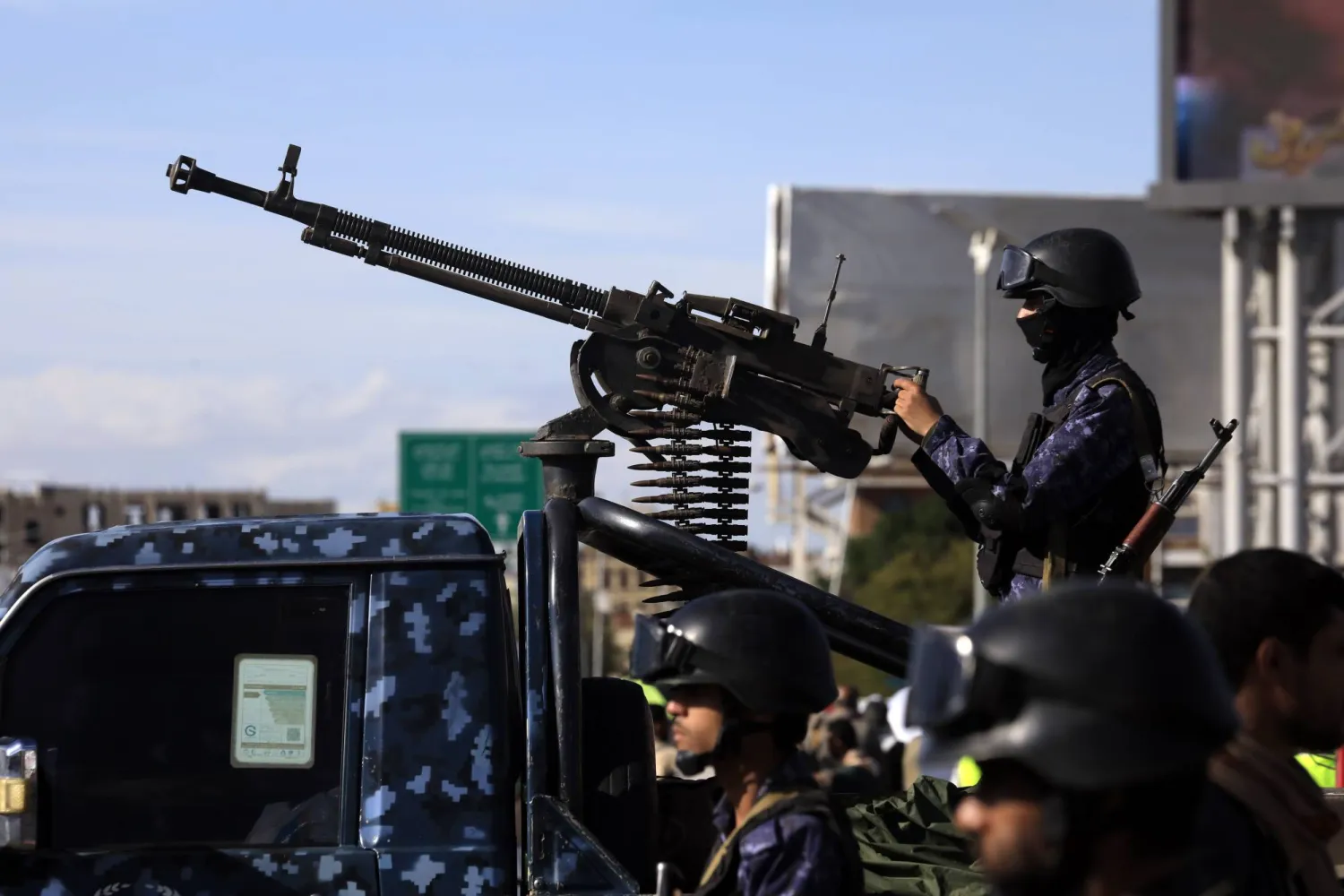
A Houthi member mans a machine gun on a pickup truck while on patrol during a rally in solidarity with Iran in Sanaa, Yemen, 27 March 2026. EPA/YAHYA ARHAB
TT

Houthis Join War by Launching Missiles at Israel

A Houthi member mans a machine gun on a pickup truck while on patrol during a rally in solidarity with Iran in Sanaa, Yemen, 27 March 2026. EPA/YAHYA ARHAB

Iranian-backed Houthi militias have claimed responsibility for a missile attack on Israel, their first such attack since the Iran war began.

Brig. Gen. Yahya Saree, a military spokesman for the Houthis, issued a statement on Saturday on the group’s Al-Masirah satellite television network.

Israel’s military had earlier said it had intercepted a missile.

The attack came after Saree signaled in a vague statement on Friday that the militias would join the war that has shocked the region and rattled the global economy.

It is the first time Israel has faced fire from Yemen since the start of the conflict last month. Houthi attacks on vessels during the Israel-Hamas war upended shipping in the Red Sea.

Before the attack from Yemen, there appeared to be a breakthrough as Tehran agreed to allow humanitarian aid and agricultural shipments through the Strait of Hormuz.

An airstrike hit the grounds of Iran’s Bushehr Nuclear Power Plant just before midnight, the country’s atomic energy agency reported.

The strike, which was the third in 10 days, did not cause any material damage and there were no casualties, according to the Atomic Energy Organization of Iran. It said no technical disruption was reported at the site.

The International Atomic Energy Agency said it was notified of the strike by Iran.

An airstrike also hit Iran’s University of Science and Technology in Tehran on Saturday, the state-run IRNA news agency reported.

The strike damaged research and educational buildings, IRNA reported, citing the university’s public relations office.

Production at a major steel factory in Iran has also been halted following US-Israeli strikes, Iranian media said on Saturday.

Citing a statement by the Khuzestan Steel Company in Iran's southwest, Shargh daily said the plant's "production lines have been shut down" after several units and steelmaking facilities were hit by strikes on Friday.