Gaza Enters its 2nd School Year Without Schooling. The Cost Could Be Heavy for Kids' Futures

A Palestinian leans on a donkey cart in the grounds of a partially destroyed school being used as a shelter by internally displaced families in the Jabalia refugee camp, in the northern Gaza Strip on June 3, 2024, amid the ongoing conflict between Israel and the Palestinian Hamas group. (Photo by Omar Al Qatta / AFP)
TT

Gaza Enters its 2nd School Year Without Schooling. The Cost Could Be Heavy for Kids' Futures

A Palestinian leans on a donkey cart in the grounds of a partially destroyed school being used as a shelter by internally displaced families in the Jabalia refugee camp, in the northern Gaza Strip on June 3, 2024, amid the ongoing conflict between Israel and the Palestinian Hamas group. (Photo by Omar Al Qatta / AFP)

This week, when they would normally be going back to school, the Qudeh family’s children stumbled with armfuls of rubble they collected from a destroyed building to sell for use in building graves in the cemetery that is now their home in southern Gaza.
“Anyone our age in other countries is studying and learning,” said 14-year-old Ezz el-Din Qudeh, after he and his three siblings — the youngest a 4-year-old — hauled a load of concrete chunks. “We’re not. We’re working at something beyond our capacities. We are forced to in order to get a living.”
As Gaza enters its second school year without schooling, most of its children are caught up helping their families in the daily struggle to survive amid Israel’s devastating campaign, The Associated Press reported.
Children trod barefoot on the dirt roads to carry water in plastic jerricans from distribution points to their families living in tent cities teeming with Palestinians driven from their homes. Others wait at charity kitchens with containers to bring back food.
Humanitarian workers say the extended deprivation of education threatens long-term damage to Gaza’s children. Younger children suffer in their cognitive, social and emotional development, and older children are at greater risk of being pulled into work or early marriage, said Tess Ingram, regional spokesperson for UNICEF, the United Nations agency for children.
“The longer a child is out of school, the more they are at risk of dropping out permanently and not returning,” she said.
Gaza’s 625,000 school-age children already missed out on almost an entire year of education. Schools shut down after Israel launched its assault on the territory in retaliation for Hamas’ Oct. 7 attack on southern Israel. With languishing negotiations to halt fighting in the Israel-Hamas war, it’s not known when they can return to classes.
More than 90% of Gaza's school buildings have been damaged by Israeli bombardment, many of them run by UNWRA, the UN agency for Palestinians, according to the Global Education Cluster, a grouping of aid organizations led by UNICEF and Save the Children. About 85% are so wrecked they need major reconstruction — meaning it could take years before they are usable again. Gaza’s universities are also in ruins. Israel contends that Hamas group operate out of schools.
Some 1.9 million of Gaza’s 2.3 million people have been driven from their homes. They have crowded into the sprawling tent camps that lack water or sanitation systems, or UN and government schools now serving as shelters.
Kids have little choice but to help families Mo’men Qudeh said that before the war, his kids enjoyed school. “They were outstanding students. We raised them well,” he said.
Now he, his four sons and his daughter live in a tent in a cemetery in Khan Younis after they had to flee their home in the eastern neighborhoods of the city. The kids get scared sleeping next to the graves of the dead, he said, but they have no alternative.
The continual flow of victims from airstrikes and shelling into the cemetery and the plentiful supply of destroyed buildings are their source for a tiny income.
Every day at 7 a.m., Qudeh and his children start picking through rubble. On a recent day of work, the young kids stumbled off the pile of wreckage with what they found. Qudeh’s 4-year-old son balanced a chunk of concrete under his arm, his blonde curly hair covered in dust. Outside their tent, they crouched on the ground and pounded the concrete into powder.
On a good day, after hours of work, they make about 15 shekels ($4) selling the powder for use in constructing new graves.
Qudeh, who was injured in Israel’s 2014 war with Hamas, said he can’t do the heavy work alone.
“I cry for them when I see them with torn hands,” he said. At night, the exhausted children can’t sleep because of their aches and pain, he said. “They lie on their mattress like dead people,” he said.
Children are eager for a lost education. Aid groups have worked to set up educational alternatives — though the results have been limited as they wrestle with the flood of other needs.
UNICEF and other aid agencies are running 175 temporary learning centers, most set up since late May, that have served some 30,000 students, with about 1,200 volunteer teachers, Ingram said. They provide classes in literacy and numeracy as well as mental health and emotional development activities.
But she said they struggle to get supplies like pens, paper and books because they are not considered lifesaving priorities as aid groups struggle to get enough food and medicine into Gaza.
In August, UNRWA began a “back to learning” program in 45 of its schools-turned-shelters that provide children activities like games, drama, arts, music and sports. The aim is to “give them some respite, a chance to reconnect with their friends and to simply be children,” spokesperson Juliette Touma said.
Education has long been a high priority among Palestinians. Before the war, Gaza had a high literacy rate — nearly 98%.
When she last visited Gaza in April, Ingram said children often told her they miss school, their friends and their teachers. While describing how much he wanted to go back to class, one boy abruptly stopped in panic and asked her, “I can go back, can’t I?”
“That was just heartbreaking to me,” she said.
Parents told her they had seen the emotional changes in their children without the daily stability provided by school and with compounding traumas from displacement, bombardment and deaths or injuries in the family. Some become sullen and withdrawn, others become easily agitated or frustrated.
Gaza's schools are packed with homeless families instead of students The 11-month Israeli campaign has destroyed large swaths of Gaza and brought a humanitarian crisis, with widespread malnutrition and diseases spreading. More than 40,000 Palestinians have been killed, according to Gaza health officials. Children are among the most severely affected. Ingram said nearly all of Gaza’s 1.1 million children are believed to need psychosocial help.
Israel says its campaign aims to eliminate Hamas to ensure it cannot repeat its Oct. 7 attack, in which militants killed some 1,200 people in southern Israel and abducted 250 others.
The conflict has also set back education for Palestinian children in the West Bank, where Israel has intensified movement restrictions and carried out heavy raids.
“On any given day since October, between 8% and 20% of schools in the West Bank have been closed,” Ingram said. When schools are open, attendance is lowered because of difficulties in movement or because children are afraid, she said.
Parents in Gaza say they struggle to give their children even informal teaching with the chaos around them.
At a school in the central town of Deir al-Balah, classrooms were packed with families, their laundry draped over the stairwells outside. Made of bedsheets and tarps propped on sticks, ramshackle tents stretched across the yard.
“The children’s future is lost,” said Umm Ahmed Abu Awja, surrounded by nine of her young grandchildren. “What they studied last year is completely forgotten. If they return to school, they have to start from the beginning.”



Lebanon Says Two Killed in Israeli Strike on Palestinian Refugee Camp

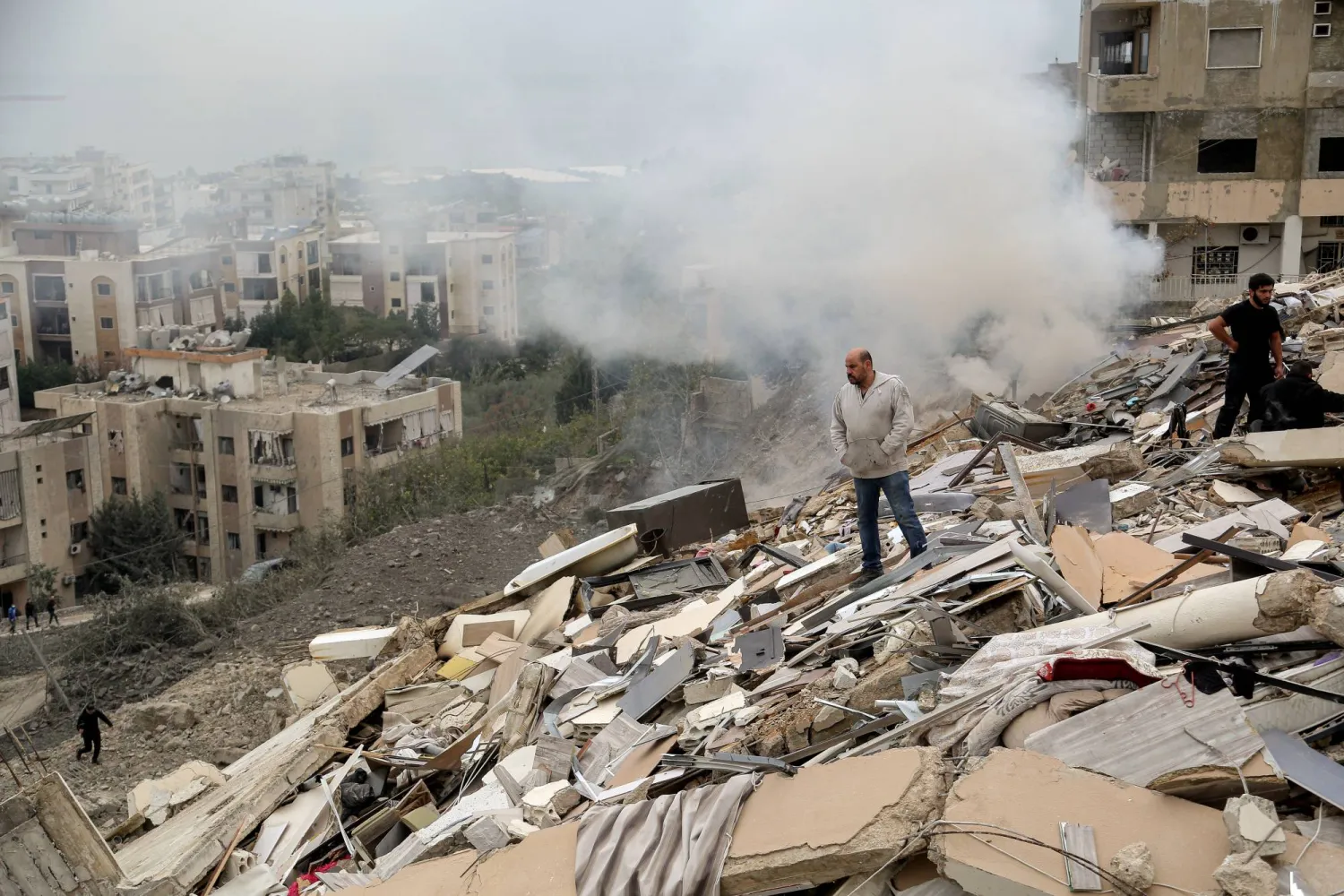
22 January 2026, Lebanon, Qnarit: People inspect the damage of a building that was destroyed by an Israeli air raid on the southern Lebanese village of Qnarit. (dpa)
TT

Lebanon Says Two Killed in Israeli Strike on Palestinian Refugee Camp

22 January 2026, Lebanon, Qnarit: People inspect the damage of a building that was destroyed by an Israeli air raid on the southern Lebanese village of Qnarit. (dpa)

Lebanon said an Israeli strike on the country's largest Palestinian refugee camp killed two people on Friday, with Israel's army saying it had targeted the Palestinian group Hamas. 

The official National News Agency said "an Israeli drone" targeted a neighborhood of the Ain al-Hilweh camp, which is located on the outskirts of the southern city of Sidon. 

Lebanon's health ministry said two people were killed in the raid. The NNA had earlier reported one dead and an unspecified number of wounded. 

An AFP correspondent saw smoke rising from a building in the densely populated camp as ambulances headed to the scene. 

The Israeli army said in a statement that its forces "struck a Hamas command center from which terrorists operated", calling activity there "a violation of the ceasefire understandings between Israel and Lebanon" and a threat to Israel. 

The Israeli military "is operating against the entrenchment" of the Palestinian group in Lebanon and will "continue to act decisively against Hamas terrorists wherever they operate", it added. 

Israel has kept up regular strikes on Lebanon despite a November 2024 ceasefire that sought to halt more than a year of hostilities with Hezbollah. 

Israel has also struck targets belonging to Hezbollah's Palestinian ally Hamas, including in a raid on Ain al-Hilweh last November that killed 13 people. 

The UN rights office had said 11 children were killed in that strike, which Israel said targeted a Hamas training compound, though the group denied it had military installations in Palestinian camps in Lebanon. 

In October 2023, Hezbollah began launching rockets at Israel in support of Hamas at the outset of the Gaza war, triggering hostilities that culminated in two months of all-out war between Israel and the Iran-backed Lebanese group. 

On Sunday, Lebanon said an Israeli strike near the Syrian border in the country's east killed four people, as Israel said it targeted operatives from Palestinian group Islamic Jihad. 


UN Says It Risks Halting Somalia Aid Due to Funding Cuts 

A Somali trader marks watermelons for sale at an open-air grocery market as Muslims start the fasting month of Ramadan, the holiest month in the Islamic calendar, within Bakara market in Mogadishu, Somalia, February 18, 2026. (Reuters)
TT

UN Says It Risks Halting Somalia Aid Due to Funding Cuts 

A Somali trader marks watermelons for sale at an open-air grocery market as Muslims start the fasting month of Ramadan, the holiest month in the Islamic calendar, within Bakara market in Mogadishu, Somalia, February 18, 2026. (Reuters)

The UN's World Food Program (WFP) warned Friday it would have to stop humanitarian assistance in Somalia by April if it did not receive new funding.

The Rome-based agency said it had already been forced to reduce the number of people receiving emergency food assistance from 2.2 million in early 2025 to just over 600,000 today.

"Without immediate funding, WFP will be forced to halt humanitarian assistance by April," it said in a statement.

In early January, the United States suspended aid to Somalia over reports of theft and government interference, following the destruction of a US-funded WFP warehouse in the capital Mogadishu's port.

The US announced a resumption of WFP food distribution on January 29.

However, all UN agencies have warned of serious funding shortfalls since Washington began slashing aid across the world following President Donald Trump's return to the White House last year.

"The situation is deteriorating at an alarming rate," said Ross Smith, WFP Director of Emergency Preparedness and Response, in Friday's statement.

"Families have lost everything, and many are already being pushed to the brink. Without immediate emergency food support, conditions will worsen quickly.

"We are at the cusp of a decisive moment; without urgent action, we may be unable to reach the most vulnerable in time, most of them women and children."

Some 4.4 million people in Somalia are facing crisis-levels of food insecurity, according to the WFP, the largest humanitarian agency in the country.

The Horn of Africa country has been plagued by conflict and also suffered two consecutive failed rainy seasons.


Hamas Says Path for Gaza Must Begin with End to ‘Aggression’ 

Makeshift tents of displaced Palestinian families among the ruins of their homes at sunset during the holy month of Ramadan in Jabaliya northern Gaza Strip on, 19 February 2026. (EPA)
TT

Hamas Says Path for Gaza Must Begin with End to ‘Aggression’ 

Makeshift tents of displaced Palestinian families among the ruins of their homes at sunset during the holy month of Ramadan in Jabaliya northern Gaza Strip on, 19 February 2026. (EPA)

Discussions on Gaza's future must begin with a total halt to Israeli "aggression", the Palestinian movement Hamas said after US President Donald Trump's Board of Peace met for the first time.

"Any political process or any arrangement under discussion concerning the Gaza Strip and the future of our Palestinian people must start with the total halt of aggression, the lifting of the blockade, and the guarantee of our people's legitimate national rights, first and foremost their right to freedom and self-determination," Hamas said in a statement Thursday.

Trump's board met for its inaugural session in Washington on Thursday, with a number of countries pledging money and personnel to rebuild the Palestinian territory, more than four months into a fragile ceasefire between Israel and Hamas.

Israeli Prime Minister Benjamin Netanyahu has insisted however that Hamas must disarm before any reconstruction begins.

"We agreed with our ally the US that there will be no reconstruction of Gaza before the demilitarization of Gaza," Netanyahu said.

The Israeli leader did not attend the Washington meeting but was represented by his foreign minister Gideon Saar.

Trump said several countries had pledged more than seven billion dollars to rebuild the territory.

Muslim-majority Indonesia will take a deputy commander role in a nascent International Stabilization Force, the unit's American chief Major General Jasper Jeffers said.

Trump, whose plan for Gaza was endorsed by the UN Security Council in November, also said five countries had committed to providing troops, including Morocco, Kazakhstan, Kosovo and Albania.