


Hezbollah Leaders among 37 Killed in Israeli Strike in Lebanon

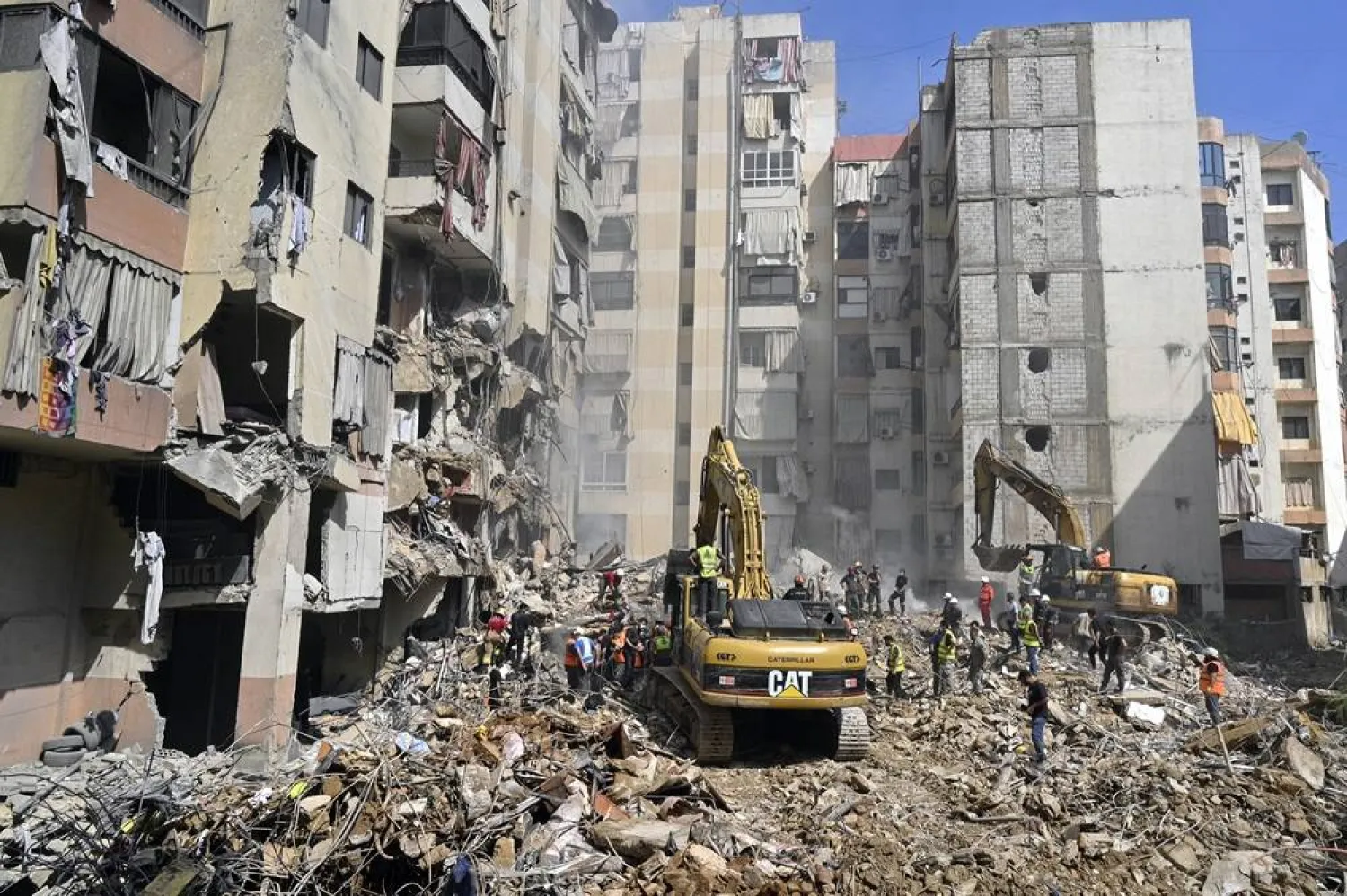
Emergency workers use excavators to clear the rubble at the site which was targeted by an Israeli strike the previous day, in the southern suburb of Beirut, Lebanon, 21 September 2024. (EPA)
TT

Hezbollah Leaders among 37 Killed in Israeli Strike in Lebanon

Emergency workers use excavators to clear the rubble at the site which was targeted by an Israeli strike the previous day, in the southern suburb of Beirut, Lebanon, 21 September 2024. (EPA)

Two Hezbollah leaders were among those killed in an Israeli airstrike on a Beirut suburb on Friday, Israel’s military said Saturday, as Lebanon raised the death toll from the attack to 37, including women and children.

Israel and Hezbollah continued to trade fire Saturday, a day after the airstrike claimed the lives of Ibrahim Akil, who was in charge of Hezbollah’s elite Radwan Force, and Ahmed Wahbi, another senior commander in the group’s military wing.

Firas Abiad told reporters that the dead included seven women and three children. He said another 68 people were wounded of whom 15 remained in hospital, adding that search and rescue operations were still ongoing, with the number of casualties likely to rise.

The rare strike hit an apartment block in a densely populated south Beirut neighborhood on Friday afternoon during rush hour. It was the deadliest strike targeting the Lebanese capital since the 2006 Israel-Hezbollah war.

Hezbollah confirms more than a dozen operatives were killed Akil, the main target, had been wanted by the US for years for his alleged role in the 1983 bombing of the US Embassy in Beirut and in taking American and German hostages in Lebanon in the 1980s.  

He was under US sanctions and the US State Department last year announced a reward of up to $7 million for information leading to his “identification, location, arrest, and/or conviction.”

Wahbi was described as a commander who played major roles within Hezbollah for decades and was imprisoned in an Israeli jail in south Lebanon in 1984. Hezbollah said he was one of the “field commanders” of a 1997 ambush in southern Lebanon that left 12 Israeli troops dead.

Hezbollah announced overnight Friday that 15 of its operatives were killed by Israeli forces, but did not elaborate on the location of these deaths. Meanwhile, the Israeli army spokesperson, Lt. Col. Nadav Shoshani, said on Saturday a total of 16 Hezbollah fighters were killed in the strike.

Israel earlier said Akil had been meeting with other Hezbollah members in the basement of the apartment block.

Rescue workers digging through rubble Lebanese troops cordoned off the area around the destroyed building as members of the Lebanese Red Cross stood nearby to take any bodies recovered from the rubble. On Saturday morning, Hezbollah’s media office took journalists on a tour of the scene of the airstrike where workers were still digging through the building’s ruins.

The Minister of Public Works and Transport Ali Hamieh told reporters at the scene that 23 people are still missing.

The airstrike on the crowded Qaim street knocked out an eight-story building that had 16 apartments and damaged another one adjacent to it. The missiles destroyed the building and cut through the basement where the meeting of Hezbollah officials was being held, according to an Associated Press journalist at the scene.

Shops in a nearby building were badly damaged.

Hezbollah bombardments preceded Israeli airstrike Friday's deadly strike came hours after Hezbollah launched one of its most intense bombardments of northern Israel in nearly a year of fighting, largely targeting Israeli military sites. Israel’s Iron Dome missile defense system intercepted most of the Katyusha rockets.

The group said its latest wave of rocket salvos was a response to Israeli strikes on southern Lebanon. However, it came days after mass explosions of Hezbollah pagers and walkie-talkies killed at least 37 people — including two children. Some 2,900 others were wounded in the assault which has been widely attributed to Israel.

The Lebanese health minister said Saturday hospitals across the country were filled with the wounded.

Israel has neither confirmed nor denied involvement in the attack, which marked a major escalation in the past 11 months of simmering conflict along the Israel-Lebanon border.

On Saturday, Israel launched an intense wave of airstrikes on southern Lebanon, according to an Associated Press journalist in the area. The Israeli military said its air force was attacking Hezbollah targets, without providing further details. The group responded by firing a large number of rockets, local media reported.

It remains unclear if there were any casualties in the latest strikes.

Earlier this week, Israel’s security cabinet said stopping Hezbollah’s attacks in the country’s north to allow residents to return to their homes is now an official war goal, as it considers a wider military operation in Lebanon that could spark an all-out conflict. Israel has since sent a powerful fighting force to the northern border.

Hezbollah has maintained that it will halt its strikes only when a cease-fire is reached in Gaza.

The tit-for-tat strikes have forced tens of thousands of people to evacuate their homes in both southern Lebanon and northern Israel.

Israel and Hezbollah have traded fire regularly since Hamas’ Oct. 7 assault on southern Israel ignited the Israeli military’s devastating offensive in Gaza. But previous cross-border attacks have largely struck areas in northern Israel that had been evacuated and less-populated parts of southern Lebanon.



Egyptian-Turkish Military Talks Focus on Strengthening Partnership

The Commander of the Egyptian Air Force during his meeting with the Turkish Air Force chief in Cairo on Wednesday (Egyptian military spokesperson)
TT

Egyptian-Turkish Military Talks Focus on Strengthening Partnership

The Commander of the Egyptian Air Force during his meeting with the Turkish Air Force chief in Cairo on Wednesday (Egyptian military spokesperson)

Senior Egyptian and Turkish air force commanders met in Cairo on Wednesday for talks focused on strengthening military partnership and expanding bilateral cooperation, in the latest sign of warming defense ties between the two countries.

The meeting brought together the Commander of the Egyptian Air Force, Lt. Gen. Amr Saqr, and his Turkish counterpart, Gen. Ziya Cemal Kadioglu, to review a range of issues of mutual interest amid growing cooperation between the two air forces.

Egypt’s military spokesperson said the talks reflect the Armed Forces’ commitment to deepening military collaboration with friendly and partner nations.

Earlier this month, Egypt and Türkiye signed a military cooperation agreement during talks in Cairo between Egyptian President Abdel Fattah el-Sisi and his Turkish counterpart, President Recep Tayyip Erdogan.

Sisi highlighted similar viewpoints on regional and international issues, while Erdogan noted that enhanced cooperation and forthcoming joint steps would help support regional peace.

Cairo and Ankara also signed an agreement last August on the joint production of vertical take-off and landing (VTOL) drones. Production of unmanned ground vehicles has also begun under a partnership between the Turkish firm HAVELSAN and Egypt’s Kader Factory.

During the talks, Saqr underscored the importance of coordinating efforts to advance shared interests and expressed hope for closer ties that would benefit both air forces.

Kadioglu, for his part, stressed the depth of bilateral partnership and the strong foundations of cooperation between the two countries’ air forces.

According to the military spokesperson, Kadioglu also toured several Egyptian Air Force units to review the latest training and armament systems introduced in recent years.

Military cooperation between Egypt and Türkiye has gained momentum since 2023, following the restoration of full diplomatic relations and reciprocal presidential visits that reflected positively on the defense sector.

In September last year, the joint naval exercise “Sea of Friendship 2025” was held in Turkish territorial waters, aimed at enhancing joint capabilities and exchanging expertise against a range of threats.


UN Says Israeli Actions Raising 'Ethnic Cleansing' Fears in West Bank, Gaza

A member of the Salhab family weeps as he sits on the on the rubble of apartment building after it was demolished by Israeli bulldozers near the Israeli settlement of Hagai, south of the occupied West Bank city of Hebron, on February 18, 2026. (Photo by HAZEM BADER / AFP)
TT

UN Says Israeli Actions Raising 'Ethnic Cleansing' Fears in West Bank, Gaza

A member of the Salhab family weeps as he sits on the on the rubble of apartment building after it was demolished by Israeli bulldozers near the Israeli settlement of Hagai, south of the occupied West Bank city of Hebron, on February 18, 2026. (Photo by HAZEM BADER / AFP)

Israel's increased attacks and forcible transfers of Palestinians "raise concerns over ethnic cleansing" in the Gaza Strip and the West Bank, the United Nations said Thursday.

The UN human rights office said the cumulative impact of Israel's military conduct during the war in Gaza, plus its blockade of the territory, had inflicted living conditions "increasingly incompatible with Palestinians' continued existence as a group in Gaza".

"Intensified attacks, the methodical destruction of entire neighborhoods and the denial of humanitarian assistance appeared to aim at a permanent demographic shift in Gaza", the office said in a report.

"This, together with forcible transfers, which appear to aim at a permanent displacement, raise concerns over ethnic cleansing in Gaza and the West Bank."

The report looked at November 1, 2024 to October 31, 2025.

In the occupied West Bank and annexed East Jerusalem, the report said the "systematic use of unlawful force" by Israeli security forces, "widespread" arbitrary detention and the "extensive unlawful demolition" of Palestinian homes was being carried out to "systematically discriminate, oppress, control and dominate the Palestinian people".

"These violations were "altering the character, status and demographic composition of the occupied West Bank, raising serious concerns of ethnic cleansing", it said.

- 'Inhumane choice' -

In Gaza, the report condemned the continued killing and maiming of "unprecedented numbers of civilians", the spread of famine, and destruction of the "remaining civilian infrastructure".

During the 12 months covered in the report, at least 463 Palestinians, including 157 children, starved to death in Gaza, it said.

"Palestinians faced the inhumane choice of either starving to death or risking being killed while trying to get food," said the report.

"The situation of famine and malnutrition was the direct result of actions taken by the Israeli government," with the deaths and suffering from hunger "foreseeable and repeatedly foretold".

Across the reporting period, Hamas and other Palestinian armed groups continued to hold Israeli and foreign hostages seized on October 7, 2023 -- dead or alive -- as "bargaining tools".

The rights office said the hostages' treatment amounted to war crimes.

"Israeli forces, Hamas, and other Palestinian armed groups committed serious violations of international humanitarian law in Gaza, gross violations and abuses of international human rights law, and atrocity crimes," the report concluded.

- Impunity 'kills' -

Last week, UN rights chief Volker Turk warned that the world was witnessing "rapid steps to change permanently the demography of the occupied Palestinian territory".

On Tuesday, Israel's far-right Finance Minister Bezalel Smotrich vowed to encourage "emigration" from the Palestinian territories.

And on Wednesday, UN Under-Secretary-General Rosemary DiCarlo warned the Security Council that steps by Israel to tighten control of areas of the West Bank administered by the Palestinian Authority amount to "gradual de facto annexation".

Thursday's rights office report concluded that considered together, Israeli practices "indicated a concerted and accelerating effort to consolidate annexation of large parts of the Occupied Palestinian Territory and to deny Palestinians' right to self-determination".

The report said there was a pervasive climate of impunity for serious violations of international law by the Israeli authorities in the Palestinian territories.

"Impunity is not abstract -- it kills. Accountability is indispensable. It is the prerequisite for a just and durable peace in Palestine and Israel," Turk said in a statement.


UN Probe: RSF Actions in Sudan's el-Fasher Point to Genocide

Forces affiliated with the Rapid Support Forces in the city of el-Fasher, Darfur region (AFP)
TT

UN Probe: RSF Actions in Sudan's el-Fasher Point to Genocide

Forces affiliated with the Rapid Support Forces in the city of el-Fasher, Darfur region (AFP)

Mass killings of non-Arab communities when the Rapid Support Forces captured the Sudanese city of el-Fasher bears hallmarks that point to genocide, an independent UN probe said in a new report on Thursday.

At the end of October last year, the RSF took over the city - which had been the last remaining stronghold of the Sudanese Armed Forces (SAF) in the Darfur region in the west of the country - with thousands of people killed and raped during three days of horror, the UN Independent International Fact-Finding Mission for Sudan said.

It followed an 18-month siege where the RSF imposed conditions of life calculated to bring about the physical destruction of non-Arab communities, in particular the Zaghawa and the Fur, ‌the report stated.

The ‌UN mission said it found evidence that the RSF carried out a pattern ‌of ⁠coordinated and repeated ⁠targeting of individuals based on ethnicity, gender and perceived political affiliation, including mass killings, rape and torture, as well as inflicting conditions of life calculated to bring about the group’s physical destruction - core elements of the crime of genocide under international law.

The final draft of the report was shared with the Government of Sudan but no response was received, while the RSF did not respond to the UN mission's request to meet with its leadership, the report stated. The RSF and SAF did not immediately respond to requests from Reuters for comment.

In the past, the RSF has ⁠denied such abuses - saying the accounts have been manufactured by its enemies and ‌making counter-accusations against them.

"The scale, coordination, and public endorsement of the operation ‌by senior RSF leadership demonstrate that the crimes committed in and around el-Fasher were not random excesses of war" said Mohamad ‌Chande Othman, Chair of the Fact-Finding Mission on Sudan.

"They formed part of a planned and organized operation ‌that bears the defining characteristics of genocide," he added.

Before its takeover el-Fasher's population mainly consisted of the Zaghawa, a non-Arab community, while displacement camps around the area were comprised of the Fur community, as well as Berti, Masalit and Tama, the report said.

"Survivors describe explicit threats to 'clean' the city," the report stated. Alongside attacking displacement camps, communal kitchens and medical centers ‌with drones and heavy weapons, the RSF also carried out killings, looting, beatings and sexual violence in el-Fasher, the report stated.

The RSF's "exterminatory rhetoric" and other violations indicated ⁠its intent to destroy ⁠the Zaghawa and Fur communities in whole or in part, the report said.

"Witnesses heard the Rapid Support Forces saying, 'Is there anyone Zaghawa among you? If we find Zaghawa, we will kill them all'," the report said.

Survivors recounted point-blank executions of civilians, as well as bodies of men, women and children filling roads, the report stated.

Women and girls aged 7 to 70 years old from non-Arab communities, particularly the Zaghawa were raped and subject to other acts of sexual violence, including whipping and forced nudity, the report stated.

British Foreign Secretary Yvette Cooper said the international response to the report and the situation in Sudan had to be emphatic and urged for a ceasefire.

"The findings of this UN report are truly horrific - atrocities including systematic starvation, torture, killings, rape and deliberate ethnic targeting used on the most horrendous scale during the Rapid Support Forces siege of el-Fasher," she said in a statement.

The UN mission was mandated by members of the Human Rights Council, following backing from countries that included Britain, to urgently investigate violations and abuses under international law in and around el-Fasher.