


Netanyahu Calls on Lebanese to 'Take this Warning Seriously' as Israeli Strikes Kill More than 270

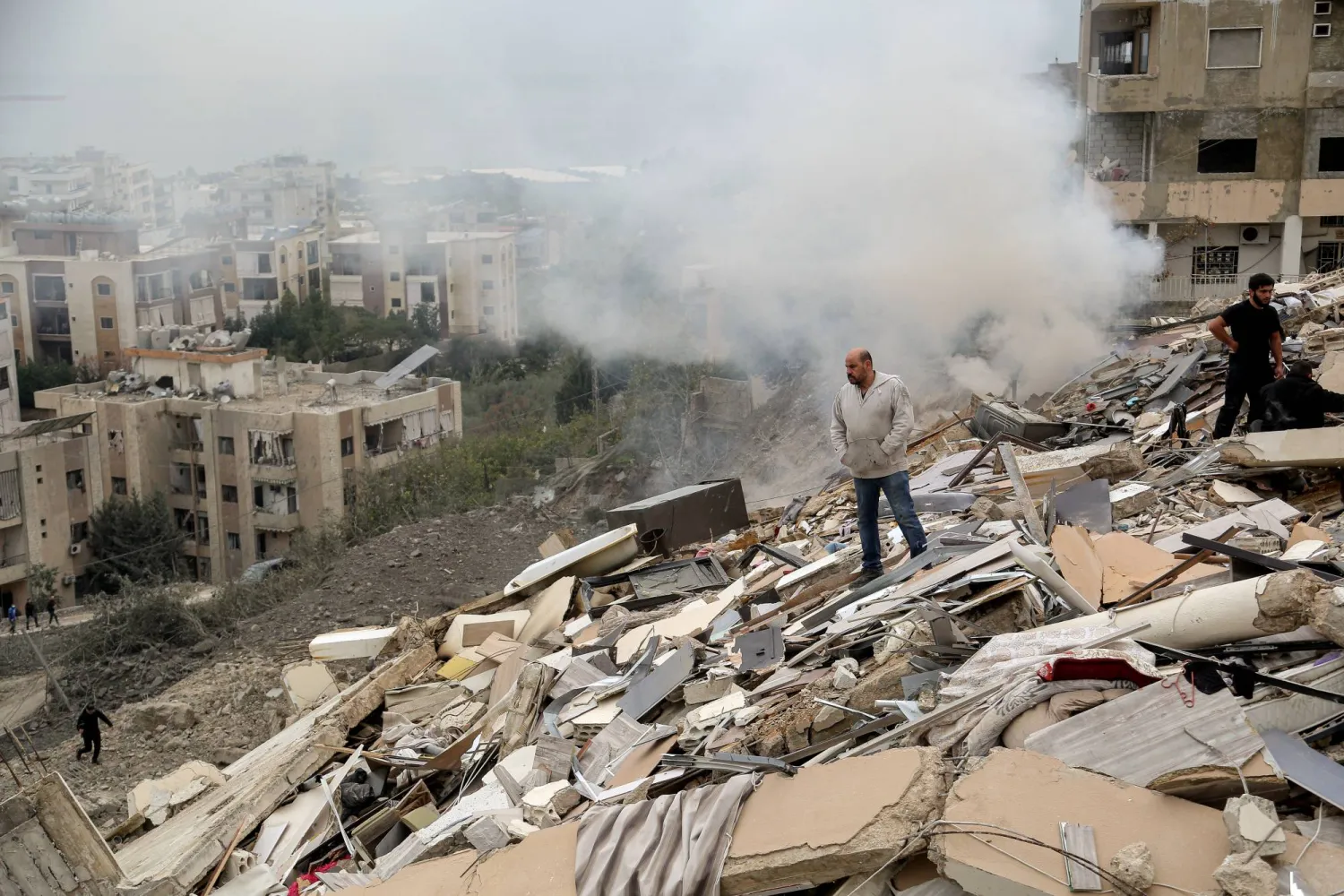
Smoke billows from the site of an Israeli airstrike in Marjayoun, near the Lebanon-Israel border, on September 23, 2024. (Photo by Rabih DAHER / AFP)
TT

Netanyahu Calls on Lebanese to 'Take this Warning Seriously' as Israeli Strikes Kill More than 270

Smoke billows from the site of an Israeli airstrike in Marjayoun, near the Lebanon-Israel border, on September 23, 2024. (Photo by Rabih DAHER / AFP)

Israeli strikes on Monday killed more than 270 Lebanese in the deadliest barrage since the 2006 Israel-Hezbollah war as the Israeli military warned residents in southern and eastern Lebanon to evacuate their homes ahead of a widening air campaign against Hezbollah.

Thousands of Lebanese fled the south, and the main highway out of the southern port city of Sidon was jammed with cars heading toward Beirut in the biggest exodus since the 2006 fighting. More than 1,000 other people were wounded in the strikes — a staggering one-day toll for a country still reeling from a deadly attack on communication devices last week.

The death toll surpassed that of Beirut's devastating port explosion in 2020, when hundreds of tons of ammonium nitrate stored in a warehouse detonated, killing at least 218 people and wounding more than 6,000.

In a recorded message to Lebanese civilians, Israeli Prime Minister Benjamin Netanyahu urged them to heed Israeli calls to evacuate, saying “take this warning seriously.”

“Please get out of harm’s way now,” Netanyahu said. “Once our operation is finished, you can come back safely to your homes.”

The Israeli military said Monday evening that it had carried out a targeted strike in Beirut. It did not give details.

Lebanese caretaker Health Minister Firass Abiad told a news conference in Beirut that the strikes hit hospitals, medical centers and ambulances. The government ordered schools and universities to close across most of the country and began preparing shelters for people displaced from the south.

The Israeli military announced that it hit some 800 targets, saying it was going after Hezbollah weapons sites. Some strikes hit in residential areas of towns in the south and the eastern Bekaa Valley. One strike hit a wooded area as far away as Byblos in central Lebanon, more than 80 miles from the border north of Beirut.

The military said it was expanding the airstrikes to include areas of the valley along Lebanon’s eastern border with Syria. Hezbollah has long had an established presence in the valley, and it is where the group was founded in 1982 with the help of Iran’s Revolutionary Guards.

Israeli military spokesman Rear Adm. Daniel Hagari repeated warnings urging residents to immediately evacuate areas where Hezbollah is storing weapons, including in the valley. The warnings left open the possibility that some residents could live in or near targeted structures without knowing that they are risk.

Meanwhile, Hezbollah said in a statement that it fired dozens of rockets toward Israel, including at military bases. It also targeted for a second day the facilities of the Rafael defense firm, headquartered in Haifa.

As Israel carried out the attacks, Israeli authorities reported a series of air-raid sirens in northern Israel warning of incoming rocket fire from Lebanon.

The evacuation warnings were the first of their kind in nearly a year of steadily escalating conflict and came after a particularly heavy exchange of fire on Sunday. Hezbollah launched around 150 rockets, missiles and drones into northern Israel in retaliation for strikes that killed a top commander and dozens of fighters.

The increasing strikes and counterstrikes have raised fears of an all-out war, even as Israel is still battling Hamas in Gaza and trying to return scores of hostages taken in Hamas' Oct. 7 attack. Hezbollah has vowed to continue its strikes in solidarity with the Palestinians and Hamas, a fellow Iran-backed armed group. Israel says it is committed to returning calm to its northern border.

Associated Press journalists in southern Lebanon reported heavy airstrikes targeting many areas Monday morning, including some far from the border.

Lebanon's state-run National News Agency said the strikes hit a forested area in the central province of Byblos, about 130 kilometers (81 miles) north of the Israeli-Lebanese border, for the first time since the exchanges began in October.

Israel also bombed targets in the northeastern Baalbek and Hermel regions, where a shepherd was killed and two family members were wounded, according to the news agency. It said a total of 30 people were wounded in strikes.

The Lebanese Health Ministry put the death toll at 274. It asked hospitals in southern Lebanon and the eastern Bekaa Valley to postpone surgeries that could be done later. The ministry said in a statement that its request aimed to keep hospitals ready to deal with people wounded by “Israel’s expanding aggression on Lebanon.”

An Israeli military official said Israel is focused on aerial operations and has no immediate plans for a ground operation. The official, speaking on condition of anonymity in keeping with regulations, said the strikes are aimed at curbing Hezbollah's ability to launch more strikes into Israel.

Lebanese media reported that residents received text messages urging them to move away from any building where Hezbollah stores arms until further notice.

“If you are in a building housing weapons for Hezbollah, move away from the village until further notice,” the Arabic message reads, according to Lebanese media.

Lebanon's caretaker information minister, Ziad Makary, said in a statement that his office in Beirut had received a recorded message telling people to leave the building.

“This comes in the framework of the psychological war implemented by the enemy,” Makary said, and urged people “not to give the matter more attention than it deserves.”

It was not immediately clear how many people would be affected by the Israeli orders. Communities on both sides of the border have largely emptied out because of the near-daily exchanges of fire.

Israel has accused Hezbollah of transforming entire communities in the south into militant bases, with hidden rocket launchers and other infrastructure. That could lead the Israeli military to wage an especially heavy bombing campaign, even if no ground forces move in.

The military said it had targeted more than 150 militant sites early Monday. Residents of different villages in southern Lebanon posted photos on social media of airstrikes and large plumes of smoke. NNA also reported airstrikes on different areas.

An Israeli airstrike on a Beirut suburb on Friday killed a top Hezbollah military commander and more than a dozen fighters, as well as dozens of civilians, including women and children.

Last week, thousands of communications devices, used mainly by Hezbollah members, exploded in different parts of Lebanon, killing 39 people and wounding nearly 3,000. Lebanon blamed Israel for the attacks, but Israel did not confirm or deny any responsibility.

Hezbollah began firing into Israel a day after the Oct. 7 attack in what it said was an attempt to pin down Israeli forces to help Palestinian fighters in Gaza. Israel has retaliated with airstrikes, and the conflict has steadily intensified over the past year.

The fighting has killed hundreds of people in Lebanon, dozens in Israel and displaced tens of thousands on both sides of the border.

Israel has vowed to push Hezbollah back from the border so its citizens can return to their homes, saying it prefers to do so diplomatically but is willing to use force. Hezbollah has said it will keep up its attacks until there is a ceasefire in Gaza, but that appears increasingly elusive as the war nears its anniversary.

Hamas-led fighters stormed into southern Israel on Oct. 7, killing some 1,200 people, mostly civilians, and abducting around 250. Some 100 captives are still held in Gaza, a third of whom are believed to be dead, after most of the rest were released during a weeklong ceasefire in November.

Israel's offensive has killed over 41,000 Palestinians, according to the Gaza Health Ministry, which does not differentiate between civilians and fighters in its count. It says women and children make up a little over half of those killed. Israel says it has killed over 17,000 militants, without providing evidence.



Israeli Reservist Rams Vehicle into Palestinian Man Praying in West Bank

Israeli security forces secure a street as they leave the Palestinian village of Bizariya, in the occupied West Bank, where Israeli authorities demolished the house of a Palestinian man killed in July after he and another man reportedly killed an Israeli settler on the same day, on December 24, 2025. (AFP)
TT

Israeli Reservist Rams Vehicle into Palestinian Man Praying in West Bank

Israeli security forces secure a street as they leave the Palestinian village of Bizariya, in the occupied West Bank, where Israeli authorities demolished the house of a Palestinian man killed in July after he and another man reportedly killed an Israeli settler on the same day, on December 24, 2025. (AFP)

An Israeli reservist soldier rammed his vehicle into a Palestinian man as he prayed on a roadside in ​the occupied West Bank on Thursday, after earlier firing shots in the area, the Israeli military said.

"Footage was received of an armed individual running over a Palestinian individual," it said in a statement, adding the individual was a reservist ‌and his ‌military service had ‌been terminated.

The ⁠reservist ​acted "in severe ‌violation of his authority" and his weapon had been confiscated, the military said.

Israeli media reported that he was being held under house arrest.

The Israeli police did not immediately respond to a Reuters request for comment.

The ⁠Palestinian man went to hospital for checks after ‌the attack, but was unhurt ‍and is now ‍at home.

Video which aired on Palestinian ‍TV shows a man in civilian clothing with a gun slung over his shoulder driving an off-road vehicle into a man praying on ​the side of the road.

This year ​was one of the most violent on ⁠record for Israeli civilian attacks against Palestinians in the West Bank, according to United Nations data that shows more than 750 injuries.

More than a thousand Palestinians were killed in the West Bank between October 7, 2023 and October 17, 2025, mostly in operations by security forces and some by settler violence, according to the UN In ‌the same period, 57 Israelis were killed in Palestinian attacks.


Deadly Blast Hits Mosque in Syria’s Homs, Saraya Ansar al-Sunna Claims Responsibility

Syrian security forces stand inside a damaged mosque after several people were killed in an explosion at a mosque as the Syrian Arab News Agency (SANA) said, in Homs, Syria December 26, 2025. REUTERS/Ali Ahmed al-Najjar
TT

Deadly Blast Hits Mosque in Syria’s Homs, Saraya Ansar al-Sunna Claims Responsibility

Syrian security forces stand inside a damaged mosque after several people were killed in an explosion at a mosque as the Syrian Arab News Agency (SANA) said, in Homs, Syria December 26, 2025. REUTERS/Ali Ahmed al-Najjar

A bombing at a mosque in Syria during Friday prayers killed at least eight people and wounded 18 others, authorities said.

Images released by Syria’s state-run Arab News Agency showed blood on the mosque’s carpets, holes in the walls, shattered windows and fire damage. The Imam Ali bin Abi Talib Mosque is located in Homs, Syria's third-largest city.

SANA, citing a security source, said that preliminary investigations indicate that explosive devices were planted inside the mosque. Authorities were searching for the perpetrators, who have not yet been identified, and a security cordon was placed around the building, Syria’s Interior Ministry said in a statement.

In a statement on Telegram, the Saraya Ansar al-Sunna said its fighters "detonated a number of explosive devices" in the mosque.

The same group had previously claimed a suicide attack in June in which a gunman opened fire and then detonated an explosive vest inside a Greek Orthodox church in Dweil’a, on the outskirts of Damascus, killing 25 people as worshippers prayed on a Sunday.

Several countries, including Saudi Arabia, Jordan and Lebanon, condemned the attack. 


Fuel Shortage Forces Gaza Hospital to Suspend Most Services

The sun sets behind a makeshift tent camp for displaced Palestinians set up in an area of al-Bureij camp, in the central Gaza Strip, Wednesday, Dec. 24, 2025. (AP)
TT

Fuel Shortage Forces Gaza Hospital to Suspend Most Services

The sun sets behind a makeshift tent camp for displaced Palestinians set up in an area of al-Bureij camp, in the central Gaza Strip, Wednesday, Dec. 24, 2025. (AP)

A major Gaza hospital has suspended several services because of a critical fuel shortage in the devastated Palestinian territory, which continues to face a severe humanitarian crisis, it said.

Devastated by more than two years of war, the Al-Awda Hospital in the central Gaza district of Nuseirat cares for around 60 in-patients and receives nearly 1,000 people seeking medical treatment each day.

"Most services have been temporarily stopped due to a shortage of the fuel needed for the generators," said Ahmed Mehanna, a senior official involved in managing the hospital.

"Only essential departments remain operational: the emergency unit, maternity ward and pediatrics."

To keep these services running, the hospital has been forced to rent a small generator, he added.

Under normal conditions, Al-Awda Hospital consumes between 1,000 and 1,200 liters of diesel per day. At present, however, it has only 800 liters available.

"We stress that this shutdown is temporary and linked to the availability of fuel," Mehanna said, warning that a prolonged fuel shortage "would pose a direct threat to the hospital's ability to deliver basic services".

He urged local and international organizations to intervene swiftly to ensure a steady supply of fuel.

Despite a fragile truce observed since October 10, the Gaza Strip remains engulfed in a severe humanitarian crisis.

While the ceasefire agreement stipulated the entry of 600 aid trucks per day into Gaza, only 100 to 300 carrying humanitarian assistance can currently enter, according to the United Nations and non-governmental organizations.

The remaining convoys largely transport commercial goods that remain inaccessible to most of Gaza's 2.2 million people.

- Health hard hit -

On a daily basis, the vast majority of Gaza's residents rely on aid from UN agencies and international NGOs for survival.

Gaza's health sector has been among the hardest hit by the war.

During the fighting, the Israeli miliary repeatedly struck hospitals and medical centers across Gaza, accusing Hamas of operating command centers there, an allegation the group denied.

International medical charity Doctors Without Borders now manages roughly one-third of Gaza's 2,300 hospital beds, while all five stabilization centers for children suffering from severe malnutrition are supported by international NGOs.

The war in Gaza was sparked on October 7, 2023, following an unprecedented Hamas attack on Israel that resulted in the deaths of 1,221 people, most of them civilians, according to an AFP tally based on official Israeli figures.

In Israel's ensuing military campaign in Gaza, at least 70,942 people - also mostly civilians - have been killed, according to the health ministry in the Hamas-run territory.