Top UN Officials on Gaza: 'These Atrocities Must End'
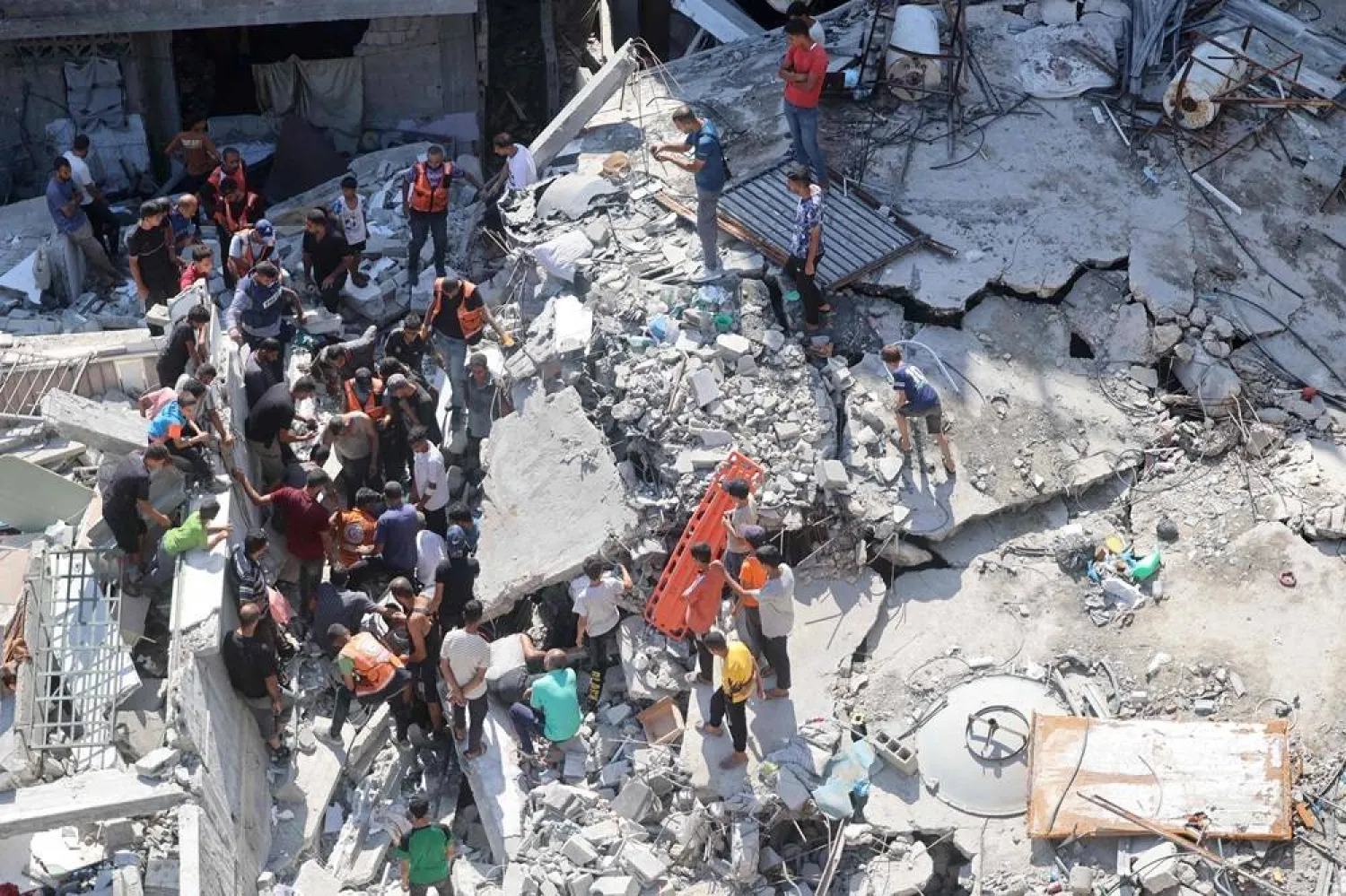
Palestinians search for survivors amid the rubble of a building, which collapsed after Israeli bombardment on a building adjacent to it, in the Sheikh Radwan neighborhood in Gaza City on September 23, 2024, amid the ongoing war between Israel and the Hamas group. (AFP)
TT
TT
Top UN Officials on Gaza: 'These Atrocities Must End'
Palestinians search for survivors amid the rubble of a building, which collapsed after Israeli bombardment on a building adjacent to it, in the Sheikh Radwan neighborhood in Gaza City on September 23, 2024, amid the ongoing war between Israel and the Hamas group. (AFP)
Leading United Nations officials demanded on Monday "an end to the appalling human suffering and humanitarian catastrophe" in the Gaza Strip nearly one year into the war between Israel and Palestinian group Hamas.
"These atrocities must end," they said in a statement signed by the heads of UN agencies that include UNICEF and the World Food Program along with other aid groups as world leaders gathered in New York for the annual UN General Assembly.
"Humanitarians must have safe and unimpeded access to those in need," they said. "We cannot do our jobs in the face of overwhelming need and ongoing violence."
The UN has long complained of obstacles to getting aid into Gaza during the war and distributing it amid "total lawlessness" in the besieged Palestinian enclave. Nearly 300 humanitarian aid workers, more than two-thirds of them UN staff, have been killed.
"The risk of famine persists with all 2.1 million residents still in urgent need of food and livelihood assistance as humanitarian access remains restricted," the UN officials said. "Healthcare has been decimated. More than 500 attacks on health care have been recorded in Gaza."
The war in the Palestinian enclave began on Oct. 7, 2023, when Hamas gunmen stormed into Israeli communities, killing around 1,200 people and taking about 250 hostages back to Hamas-run Gaza, according to Israeli tallies.
Since then, Israel's military has leveled swathes of the Palestinian enclave, driving nearly all of its 2.3 million people from their homes, giving rise to deadly hunger and disease and killing more than 41,000 people, according to Palestinian health authorities who do not distinguish between combatants and non-combatants.
The Israeli military says it takes steps to reduce the risk of harm to civilians and that at least a third of the Palestinian fatalities are militants. It accuses Hamas of using Palestinian civilians as human shields, which Hamas denies.
Israel Intensifies Ceasefire Violations, Destroying and Burning Occupied Lebanese Villageshttps://english.aawsat.com/arab-world/5263940-israel-intensifies-ceasefire-violations-destroying-and-burning-occupied-lebanese
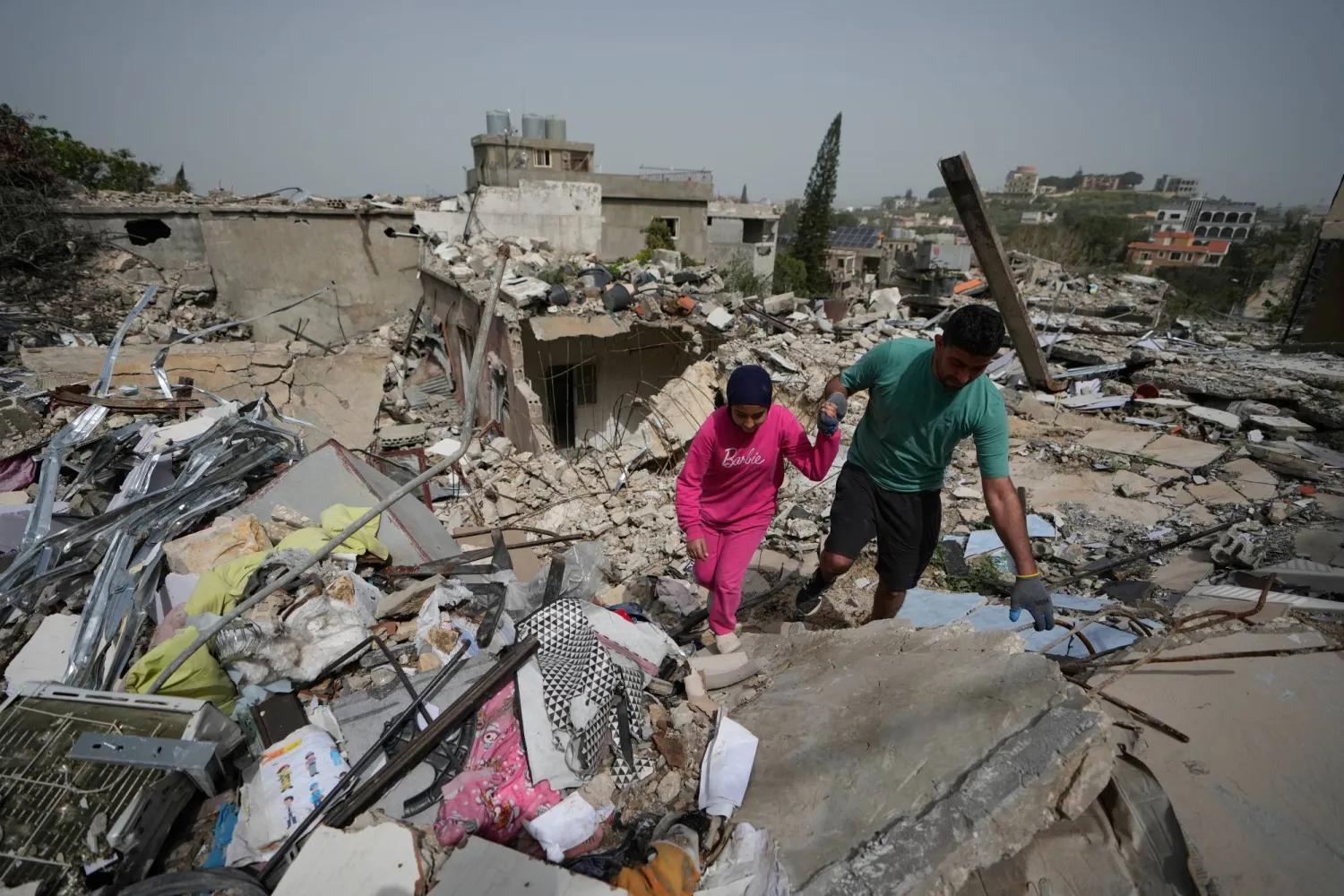
Residents walk on the rubble of destroyed houses on the second day of a ceasefire between Hezbollah and Israel in Jibchit village, south Lebanon, Saturday, April 18, 2026.(AP Photo/Mohammed Zaatari)
Israel Intensifies Ceasefire Violations, Destroying and Burning Occupied Lebanese Villages
Residents walk on the rubble of destroyed houses on the second day of a ceasefire between Hezbollah and Israel in Jibchit village, south Lebanon, Saturday, April 18, 2026.(AP Photo/Mohammed Zaatari)
Israeli violations of the US-brokered ceasefire on the Lebanon front continue, as military operations and airstrikes persist against targets Israel claims are affiliated with Hezbollah. This has forced residents who had returned to some southern villages to leave again immediately, fearing a rapid return to fighting.
The yellow line
These violations coincide with the Israeli army’s announcement of the creation of a “yellow line” in southern Lebanon, similar to the one in Gaza, effectively preventing residents from returning to 55 Lebanese towns located within this line.
On Saturday, the Israeli army said it had established a separating “yellow line” in southern Lebanon, similar to the line dividing its forces from areas controlled by Hamas in Gaza. It stated that it had targeted suspected militants who approached its forces along this line.
The army said that over the past 24 hours, its forces operating south of the yellow line had identified individuals it described as militants who violated the ceasefire and approached from the north of the line in what it called a direct threat. This marked the first reference to the line since the ceasefire took effect.
It added that its forces struck those individuals in several areas of southern Lebanon immediately after detecting them, in order to eliminate the threat, stressing that it is authorized to act against threats despite the ceasefire.
In this context, military and security expert Brig. Gen. Fadi Daoud told Asharq Al-Awsat that the Israeli security line is unofficial but effectively constitutes a dangerous point of friction. He said it is known in the field as the Israeli technical line along the Lebanon-Israel border. It is not an internationally recognized boundary but a security measure imposed by Israel that extends beyond the Blue Line and is used to impose facts on the ground, and could quickly trigger clashes.
An unstable situation
Amid the developments imposed by the recent war, it has become difficult to quantify Israeli violations, as UNIFIL forces are unable to enter towns under full Israeli control. A security source told Asharq Al-Awsat that violations are not limited to artillery shelling, drone strikes, or clashes with Hezbollah fighters, but also include the deliberate booby-trapping and complete demolition of homes under the pretext of destroying the group’s infrastructure.
The source described the situation in the south as unstable, warning of concerns about a return to a cycle of fighting. The source added that the Lebanese side had been monitoring developments through the mechanism committee, but the committee is currently not in place, leaving no mechanism to address new Israeli attacks.
On the ground, one person was killed in the town of Kounine and others were wounded by a suspicious object believed to be a cluster munition left over from Israeli bombardment, just hours after the ceasefire came into effect. Artillery shelling continues to be heard in several villages in the central sector, while Israeli forces fired bursts of gunfire toward the town of Aitaroun.
Field reports indicate that the town of Khiam continues to come under artillery fire. Israeli forces have also carried out demolitions in Khiam, Qantara, Shamaa, Bint Jbeil, and Bayyada. Explosions and sweeping fire were also reported in the vicinity of Bint Jbeil.
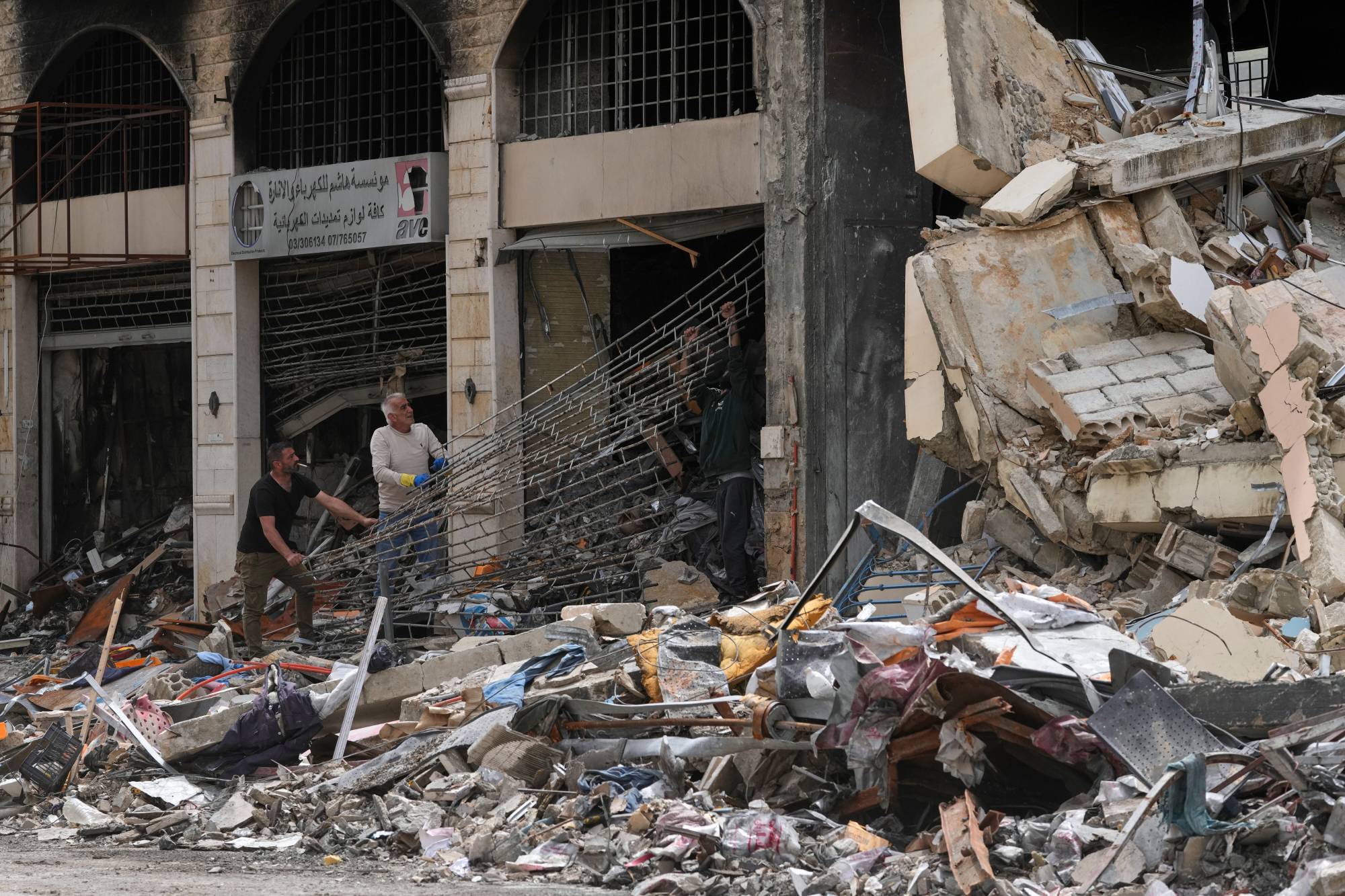
Lebanese citizens remove rubble from their destroyed shops on the second day of a ceasefire between Hezbollah and Israel in Nabatiyeh town, south Lebanon, Saturday, April 18, 2026.(AP Photo/Mohammed Zaatari)
Two tracks of operations in the south
The ceasefire terms, which took effect at midnight between Thursday and Friday, have imposed a new and more difficult reality compared with the cessation of hostilities agreement reached between Lebanon and Israel on November 27, 2024.
Daoud said Israeli operations south of the Litani River are proceeding along two parallel tracks aimed at establishing a new reality on the ground. The first track involves efforts by the Israeli army to entrench its presence in villages it has taken control of, alongside continuing a policy of widespread destruction similar to what it previously carried out in Gaza.
He said the Israeli army is focusing on demolishing buildings in villages it controls in the first and second defensive lines, uprooting trees including olive trees, and setting forests on fire to turn them into completely scorched areas. He added that Israel is also clearing the rubble of destroyed homes and transporting it for recycling, indicating an intention to fundamentally alter the nature of the area.
The battle for Bint Jbeil
The second track centers, according to Daoud, on the battle for Bint Jbeil. He said the battle has two main dimensions: a symbolic one, as Hezbollah has called the city the “capital of the resistance,” and a strategic one due to its geographic location near the border, allowing whoever controls it to influence both northern Israel and southern Lebanon.
The importance of Bint Jbeil is not limited to symbolism but extends to its surroundings. Daoud said controlling the city effectively means controlling surrounding roads and towns, as it provides a tactical advantage that allows fire control over the northeastern and western sectors of the area. He added that operations inside Bint Jbeil will continue regardless of the ceasefire.
He also suggested that if a US green light is given, Israel may continue operations under what is described as “low-intensity warfare” or guerrilla-style operations, aimed at completing control over remaining Hezbollah positions in the city.
Daoud stressed that Israel’s less visible operations reflect a scorched-earth policy, turning occupied towns south of the Litani into fully devastated areas, mirroring the operational pattern seen in Gaza.
Israel Intensifies Ceasefire Violations, Destroying and Burning Occupied Lebanese Villageshttps://english.aawsat.com/arab-world/5263882-israel-intensifies-ceasefire-violations-destroying-and-burning-occupied-lebanese
Residents walk on the rubble of destroyed houses on the second day of a ceasefire between Hezbollah and Israel in Jibchit village, south Lebanon, Saturday, April 18, 2026.(AP Photo/Mohammed Zaatari)
Israel Intensifies Ceasefire Violations, Destroying and Burning Occupied Lebanese Villages
Residents walk on the rubble of destroyed houses on the second day of a ceasefire between Hezbollah and Israel in Jibchit village, south Lebanon, Saturday, April 18, 2026.(AP Photo/Mohammed Zaatari)
Israeli violations of the US-brokered ceasefire on the Lebanon front continue, as military operations and airstrikes persist against targets Israel claims are affiliated with Hezbollah. This has forced residents who had returned to some southern villages to leave again immediately, fearing a rapid return to fighting.
The yellow line
These violations coincide with the Israeli army’s announcement of the creation of a “yellow line” in southern Lebanon, similar to the one in Gaza, effectively preventing residents from returning to 55 Lebanese towns located within this line.
On Saturday, the Israeli army said it had established a separating “yellow line” in southern Lebanon, similar to the line dividing its forces from areas controlled by Hamas in Gaza. It stated that it had targeted suspected militants who approached its forces along this line.
The army said that over the past 24 hours, its forces operating south of the yellow line had identified individuals it described as militants who violated the ceasefire and approached from the north of the line in what it called a direct threat. This marked the first reference to the line since the ceasefire took effect.
It added that its forces struck those individuals in several areas of southern Lebanon immediately after detecting them, in order to eliminate the threat, stressing that it is authorized to act against threats despite the ceasefire.
In this context, military and security expert Brig. Gen. Fadi Daoud told Asharq Al-Awsat that the Israeli security line is unofficial but effectively constitutes a dangerous point of friction. He said it is known in the field as the Israeli technical line along the Lebanon-Israel border. It is not an internationally recognized boundary but a security measure imposed by Israel that extends beyond the Blue Line and is used to impose facts on the ground, and could quickly trigger clashes.
An unstable situation
Amid the developments imposed by the recent war, it has become difficult to quantify Israeli violations, as UNIFIL forces are unable to enter towns under full Israeli control. A security source told Asharq Al-Awsat that violations are not limited to artillery shelling, drone strikes, or clashes with Hezbollah fighters, but also include the deliberate booby-trapping and complete demolition of homes under the pretext of destroying the group’s infrastructure.
The source described the situation in the south as unstable, warning of concerns about a return to a cycle of fighting. The source added that the Lebanese side had been monitoring developments through the mechanism committee, but the committee is currently not in place, leaving no mechanism to address new Israeli attacks.
On the ground, one person was killed in the town of Kounine and others were wounded by a suspicious object believed to be a cluster munition left over from Israeli bombardment, just hours after the ceasefire came into effect. Artillery shelling continues to be heard in several villages in the central sector, while Israeli forces fired bursts of gunfire toward the town of Aitaroun.
Field reports indicate that the town of Khiam continues to come under artillery fire. Israeli forces have also carried out demolitions in Khiam, Qantara, Shamaa, Bint Jbeil, and Bayyada. Explosions and sweeping fire were also reported in the vicinity of Bint Jbeil.
Two tracks of operations in the south
The ceasefire terms, which took effect at midnight between Thursday and Friday, have imposed a new and more difficult reality compared with the cessation of hostilities agreement reached between Lebanon and Israel on November 27, 2024.
Daoud said Israeli operations south of the Litani River are proceeding along two parallel tracks aimed at establishing a new reality on the ground. The first track involves efforts by the Israeli army to entrench its presence in villages it has taken control of, alongside continuing a policy of widespread destruction similar to what it previously carried out in Gaza.
He said the Israeli army is focusing on demolishing buildings in villages it controls in the first and second defensive lines, uprooting trees including olive trees, and setting forests on fire to turn them into completely scorched areas. He added that Israel is also clearing the rubble of destroyed homes and transporting it for recycling, indicating an intention to fundamentally alter the nature of the area.
The battle for Bint Jbeil
The second track centers, according to Daoud, on the battle for Bint Jbeil. He said the battle has two main dimensions: a symbolic one, as Hezbollah has called the city the “capital of the resistance,” and a strategic one due to its geographic location near the border, allowing whoever controls it to influence both northern Israel and southern Lebanon.
The importance of Bint Jbeil is not limited to symbolism but extends to its surroundings. Daoud said controlling the city effectively means controlling surrounding roads and towns, as it provides a tactical advantage that allows fire control over the northeastern and western sectors of the area. He added that operations inside Bint Jbeil will continue regardless of the ceasefire.
He also suggested that if a US green light is given, Israel may continue operations under what is described as “low-intensity warfare” or guerrilla-style operations, aimed at completing control over remaining Hezbollah positions in the city.
Daoud stressed that Israel’s less visible operations reflect a scorched-earth policy, turning occupied towns south of the Litani into fully devastated areas, mirroring the operational pattern seen in Gaza.
Lebanon President, PM Discuss Readiness for Israel Talkshttps://english.aawsat.com/arab-world/5263855-lebanon-president-pm-discuss-readiness-israel-talks
Vehicles line up as displaced people make their way to return to their homes after a 10-day ceasefire between Lebanon and Israel went into effect, in Sidon, Lebanon, April 18, 2026. REUTERS/Aziz Taher
Lebanon President, PM Discuss Readiness for Israel Talks
Vehicles line up as displaced people make their way to return to their homes after a 10-day ceasefire between Lebanon and Israel went into effect, in Sidon, Lebanon, April 18, 2026. REUTERS/Aziz Taher
Lebanon's president and prime minister discussed on Saturday preparations for the first direct negotiations with Israel in decades, as southerners headed home after the ceasefire in the Israel-Hezbollah war.
In a statement, the office of President Joseph Aoun said he and Prime Minister Nawaf Salam conducted "an assessment of the post-ceasefire phase and the ongoing efforts to consolidate it", and discussed "Lebanese readiness for the anticipated negotiations" with Israel.
Their meeting came a day after a strongly-worded speech to the nation from Aoun stating that the country was entering a new phase to work on "permanent agreements" with Israel and insisting that direct talks were not a "concession" -- an apparent rebuttal of Hezbollah criticism.
The 10-day ceasefire seeking to end more than six weeks of war between Hezbollah and Israel has been in place since midnight on Thursday (2100 GMT) after being announced by US President Donald Trump.
More than 2,300 people have been killed in Israeli attacks and more than a million displaced since Hezbollah dragged Lebanon into the Middle East conflict last month.
Iran-backed Hezbollah and its supporters strongly oppose the negotiations, and have rejected several government decisions over the past year, including Beirut's commitment to disarming the group in 2025.
As the truce entered its second day, displaced people were still flocking to the south, which saw the brunt of the fighting, with roads packed with cars.
Lebanon's military and other local bodies are working to open roads that were blocked due to Israeli strikes.
In the heavily bombed southern suburbs of Beirut, families came to inspect their homes and grab belongings, though neighborhoods in the area remained largely empty, according to an AFP correspondent, with people hesitant to return.
Among the residents briefly visiting was Samah Hajoul, who is currently staying in a tent on Beirut's seafront.
"We do not feel safe to return, for fear that something might happen at night and I would not be able to carry my children and flee with them," she told AFP.
She only visited her home, which sustained minor damage, to "bathe the children and get summer clothes" as temperatures started to rise.
"We will wait and see what happens during the days of the truce. If the ceasefire is consolidated, we will return to our homes," she added, saying that dozens of families staying in nearby tents were doing the same.
During his meeting with Aoun, Salam expressed hope that "the displaced will be able to return safely to their homes as soon as possible after the ceasefire holds".
He stressed that the government was working to "facilitate this return, especially by repairing the destroyed bridges, opening roads, and providing supplies in the areas where the return will be safe and possible".
لم تشترك بعد
انشئ حساباً خاصاً بك لتحصل على أخبار مخصصة لك ولتتمتع بخاصية حفظ المقالات وتتلقى نشراتنا البريدية المتنوعة