


Terrified Lebanese Families Flee Massive Israeli Bombardment

 Cars go north from Lebanon's southern coastal city Sidon as some Lebanese flee heavy Israeli bombardment, Lebanon September 23, 2024. (Reuters)
Cars go north from Lebanon's southern coastal city Sidon as some Lebanese flee heavy Israeli bombardment, Lebanon September 23, 2024. (Reuters)
TT

Terrified Lebanese Families Flee Massive Israeli Bombardment

 Cars go north from Lebanon's southern coastal city Sidon as some Lebanese flee heavy Israeli bombardment, Lebanon September 23, 2024. (Reuters)
Cars go north from Lebanon's southern coastal city Sidon as some Lebanese flee heavy Israeli bombardment, Lebanon September 23, 2024. (Reuters)

Families from south Lebanon clogged the highways north on Monday, fleeing an expanding Israeli bombardment for an uncertain future with children crammed onto parents' laps, suitcases tied to car roofs and dark smoke rising behind them.

Countless cars, vans and pick-up trucks were loaded with belongings and filled with people, sometimes several generations to a vehicle, while other families had fled fast, taking only the bare essentials as bombs rained down from above.

"When the strikes happened in the morning on the houses, I grabbed all the important papers and we got out. Strikes all around us. It was terrifying," said Abed Afou whose village of Yater was hit heavily in the dawn barrage.

Israel and Lebanon's Hezbollah group have been trading fire across the border since the war in Gaza began last year with an attack by Hezbollah's ally Hamas, but Israel has rapidly intensified its military campaign over the past week.

On Monday, as the bombardment escalated to encompass more parts of Lebanon, people received pre-recorded telephone calls on behalf of Israel's military telling them to leave their homes for their own safety.

Afou, who had stayed in Yater since the start of the fighting despite being only about 5 km (3 miles) from the Israeli border, decided to leave as blasts started striking residential houses in the district, he said.

"I had one hand on my son's back telling him not to be afraid," he said. Afou's family with three sons aged 6-13, and several other relatives, were now stuck on the highway as traffic crawled north.

They did not know where they would stay, he said, but just wanted to reach Beirut.

'WE WILL RETURN'

As the traffic passed through Sidon long queues formed. A van crawled by, its back doors hanging open and a family sitting inside, a woman in a red scarf by the door with one foot hanging out and a boy standing in the middle, hanging onto a rail.

By the roadside a group from Lebanon's security forces, wearing blue jeans and black gilets marked "Police" stood with their guns.

A man leaned across a woman in the passenger seat of a car to shout through the window: "We will be back. God willing, we will be back. Tell (Israeli Prime Minister Benjamin) Netanyahu that we will return."

But another man, who gave only his first name Ahmed, said only God knew if his family could ever go back home. He had pulled up by the roadside, his van filled with more than 10 people, many of them children.

"Strikes. Warplanes. Destruction. No one is left there. Everyone has fled. We took our belongings and left," he said.

Lebanon's health ministry said more than 270 people were killed in the bombardment and an official said it was the country's deadliest single day since the end of the civil war in 1990.

Israel said it had struck about 800 targets connected to Hezbollah and that buildings it hit contained weapons belonging to the group.

Some had witnessed the destruction up close.

"The strength and intensity of the bombing are something we haven't witnessed before in all the previous wars," said Abu Hassan Kahoul, on his way to Beirut with his family after two buildings were levelled near the apartment block where he lives.

"Small children don't know what is happening but there's fear in their eyes," he added.

Even in Beirut there was growing alarm, and parents rushed to pull their children from schools as Israel warned of more strikes. "The situation is not reassuring," said a man called Issa, coming to pick up a young student.



Lebanon Says One Killed in Israeli Strike on Palestinian Refugee Camp

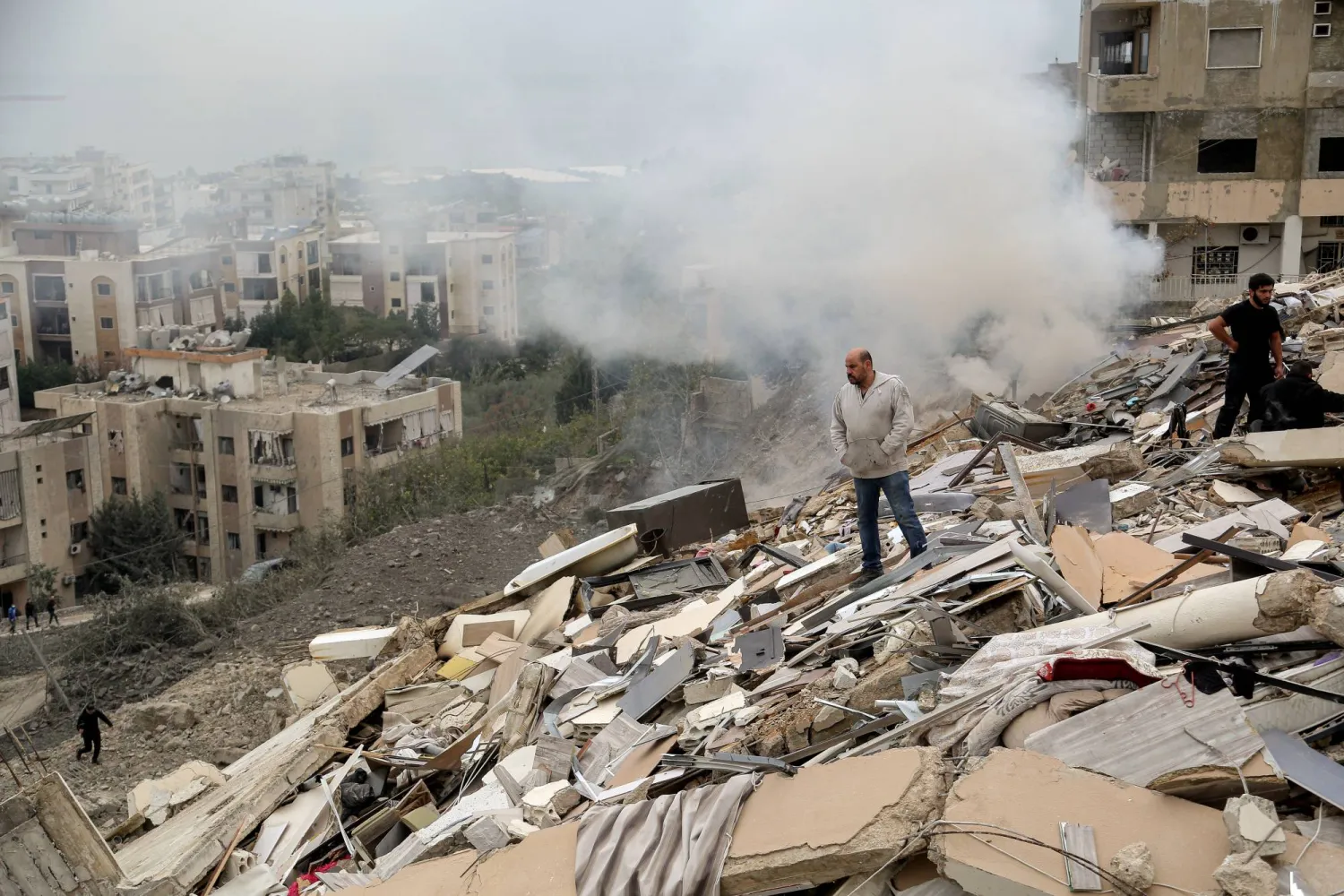
22 January 2026, Lebanon, Qnarit: People inspect the damage of a building that was destroyed by an Israeli air raid on the southern Lebanese village of Qnarit. (dpa)
TT

Lebanon Says One Killed in Israeli Strike on Palestinian Refugee Camp

22 January 2026, Lebanon, Qnarit: People inspect the damage of a building that was destroyed by an Israeli air raid on the southern Lebanese village of Qnarit. (dpa)

An Israeli strike on Lebanon's largest Palestinian refugee camp killed one person on Friday, state media reported, with the Israeli army saying it had targeted the Palestinian group Hamas.

The official National News Agency said "an Israeli drone" targeted a neighborhood of the Ain al-Hilweh camp, which is located on the outskirts of the southern city of Sidon.

It reported that one person was killed and an unspecified number wounded.

An AFP correspondent saw smoke rising from a building in the densely populated camp as ambulances headed to the scene.

The Israeli army said in a statement that its forces "struck a Hamas command center from which terrorists operated".

Israel has kept up regular strikes on Lebanon despite a November 2024 ceasefire that sought to halt more than a year of hostilities with Hezbollah.

Israel has also struck targets belonging to Hezbollah's Palestinian ally Hamas, including in a raid on Ain al-Hilweh last November that killed 13 people.

The UN rights office had said 11 children were killed in that strike, which Israel said targeted a Hamas training compound, though the group denied it had military installations in Palestinian camps in Lebanon.

In October 2023, Hezbollah began launching rockets at Israel in support of Hamas at the outset of the Gaza war, triggering months of exchanges that culminated in two months of all-out war in Lebanon.

On Sunday, Lebanon said an Israeli strike near the Syrian border in the country's east killed four people, as Israel said it targeted operatives from Palestinian group Islamic Jihad.


UN Says It Risks Halting Somalia Aid Due to Funding Cuts 

A Somali trader marks watermelons for sale at an open-air grocery market as Muslims start the fasting month of Ramadan, the holiest month in the Islamic calendar, within Bakara market in Mogadishu, Somalia, February 18, 2026. (Reuters)
TT

UN Says It Risks Halting Somalia Aid Due to Funding Cuts 

A Somali trader marks watermelons for sale at an open-air grocery market as Muslims start the fasting month of Ramadan, the holiest month in the Islamic calendar, within Bakara market in Mogadishu, Somalia, February 18, 2026. (Reuters)

The UN's World Food Program (WFP) warned Friday it would have to stop humanitarian assistance in Somalia by April if it did not receive new funding.

The Rome-based agency said it had already been forced to reduce the number of people receiving emergency food assistance from 2.2 million in early 2025 to just over 600,000 today.

"Without immediate funding, WFP will be forced to halt humanitarian assistance by April," it said in a statement.

In early January, the United States suspended aid to Somalia over reports of theft and government interference, following the destruction of a US-funded WFP warehouse in the capital Mogadishu's port.

The US announced a resumption of WFP food distribution on January 29.

However, all UN agencies have warned of serious funding shortfalls since Washington began slashing aid across the world following President Donald Trump's return to the White House last year.

"The situation is deteriorating at an alarming rate," said Ross Smith, WFP Director of Emergency Preparedness and Response, in Friday's statement.

"Families have lost everything, and many are already being pushed to the brink. Without immediate emergency food support, conditions will worsen quickly.

"We are at the cusp of a decisive moment; without urgent action, we may be unable to reach the most vulnerable in time, most of them women and children."

Some 4.4 million people in Somalia are facing crisis-levels of food insecurity, according to the WFP, the largest humanitarian agency in the country.

The Horn of Africa country has been plagued by conflict and also suffered two consecutive failed rainy seasons.


Hamas Says Path for Gaza Must Begin with End to ‘Aggression’ 

Makeshift tents of displaced Palestinian families among the ruins of their homes at sunset during the holy month of Ramadan in Jabaliya northern Gaza Strip on, 19 February 2026. (EPA)
TT

Hamas Says Path for Gaza Must Begin with End to ‘Aggression’ 

Makeshift tents of displaced Palestinian families among the ruins of their homes at sunset during the holy month of Ramadan in Jabaliya northern Gaza Strip on, 19 February 2026. (EPA)

Discussions on Gaza's future must begin with a total halt to Israeli "aggression", the Palestinian movement Hamas said after US President Donald Trump's Board of Peace met for the first time.

"Any political process or any arrangement under discussion concerning the Gaza Strip and the future of our Palestinian people must start with the total halt of aggression, the lifting of the blockade, and the guarantee of our people's legitimate national rights, first and foremost their right to freedom and self-determination," Hamas said in a statement Thursday.

Trump's board met for its inaugural session in Washington on Thursday, with a number of countries pledging money and personnel to rebuild the Palestinian territory, more than four months into a fragile ceasefire between Israel and Hamas.

Israeli Prime Minister Benjamin Netanyahu has insisted however that Hamas must disarm before any reconstruction begins.

"We agreed with our ally the US that there will be no reconstruction of Gaza before the demilitarization of Gaza," Netanyahu said.

The Israeli leader did not attend the Washington meeting but was represented by his foreign minister Gideon Saar.

Trump said several countries had pledged more than seven billion dollars to rebuild the territory.

Muslim-majority Indonesia will take a deputy commander role in a nascent International Stabilization Force, the unit's American chief Major General Jasper Jeffers said.

Trump, whose plan for Gaza was endorsed by the UN Security Council in November, also said five countries had committed to providing troops, including Morocco, Kazakhstan, Kosovo and Albania.