Barham Salih to Asharq Al-Awsat: Region Nearing Crisis…Iraq Best Witness to Violence

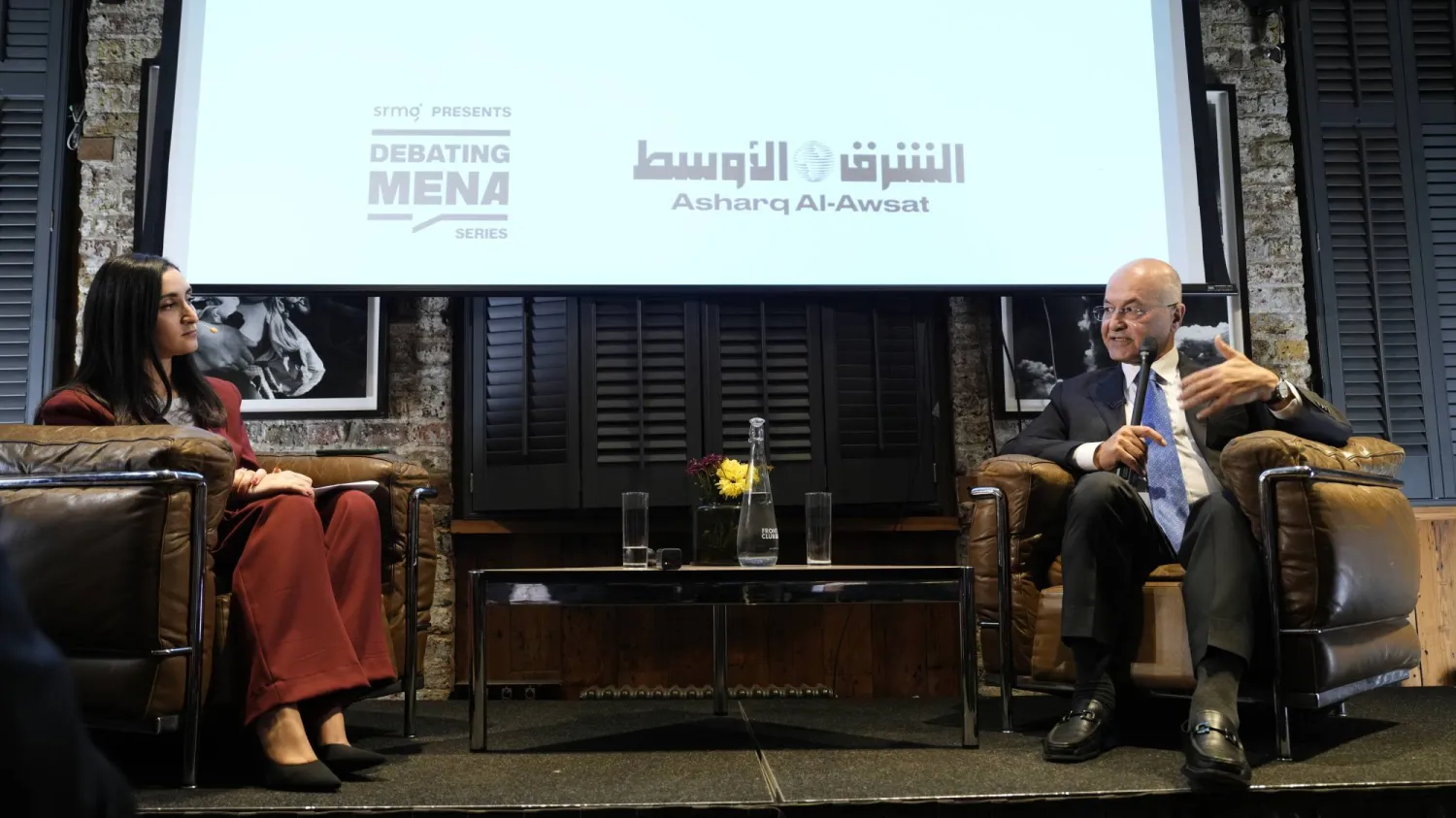
Barham Salih with Asharq Al-Awsat colleague Najlaa Habreiri (Asharq Al-Awsat)
TT

Barham Salih to Asharq Al-Awsat: Region Nearing Crisis…Iraq Best Witness to Violence

Barham Salih with Asharq Al-Awsat colleague Najlaa Habreiri (Asharq Al-Awsat)

Former Iraqi President Barham Salih warned that the Middle East is on the edge of a crisis but remains hopeful, citing growing international efforts to stop the ongoing war.
He also pointed to Iraq’s fragile situation, with local groups becoming more involved in the conflict.
Speaking at a panel in London organized by Asharq Al-Awsat and moderated by journalist Najlaa Habriri, Salih—who was president from 2018 to 2022—shared his thoughts on key political and historical events in Iraq and the region.
This event was the first in a series of talks with policymakers, business leaders, and academics hosted by Asharq Al-Awsat as part of SRMG’s initiatives.
A New Face for the Middle East
Salih believes the Middle East is entering a dangerous new phase, with the current conflict giving the region a “new face.”
“We’re witnessing a great tragedy. The destruction in Gaza is now spreading to Lebanon,” Salih said.
He expressed concern over growing anger in the Arab world due to repeated cycles of violence but stressed the need for change.
“We must move away from this crisis and find new ways to help the region grow and stabilize,” he said.
Salih called for bold action, urging leaders to cool the rising tensions and prevent further loss of innocent lives. He also shared cautious optimism after recent talks with policymakers in Baghdad and Washington, noting efforts to calm the situation.
“I hear there’s serious work underway to de-escalate, and while I can't guarantee success, I still have hope for a ceasefire,” he said.
Salih expected a temporary halt to fighting, allowing people to return home, but emphasized the need for fresh thinking to end the conflict.
“We can't go back to the old ways without addressing the root causes of violence,” he added.
Despite the challenges, Salih acknowledged ongoing global efforts, especially from Washington, to reduce the war’s catastrophic impact on the region.
Iraq at the Heart of the Storm
For the former Iraqi president, Iraq is “the best example of the consequences of violence,” and now the country faces a tough situation, caught between conflicting interests.
However, Salih is confident that “the decision to go to war in Iraq lies solely with the state,” not with the various groups pushing for escalation.
Salih noted that Iraqis don’t just offer sympathy—they provide real support, as shown with the Palestinians and now the Lebanese. He pointed to the flow of humanitarian aid from both government and civilian sources, stressing that in Iraq, there is widespread support for just causes.
Despite this, Salih warned that Iraq’s own challenges “make it clear that the country should avoid getting involved in more conflict.”
While Iraq’s stability is fragile, he believes it can be maintained if the country steers clear of the ongoing escalation.
Salih reflected on Iraq’s history of violence and conflict since 1958 but expressed optimism after meeting with Iraqi leaders.
“I was in Baghdad two months ago, and the main topic was clear: either we become a strong state, or we don’t. There’s no middle ground,” he said.
Salih insisted that “the decision for war or peace is a national one, not something that can be decided by any group or movement.”
He voiced concern that some factions are pushing Iraq into deeper involvement in the regional conflict, warning that this could lead to broader, more destructive consequences.
“We must be careful to avoid being dragged into a wider regional war. Iraq needs time to heal,” he noted.
While Iraq holds deep support for the Palestinian cause, Salih emphasized that “slogans won’t solve anything. The solution is in taking concrete steps to help Palestinians and Lebanese, both of whom are suffering from the conflict.”
“Anyone seeking a better Middle East must firmly support the Palestinians' right to a state and their rights as a people,” he affirmed.
US Withdrawal from Iraq
“Yes, there’s an agreement,” Salih said, referring to discussions between Washington and Baghdad on the future of the US-led international coalition in Iraq.
He suggested the topic was likely addressed during Prime Minister Mohammed Shia al-Sudani’s recent meeting with US Secretary of State Antony Blinken in New York.
An announcement about shifting the international coalition’s mission and gradually withdrawing US combat forces was expected, but Salih noted the recent escalation in Lebanon may have delayed it.
“Talks are ongoing, but nothing is finalized,” he added.
Salih acknowledged the key role US forces played in defeating ISIS, but emphasized that countries, including Iraq, seek full sovereignty.
While many believe Iraq’s stronger military means foreign troops are no longer needed, Salih disagrees. He argued that Iraq still requires intelligence support, especially for counterterrorism operations.
He pointed to reports of potential terrorist resurgence in the region, particularly in Syria.
“There are tens of thousands of angry individuals in the Middle East who could become a ticking time bomb, threatening Iraq and its neighbors. Just look at what’s happening in Idlib and the reappearance of Abu Mohammad al-Jolani,” said Salih.
He stressed that the risks are clear, even without specific intelligence.
“This is a global challenge, not just Iraq’s,” stressed Salih.
“I’m proud of the progress made by Iraqi forces, but there’s still a need for intelligence-sharing, especially in air operations,” he affirmed.



Hamas Angered by Continued Violations, Prepares Amendments to New Mediator Plan

Mourners weep beside the body of a child at a hospital in Gaza City (AFP)
TT

Hamas Angered by Continued Violations, Prepares Amendments to New Mediator Plan

Mourners weep beside the body of a child at a hospital in Gaza City (AFP)

Three Hamas sources said the movement has expressed anger to mediators over the continued Israeli violations in the Gaza Strip, most recently the assassination of Iyad al-Shanbari, a senior commander in the Qassam Brigades, the movement’s armed wing.

The three sources, speaking to Asharq Al-Awsat, said Hamas considers these violations, particularly the assassination of security leaders, a blow to mediation efforts aimed at establishing a clear agreement that obliges Israel to carry out its commitments.

It called on mediators to intervene in a “serious and firm” manner to halt these operations, which have led to the killing of about 1,000 Palestinians since the ceasefire entered into force on October 10, 2025. The sources said mediators confirmed they are continuing their efforts to put an end to the Israeli violations.

A Palestinian source in contact with the Gaza Administration Committee told Asharq Al-Awsat that Nickolay Mladenov, the highest representative for Gaza in the Peace Council, “requested on Monday that Israel halt airstrikes in the Gaza Strip for 48 hours to give the Cairo negotiations a chance to succeed, but received no response.” Hamas sources said they had no knowledge of this request.

A day after a new proposal was presented by mediators and the Peace Council regarding Gaza and advancing the implementation of the ceasefire agreement, Hamas sources said the movement is preparing a response containing remarks and requested amendments to be submitted by its negotiating delegation to Mladenov and the mediators.

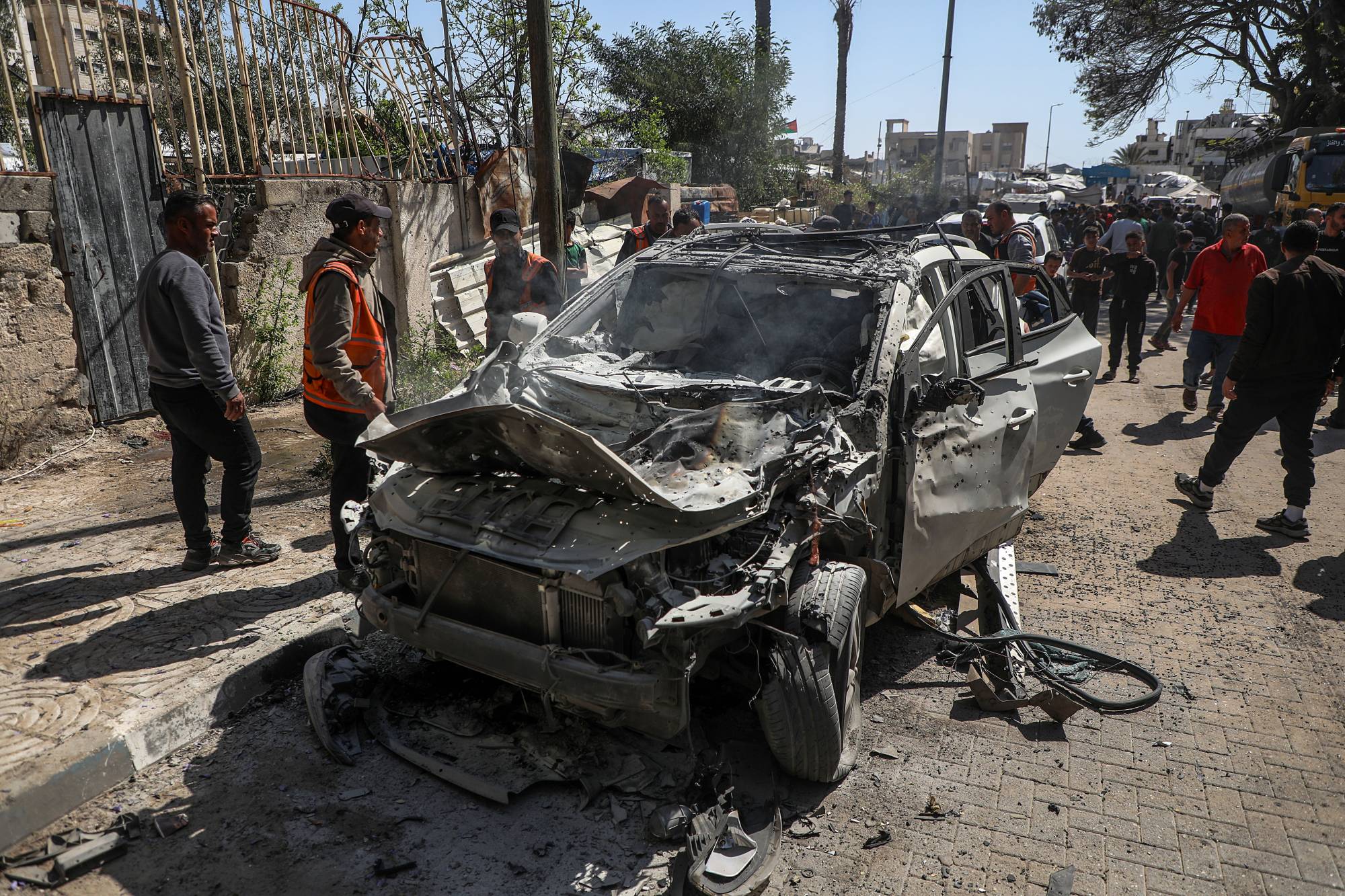
Members of the Palestinian Civil Defense and local residents inspect a damaged vehicle following an Israeli airstrike in the west of Gaza City, Gaza Strip, 28 April 2026. EPA/MOHAMMED SABER

Asharq Al-Awsat had obtained details of the proposal drafted by representatives of the Peace Council and mediators from Egypt, Qatar and Türkiye, along with the United States, concerning the Gaza Strip, particularly its disarmament.

The document, titled “Roadmap” to complete implementation of US President Donald Trump’s comprehensive Gaza peace plan, outlines 15 provisions addressing the implementation of the second phase of the ceasefire agreement between Israel and Hamas.

The response will focus, according to the sources, on demands for a clear timetable for Israeli withdrawal, the establishment of clear international mechanisms and guarantees to oblige Israel, rejecting any linkage between reconstruction and the confinement and disarmament issue, and affirming the right of factions to fully exercise their political role without restrictions.

The new paper indicates the formation of a body named the “Implementation Verification Committee,” to be established by the highest representative for Gaza, comprising guarantor states, an international stabilization force and the Peace Council, to ensure that the parties fulfill their obligations, supported by an enhanced monitoring mechanism.

In its first provisions, the document stresses the importance of full commitment by all parties to implement UN Security Council Resolution 2803 and Trump’s comprehensive plan, as an agreed international framework that will guide the implementation of this process, in a way that ensures achieving the primary objective of restoring civilian life, enabling Palestinian governance, reconstruction, security and economic recovery, and creating the conditions for a credible path toward self-determination and a Palestinian state in line with the Security Council resolution.


Lebanon President Says Israel Must 'Fully Implement Ceasefire' before Talks

 Smoke rises following an Israeli airstrike in a southern Lebanese village, as seen from the Upper Galilee 29 April 2026, amid a ceasefire between Israel and Lebanon.  EPA/ATEF SAFADI
Smoke rises following an Israeli airstrike in a southern Lebanese village, as seen from the Upper Galilee 29 April 2026, amid a ceasefire between Israel and Lebanon. EPA/ATEF SAFADI
TT

Lebanon President Says Israel Must 'Fully Implement Ceasefire' before Talks

 Smoke rises following an Israeli airstrike in a southern Lebanese village, as seen from the Upper Galilee 29 April 2026, amid a ceasefire between Israel and Lebanon.  EPA/ATEF SAFADI
Smoke rises following an Israeli airstrike in a southern Lebanese village, as seen from the Upper Galilee 29 April 2026, amid a ceasefire between Israel and Lebanon. EPA/ATEF SAFADI

Lebanese President Joseph Aoun said Wednesday that Israel must "fully implement" the ceasefire between the two countries before beginning direct negotiations, adding that Beirut was waiting for Washington to set a date for the talks, AFP reported.

Israel "must first fully implement the ceasefire in order to move on to negotiations... Israeli attacks cannot continue as they are," Aoun said in a statement shared by the presidency.

"We are now waiting for the United States to set a date to begin direct negotiations" with Israel.

Despite the ceasefire, Israel and Iran-backed Lebanese militant group Hezbollah have both engaged in fighting, trading blame over violations of the fragile truce.


Over 1.2 mn People in Lebanon to Face Acute Hunger due to War

UN forces operate in southern Lebanon, as seen from northern Israel, Wednesday, April 29, 2026. (AP Photo/Ariel Schalit)
TT

Over 1.2 mn People in Lebanon to Face Acute Hunger due to War

UN forces operate in southern Lebanon, as seen from northern Israel, Wednesday, April 29, 2026. (AP Photo/Ariel Schalit)

A UN-backed report said Wednesday that more than 1.2 million people in Lebanon were expected to face acute hunger due to the latest war between Israel and Hezbollah.

The figure was announced in a joint statement by the UN's Food and Agriculture Organization, the World Food Program and Lebanon's agriculture ministry.

Some "1.24 million people -- nearly one in four of the population analysed -- are expected to face food insecurity" at crisis levels or worse between April and August 2026, they said.

They were referring to analysis from the Integrated Food Security Phase Classification (IPC), a UN-backed group that monitors hunger and malnutrition.

This marks a "significant deterioration" from before the war erupted in March, "when an estimated 874,000 people, roughly 17 percent of the population, were experiencing acute food insecurity", the statement said.

"The deterioration is due to conflict, displacement and economic pressures," it added.

A ceasefire since April 17 has paused six weeks of war between Israel and Iran-backed militant group Hezbollah that has killed more than 2,500 people in Lebanon and displaced more than one million, according to the authorities.

Israeli forces are operating in south Lebanon near the border where residents have been warned not to return, and both sides have been trading fire despite the truce.

"Acute food insecurity is likely to deepen without sustained and timely humanitarian and livelihood support," the statement added.