A Picture of Her Grief Gripped the World. A Year On, Gaza Woman Haunted by Memories

A combination picture shows Palestinian woman Inas Abu Maamar, 36, embraces the body of her 5-year-old niece Saly, who was killed in an Israeli strike, at Nasser hospital in Khan Younis in the southern Gaza Strip, October 17, 2023 (L) and Inas visits a damaged cemetery where Saly was buried, in Khan Younis in the southern Gaza Strip, September 11, 2024. REUTERS/Mohammed Salem
TT

A Picture of Her Grief Gripped the World. A Year On, Gaza Woman Haunted by Memories

A combination picture shows Palestinian woman Inas Abu Maamar, 36, embraces the body of her 5-year-old niece Saly, who was killed in an Israeli strike, at Nasser hospital in Khan Younis in the southern Gaza Strip, October 17, 2023 (L) and Inas visits a damaged cemetery where Saly was buried, in Khan Younis in the southern Gaza Strip, September 11, 2024. REUTERS/Mohammed Salem

The Reuters photograph of Inas Abu Maamar, face buried in the shrouded body of her dead five-year-old niece Saly, was taken days after Israel began its military offensive on Gaza.
It has become one of the most vivid images of Palestinian suffering during the year-long bombing of Gaza, Israel's response to Hamas' Oct. 7 attack.
Saly was killed with her mother, baby sister, grandparents, uncle, aunt and three cousins. Since then, Abu Maamar, 37, has also lost her sister, killed along with her four children in an airstrike in northern Gaza.
Abu Maamar has moved three times to avoid bombing, at one point spending four months living in a tent. Today, she is back in her home in Khan Younis, in southern Gaza. Cracks run through the corrugated roof; a shower curtain covers a window-sized hole in the wall.
"We lost all hope in everything," said Abu Maamar, sitting amid rubble in the small graveyard by the family house. Beneath the debris, she said, lay Saly's grave.
"Even the grave was not safe."
Hamas' attack on Oct. 7 killed around 1,200 people in Israel, mostly civilians, and about 250 people were taken hostage, according to Israeli tallies.
Israel's campaign in Gaza, with the declared goal of wiping out Hamas, has since killed at least 41,500 people, mostly civilians, according to Palestinian health authorities.
Israel's military has said its bombardment of Gaza is necessary to crush Hamas, which it accuses of hiding among the general Palestinian population. Hamas denies this. Israel says it tries to reduce harm to civilians.
AIRSTRIKE
Before Oct. 7, Gaza had faced an extensive Israeli blockade following Hamas' takeover of the Palestinian territory in 2007. There was little work and imports were severely restricted but her family was settled, Abu Maamar said.
Abu Maamar lived with her husband near her brother Ramez' family, allowing her to spend much of her time with her nieces Saly and Seba and her nephew Ahmed.
As bombing intensified near the house after Oct. 7, Ramez sheltered with his family at his in-laws' about 1 km (0.6 miles) away. It was hit in an airstrike the next day.
When Abu Maamar heard she went straight to the Nasser hospital in Khan Younis. There she saw Ahmed, then 4, and grabbed him by the hand. She found Saly, dead, in the mortuary.
"I tried to wake her up. I couldn't believe she was dead," she said.
It was there that Reuters photographer Mohammed Salem took the picture of Abu Maamar cradling her dead niece, her body wrapped in a white sheet. The image was named World Press Photo of the year and won a Pulitzer Prize along with other Reuters images of the Oct. 7 attack and war in Gaza.
DISPLACEMENT
Israel said it had attacked 5,000 Hamas targets in Gaza from Oct. 7 until Oct. 17, the day of the airstrike that killed Saly. Palestinian health authorities said about 3,000 people had been killed by that point, including 940 children.
Israel's military did not respond to a request for comment on the strike that killed Saly.
In a comment six days after her death about the killing of another family in a different airstrike in Khan Younis, a spokesperson for Israel's military said: "Hamas has entrenched itself among the civilian population throughout the Gaza Strip. So wherever a Hamas target arises, the Israeli army will strike at it in order to thwart the terrorist capabilities of the group, while taking feasible precautions to mitigate the harm to uninvolved civilians."
By December, with Palestinian authorities saying the death toll in Gaza had topped 15,000 and Israel preparing to expand its ground assault to southern Gaza, Abu Maamar and other family members moved to Mawasi, a beach area where displaced people sought refuge in tents. They moved twice more as Israeli forces battled Hamas across the south, ordering civilians first from Khan Younis and then the city of Rafah.
Now back home, Abu Maamar says there is no point moving any more. She picked up Saly's favorite outfit, a black dress with traditional red Palestinian embroidery, and pressed it to her face.
"We are just waiting for the cascade of blood to stop."



UN: Drone Attack Hits Sudan Aid Truck

Shops operate beneath a war-damaged building in Omdurman, on the outskirts of Khartoum, Sudan, Thursday, April 23, 2026. (AP Photo/Bernat Armangue)
TT

UN: Drone Attack Hits Sudan Aid Truck

Shops operate beneath a war-damaged building in Omdurman, on the outskirts of Khartoum, Sudan, Thursday, April 23, 2026. (AP Photo/Bernat Armangue)

A drone attack hit an aid truck in Sudan's North Darfur state, destroying all the supplies on board, the UN refugee agency said on Sunday, without identifying who was responsible.

Drone strikes by both the Sudanese army and the Rapid Support Forces (RSF), who have been locked in a brutal war since April 2023, have escalated in recent months, often killing dozens at a time.

The UNHCR-operated vehicle "came under drone attack" on Friday while transporting emergency shelter kits to Tawila, home to more than 700,000 displaced people who fled fighting elsewhere in the western Darfur region, AFP quoted the agency as saying.

The driver escaped unhurt, but all supplies were destroyed in the resulting fire, it added.

UNHCR condemned the attack, warning that it would "leave 1,314 families living in desperate conditions in Tawila without shelter" at a time when humanitarian needs are already overwhelming.

More than 127,000 people fled El-Fasher, North Darfur's capital and the army's last stronghold in the region, after it fell to paramilitary forces in October, with reports of mass killings, sexual violence, looting and rape following the takeover.

Fighting has since spread to neighboring Kordofan, now the main theatre of the war, and the southeastern Blue Nile state, raising fears of a longer and increasingly fragmented conflict.

According to the UN, nearly 700 civilians have been killed in drone strikes by both sides since January alone.

UNHCR voiced "deep concern" over the rising use of drones, calling repeated attacks on humanitarian operations "particularly abhorrent".

According to an assessment by the UN's Food and Agriculture Organization, 28.9 million people, around 62 percent of Sudan's population, are facing acute food insecurity.

That includes 10.2 million who face severe food insecurity, in particular in the wider Darfur region and South Kordofan state.

Famine was declared last year in El-Fasher and Kadugli, the capital of South Kordofan, with 20 other areas at risk in Darfur and Kordofan, a UN-backed assessment found.

The conflict has already killed tens of thousands, uprooted over 11 million and created the world's largest displacement and hunger crises.


Palestinian Leader's Loyalists Win Local Elections, including Some in Gaza

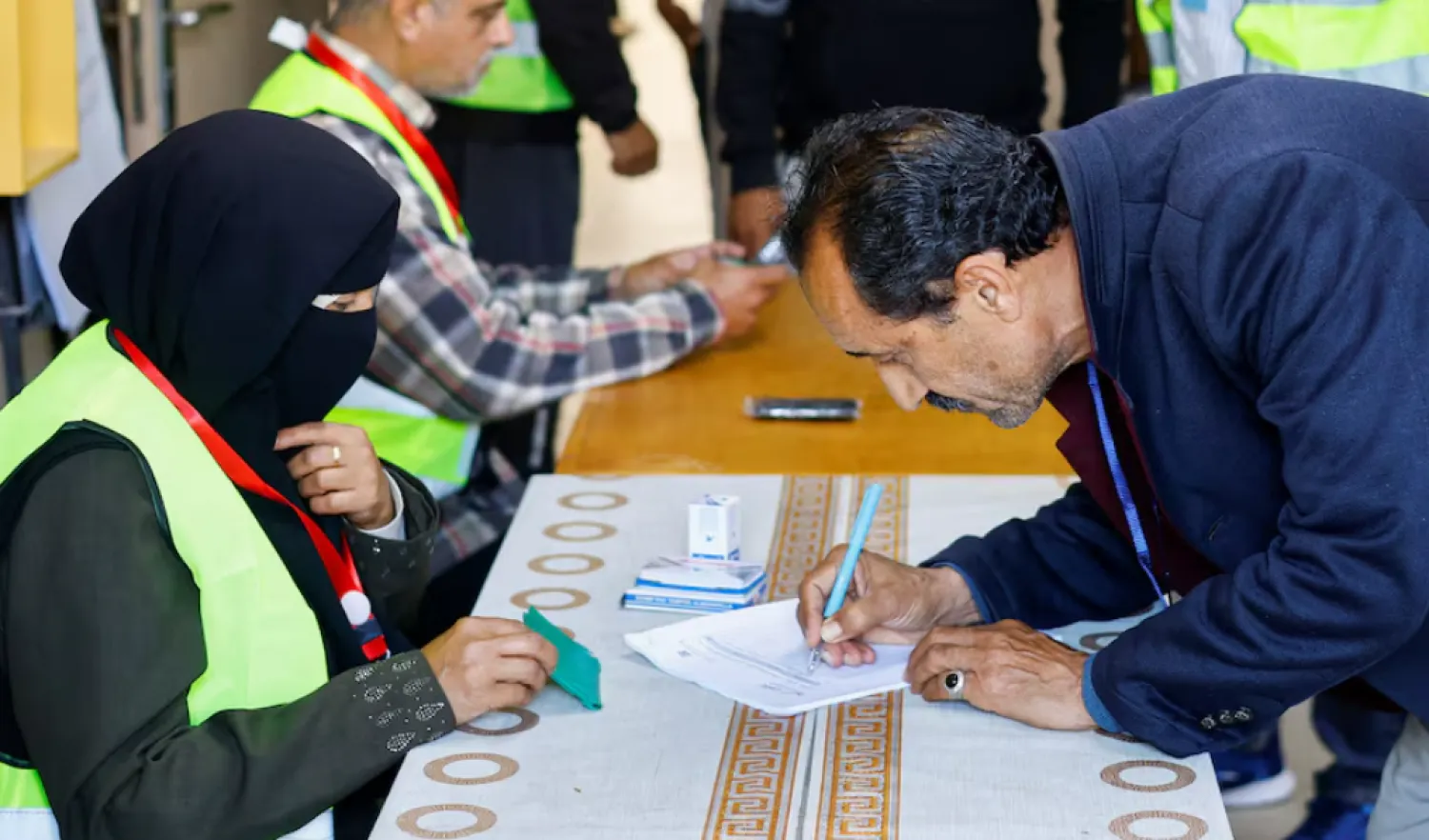
A Palestinian man votes during the municipal election at a polling station in Deir al-Balah, central Gaza Strip April 25, 2026. REUTERS/Mahmoud Issa
TT

Palestinian Leader's Loyalists Win Local Elections, including Some in Gaza

A Palestinian man votes during the municipal election at a polling station in Deir al-Balah, central Gaza Strip April 25, 2026. REUTERS/Mahmoud Issa

Loyalists of President Mahmoud Abbas won most races in Palestinian municipal elections, election officials said on Sunday, in a vote that for the first time in nearly two decades included a city in the Gaza Strip run by rival Hamas.

Saturday’s ballot marked the first elections of any kind in Gaza since 2006 and the first Palestinian polls since the Gaza war began more than two years ago with Hamas' cross-border attack on southern Israel.

Abbas' West Bank–based Palestinian Authority (PA) said the inclusion of the Gaza city Deir al-Balah, which suffered less damage than other areas of the coastal territory during the war, was intended to show that Gaza was an inseparable part of a future Palestinian state.

The elections, in which voter turnout was low, had been held "at a highly sensitive moment amid complex challenges and exceptional circumstances", Palestinian Prime Minister Mohammad Mustafa said as results were announced on Sunday.

But they represented "an important first step in a broader national process aimed at strengthening democratic life ... and ultimately achieving the unity of the land", he said.

POSSIBLE INDICATOR OF HAMAS SUPPORT

Hamas, which ousted the PA from Gaza in 2007, did not formally nominate candidates in Gaza and boycotted the race in the Israeli-occupied West Bank, where Fatah's victory was widely expected.

But some candidates on one of the Deir al-Balah lists were widely seen by residents and analysts as aligned with the movement, making the vote a potential indicator of support for the Islamist group.

Preliminary results showed that the list, known as Deir al-Balah Brings Us Together, won only two of the 15 seats contested in Gaza.

The Nahdat Deir al-Balah list, backed by Abbas' Fatah party and the Western-backed PA, secured six seats. The remaining seats were won by two other Gaza-based groups, Future of Deir al-Balah and Peace and Building, not affiliated with either faction.

Abbas loyalists swept the election in the West Bank, running unchallenged in many seats.

"By electing figures linked to Fatah, voters appear to be seeking unrestricted international support for municipal governance and a gradual political shift that could extend beyond the local level," said Palestinian political analyst Reham Ouda.

The recent war has left much of Gaza reduced to rubble, with many residents displaced and focused on survival. Israel has continued conducting strikes despite an October ceasefire.

In Gaza voter turnout reached just 23%, while in the West Bank it was 56%, according to Chairman of the Central Elections Commission Rami al-Hamdallah.

Al-Hamdallah said some of the ballot boxes and voting equipment did not make it into the enclave because of Israeli security restrictions, though those challenges were overcome.

Hamas' Gaza spokesperson, Hazem Qassem, downplayed the significance of the election results, saying that they had no impact on wider national issues.


Arab Parliament Condemns Attack Targeting Two Border Posts in Kuwait

Arab Parliament logo
TT

Arab Parliament Condemns Attack Targeting Two Border Posts in Kuwait

Arab Parliament logo

Arab Parliament Speaker Mohammed Al-Yamahi has condemned the blatant attack that targeted two sites at the northern land border posts of Kuwait using two explosive-laden drones coming from Iraq, SPA reported.

In a statement, Al-Yamahi stressed the Arab Parliament’s condemnation and categorical rejection of any infringement on the sovereignty of Kuwait or any attempt to undermine its security and stability.

He stressed the Arab Parliament’s full solidarity and support for Kuwait in confronting such attacks, reiterating its backing for all measures taken to protect its security and noting that the security of Kuwait is an integral part of Arab national security.