

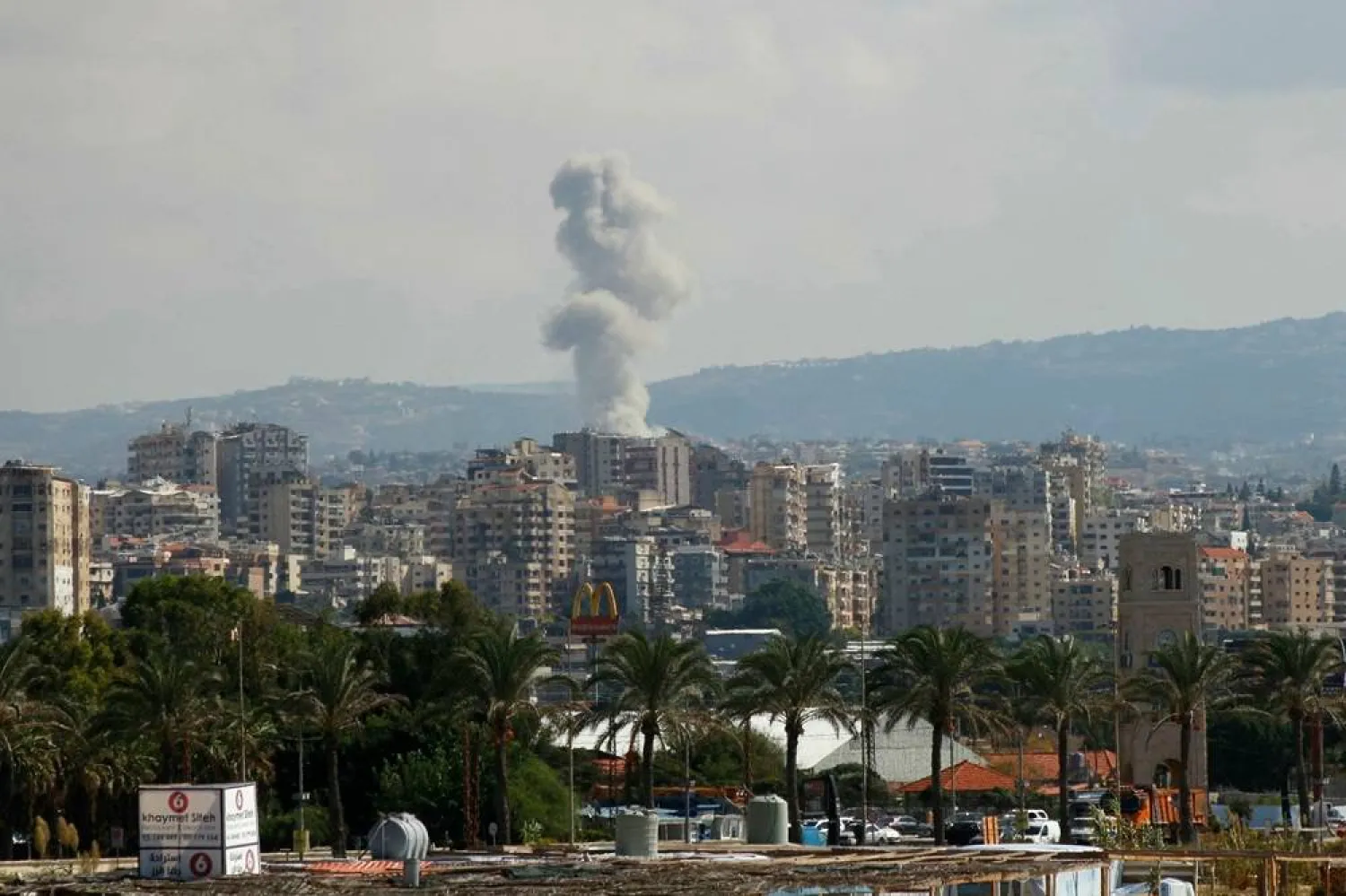

Israeli Strikes Kill at Least 15 in Qana, a Lebanese Town with Dark History of Civilian Deaths by Israel

 A picture taken from the southern Lebanese city of Tyre shows smoke rising from the site of an Israeli strike targeting the village of Qana on October 12, 2024. (AFP)
A picture taken from the southern Lebanese city of Tyre shows smoke rising from the site of an Israeli strike targeting the village of Qana on October 12, 2024. (AFP)
TT

Israeli Strikes Kill at Least 15 in Qana, a Lebanese Town with Dark History of Civilian Deaths by Israel

 A picture taken from the southern Lebanese city of Tyre shows smoke rising from the site of an Israeli strike targeting the village of Qana on October 12, 2024. (AFP)
A picture taken from the southern Lebanese city of Tyre shows smoke rising from the site of an Israeli strike targeting the village of Qana on October 12, 2024. (AFP)

Israeli strikes have killed at least 15 people in the southern Lebanese town of Qana, which has long been associated with civilian deaths after Israeli strikes during previous conflicts with Hezbollah. Israel meanwhile struck Beirut's southern suburbs early Wednesday for the first time in nearly a week.

There was no immediate comment from the Israeli military on the strikes in Qana late Tuesday. Lebanon's Civil Defense said 15 bodies had been recovered from the rubble of a building and that rescue efforts were still underway.

In 1996, Israeli artillery shelling on a United Nations compound housing hundreds of displaced people in Qana killed at least 100 civilians and wounded scores more, including four UN peacekeepers.

During the 2006 war, an Israeli strike on a residential building killed nearly three dozen people, a third of them children. Israel said at the time that it struck a Hezbollah rocket launcher behind the building.

The strikes on southern Beirut were the first in six days, and came after Lebanon's caretaker Prime Minister Najib Mikati said the United States had given him assurances that Israel would curb its strikes on the capital. There was no immediate word on casualties.

Hezbollah has a strong presence in southern Beirut, known as the Dahiyeh, which is also a residential and commercial area home to large numbers of civilians and people unaffiliated with the armed group.

The Israeli military said it targeted an arms warehouse under a residential building, without providing evidence.

Hezbollah began firing rockets into Israel on Oct. 8 in solidarity with the Palestinian group Hamas, following the surprise Hamas attack on southern Israel that triggered the war in Gaza. A year of low-level fighting along the Israel-Lebanon border escalated into all-out war last month, and has displaced some 1.2 million people in Lebanon.

Some 2,300 people have been killed by Israeli strikes in Lebanon since last October, more than three-quarters of them in the past month, according to Lebanon's Health Ministry.

Hezbollah's rocket attacks, which have extended their range and grown more intense over the past month, have driven around 60,000 Israelis from their homes in the north. The attacks have killed nearly 60 people in Israel, around half of them soldiers.

Hezbollah has said it will keep up its attacks until there is a ceasefire in Gaza, but that appears increasingly remote after months of negotiations brokered by the United States, Egypt and Qatar sputtered to a halt last month.

Israel, which invaded Lebanon earlier this month and has been carrying out ground operations along the border, has vowed to continue its offensive until its citizens can safely return to communities near the border.



Attack on Iraqi Intelligence HQ Ends Opportunities for Dialogue between Govt, Armed Factions

Iraqi Prime Minister Mohammed Shia al-Sudani visits the intelligence HQ in Baghdad on Sunday after Saturday's attack. (Iraqi Prime Minister’s Office)
TT

Attack on Iraqi Intelligence HQ Ends Opportunities for Dialogue between Govt, Armed Factions

Iraqi Prime Minister Mohammed Shia al-Sudani visits the intelligence HQ in Baghdad on Sunday after Saturday's attack. (Iraqi Prime Minister’s Office)

Iraqi Prime Minister Mohammed Shia al-Sudani slammed on Sunday the attack by a “cowardly” armed faction against an intelligence headquarters in Baghdad.

His position effectively puts an end to opportunities to hold dialogue between his government and the factions to stop their attacks on various US interests in Iraq and Kurdistan in solidarity with Iran in its war with Washington and Tel Aviv.

One officer was killed and other intelligence personnel were wounded in Saturday’s drone attack.

Sudani called on the political forces to take a “clear and frank” stance against the attacks on state institutions, a reference to some members of the pro-Iran Shiite Coordination Framework that have yet to make their position clear about the attacks.

The factions continue to target the US embassy in Baghdad and have struck a diplomatic logistics support base affiliated with the embassy at Baghdad airport and the US consulate in the Kurdistan Region capital Erbil.

Sudani visited the intelligence headquarters on Sunday, urging the concerned agencies to investigate the “heinous terrorist” attack.

He called on them to not hesitate in exposing the truth and bringing the perpetrators to justice.

“The perpetrators are a cowardly group that have violated Iraqi blood and state institutions. Whoever dares to do so does not represent Iraq. There can be no justification for this crime,” he added.

“The government is acting wisely and responsibly, but it will not stand idly as the country’s higher interests are violated,” he went on to say.

Sudani called on the political forces to “assume their responsibilities and issue clear and frank statements against the violations that are gambling with the future of the country.”

“Some party gave itself the right to control decisions of war and peace. We declare that this decision is the state’s alone. It alone sets and protects Iraq’s interests,” he stressed.

The national intelligence agency said outlaws had carried out Saturday's “terrorist” attack.

Sudani also denied reports that he had tasked national security advisor Qasim al-Araji to hold dialogue with the armed factions to make them stop attacks on US interests and residential neighborhoods in Baghdad.


Army Chief: Israel to 'Advance Targeted Ground Operations' in Lebanon

People inspect a crater following an Israeli airstrike that hit the Qasmiyeh Bridge near the coastal city of Tyre, Lebanon, Sunday, March 22, 2026. (AP Photo/Mohammad Zaatari)
TT

Army Chief: Israel to 'Advance Targeted Ground Operations' in Lebanon

People inspect a crater following an Israeli airstrike that hit the Qasmiyeh Bridge near the coastal city of Tyre, Lebanon, Sunday, March 22, 2026. (AP Photo/Mohammad Zaatari)

Israel's military will expand its ground operations in Lebanon against Hezbollah, its army chief said Sunday, warning that the offensive against the group was still in its early stages.

"The operation against the Hezbollah terrorist organization has only begun... This is a prolonged operation," Lieutenant General Eyal Zamir said in a statement.

"We are now preparing to advance the targeted ground operations and strikes according to an organized plan," he added.

Zamir's comments came as Israel struck more targets in south Lebanon on Sunday, including a key bridge, triggering a warning from the Lebanese president that it could be launching a full ground invasion.

Destroying bridges further isolates residents from the rest of Lebanon.

The destruction of bridges and homes marks a significant escalation in Israel's military campaign in Lebanon, which was pulled into the regional war on March 2 when Hezbollah fired into Israeli territory.

Sunday's strike damaged a crossing on Lebanon's coastal highway that runs through farmland and is one of the main routes linking southern and central Lebanon.

An Israeli military spokesperson had ‌announced the army would ‌strike the Qasmiyeh bridge earlier on Sunday.

Smoke and flames rise after an Israeli strike targeting the Qasmiyeh Bridge near Tyre, in southern Lebanon, 22 March 2026. EPA/STRINGER

Israel has sent troops into Lebanon and carried out extensive airstrikes, while Hezbollah has launched rocket barrages.

"In recent weeks, we have achieved significant accomplishments: we have struck more than 2,000 targets, dozens of weapons storage facilities, and struck and eliminated hundreds of terrorists," Zamir said.

"We will not stop until the threat is pushed away from the border and long term security is ensured for the residents of northern Israel," he added.

Lebanese authorities say Israel's strikes have killed more than 1,000 people and displaced more than 1 million.


Israel Probing if Own Forces Killed Civilian on Lebanon Border

Smoke rises after an Israeli strike, following an escalation between Hezbollah and Israel amid the US-Israeli conflict with Iran, as seen from Marjayoun, Lebanon, March 22, 2026. REUTERS/Karamallah Daher
TT

Israel Probing if Own Forces Killed Civilian on Lebanon Border

Smoke rises after an Israeli strike, following an escalation between Hezbollah and Israel amid the US-Israeli conflict with Iran, as seen from Marjayoun, Lebanon, March 22, 2026. REUTERS/Karamallah Daher

Israel's military said it was investigating whether its own fire killed an Israeli civilian near the Lebanese border on Sunday, after Hezbollah claimed an attack in the same area.

Israeli emergency workers said earlier Sunday that a man was killed in a "direct hit" on his car by a rocket from Lebanon, making him the first fatality in the country's north since the latest round of fighting with Hezbollah broke out.

The Iran-backed militant group said after the incident that its fighters had attacked Israeli soldiers in the same area.

But the Israeli army later announced it was "conducting a comprehensive investigation" into the death, AFP reported.

"The possibility that the incident involved fire originating from IDF soldiers is being examined," the military said in a statement.

Lebanon was pulled into the Middle East war when Hezbollah began firing rockets into Israel on March 2 to avenge the killing of Iran's supreme leader Ali Khamenei in Israeli-US attacks.

Israel has sent troops into Lebanon and carried out extensive airstrikes in the country, while Hezbollah continues to fire rocket barrages across the border.