

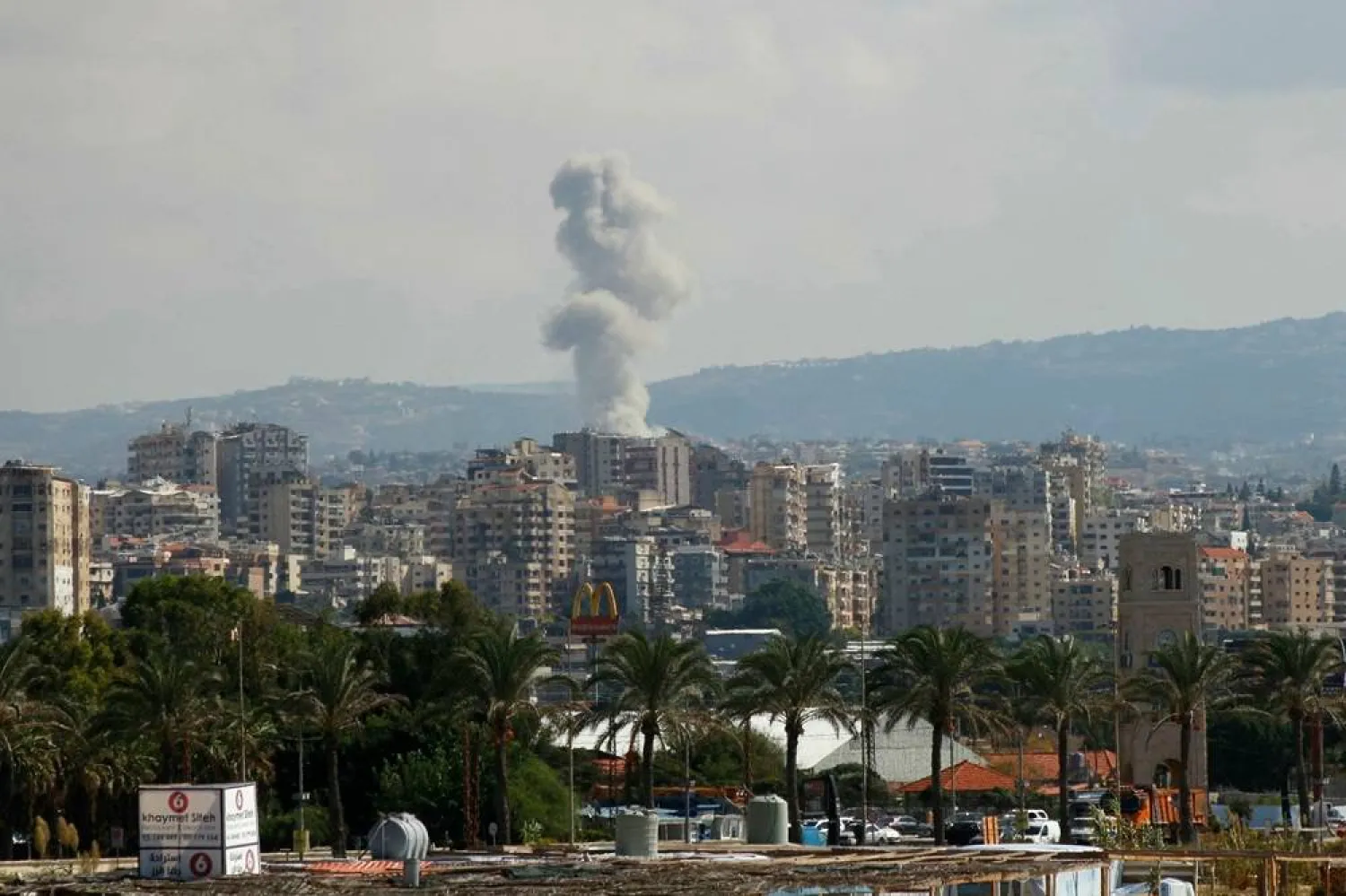

Israeli Strikes Kill at Least 15 in Qana, a Lebanese Town with Dark History of Civilian Deaths by Israel

 A picture taken from the southern Lebanese city of Tyre shows smoke rising from the site of an Israeli strike targeting the village of Qana on October 12, 2024. (AFP)
A picture taken from the southern Lebanese city of Tyre shows smoke rising from the site of an Israeli strike targeting the village of Qana on October 12, 2024. (AFP)
TT

Israeli Strikes Kill at Least 15 in Qana, a Lebanese Town with Dark History of Civilian Deaths by Israel

 A picture taken from the southern Lebanese city of Tyre shows smoke rising from the site of an Israeli strike targeting the village of Qana on October 12, 2024. (AFP)
A picture taken from the southern Lebanese city of Tyre shows smoke rising from the site of an Israeli strike targeting the village of Qana on October 12, 2024. (AFP)

Israeli strikes have killed at least 15 people in the southern Lebanese town of Qana, which has long been associated with civilian deaths after Israeli strikes during previous conflicts with Hezbollah. Israel meanwhile struck Beirut's southern suburbs early Wednesday for the first time in nearly a week.

There was no immediate comment from the Israeli military on the strikes in Qana late Tuesday. Lebanon's Civil Defense said 15 bodies had been recovered from the rubble of a building and that rescue efforts were still underway.

In 1996, Israeli artillery shelling on a United Nations compound housing hundreds of displaced people in Qana killed at least 100 civilians and wounded scores more, including four UN peacekeepers.

During the 2006 war, an Israeli strike on a residential building killed nearly three dozen people, a third of them children. Israel said at the time that it struck a Hezbollah rocket launcher behind the building.

The strikes on southern Beirut were the first in six days, and came after Lebanon's caretaker Prime Minister Najib Mikati said the United States had given him assurances that Israel would curb its strikes on the capital. There was no immediate word on casualties.

Hezbollah has a strong presence in southern Beirut, known as the Dahiyeh, which is also a residential and commercial area home to large numbers of civilians and people unaffiliated with the armed group.

The Israeli military said it targeted an arms warehouse under a residential building, without providing evidence.

Hezbollah began firing rockets into Israel on Oct. 8 in solidarity with the Palestinian group Hamas, following the surprise Hamas attack on southern Israel that triggered the war in Gaza. A year of low-level fighting along the Israel-Lebanon border escalated into all-out war last month, and has displaced some 1.2 million people in Lebanon.

Some 2,300 people have been killed by Israeli strikes in Lebanon since last October, more than three-quarters of them in the past month, according to Lebanon's Health Ministry.

Hezbollah's rocket attacks, which have extended their range and grown more intense over the past month, have driven around 60,000 Israelis from their homes in the north. The attacks have killed nearly 60 people in Israel, around half of them soldiers.

Hezbollah has said it will keep up its attacks until there is a ceasefire in Gaza, but that appears increasingly remote after months of negotiations brokered by the United States, Egypt and Qatar sputtered to a halt last month.

Israel, which invaded Lebanon earlier this month and has been carrying out ground operations along the border, has vowed to continue its offensive until its citizens can safely return to communities near the border.



Israel Strikes Hezbollah’s Civilian as Well as Military Wings in an Attempt to Crush the Group

Destroyed houses and buildings in southern Lebanon are seen across the border from the Upper Galilee in northern Israel on March 20, 2026. (AFP)
TT

Israel Strikes Hezbollah’s Civilian as Well as Military Wings in an Attempt to Crush the Group

Destroyed houses and buildings in southern Lebanon are seen across the border from the Upper Galilee in northern Israel on March 20, 2026. (AFP)

An Israeli strike on a health center in southern Lebanon instantly killed 12 medical workers, seriously wounded one and left four missing under the rubble for hours.

The March 13 strike in the village of Burj Qalaouiyah, one of the single deadliest strikes in Lebanon since the latest Israel-Hezbollah war began on March 2, targeted a center run by Hezbollah’s health arm, the Islamic Health Society, which has so far lost 24 members over the past two weeks.

Since the latest war began, Israel’s military has not only been targeting the group’s military assets but also its civilian institutions in an apparent attempt to weaken the Iran-backed group further and try to push its supporters away from it.

Hezbollah is a political party as well as an armed group, and its health and social service institutions have helped strengthen its base of support over the years.

In addition to health centers, Israel has destroyed more than a dozen branches of Hezbollah’s financial arm, al-Qard al-Hasan. Other strikes heavily damaged Hezbollah’s Al-Manar TV headquarters and its Al-Nour radio stations.

The strikes also have targeted the group's Amana gas stations and discount shops known as Sajjad, where low-income people can buy highly subsidized products.

On Wednesday, an Israeli airstrike on an apartment in central Beirut killed Mohammed Sherri, the head of political programs at Hezbollah's Al-Manar TV, along with his wife.

Israel has accused Hezbollah of using health facilities for military purposes and has said al-Qard al-Hasan — officially a charitable organization that provides interest-free loans — finances the group's military activities. Lebanon's Health Ministry denies the Israeli claims about Hezbollah's health facilities being used for military purposes.

"This is a different war that will not end with a ceasefire," said Hilal Khashan, a political scientist at American University of Beirut. "This war will not end before Israel achieves its full objective - that is, the elimination of Hezbollah not only as a military movement, but also the ultimate objective is to erase Hezbollah from the Lebanese political picture."

Hezbollah is under internal and external pressure to disarm and knows this latest fight is crucial. Intense clashes along Lebanon's southern border between Hezbollah fighters and advancing Israeli troops have left dozens of Lebanese gunmen dead.

During a visit to the northern front Monday, Israel's army chief Gen. Eyal Zamir said that Hezbollah is now fighting "a war for its very existence and is paying a heavy price for entering this battle." He added that pressures exerted by Israel's military will only "increase more and more."

Hezbollah vows to keep fighting

"This is an existential battle. It is not a limited or simple battle," Hezbollah leader Sheikh Naim Qassem said in a televised speech over the weekend. Qassem vowed that his group would fight to the end and never surrender.

Israel says that Lebanon has failed to disarm the group in accordance with the Lebanese government's own plans, and that therefore Israel will carry out the mission itself.

Unlike previous conflicts with Israel, the current one comes as the Lebanese government has called Hezbollah’s military activities illegal and authorities have detained several members of the group for carrying weapons without a license.

Like previous wars, Hezbollah is being criticized by its opponents in Lebanon who blame the Iran-backed group for triggering this war by firing rockets into Israel. Hezbollah fired the rockets to avenge the killing of Iran's Supreme Leader Ali Khamenei, less than two days after the US and Israel began their attacks on Iran, triggering a war in the Middle East.

Israel retaliated with a campaign of airstrikes on parts of Lebanon that has so far left more than 1,000 people dead and over 1 million displaced from their homes in southern and eastern Lebanon, as well as in Beirut’s southern suburbs.

"Hezbollah took a suicidal initiative that will not change the equation," said legislator Sami Gemayel, who heads the nationalist Kataeb Party, adding that Tehran is using Lebanon "as a platform to defend Iran."

A previous 34-day war between Israel and Hezbollah in 2006 ended with a draw. A 14-month conflict that started in October 2023 — when Hezbollah fired rockets in support of Palestinians a day after the Oct. 7, 2023, Hamas-led attack on southern Israel — killed much of Hezbollah’s political and military command and left the group severely weakened but not destroyed.

Strikes followed by backlash

After airstrikes hit Hezbollah’s institutions even in central Beirut, residents protested and forced the group to close a branch of al-Qard al-Hasan in the heart of the capital. Bowing to the pressure, workers removed the financial institution's sign and dismantled ATMs, marking the end of its presence in central Beirut.

Amnesty International has said that the al-Qard al-Hasan branches are not legitimate military targets under international humanitarian law and that the strikes should be investigated as war crimes.

"The Israeli military has appeared to assume that labelling something as Hezbollah-affiliated, be that healthcare workers, homes in border villages, or financial institutions, makes it targetable. That’s wrong," said Heba Morayef, regional director for the Middle East and North Africa at Amnesty International.

Mahmoud Karaki of Hezbollah’s Islamic Health Society said that during the last war in 2024, his group lost 153 members in Israeli attacks. But he vowed that the group would continue its work as it has done in previous wars.

"By targeting us, they are targeting the safety network for the people and their steadfastness in areas under attack," Karaki said

The Israeli military’s Arabic spokesperson alleged that Hezbollah is using ambulances to transport weapons and fighters, a charge that the paramedic group strongly denies.

Hezbollah and Iranian officials have said that any halt in US-Israeli strikes on Iran should also include a stop to Israeli attacks in Lebanon.

Senior Hezbollah official Mahmoud Qamati told Lebanon’s Al-Jadeed TV on Monday that "Iran will not leave Lebanon nor the resistance, nor will it allow that Lebanon remains vulnerable," adding that "Lebanon will be part of this victory and will not be left alone."

When Iran’s Foreign Minister Abbas Araghchi was asked if Tehran could accept a ceasefire to stop strikes on Iran while they continue in Lebanon, he said: "I don't think so."

"We do not believe in a ceasefire; we believe in ending the war. And ending the war means exactly that — ending the war on all fronts," Araghchi told Al Jazeera English, adding that this includes Lebanon, Yemen, Iraq, Iran and "other countries of the region."


Sharaa Says Working to Steer Syria Clear of Any Conflict

This handout photograph released by the official Syrian Arab News Agency (SANA) shows Syria's interim President Ahmed al-Sharaa (2nd-R) attending the early morning prayers for Eid al-Fitr, marking the end of the holy month of Ramadan, in Damascus on March 20, 2026. (SANA/AFP)
TT

Sharaa Says Working to Steer Syria Clear of Any Conflict

This handout photograph released by the official Syrian Arab News Agency (SANA) shows Syria's interim President Ahmed al-Sharaa (2nd-R) attending the early morning prayers for Eid al-Fitr, marking the end of the holy month of Ramadan, in Damascus on March 20, 2026. (SANA/AFP)

Syrian President Ahmed al-Sharaa stressed on Friday that he was working on steering the country clear of the war in the Middle East.

“We are taking steps very carefully and working on keeping Syria out of any conflict,” he said after Eid al-Fitr prayers in Damascus.

“We must remember that Syria had for 15 years been the arena for conflicts. Today, it is on good terms with all neighboring countries in the region, as well as countries around the world. At the same time, we stand in full solidarity with Arab countries,” he added.

Syria has transformed from an arena of conflict to one that can influence stability and security on the internal scene, as well as in the region, he went on to say.

The conflict in the Middle East erupted on February 28 after the United States and Israel launched strikes against Iran. Iran in turn retaliated by launching attacks against Israel and American interests and embassies, and oil installations in the Gulf.

Lebanon was dragged into the war on March 2 when Hezbollah started firing rockets at Israel in retaliation to the killing of Irania supreme leader Ali Khamenei at the beginning of the conflict.

Syria has so far avoided being dragged into the war, but on Friday Israel's military said it had struck Syrian army camps in response to what it called attacks against the Druze community in the southern Sweida province.


Arab Nations Condemn Israeli Strikes on Syria

 Demonstrators march during a rally commemorating the15th anniversary of the Syrian uprising against the Bashar al-Assad regime in Daraa, southern Syria, Wednesday, March 18, 2026. (AP)
Demonstrators march during a rally commemorating the15th anniversary of the Syrian uprising against the Bashar al-Assad regime in Daraa, southern Syria, Wednesday, March 18, 2026. (AP)
TT

Arab Nations Condemn Israeli Strikes on Syria

 Demonstrators march during a rally commemorating the15th anniversary of the Syrian uprising against the Bashar al-Assad regime in Daraa, southern Syria, Wednesday, March 18, 2026. (AP)
Demonstrators march during a rally commemorating the15th anniversary of the Syrian uprising against the Bashar al-Assad regime in Daraa, southern Syria, Wednesday, March 18, 2026. (AP)

Saudi Arabia's Foreign Ministry condemned on Saturday Israel's strikes on Syrian army camps as "aggression", joining other Arab nations and Türkiye in calling on the international community to intervene.

Israel's military said on Friday it had struck southern Syria in response to what it called attacks against the Druze community in Sweida province.

Israel had bombed Syria during a deadly bout of sectarian violence last year, saying it was acting to defend the minority group.

The Saudi Foreign Ministry said in a statement that the Kingdom condemned "the blatant Israeli aggression... in flagrant violation of international law and Syrian sovereignty".

It urged the international community "to put an end to Israel's violations of international laws and norms".

The Turkish foreign ministry earlier called the Israeli attack "a dangerous escalation" that must be stopped.

Egypt, Jordan, Qatar and Kuwait all joined in condemning the Israeli strikes, stressing the need to ensure Syria's sovereignty and the global community's role in preventing such attacks.

Cairo's foreign ministry urged "the UN Security Council to assume its responsibilities and take immediate action to put an end to these ongoing Israeli violations and attacks".

The Israeli strikes came as war roiled the Middle East after the US and Israel attacked Iran on February 28, sparking a conflict that has engulfed much of the region, although Syria has avoided being dragged into it.

After the overthrow of Syria's longtime ruler Bashar al-Assad in December 2024, Israel moved its forces into the UN-patrolled demilitarized zone on the Israeli-annexed Golan Heights, and has carried out hundreds of strikes in Syria as well as regular incursions.

The military said on Friday it "will not allow harm to come to Druze in Syria and will continue to act for their protection".

The Syrian foreign ministry denounced an "outrageous assault on Syria's sovereignty and territorial integrity" and called the Israeli justification "flimsy pretexts and fabricated excuses".

President Ahmed al-Sharaa said on Friday that he was working "to keep Syria away from any conflict" and that his government was on good terms "with all neighboring states".