Massive Displacement from Israel-Hezbollah War Transforms Beirut’s Famed Commercial Street

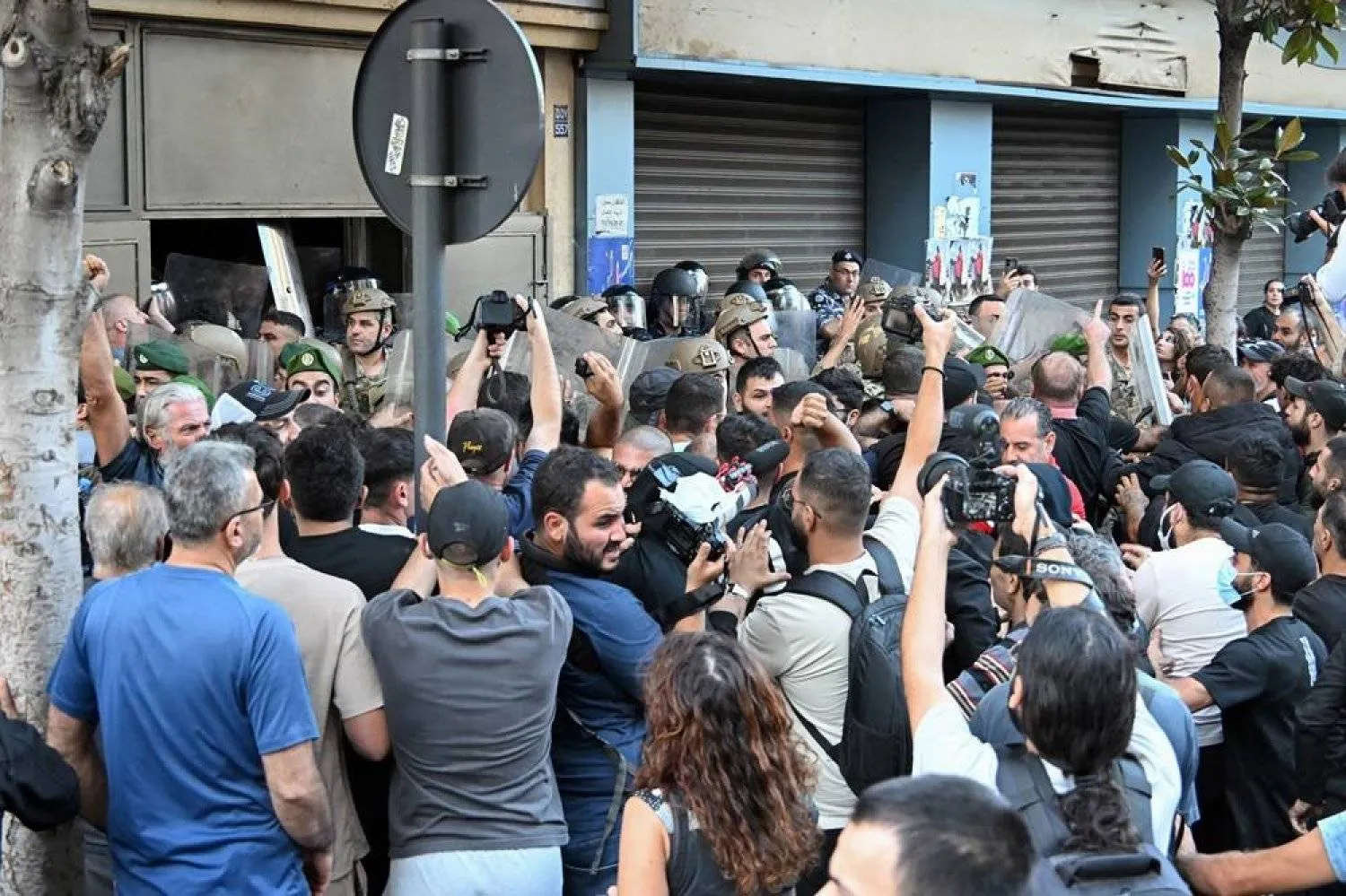
Lebanese civilians argue with army soldiers as they attempt to evict internally displaced people from an old hotel's premises, at Hamra Street in Beirut, Lebanon, 21 October 2024. (EPA)
TT

Massive Displacement from Israel-Hezbollah War Transforms Beirut’s Famed Commercial Street

Lebanese civilians argue with army soldiers as they attempt to evict internally displaced people from an old hotel's premises, at Hamra Street in Beirut, Lebanon, 21 October 2024. (EPA)

Inside what was once one of Beirut’s oldest and best-known cinemas, dozens of Lebanese, Palestinians and Syrians displaced by the Israel-Hezbollah war spend their time following the news on their phones, cooking, chatting and walking around to pass the time.
Outside on Hamra Street, once a thriving economic hub, sidewalks are filled with displaced people, and hotels and apartments are crammed with those seeking shelter. Cafes and restaurants are overflowing, The Associated Press said.
In some ways, the massive displacement of hundreds of thousands of people from south Lebanon, the eastern Bekaa Valley and Beirut’s southern suburbs has provided a boost for this commercial district after years of decline as a result of Lebanon’s economic crisis.
But it is not the revival many had hoped for.
“The displacement revived Hamra Street in a wrong way,” said the manager of a four-star hotel on the boulevard, who requested anonymity to speak candidly about the problems the influx has caused for the neighborhood.
For three weeks after the war intensified in mid-September, his hotel enjoyed full occupancy. Today, it stands at about 65% capacity — still good for this time of year — after some left for cheaper rented apartments.
But, he said, the flow of displaced people has also brought chaos. Traffic congestion, double parking and motorcycles and scooters scattered on sidewalks has become the norm, making it difficult for pedestrians to walk. Tensions regularly erupt between displaced people and the district’s residents, he said.
Hamra Street has long been a bellwether for Lebanon’s turbulent politics. During the country's heyday in the 1960s and early 1970s, it represented everything that was glamorous, filled with Lebanon’s top movie houses and theaters, cafes frequented by intellectuals and artists, and ritzy shops.
Over the past decades, the street has witnessed rises and falls depending on the situation in the small Mediterranean nation that has been marred by repeated bouts of instability, including a 15-year civil war that ended in 1990. In 1982, Israeli tanks rolled down Hamra Street after Israel invaded the country, reaching all the way to west Beirut.
In recent years, the district was transformed by an influx of Syrian refugees fleeing the war in the neighboring nation, and businesses were hammered by the country’s financial collapse, which began in 2019.
Israel dramatically escalated its attacks on parts of Lebanon on Sept. 23, killing nearly 500 people and wounding 1,600 in one day after nearly a year of skirmishes along the Lebanon-Israel border between Israeli troops and the militant Hezbollah group. The intensified attacks sparked an exodus of people fleeing the bombardment, including many who slept in public squares, on beaches or pavements around Beirut.
More than 2,574 people have been killed in Lebanon and over 12,000 wounded in the past year of war, according to the country's Health Ministry, and around 1.2 million people are displaced.
Many have flooded Hamra, a cosmopolitan and diverse area, with some moving in with relatives or friends and others headed to hotels and schools turned into shelters. In recent days several empty buildings were stormed by displaced people, who were forced to leave by security forces after confrontations that sometimes turned violent.
Mohamad Rayes, a member of the Hamra Traders Association, said before the influx of displaced people, some businesses were planning to close because of financial difficulties.
“It is something that cannot be imagined,” Rayes said about the flow of displaced people boosting commerce in Hamra in ways unseen in years. He said some traders even doubled prices because of high demand.
At a cellular shop, Farouk Fahmy said during the first two weeks his sales increased 70%, with people who fled their homes mostly buying chargers and internet data to follow the news.
“The market is stagnant again now,” Fahmy said.
Since many fled their homes with few belongings, men's and women's underwear and pajama sales grew by 300% at the small boutique business owned by Hani, who declined to give his full name for safety reasons.
The 60-year-old movie theater, Le Colisee, a landmark on Hamra Street, had been closed for more than two decades until earlier this year when Lebanese actor Kassem Istanbouli, founder of the Lebanese National Theater, took over and began renovating it. With the massive tide of displacement, he transformed it into a shelter for families who fled their homes in south Lebanon.
Istanbouli, who has theaters in the southern port city of Tyre and the northern city of Tripoli, Lebanon’s second-largest, has turned all three into shelters where people, no matter their nationality, can take refuge.
This week, displaced people in the Beirut movie theater sat on thin mattresses on its red carpeting, checking their phones and reading. Some were helping with the theater's renovation work.
Among them was Abdul-Rahman Mansour, a Syrian citizen, along with his three brothers and their Palestinian-Lebanese mother, Joumana Hanafi. Mansour said they fled Tyre after a rocket attack near their home, taking shelter at a school in the coastal city of Sidon, where they were allowed to stay since their mother is a Lebanese citizen.
When the shelter’s management found out that Mansour and his brothers were Syrian they had to leave because only Lebanese citizens were allowed. With no place to stay, they returned to Tyre.
“We slept for a night in Tyre, but I hope you never witness such a night,” Hanafi said of the intensity of the bombardment.
She said one of her sons knew Istanbouli and contacted him. “We told him, ‘Before anything, we are Syrians.’ He said, ‘It is a shame that you have to say that.’”
Istanbouli spends hours a day at his theaters in Beirut and Tripoli to be close to the displaced people sheltering there.
“Normally people used to come here to watch a movie. Today we are all at the theater and the movie is being played outside,” Istanbouli said of the ongoing war.



Palestinians Say Israeli Forces Kill Man in Jenin Refugee Camp

 Israeli soldiers keep watch during a weekly settlers' tour in Hebron, in the Israeli-occupied West Bank, May 23, 2026. (Reuters)
Israeli soldiers keep watch during a weekly settlers' tour in Hebron, in the Israeli-occupied West Bank, May 23, 2026. (Reuters)
TT

Palestinians Say Israeli Forces Kill Man in Jenin Refugee Camp

 Israeli soldiers keep watch during a weekly settlers' tour in Hebron, in the Israeli-occupied West Bank, May 23, 2026. (Reuters)
Israeli soldiers keep watch during a weekly settlers' tour in Hebron, in the Israeli-occupied West Bank, May 23, 2026. (Reuters)

Israeli forces killed a Palestinian man inside the Jenin refugee camp in the northern West Bank, the Palestinian health ministry said on Tuesday.

"A citizen... was killed by Israeli fire in the Jenin camp, and ambulance crews transported his body to Jenin Government Hospital," the Ramallah-based ministry said in a statement, without specifying when he was killed.

Contacted by AFP, Israel's military said it was "checking" reports of the man's killing.

The director of Jenin's Government Hospital, Wissam Baker, identified the victim as Nasser al-Saadi, noting that "he arrived dead at the hospital after being shot in the thigh".

"It appears he bled heavily after being injured before an ambulance was called to transport him to the hospital," Baker told AFP.

The Palestinian Red Crescent had earlier announced that Israeli forces handed over the body of a 30-year-old from inside the Jenin refugee camp, which is adjacent to the city of Jenin.

Israeli forces have occupied and barred access to the Jenin refugee camp since January 2025, when they launched a wide-ranging operation aimed at uprooting Palestinian armed groups from the West Bank's densely populated refugee camps.

The operation has caused the displacement of nearly 40,000 people from the camps, according to the UN agency for Palestinian refugees, UNRWA.

At least 1,073 Palestinians, including several armed fighters, have been killed by Israeli soldiers or settlers since the outbreak of the Gaza war following Hamas's attack on 7 October 2023, according to an AFP tally based on Palestinian Authority data.

On the other hand, official Israeli data shows at least 46 Israelis -- civilians and soldiers -- have been killed in Palestinian attacks or during Israeli military operations in the same period.


Israel Issues Expropriation Order for West Bank Religious Site

 Israeli soldiers keep watch during a weekly settlers' tour in Hebron, in the Israeli-occupied West Bank, May 23, 2026. (Reuters)
Israeli soldiers keep watch during a weekly settlers' tour in Hebron, in the Israeli-occupied West Bank, May 23, 2026. (Reuters)
TT

Israel Issues Expropriation Order for West Bank Religious Site

 Israeli soldiers keep watch during a weekly settlers' tour in Hebron, in the Israeli-occupied West Bank, May 23, 2026. (Reuters)
Israeli soldiers keep watch during a weekly settlers' tour in Hebron, in the Israeli-occupied West Bank, May 23, 2026. (Reuters)

Israel has issued an expropriation order for land in the occupied West Bank near the site of a Biblical prophet's grave north of Jerusalem, an Israeli NGO reported Tuesday.

The site, known as Nabi Samuel, is believed in Christian, Jewish, and Muslim tradition to include the grave of the Biblical figure of prophet Samuel, and includes a mosque owned by Palestinian religious authorities, the Waqf.

"This marks the first time that the (Israeli) Civil Administration has expropriated a holy site owned by the Muslim Waqf in the occupied West Bank," Israeli settlement watchdog Peace Now said in a statement.

According to the Israeli order, dated May 9 but published this week, the area for expropriation will include 109.79 dunams (roughly 11 hectares), including access roads, agricultural land, and a mosque.

The order says the decision was made "for the development and preservation of the archaeological site of the Tomb of the Prophet Samuel".

A source in COGAT, the Israel defense ministry body in charge of civilian matters in the Palestinian territories, said the decision was made "following the refusal of Waqf officials to cooperate with the procedures required for the renovation of the tomb compound".

The Palestinian Authority's Ministry of Waqf and Religious Affairs issued a "strong condemnation" of the expropriation order for Nabi Samuel.

"This confiscation is part of a policy aimed at suffocating the mosque and completely isolating it from its Palestinian surroundings, turning it into a Jewish archaeological site by force of arms," the ministry said in a statement.

Peace Now's Yonatan Mizrahi pointed out that Israeli authorities had already taken over administration of much of the land by converting it into an Israeli national park in the 1990s, decades after demolishing a Palestinian village on the site.

"There was no need to decide about the expropriation of the land," Mizrahi told AFP, while Peace Now denounced "the messianic agenda of the Israeli government".

Israel has occupied the West Bank since 1967.

In 2025, Israel expropriated an area in the center of the Tomb of the Patriarchs in the southern West Bank city of Hebron, arguing the order concerned an open area intended for roofing works and not a religious structure.


Remnants of Assad's Chemical Weapons Program Recovered, Syrian Official Says

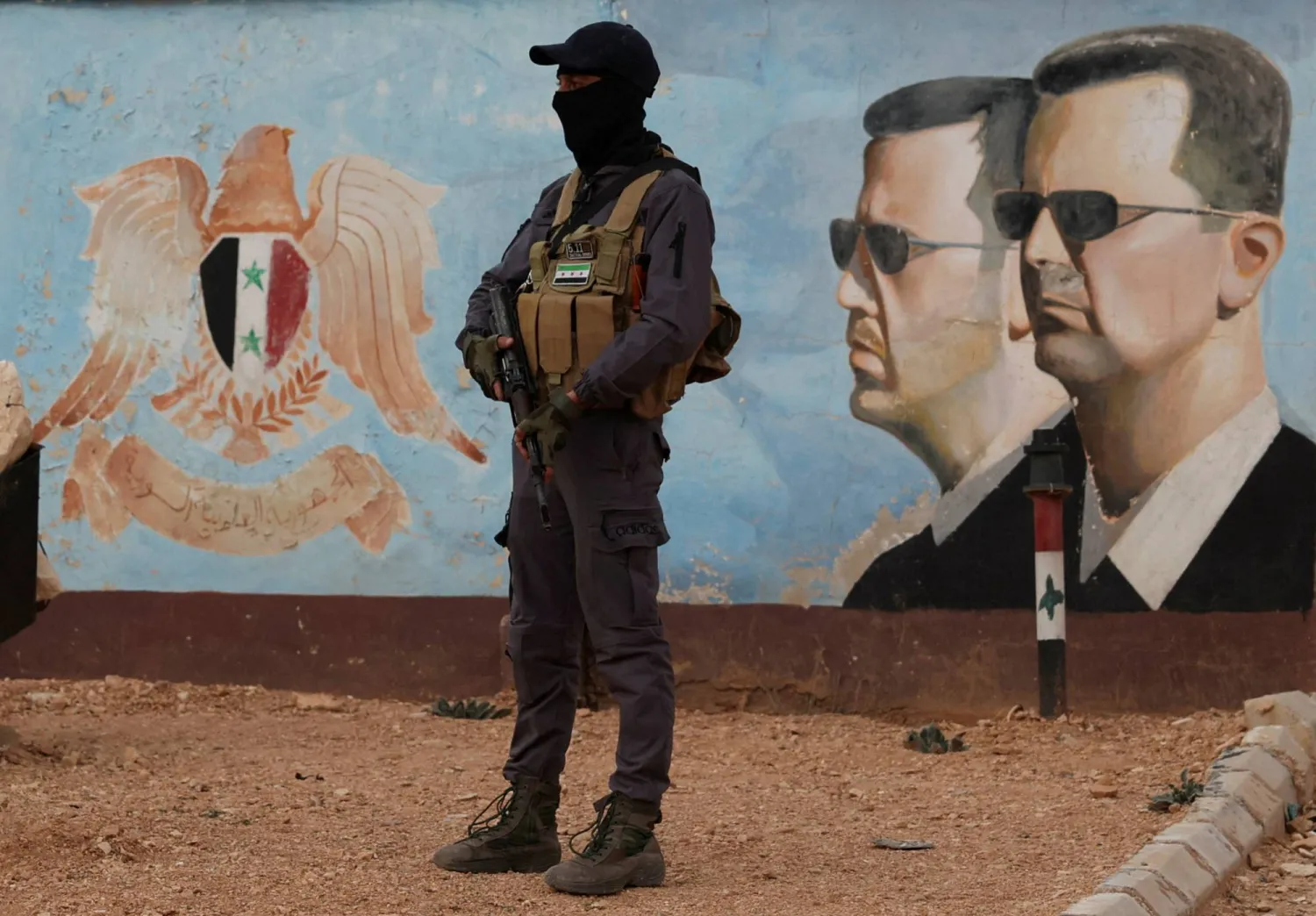
FILE PHOTO: A member of the former rebel group Hayat Tahrir al-Sham stands guard near an image of Syria's Bashar al-Assad at the fourth division headquarters in Damascus, Syria, January 23, 2025 REUTERS/Yamam Al Shaar/File Photo
TT

Remnants of Assad's Chemical Weapons Program Recovered, Syrian Official Says

FILE PHOTO: A member of the former rebel group Hayat Tahrir al-Sham stands guard near an image of Syria's Bashar al-Assad at the fourth division headquarters in Damascus, Syria, January 23, 2025 REUTERS/Yamam Al Shaar/File Photo

Syria's transitional leadership has located remnants of former Syrian president Bashar al-Assad's clandestine chemical weapons program, including raw materials and munitions similar to those used to carry out deadly gas attacks during the country's long-running civil war, a Syrian official told Reuters on Tuesday.

Syrian authorities have also taken into custody 18 suspects for alleged involvement in Assad's chemical weapons program, including high-level military, political and technical officials, said Mohamad Katoub, Syria's permanent representative to the Organization for the Prohibition of Chemical Weapons (OPCW) in The Hague, in an interview.