UNHCR: Israel's Border Airstrikes Hindering Refugees Fleeing Lebanon for Syria

Displaced Syrians from Lebanon arrive in areas controlled by the Syrian opposition in northwestern Syria via the crossing Aoun al-Dadat north of Manbij with the Syrian Democratic Forces after a long displacement journey. Photo: Anas Alkharboutli/dpa
TT

UNHCR: Israel's Border Airstrikes Hindering Refugees Fleeing Lebanon for Syria

Displaced Syrians from Lebanon arrive in areas controlled by the Syrian opposition in northwestern Syria via the crossing Aoun al-Dadat north of Manbij with the Syrian Democratic Forces after a long displacement journey. Photo: Anas Alkharboutli/dpa

Israeli air strikes overnight on the main border crossing to Syria had left Lebanon's main crossing point to its neighbor unable to function, hindering refugee attempts to flee a country where a fifth of the population is already internally displaced, the UN's refugee agency said.
Rula Amin, the UNHCR's Amman-based spokesperson, said she was unaware of any warning being given before the strike, which landed 500 meters from the main border crossing, Reuters reported.
Some 430,000 people have crossed from Lebanon to Syria since Israel's campaign started, she said.
"The attacks on the border crossings are a major concern," she said. "They are blocking the path to safety for people fleeing conflict."


‘Tactical Calm’ May Precede Long War in Iraq

Demonstrators run amid tear gas as supporters of Iraqi Shiite armed groups attempt to move toward the US embassy located in Baghdad's Green Zone following the Israel and US strikes on Iran and the killing of Iran’s Supreme Leader Ali Khamenei, in Baghdad, Iraq, March 1, 2026. (Reuters)
TT

‘Tactical Calm’ May Precede Long War in Iraq

Demonstrators run amid tear gas as supporters of Iraqi Shiite armed groups attempt to move toward the US embassy located in Baghdad's Green Zone following the Israel and US strikes on Iran and the killing of Iran’s Supreme Leader Ali Khamenei, in Baghdad, Iraq, March 1, 2026. (Reuters)

The violent protests that erupted in Iraq among supporters of Iran’s slain Supreme Leader Ali Khamenei against US interests subsided on Monday.

It appears that a decision has been taken for the pro-Iran factions to rein in their reactions to give time for the resumption of communication with the Iranian Revolutionary Guards.

Restoring contacts will help put in place a plan for a possible long war against the US that covers a number of potential targets, some of which may be out of reach.

Influential leaderships ordered the angry protesters to withdraw from Baghdad’s Green Zone where they were trying to inch their way towards the American embassy. “An eerie calm has since been restored with the situation open for any scenario,” observers said.

The protesters had flooded the Green Zone soon after the confirmation of Khamenei’s death on Saturday. Security forces were clearly given an order to prevent them from reaching the US embassy, said an Iraqi official.

Overnight on Sunday, a number of protesters opened live fire at government forces. The Interior Ministry later said a “fifth column” had opened fire at security forces who were there to protect the protesters. Thirteen people were wounded in the unrest.

It did not detail how many were wounded by live fire shot by security forces, according to witnesses.

Various sources confirmed that the government, which is composed of various pro-Iran powers, had issued strict orders to prevent the protesters from breaching the embassy and to arrest any security leader who fails in preventing the launch of rockets and drones.

No leadership

Over the weekend, Iran’s supporters in Iraq acted without clear orders from their central command as the Revolutionary Guards were coming under Israeli and US attacks. What ensued were attacks against any target in Iraq and Kurdistan the factions could come up with.

American reports on Sunday said the Guards no longer have a central base for guiding operations, forcing allied factions to improvise in launching their retaliatory attacks.

Consequently, the factions hit the US Victoria base near Baghdad International Airport. In Basra, they attacked a system of radars; and in Nasiriyah, they fired booby-trapped drones at the Imam Ali base.

The capital of the Iraqi Kurdistan Region, Erbil, “paid the highest price” for Khamenei’s killing, said a Kurdish officer.

“The attacks have been countless. Drones are fired every hour,” he added.

The drone attacks focused on the new US consulate building and Harir military base, revealed American and Kurdish sources.

Calm

By Monday, the strict security measures around the Green Zone remained in place, but the angry factions, mostly Iran-aligned Popular Mobilization Forces, had retreated.

Observers believe Baghdad has entered a phase of “tactical calm” after the shock of Khamenei’s death. The Guards appear to be “catching their breath” and will begin resuming regular communication with their Iraqi agents.

Various sources said the Iraqi factions view Hezbollah’s attack against Israel overnight on Sunday as a sign that contacts had resumed between the Lebanese party and Iran. Tehran had ordered Hezbollah to act, and it did. A similar order will likely be issued to the factions in Iraq.

American estimates believe that the Iranian response to Khamenei’s killing will ease in the coming days due to logistical reasons or because Tehran will be preoccupied with the transition to post-Khamenei rule. Shiite circles in Iraq, however, believe that a long war is in store.

Secretary of Iran’s national security council Ali Larijani said his country has prepared itself for a long war more so than the US.

Target bank

Such a conflict demands a target bank that is not all within reach of the factions seeking to avenge Khamenei’s death, said a leading member of the pro-Iran Shiite Coordination Framework in Iraq.

The targets may include American interests that will harm Washington in the medium-term, such as the consulate and Harir base in Erbil and Victoria base in Baghdad.

In a longer war, the factions may target American investments in gas and oil fields across Iraq. An attack against the US embassy may be saved for a decisive moment in the conflict and will be decided by the Guards, said sources close to the factions.

The factions may also “relish” the idea of carrying out assassinations against the “enemies of Iran,” they added.

The unrest will pose the biggest challenge to Iraqi Prime Minister Mohammed Shia al-Sudani's caretaker government. It will find itself caught in the middle of Shiite factions that want to escalate the conflict against the US and an emerging Arab alliance that has been targeted by Iran’s attacks, said a former government official.



Israel Says Will Reopen a Gaza Aid Crossing on Tuesday

A displaced Palestinian boy walks over the rubble before taking the "iftar" fast-breaking meal during the Muslim holy month of Ramadan, amidst the destruction in Bureij refugee camp in the central Gaza Strip on February 25, 2026. (Photo by Eyad Baba / AFP)
TT

Israel Says Will Reopen a Gaza Aid Crossing on Tuesday

A displaced Palestinian boy walks over the rubble before taking the "iftar" fast-breaking meal during the Muslim holy month of Ramadan, amidst the destruction in Bureij refugee camp in the central Gaza Strip on February 25, 2026. (Photo by Eyad Baba / AFP)

Israel said it would reopen a crossing into Gaza on Tuesday to allow for the "gradual entry of humanitarian aid" into the territory.

The Kerem Shalom crossing was closed on Saturday when Israel and the United States began striking Iran, which sparked reprisals from Tehran.

The decision to reopen it was made "in accordance with a security assessment," said COGAT, the Israeli defense ministry body responsible for civil affairs in the Palestinian territories.

The Israeli-controlled Kerem Shalom crossing sits at the intersection between the Gaza Strip, Israel and Egypt.

Israel on Saturday announced the closure of all crossing points into Gaza as a "security" measure, including Rafah on the border between the Palestinian territory and Egypt.

The Rafah crossing, the only gateway for Gazans to the outside world that does not pass through Israel, had reopened for the movement of people on February 2, nearly two years after Israeli forces seized control of it during the war with Hamas.

US President Donald Trump warned Monday that his attack on Iran could extend longer than a month, as the war spread with Israel bombarding Lebanon while Tehran targeted Israel and Gulf countries that host US bases.


Hezbollah Says Targeted 3 Israeli Bases after Strikes on Lebanon

Plumes of smoke rise from the sites of Israeli airstrikes on the southern suburbs of Beirut on March 3, 2026. (Photo by IBRAHIM AMRO / AFP)
TT

Hezbollah Says Targeted 3 Israeli Bases after Strikes on Lebanon

Plumes of smoke rise from the sites of Israeli airstrikes on the southern suburbs of Beirut on March 3, 2026. (Photo by IBRAHIM AMRO / AFP)

Hezbollah on Tuesday said it targeted three Israeli military bases in response to the strikes on the group's strongholds in Lebanon, including the south Beirut suburbs.

"In response to the criminal Israeli aggression on dozens of Lebanese cities and towns,” Hezbollah fighters targeted with drones the Ramat David air base and the Meron base in northern Israel with drone strikes, the group said in multiple statements.

Hezbollah added that it also targeted a base in the occupied Golan Heights with a rocket barrage.

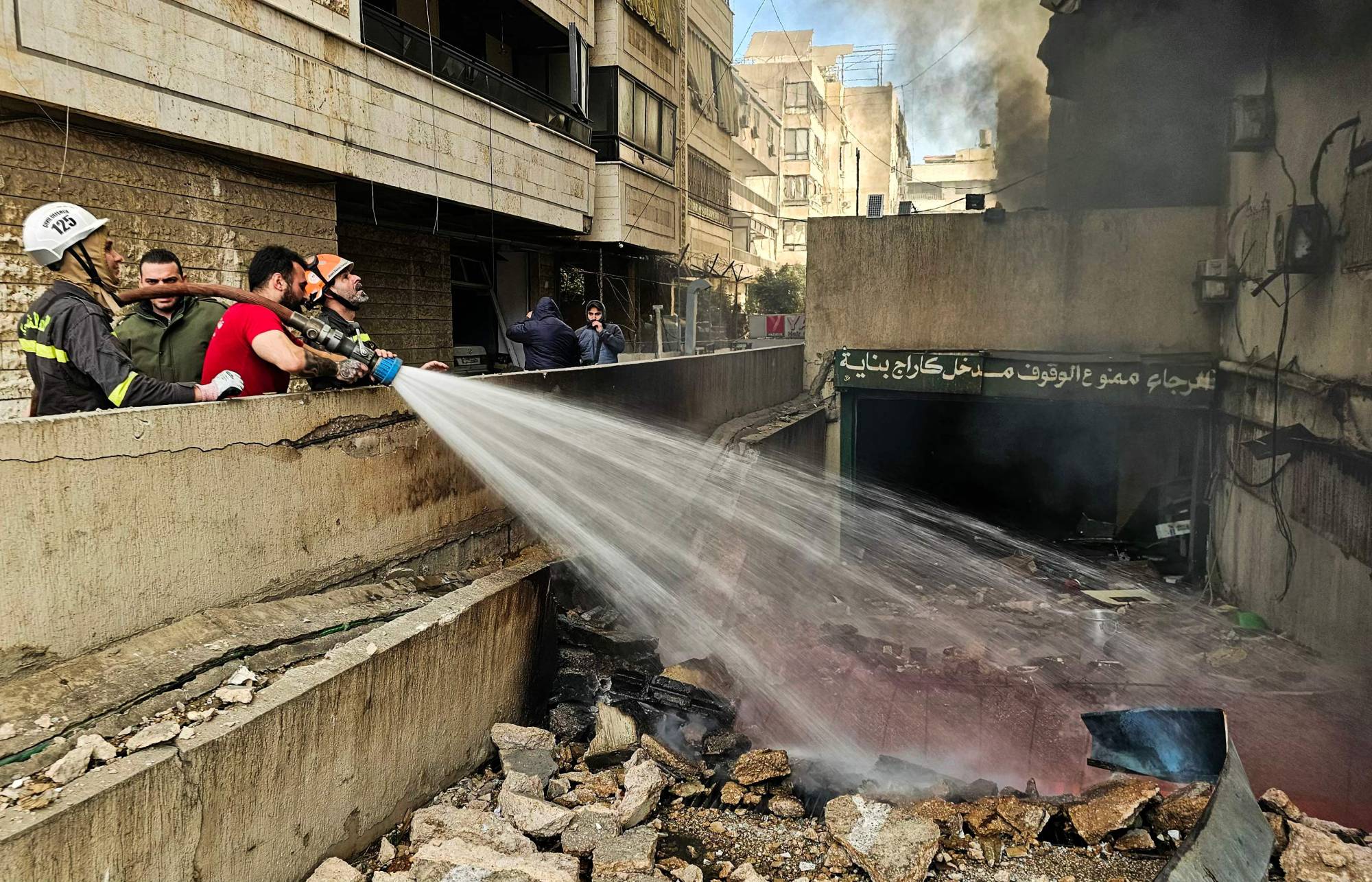
Firefighters extinguish fires at the site of an Israeli airstrike on the southern suburbs of Beirut on March 3, 2026. (Photo by AFP)

Israel's military on Monday vowed to intensify its attacks on Lebanon and make Hezbollah pay a "heavy price" after rocket and drone fire from the group.

The group said just after midnight that the attack on Israel was a "defensive act" after more than a year of Israeli strikes despite a ceasefire.

Israel's military said Tuesday that it had launched strikes on Hezbollah targets including "command centers and weapons storage facilities" in Beirut’s southern suburbs.

Lebanon's government on Monday took the unprecedented step of banning Hezbollah's military and security activity, prompting the Iran-backed group to lash out at the decision.

Hezbollah is represented in both the government and parliament, and the move came hours after it announced it had launched rockets and drones towards Israel early Monday to avenge the killing of Iranian supreme leader Ali Khamenei in US-Israeli attacks.