

It was Sunday, family time for most in Lebanon, and Hecham al-Baba was visiting his sister. She insisted he and their older brother stay for lunch, hoping to prolong the warm gathering in stressful times.
The brother declined. Like many in Lebanon, he hadn’t been sleeping because of Israel’s intensifying airstrikes, so he left to take a nap.
The 60-year-old al-Baba, on his annual visit from Germany to see his family in Lebanon, stayed. His sister Donize even convinced him to call an old flame over for coffee. He excitedly stepped into the bathroom to clean up before his visitor arrived.
Within seconds, a huge boom shook the basement apartment. Al-Baba fell to the floor. Something hit him in the chest, knocking the breath out of him. He pulled himself up and reached for the door, screaming his sister’s name. A second explosion threw him back to the floor. The bathroom ceiling — and the whole building above it — collapsed on his back.
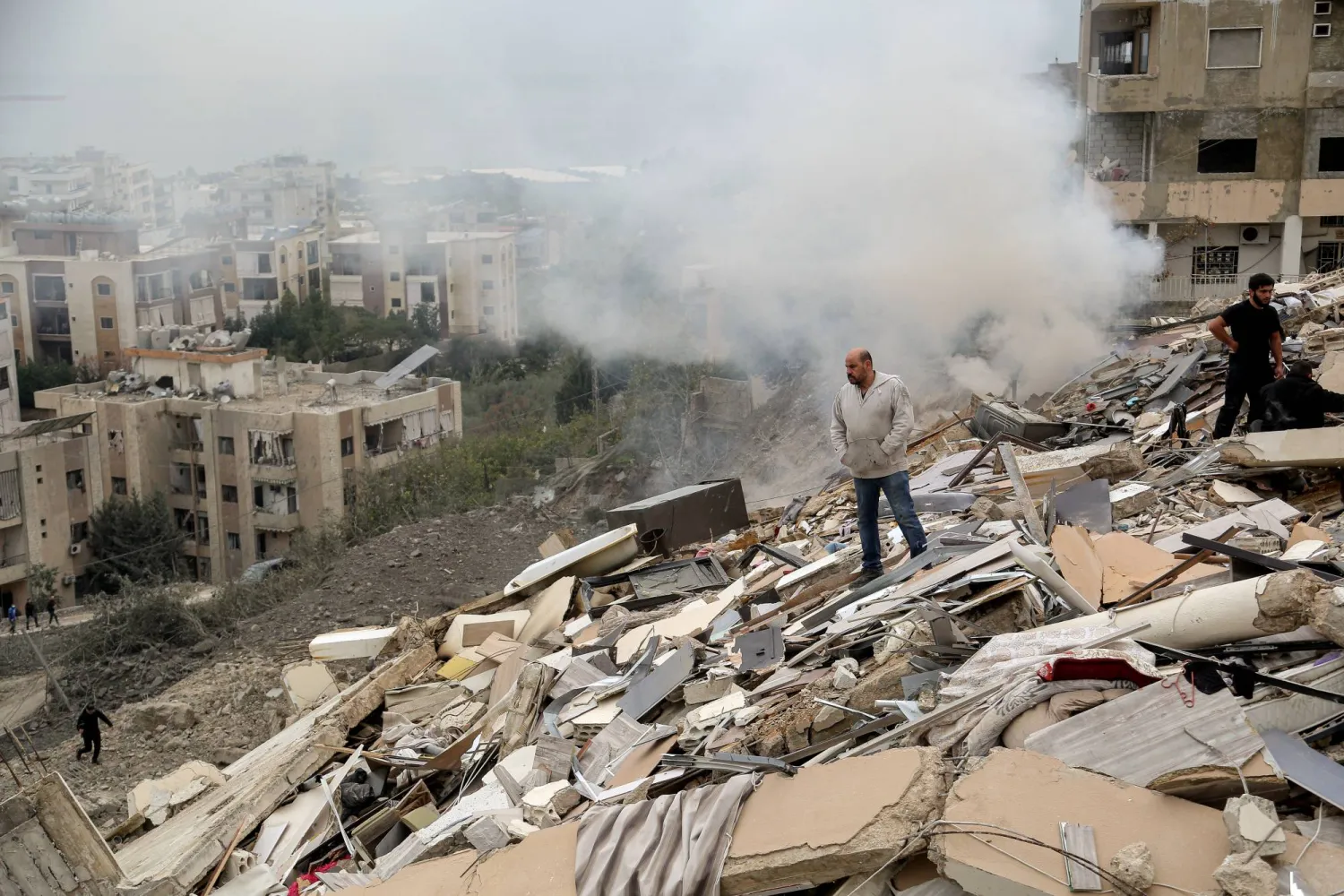
An Israeli air raid hit the six-story residential building in Ain el Delb, a neighborhood outside the coastal city of Sidon. The entire building tipped over down a hillside and landed on its face, taking with it 17 apartments full of families and visitors. More than 70 people were killed, and 60 injured, The Associated Press reported.
Israel said the Sept. 29 strike targeted a Hezbollah commander and claimed the building was a headquarters for the group. It could not be independently confirmed whether any of the residents belonged to Hezbollah.
In a video that surfaced online mourning one of the people believed to be residing in the building, he appeared in an old photo wearing military fatigues, a sign of affiliation with Hezbollah.
Either way, experts say the strike illustrates Israel’s willingness to kill significant numbers of civilians in pursuit of a single target. That tactic has fueled the high death toll among Palestinians in Gaza in Israel’s year-old campaign against Hamas.
Israel has intensified bombardment of Lebanon since Sept. 23, vowing to cripple Hezbollah, which began firing into northern Israel after Hamas’ Oct. 7 attack triggered the war in Gaza. Israel says it is targeting Hezbollah members and infrastructure and says the group places military assets in civilian areas.
Some 2,000 people have been killed, including Hezbollah fighters and commanders — but also hundreds of civilians, often in strikes on homes.
“It seems to be a feature so similar to Gaza in that these are families being killed together in single strikes,” said Emily Tripp, director of the London-based group Airwars, which monitors conflicts.
In the first week of Israel's escalation, it hit a home in Tyre province, killing a family of 15, all of them women and children except for a Hezbollah member. A strike in Byblos killed six family members of a Hezbollah fighter, who had already died in fighting a month before — raising questions about the quality of intelligence used in the strikes. A hit on a shack housing Syrian migrant worker families killed 23.
The strike in Ain el Delb was one of the deadliest of the Israeli campaign. Among those killed were al-Baba’s sister, her husband and two of their children, a daughter in her 20s and a teenage boy.
Al-Baba was trapped for hours, with the rubble pressing him in an agonizing, kneeling position, his neck twisted, his face stuck to the bathroom floor, unable to feel his legs. He knew his sister’s family was dead from the constant, unanswered ringing of their phones.
“No one said a word. I didn’t hear a movement,” he said.
'People don't know. Israel knows' The Israeli military said it enacted evacuation procedures before acting on confirmed intelligence in the Ain el Delb strike. Residents who spoke to The Associated Press said they received no warning.
“I wish we had. We would have left,” said Abdul-Hamid Ramadan, who lived on the top floor and whose wife Jinan and daughter Julia were killed. “I would have lost my home. But not my wife and daughter.”
Israel says it often issues evacuation orders before striking. But in Lebanon, as in Gaza, rights groups say the advance warnings are often inadequate and come in the middle of the night or through social media.
Ramadan, a retired army officer, said he knew of no Hezbollah members or weapons in the building, where he has lived for more than 20 years.
No one thought the neighborhood — where most residents are Sunni Muslims and Christians — would be on the list of Israeli targets. In the building, 15 out of the 17 apartments were occupied by longtime residents who all knew each other. Displaced people from the south had begun arriving a week earlier, seeking shelter with relatives in the building.
Al-Baba said his sister confided in him before she was killed that she was concerned about a much-loved Shiite tenant, mainly because he had been receiving guests. She feared he may be a target of Israel and asked her brother if she should leave. She decided to stay because she had no idea where to go.
Neither al-Baba nor his sister knew anything about the tenant being linked to Hezbollah.
Israeli strikes have stoked fears among Lebanese over the possibility their building could be hit for hosting someone who Israel claims, rightly or wrongly, to be connected to Hezbollah. Building administrations have asked tenants to declare the names of displaced sheltering with them. Some have refused to take in people from the south.
The first strike hit the building's lower floors around 4 p.m. The Ramadan family were shocked but didn’t think the building was collapsing. Only Ramadan's wife, Jinan, ran for the stairs. A few moments passed, long enough for Ramadan’s son Achraf to bring his sister Julia a glass of water to calm her.
Then the second missile hit. The building swayed, then collapsed.
Ramadan fell off the couch, which along with a nearby cabinet protected him from the falling ceiling. Achraf, a fitness trainer and former soldier, took cover under a door frame. Julia fell to the floor.
For what seemed like two hours, the three communicated through the rubble. Ramadan said Julia was only two meters (yards) away, her voice faint but audible. He called for help using his mobile phone still in his hands.
When help came, Achraf got out first; then his father, about six hours after the strike. In the chaos, they thought Julia had been pulled out. But the rescuers returned to find the 28-year-old dead. Her mother died in the hospital from internal bleeding.
“I lost the cornerstone of the house: my wife, my partner and friend,” Ramadan said. “I lost my daughter Julia ... She was my joy, my smile, the future.”
They are buried in unmarked graves in a section of the Sidon cemetery dedicated to the Ain el Delb building victims.
Like in Gaza, there is concern that the number of civilian casualties is “quite high” given that the alleged military target is often unstated or relatively small, said Rich Weir, the senior conflict, crisis and arms researcher at Human Rights Watch.
He said there has been an “escalation in terms of the amount of damage ... the taking down of entire buildings in densely packed residential neighborhoods, which brings inherent risks to civilians.” Israel has also expanded the scope of its targets, hitting Hezbollah financial institutions, he said.
Ramadan was not surprised at the killing of so many people for one possible Hezbollah member. It has happened before, he said.
“We hear in the news an apartment was targeted. And people wonder who it was,” he said. “People don’t know. Israel knows.”
‘Worse than a coffin’ At the bottom of the building’s wreckage, Hecham al-Baba was trapped in pitch black darkness for four hours, squeezed with his legs bent under him. The falling door had broken two of his ribs. It was difficult to breathe. All he could think about was that he might lose his legs.
“There was no blood going to my legs,” he said. “I couldn’t feel them. I couldn’t move. I tried to stay strong. I don’t want to remember. It upsets me.”
Finally, he heard movement: people removing bricks, a bulldozer. He started screaming. His lungs and chest hurt. They called to him to shout louder. “I told them I can’t.”
Then through a hole, a beam of light flashed in the darkness. At the sight of him, a rescuer cried out, “What a way to be stuck! It’s worse than a coffin.”
It took another four hours before the rescuers pulled him out head-first through the floor beneath him, covered in dust and soot.
The entire rescue operation took more than 43 hours. The Health Ministry put the death toll at 45, but the civil defense chief for Sidon, Mohamed Arkadan, said first responders pulled 73 bodies from the rubble. Five bodies remain unaccounted for, he said.
Doctors told al-Baba his ribs will heal with time.
But not his pain.
He said he will wear black all his life to mourn his sister. Past conflicts never stopped him from returning to Lebanon to visit family. This time, it may be a while before he comes back.
“There will be no peace,” he said, thinking of his family tragedy and the wars in both Lebanon and Gaza. “No one will bring me justice. No one.”


A Lebanese Family Was Holding a Sunday Gathering When an Israeli Strike Toppled Their Building

First responders inspect the rubble of a building after it was targeted by an Israeli airstrike in the southern Lebanese village of Ain El Delb on September 29, 2024. (AFP)

A Lebanese Family Was Holding a Sunday Gathering When an Israeli Strike Toppled Their Building
First responders inspect the rubble of a building after it was targeted by an Israeli airstrike in the southern Lebanese village of Ain El Delb on September 29, 2024. (AFP)


لم تشترك بعد
انشئ حساباً خاصاً بك لتحصل على أخبار مخصصة لك ولتتمتع بخاصية حفظ المقالات وتتلقى نشراتنا البريدية المتنوعة
