In East Lebanon, Looming Winter Hints at Stretched Aid Response

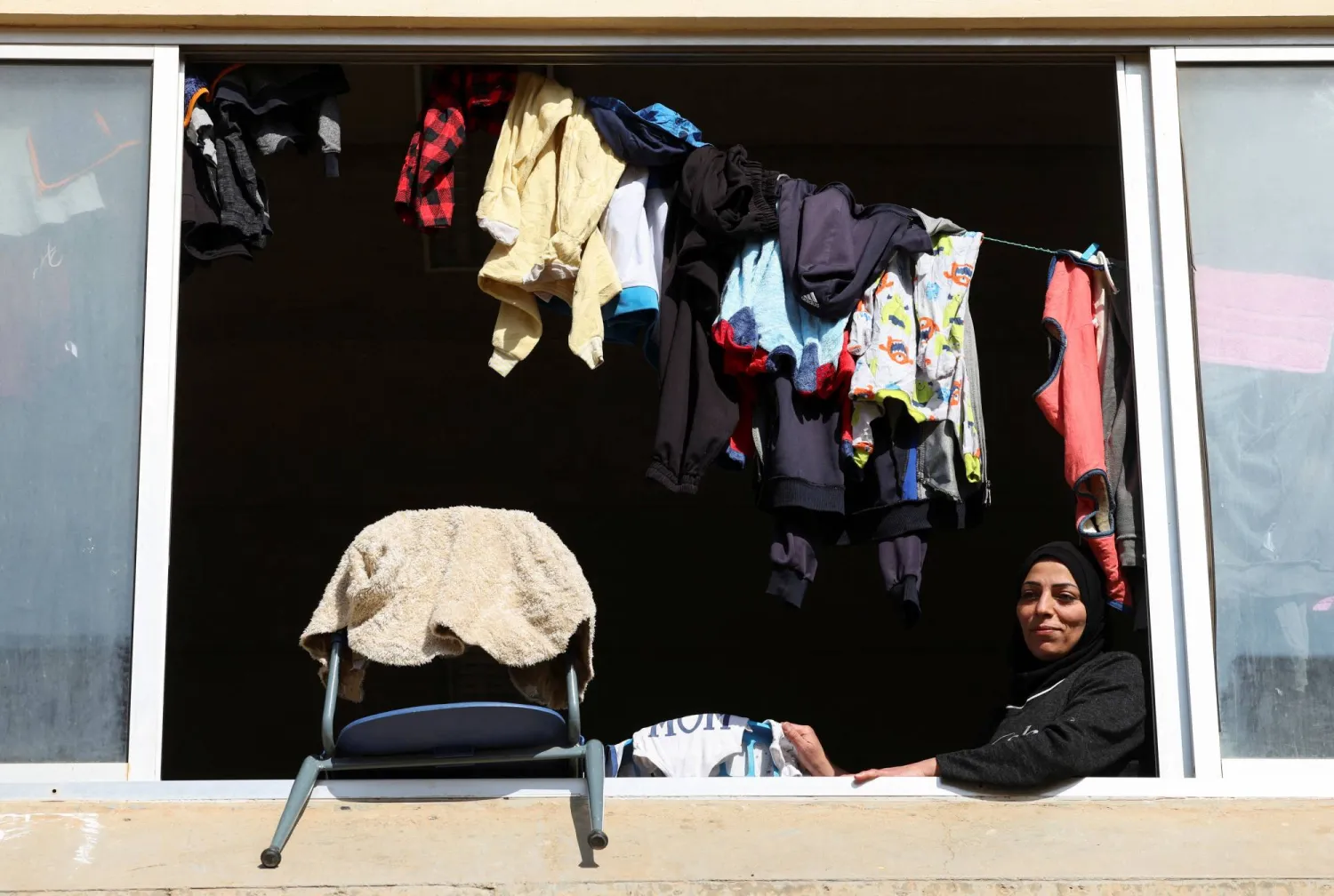
A displaced woman looks out from a window at a school turned into a shelter housing displaced people who fled from Baalbek and surrounding areas, in the mountainous Christian town of Deir al-Ahmar in eastern Lebanon October 31, 2024. REUTERS/Mohamed Azakir
TT

In East Lebanon, Looming Winter Hints at Stretched Aid Response

A displaced woman looks out from a window at a school turned into a shelter housing displaced people who fled from Baalbek and surrounding areas, in the mountainous Christian town of Deir al-Ahmar in eastern Lebanon October 31, 2024. REUTERS/Mohamed Azakir

Nerjes Hassan was so worried her children would fall ill from bathing in the frigid water of a displacement shelter in northeast Lebanon that she drove back into her hometown to give them a hot bath and pick up food preserves.
While at home on Wednesday morning in the town of Buday, near the eastern city of Baalbek, an Israeli air strike killed her, her husband and her two children, according to her coworkers and neighbors.
Hassan, who worked for the Lebanese Organization for Studies and Training (LOST) aid organization, was among thousands seeking refuge from Israeli strikes in the mountainous Christian town of Deir al-Ahmar in eastern Lebanon.
The town was already hosting more than 10,000 displaced people before Israel escalated its strikes on predominantly Shi'ite Muslim Baalbek and nearby towns starting on Wednesday this week.
Thousands more are flowing into Deir al-Ahmar as Israel's bombardment continues. The needs are growing, temperatures are dropping, and supplies in the town are getting tight.
In one school now serving as a shelter, aid groups that once served two meals have cut breakfast to feed more at lunch. Townspeople have put together donation drives for winter clothes and blankets but are facing shortages, leaving displaced sharing blankets overnight.
"If we flee the bombing, are we meant to die of cold?" said Suzanne Qassem, a mother of two at one displacement center, whose home in Buday had been destroyed.
"I'm sick, I've been taking medicine for a week and I'm still coughing... If my son gets sick, am I going to be able to get him medicine?"
'LIKE A SIEGE'
Temperatures in Deir al-Ahmar are dropping to 6 degrees Celsius (43 degrees Fahrenheit) overnight even before winter fully sets in and the schools have no diesel to run central heating systems.
"At night, we're shaking. I put my mattress up next to my daughter and tell her to hug me so that we can keep warm. But we're not keeping warm," said Neyfe Mazloum, 69.
Most families fled with just the clothes on their backs, rushing out of their homes after Israeli evacuation warnings for Baalbek and surrounding towns on Wednesday and Thursday.
More than 1.2 million people have been displaced by Israeli strikes on Lebanon over the last year in its campaign against militant group Hezbollah. That includes nearly 190,000 who have sought refuge in shelters. Others are staying with relatives, have rented out homes, or are sleeping in the streets.
Lebanon's crisis management cell says that out of 1,130 accredited shelters, 948 have reached maximum capacity. Most of the displaced are in the districts of Mount Lebanon and Beirut - easy to reach for most aid organizations.
But Deir al-Ahmar is much further afield.
The quickest routes run through the massive area that the Israeli military says must evacuate. To avoid it, aid groups planning to deliver supplies this week will travel further north through mountain peaks before cutting back down to the town.
Imran Riza, the United Nations humanitarian coordinator for Lebanon, told Reuters that aid deliveries to the Baalbek region had to be postponed this week due to Israeli air strikes. Other deliveries of medical aid to Lebanon from foreign countries have been delayed due to strikes near the airport.
"Access is becoming more and more difficult. The needs are growing in Deir al-Ahmar. It's up to us to try to get there, and to plan a way to be able to access it in a way that is reasonably safe," he said.
Local volunteers are worried that the looming winter will cut off the only safe route into Deir al-Ahmar, leaving them stranded.
"That road will close with the first snow. It will be like a siege," said Khodr Zeaiter, a volunteer with LOST. Displaced himself, he is now helping to organize aid in Deir al-Ahmar.
Beyond the immediate concerns of food and fuel, Zeaiter is worried about the education ministry's directive that public schools - now hosting displaced - will need to reopen for students in three weeks.
Volunteers are studying the possibility of refurbishing an abandoned school to host morning and evening classes, he said.
"We're grateful to the people of Deir al-Ahmar so much. It's their solidarity that has gotten us through this. But how long that will last - who knows."



Lebanon FM Urges Iran to Find ‘New Approach’ on Hezbollah Arms

Iranian Foreign Minister Abbas Araghchi (L) shakes hands with Lebanese Minister of Foreign Affairs and Emigrants Youssef Raggi (R) at the Foreign Ministry in downtown Beirut, Lebanon, 09 January 2026. (EPA)
TT

Lebanon FM Urges Iran to Find ‘New Approach’ on Hezbollah Arms

Iranian Foreign Minister Abbas Araghchi (L) shakes hands with Lebanese Minister of Foreign Affairs and Emigrants Youssef Raggi (R) at the Foreign Ministry in downtown Beirut, Lebanon, 09 January 2026. (EPA)

Lebanese Foreign Minister Youssef Raggi on Friday urged his visiting Iranian counterpart to find a "new approach" to the thorny issue of disarming the Iran-backed Hezbollah group.

Lebanon is under heavy US pressure to disarm Hezbollah, which was heavily weakened in more than a year of hostilities with Israel that largely ended with a November 2024 ceasefire, but Iran and the group have expressed opposition to the move.

Iran has long wielded substantial influence in Lebanon by funding and arming Hezbollah, but as the balance of power shifted since the recent conflict, officials have been more critical towards Tehran.

"The defense of Lebanon is the sole responsibility of the Lebanese state", which must have a monopoly on weapons, Raggi told Iranian Foreign Minister Abbas Araghchi, a Lebanese foreign ministry statement said.

Raggi called on Iran to engage in talks with Lebanon to find "a new approach to the issue of Hezbollah's weapons, drawing on Iran's relationship with the party, so that these weapons do not become a pretext for weakening Lebanon".

He asked Araghchi "whether Tehran would accept the presence of an illegal armed organization on its own territory".

Last month, Raggi declined an invitation to visit Iran and proposed meeting in a neutral third country.

Lebanon's army said Thursday that it had completed the first phase of disarming Hezbollah, doing so in the south Lebanon area near the border with Israel, which called the efforts "far from sufficient".

Araghchi also met President Joseph Aoun on Friday and was set to hold talks with several other senior officials.

After arriving on Thursday, he visited the mausoleum of former Hezbollah leader Hassan Nasrallah, who was killed in a massive Israeli air strike on south Beirut in September 2024.

Last August, Lebanese leaders firmly rejected any efforts at foreign interference during a visit by Iran's security chief Ali Larijani, with the prime minister saying Beirut would "tolerate neither tutelage nor diktat" after Tehran voiced opposition to plans to disarm Hezbollah.


Hamas Says Israeli Strikes on Gaza ‘Cannot Happen without American Cover’

 Palestinians inspect damaged tents at a displacement camp following an Israeli strike in Gaza City, Friday, Jan. 9, 2026. (AP)
Palestinians inspect damaged tents at a displacement camp following an Israeli strike in Gaza City, Friday, Jan. 9, 2026. (AP)
TT

Hamas Says Israeli Strikes on Gaza ‘Cannot Happen without American Cover’

 Palestinians inspect damaged tents at a displacement camp following an Israeli strike in Gaza City, Friday, Jan. 9, 2026. (AP)
Palestinians inspect damaged tents at a displacement camp following an Israeli strike in Gaza City, Friday, Jan. 9, 2026. (AP)

A Hamas official said Friday that Israeli strikes on Gaza "cannot happen without American cover", the day after Israeli attacks killed at least 13 people according to the Palestinian territory's civil defense agency.

Since October 10, a fragile US-sponsored truce in Gaza has largely halted the fighting between Israeli forces and Hamas, but both sides have alleged frequent violations.

Gaza's civil defense agency -- which operates as a rescue force under Hamas authority -- said Israeli attacks across the territory on Thursday killed at least 13 people, including five children.

In a statement on Friday morning, the Israeli military said it "precisely struck Hamas terrorists and terror infrastructure" in response to a "failed projectile" launch.

"Just yesterday, 13 people were killed in different areas of the Strip on fabricated pretexts, in addition to the hundreds of killed and wounded who preceded them after the ceasefire," Hamas political bureau member, Bassem Naim, wrote on Telegram.

"This cannot happen without American cover or a green light."

Israeli forces have killed at least 439 Palestinians in Gaza since the ceasefire took effect, according to the health ministry in the Hamas-run territory.

The Israeli military said gunmen have killed three of its soldiers during the same period.

Media restrictions in Gaza and difficulties in accessing many areas mean AFP is unable to independently verify the tolls and details provided by both sides.

Naim also accused Israeli Prime Minister Benjamin Netanyahu of "evading his commitments and escalating in order to sabotage the agreement and return to war".

He said the Palestinian movement had "complied with all its obligations under the agreement" and was "ready to engage positively and constructively with the next steps of the plan".

Israel has previously said it is awaiting the return of the last hostage body held in Gaza before beginning talks on the second phase of the ceasefire and has insisted that Hamas disarm.

Hamas officials told AFP that search operations for the remains of deceased hostage Ran Gvili resumed on Wednesday after a two-week pause due to bad weather.


Germany Calls on Israel to Halt E1 Settlement Plan

A view of Israeli settlement of Maale Adumim, in the West Bank, Sunday, June 18, 2023. (AP)
TT

Germany Calls on Israel to Halt E1 Settlement Plan

A view of Israeli settlement of Maale Adumim, in the West Bank, Sunday, June 18, 2023. (AP)

Germany calls on Israel to halt its controversial ​E1 settlement project, said a foreign ministry spokesperson in Berlin on Friday, warning that construction carries the risk of ‌creating more ‌instability in the ‌West ⁠Bank ​and ‌the region.

"The plans for the E1 settlement project, it must be said, are part of a comprehensive ⁠intensification of settlement policy in ‌the West Bank, ‍which ‍we have recently ‍observed," said the spokesperson at a regular government press conference.

"It carries the ​risk of creating even more instability, as it ⁠would further restrict the mobility of the Palestinian population in the West Bank," as well as jeopardize the prospects of a two-state solution, the spokesperson added.