Israel Turns Araya-Kahhale Road into Trap for Hezbollah Fighters

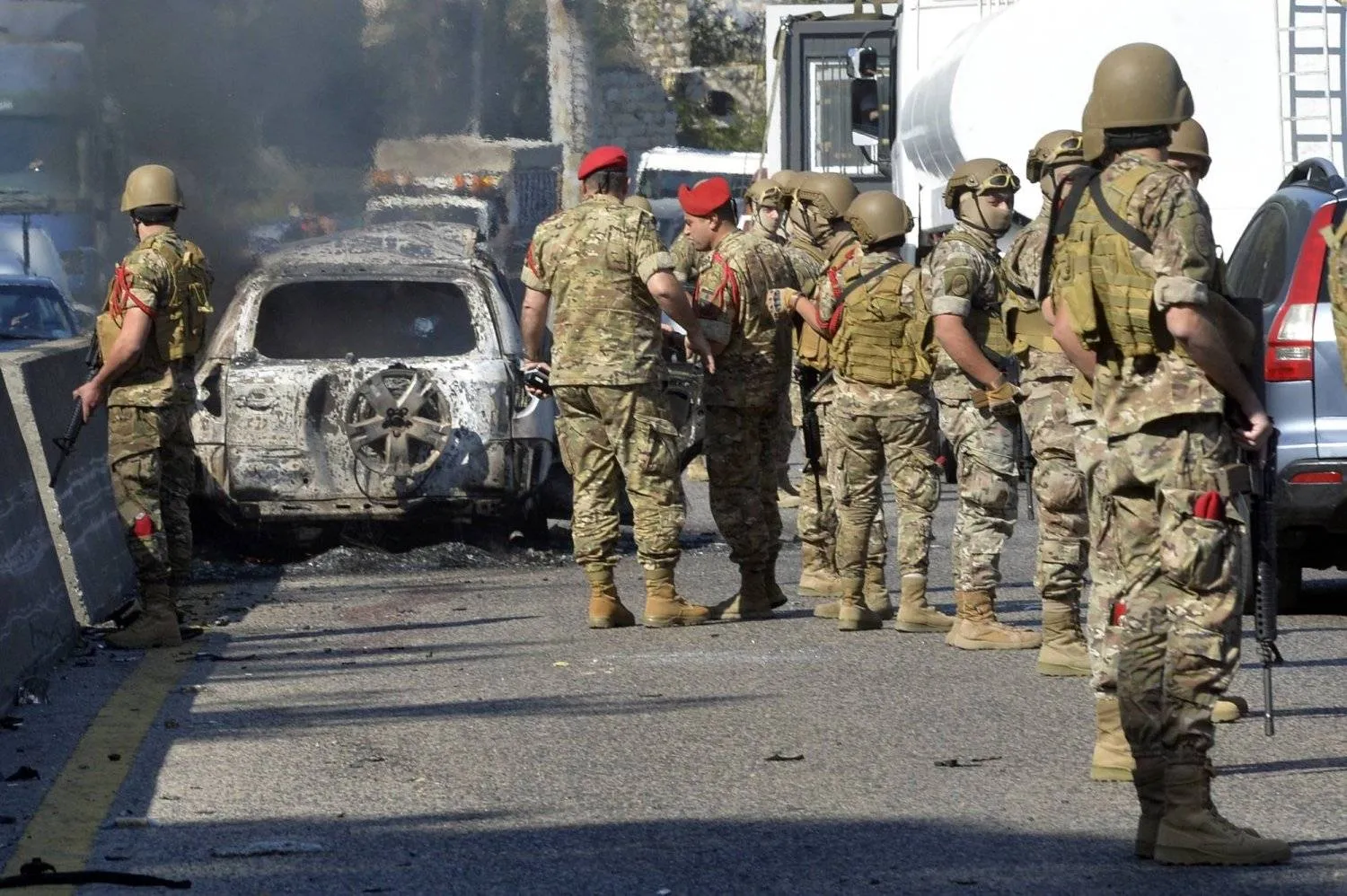
Lebanese army soldiers and military police seal off the site of an Israeli drone strike targeting a car in the Kahhale area of Mount Lebanon (EPA)
TT

Israel Turns Araya-Kahhale Road into Trap for Hezbollah Fighters

Lebanese army soldiers and military police seal off the site of an Israeli drone strike targeting a car in the Kahhale area of Mount Lebanon (EPA)

Israel has turned the narrow Araya-Kahhale road into a trap for Hezbollah fighters and weapons transported from Lebanon’s Bekaa Valley to southern battlefronts.
Israeli drones have launched seven attacks on this route, targeting Hezbollah personnel and vehicles carrying arms.
Two of these strikes took place before Sep. 23, with the others following the escalation of the conflict.
Israeli Goals: Psychological and Military
According to military analyst Brig. Gen. Saeed al-Qazah, Israel’s strikes aim to create both psychological and military pressure.
The psychological goal, he says, is to create fear and division in communities hosting displaced people, causing tensions over possible Hezbollah presence.
“Hitting moving targets in Christian, Sunni, or Druze areas could spark local fear and mistrust toward the displaced, leading to conflicts,” al-Qazah explained to Asharq Al-Awsat.
Militarily, the Araya-Kahhale road’s narrowness and steep curves slow vehicles to about 30 km/h, making it easier for Israeli drones to strike accurately. The route is a crucial passage for Hezbollah moving from the Bekaa Valley to southern Lebanon, making it a vulnerable target for Israel.
Tensions recently flared in August when a Hezbollah truck loaded with ammunition overturned on a tight turn, leading to clashes between Hezbollah members and locals that resulted in two deaths before the Lebanese army intervened.
A Vital Route
Security expert Brig. Gen. Khaled Hamadeh calls the Araya-Kahhale route essential for Hezbollah’s southbound arms movements.
Hamadeh told Asharq Al-Awsat that this road is “closely monitored by Israeli reconnaissance aircraft, which patrol the area around the clock.”
While the route remains a vital link, he noted that Hezbollah also relies on alternative paths to deliver missiles to southern fronts.
Small vans are often used to disguise arms shipments among daily traffic, especially as missiles are crucial for countering Israeli ground forces.
Israeli Air Dominance
Recent assassinations along Lebanese roads highlight Israel’s control of Lebanese airspace and ability to track Hezbollah operatives.
Two weeks ago, a Hezbollah commander and his wife were killed on the Jounieh-Beirut road, and days ago, another operative was assassinated in the area of Aley.
The strikes are pressuring Hezbollah’s supply routes. Hamadeh suggests these arms are likely sourced from Lebanon’s Bekaa Valley or Syria and transported in stages.
Hezbollah’s persistence in transporting these weapons, despite risks, signals that it is drawing on reserves critical to its ground defenses against Israeli forces.



Germany Moves Troops Out of Iraq, Citing Mideast 'Tensions'

FILE PHOTO: German Defense Minister Ursula von der Leyen visits the Transport Helicopter Regiment 30 (Transporthubschrauberregiment 30) at the Hermann-Koehl-Kaserne in Niederstetten, Germany, August 20, 2018. REUTERS/Ralph Orlowski
TT

Germany Moves Troops Out of Iraq, Citing Mideast 'Tensions'

FILE PHOTO: German Defense Minister Ursula von der Leyen visits the Transport Helicopter Regiment 30 (Transporthubschrauberregiment 30) at the Hermann-Koehl-Kaserne in Niederstetten, Germany, August 20, 2018. REUTERS/Ralph Orlowski

Germany's military has "temporarily" moved some troops out of Erbil in northern Iraq because of "escalating tensions in the Middle East," a German defense ministry spokesman told AFP on Thursday.

Dozens of German soldiers had been relocated away from the base in Erbil, capital of Iraq's autonomous Kurdistan region.

"Only the personnel necessary to maintain the operational capability of the camp in Erbil remain on site," the spokesman said.

The spokesman did not specify the source of the tensions, but US President Donald Trump has ordered a major build-up of US warships, aircraft and other weaponry in the region and threatened action against Iran.

German troops are deployed to Erbil as part of an international mission to train local Iraqi forces.

The spokesman said the German redeployment away from Erbil was "closely coordinated with our multinational partners".


UN: At Least 15 Children Killed in Sudan Drone Strike

The war in Sudan, ongoing since mid-April 2023, has caused extensive destruction across the country (AFP)
TT

UN: At Least 15 Children Killed in Sudan Drone Strike

The war in Sudan, ongoing since mid-April 2023, has caused extensive destruction across the country (AFP)

A drone strike on a displacement camp in Sudan killed at least 15 children earlier this week, the United Nations reported late on Wednesday.

"On Monday 16 February, at least 15 children were reportedly killed and 10 wounded after a drone strike on a displacement camp in Al Sunut, West Kordofan," the UN children's agency said in a statement.

Across the Kordofan region, currently the Sudan war's fiercest battlefield, "we are seeing the same disturbing patterns from Darfur -- children killed, injured, displaced and cut off from the services they need to survive," UNICEF's Executive Director Catherine Russell said.


MSF Will Keep Operating in Gaza 'as Long as We Can'

(FILES) A Palestinian man walks on his crutches to the Doctors Without Borders or Medecins Sans Frontieres (MSF) clinic, in the al-Rimal neighborhood of Gaza City on new year's Eve, December 31, 2025. (Photo by Omar AL-QATTAA / AFP)
TT

MSF Will Keep Operating in Gaza 'as Long as We Can'

(FILES) A Palestinian man walks on his crutches to the Doctors Without Borders or Medecins Sans Frontieres (MSF) clinic, in the al-Rimal neighborhood of Gaza City on new year's Eve, December 31, 2025. (Photo by Omar AL-QATTAA / AFP)

The head of Doctors Without Borders in the Palestinian territories told AFP the charity would continue working in Gaza for as long as possible, following an Israeli decision to end its activities there.

In early February, Israel announced it was terminating all the activities in Gaza by the medical charity, known by its French acronym MSF, after it failed to provide a list of its Palestinian staff.

MSF has slammed the move, which takes effect on March 1, as a "pretext" to obstruct aid.

"For the time being, we are still working in Gaza, and we plan to keep running our operations as long as we can," Filipe Ribeiro told AFP in Amman, but said operations were already facing challenges.

"Since the beginning of January, we are not anymore in the capacity to get international staff inside Gaza. The Israeli authorities actually denied any entry to Gaza, but also to the West Bank," he said.

Ribeiro added that MSF's ability to bring medical supplies into Gaza had also been impacted.

"They're not allowed for now, but we have some stocks in our pharmacies that will allow us to keep running operations for the time being," he said.

"We do have teams in Gaza that are still working, both national and international, and we have stocks."

In December, Israel announced it would prevent 37 aid organizations, including MSF, from working in Gaza from March 1 for failing to submit detailed information about their Palestinian employees, drawing widespread condemnation from NGOs and the United Nations.

It had alleged that two MSF employees had links with Palestinian militant groups Hamas and Islamic Jihad, which the medical charity has repeatedly and vehemently denied.

MSF says it did not provide the names of its Palestinian staff because Israeli authorities offered no assurances regarding their safety.

Ribeiro warned of the massive impact the termination of MSF's operations would have for healthcare in war-shattered Gaza.

"MSF is one of the biggest actors when it comes to the health provision in Gaza and the West Bank, and if we are obliged to leave, then we will create a huge void in Gaza," he said.

The charity says it currently provides at least 20 percent of hospital beds in the territory and operates around 20 health centers.

In 2025 alone, it carried out more than 800,000 medical consultations, treated more than 100,000 trauma cases and assisted more than 10,000 infant deliveries.