


Israel Investigates Leaks that Appear to Have Bolstered Netanyahu as Gaza Truce Talks Stalled

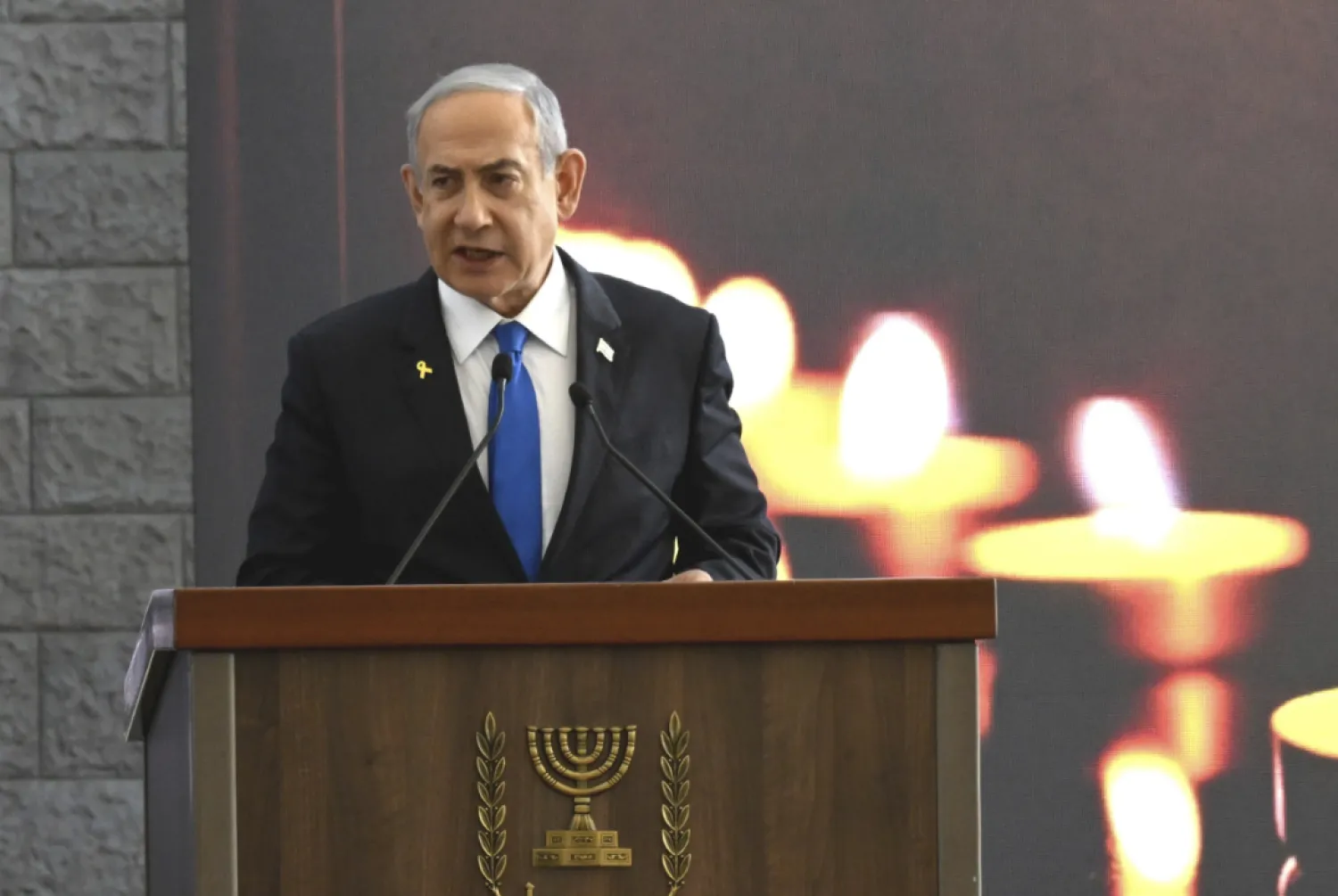
Israeli Prime Minister Benjamin Netanyahu . (Debbie Hill, Pool Photo via AP)
TT

Israel Investigates Leaks that Appear to Have Bolstered Netanyahu as Gaza Truce Talks Stalled

Israeli Prime Minister Benjamin Netanyahu . (Debbie Hill, Pool Photo via AP)

An Israeli court on Sunday was considering whether to lift a gag order on a case surrounding suspected leaks of classified information from an associate of Prime Minister Benjamin Netanyahu. Critics say they were aimed at giving him political cover as Gaza cease-fire talks ground to a halt.

Netanyahu has denied any wrongdoing and says no one from his office has been arrested or is under investigation. He has downplayed the affair and publicly called for the gag order to be lifted, according to The AP.

Israeli media reports say the case concerns the leak of classified information to two European media outlets by an adviser who may not have been formally employed and did not have security clearance, without naming the individual.

Netanyahu said the person in question “never participated in security discussions, was not exposed to or received classified information, and did not take part in secret visits.”

The leaked documents are said to have formed the basis of a widely discredited article in the London-based Jewish Chronicle — which was later withdrawn — suggesting Hamas planned to spirit hostages out of Gaza through Egypt, and an article in Germany's Bild newspaper that said Hamas was drawing out the talks as a form of psychological warfare on Israel.

Israeli media and other observers expressed skepticism about the articles, which appeared to support Netanyahu's demands in the talks and absolve him of blame for their failure.

The articles came out as Netanyahu was calling for lasting Israeli control over the Philadelphi corridor along the Gaza-Egypt border, a demand that was first made public over the summer. Hamas rejected the demand and accused Netanyahu of deliberately sabotaging the talks, which have been mediated by the United States, Qatar and Egypt.

The articles also seemed to provide political cover as Netanyahu faced intense criticism from families of the hostages and much of the Israeli public, who blame him for the failure to reach a deal. The criticism reached a fever pitch in early September, with mass protests and calls for a general strike, after Hamas killed six hostages as Israeli troops closed in on them.

A court document confirmed that an investigation by police, the military and the Shin Bet internal security agency is underway and that a number of suspects have been arrested for questioning. It said the affair poses “a risk to sensitive information and sources" and "harms the achievement of the goals of the war in the Gaza Strip."

The court will decide on Sunday whether to lift a gag order on other details of the case.

The leak led to a scandal at the Jewish Chronicle, where prominent columnists resigned in protest over the discredited articles. The London-based newspaper removed the article in question and others by a freelance journalist, saying it was “not satisfied with some of his claims.”

The Bild article suggested Hamas was not serious about the negotiations and was using psychological warfare to stoke Israeli divisions. Netanyahu cited it in a meeting with his Cabinet after it was published.

He again defended the article in a statement released over the weekend, saying it had “exposed the Hamas methods of exerting psychological pressure from home and abroad on the Israeli government and public by blaming Israel for the failure of the talks to release the hostages.”

Netanyahu has sought to blame Hamas, whose Oct. 7, 2023, attack into Israel ignited the war, for the failure of the talks. Hamas, which is still holding scores of hostages, has said it will only release them in exchange for a lasting cease-fire, a complete Israeli withdrawal from Gaza and the release of a large number of Palestinian prisoners.

Hamas says those demands have not changed following last month's killing of its top leader Yahya Sinwar, as the United States, Egypt and Qatar seek to restart the negotiations.

Netanyahu, often described by critics as image-obsessed, is on trial for corruption in three separate cases, two of which involve accusations that he gave favors to media moguls in exchange for positive coverage.

His office has downplayed the latest affair and accused the judiciary of bias, citing the many other leaks over the course of the war. It has also denied the leak in question had any impact on the cease-fire talks.

“The document only helped the effort to return the hostages, and certainly did not harm it,” Netanyahu's office said in a statement Saturday, adding that he only learned about the document when it was publicized.

His critics say the allegations are far more serious.

Yoav Limor, writing in the pro-Netanyahu daily Israel Hayom, called it “one of the gravest affairs Israel has ever known.”

“The damage it caused extends beyond the realm of national security and gives rise to suspicion that the prime minister’s bureau acted to scuttle a hostage deal, contrary to the war’s objectives.”



Yemen PM Announces Comprehensive Reform Plan with Saudi Support

Zindani government holds first meeting after ministers return to Aden (Saba News Agency)
TT

Yemen PM Announces Comprehensive Reform Plan with Saudi Support

Zindani government holds first meeting after ministers return to Aden (Saba News Agency)

Yemen’s new government convened its first cabinet meeting on Thursday in the temporary capital Aden, with Prime Minister Shayea al-Zindani presiding after ministers completed their return to the country to resume duties, in what officials cast as the start of a hands-on push to stabilize security, revive services and shore up a battered economy with broad Saudi backing.

The meeting coincided with remarks by Presidential Leadership Council member Abdulrahman al-Mahrami, who warned against unrest in Aden, in an apparent reference to attempts led by elements of the dissolved Southern Transitional Council. “We will not allow any attempts to destabilize public order or drag our city into chaos or futile conflicts,” he said.

At the cabinet’s first meeting following its return to Aden, Zindani stressed that “there is no room for any government member to remain outside the country,” affirming that the government would be present on the ground, living among the population and addressing their daily needs, in a move aimed at restoring public trust and strengthening direct government performance.

The Yemeni prime minister, who also retains the foreign affairs portfolio, said his government would enter a new phase of field-based work from Aden, emphasizing that the next stage would rely on direct engagement with citizens, enhancing the effectiveness of state institutions and achieving tangible improvements in services and economic and security stability.

He said improvements in some basic services in recent weeks were not temporary, but the result of disciplined measures and practical reforms, alongside significant Saudi support, which he said had once again proven to be a pillar of the Yemeni state and a key partner in achieving peace and ensuring stability. He added that Saudi moves in support of the Yemeni people were consistent with international law.

Zindani said the government was working to ensure the sustainability of service delivery so that citizens feel a real and lasting difference, not a fleeting improvement, noting that the coming phase would include serious steps to combat corruption, enhance transparency and enforce the law as key pillars for building effective state institutions.

Reforms on all fronts

On the economic front, Zindani announced that the government would present a realistic 2026 budget for the first time in years, giving top priority to the regular payment of public-sector salaries as a legal and moral obligation.

Measures would also be taken to curb inflation and contain the erosion of citizens’ purchasing power, thereby easing living burdens.

On the security and military fronts, he said the government was committed to removing all military camps from Aden and other cities and to unifying military and security decision-making under the state’s authority, to strengthen stability and prevent multiple centers of influence.

He stressed the importance of respecting rights and equality for all citizens, and of not allowing calls that promote chaos or threaten public order.

Regarding the southern issue, the prime minister expressed confidence that south-south dialogue would open a genuine window to address it, calling on southerners to abandon the rhetoric of treason and avoid fueling strife and grudges, and to entrench a culture of tolerance and move beyond past conflicts.

He said southerners are the ones concerned with determining their present and future through dialogue, away from the imposition of individual or factional will, stressing there was no room to politicize or diminish the southern issue, which he described as a national cause concerning all Yemenis.

On the peace track, Zindani said the state retained all options to restore its institutions if the Houthis remained intransigent, while affirming that the internationally recognized government continues to extend its hand for peace and to end the Houthi coup, alongside efforts to launch a broad process of reconstruction, development and modernization.

Gradual work

Upon his arrival at Aden International Airport, Zindani said the government’s return to the country represents a practical commitment to shoulder national responsibilities and directly address accumulated challenges facing citizens, particularly amid difficult economic conditions and the repercussions of the ongoing war.

In his first interview after being sworn in as prime minister, Zindani said his government would soon relocate to Aden, noting that being inside the country was not a symbolic step but a prerequisite for effective decision-making and restoring the regular functioning of state institutions.

Speaking to Asharq Al-Awsat, he said the current phase “does not tolerate broad rhetoric,” but requires gradual work to rebuild trust and restore institutional rhythm, stressing that improving living conditions, services, and economic recovery are urgent priorities.

He justified retaining the foreign affairs portfolio as necessary to complete organizational and diplomatic reforms he had previously begun.

Zindani said his cabinet was formed based on professional criteria, away from quota-based arrangements, with a focus on competence, specialization and national balance.

Economically, he adopted what he described as a realistic tone, avoiding quick promises, and said recovery requires restructuring financial administration, controlling resources, enhancing transparency and activating oversight.

He said unifying political and military decision-making would enable state institutions to enforce the law, make accountability possible and give the government a more cohesive negotiating position in any upcoming peace process with the Houthis.

No tolerance for unrest

In support of Zindani’s government, Presidential Leadership Council member Abdulrahman al-Mahrami said security and stability in Aden would remain a non-negotiable priority.

He stressed that no attempts would be allowed to undermine public order or drag Aden into chaos and futile conflicts.

In a statement on his official X account, he reaffirmed that Aden’s security and stability will remain a priority and the government will accept no compromise or negligence.

"We will not allow any attempts to destabilize public order or drag our city into chaos or futile conflicts, without detracting from the political path of the south and its cause," he said.

He added: “We look forward to a South-South dialogue sponsored by Riyadh. It is a historic opportunity that we value and hold on to, and we thank the Kingdom’s leadership for it. We also affirm our full support for the government headed by Dr. Shayea al-Zindani, urging all its members to provide services and improve living conditions in a way that citizens can feel.”

Al-Mahrami pledged to follow up on performance “with care, transparency and responsibility,” calling on “everyone to unite, reject rumors, strengthen the spirit of national responsibility and stand together to protect the capital and safeguard state institutions.”

He added: “We trust that all understand the importance of preserving security and stability as the foundation for government and institutional work and the provision of services, away from political direction or exploitation by any party to harm people’s lives and increase their suffering, without detracting from our just cause.”


Rafah Crossing Traffic Lags Two Weeks after Reopening

Humanitarian and relief aid crosses Rafah Crossing (Egyptian Red Crescent)
TT

Rafah Crossing Traffic Lags Two Weeks after Reopening

Humanitarian and relief aid crosses Rafah Crossing (Egyptian Red Crescent)

Despite nearly two weeks since the reopening of the Rafah crossing in both directions, the number of people and humanitarian aid entering the Gaza Strip falls short of what was agreed under the “Gaza ceasefire agreement,” according to an official from the Egyptian Red Crescent in North Sinai.

The daily movement of individuals to and from Gaza does not exceed 50 people, Khaled Zayed, head of the Egyptian Red Crescent in North Sinai, told Asharq Al-Awsat. He said this figure represents only one-third of what was agreed upon in the ceasefire deal.

He added that truck traffic stands at about 100 per day, despite Gaza’s population requiring the entry of around 600 trucks daily.

On Feb. 2, Israel reopened the Rafah crossing on the Palestinian side for individual travel, allowing Palestinians to leave and return to the enclave. Indicators show that most of those departing Gaza are patients and wounded individuals, who are being received at Egyptian hospitals.

This comes as Egyptian Foreign Minister Badr Abdelatty stressed the need to “ensure the unhindered delivery of humanitarian aid and not obstruct movement through the Rafah crossing.”

In his remarks during a ministerial Security Council session on developments in the Middle East on Wednesday, he underscored the importance of “halting all measures aimed at displacing residents or altering the demographic character of the occupied Palestinian territories.”

Israel took control of the Rafah border crossing in May 2024, about nine months after the outbreak of the war in Gaza. The reopening of the crossing was part of the first phase of the ceasefire agreement that entered into force last October, though the deal remains fragile.

The Egyptian Red Crescent announced the departure of the 14th group of wounded, sick, and injured Palestinians arriving and leaving through the crossing.

In a statement on Thursday, it said humanitarian efforts to receive and see off Palestinians include a comprehensive package of relief services, psychological support for children, distribution of suhoor and iftar meals, and heavy clothing, in addition to providing “return bags” for those heading back to Gaza.

At the same time, the Red Crescent dispatched the 142nd “Zad Al-Ezza” convoy, which includes 197,000 food parcels and more than 235 tons of flour as part of the “Iftar for One Million Fasters” campaign in Gaza.

The convoy also carries more than 390 tons of medicines, relief, and personal care supplies, as well as about 760 tons of fuel, according to the organization’s statement.

Zayed said the daily number of individuals crossing through Rafah over the past two weeks does not compare with what was stipulated in the ceasefire agreement.

With the reopening of the Rafah crossing on the Palestinian side, Israel’s Arabic-language public broadcaster Makan reported that 150 people were expected to leave Gaza, including 50 patients, while 50 people would be allowed to enter the enclave.

Despite what he described as Israeli obstacles, Zayed said allowing the movement of individuals and the wounded represents “an unsatisfactory breakthrough in the humanitarian situation in Gaza,” stressing the need to fulfill the ceasefire’s obligations and advance early recovery efforts inside the territory.

The total number of Palestinians who have left through the Rafah crossing since it reopened on both sides does not exceed 1,000, according to Salah Abdel Ati, head of the International Commission to Support Palestinian Rights.

He said around 20,000 wounded and sick Palestinians require urgent evacuation, and that Israeli restrictions are hindering access to medical care, adding that the humanitarian situation requires continued pressure by mediators on Israel.

Abdelatty told Asharq Al-Awsat he was counting on the outcome of the first meeting of the Board of Peace to adopt easing measures, including lifting Israeli restrictions and establishing guarantees for the ceasefire in the Palestinian territories, as well as securing the funding needed for Gaza’s early recovery, in line with US President Donald Trump’s peace plan for the enclave.

According to a statement by the Egyptian Red Crescent, Egypt continues relief efforts at all logistical hubs to facilitate the entry of humanitarian aid, which has exceeded 800,000 tons, with the participation of more than 65,000 volunteers from the Egyptian Red Crescent.


US Slaps Sanctions on Sudan’s RSF Commanders over El-Fasher Killings

FILE - A Sudanese child, who fled el-Fasher city with family after Sudan's RSF attacked the western Darfur region, receives treatment at a camp in Tawila, Sudan, Nov. 2, 2025. (AP Photo/Mohammed Abaker, File)
TT

US Slaps Sanctions on Sudan’s RSF Commanders over El-Fasher Killings

FILE - A Sudanese child, who fled el-Fasher city with family after Sudan's RSF attacked the western Darfur region, receives treatment at a camp in Tawila, Sudan, Nov. 2, 2025. (AP Photo/Mohammed Abaker, File)

The United States announced sanctions on Thursday on three Sudanese Rapid Support Forces (RSF) commanders over their roles in the "horrific campaign" of the siege and capture of El-Fasher.

The US Treasury said the RSF carried out "ethnic killings, torture, starvation, and sexual violence" in the operation.

Earlier Thursday, the UN's independent fact-finding mission on Sudan said the siege and seizure of the city in Darfur bore "the hallmarks of genocide."

Its investigation concluded that the seizure last October had inflicted "three days of absolute horror," and called for those responsible to be brought to justice.

"The United States calls on the Rapid Support Forces to commit to a humanitarian ceasefire immediately," US Treasury Secretary Scott Bessent said in a statement.

"We will not tolerate this ongoing campaign of terror and senseless killing in Sudan."

The Treasury noted that the three sanctioned individuals were part of the RSF's 18-month siege of and eventual capture of El-Fasher.

They are RSF Brigadier General Elfateh Abdullah Idris Adam, Major General Gedo Hamdan Ahmed Mohamed and field commander Tijani Ibrahim Moussa Mohamed.

Bessent warned that Sudan's civil war risks further destabilizing the region, "creating conditions for terrorist groups to grow and threaten the safety and interests of the United States."

The UN probe into the takeover of El-Fasher -- after the 18-month siege -- concluded that thousands of people, particularly from the Zaghawa ethnic group, "were killed, raped or disappeared."