


Israel Investigates Leaks that Appear to Have Bolstered Netanyahu as Gaza Truce Talks Stalled

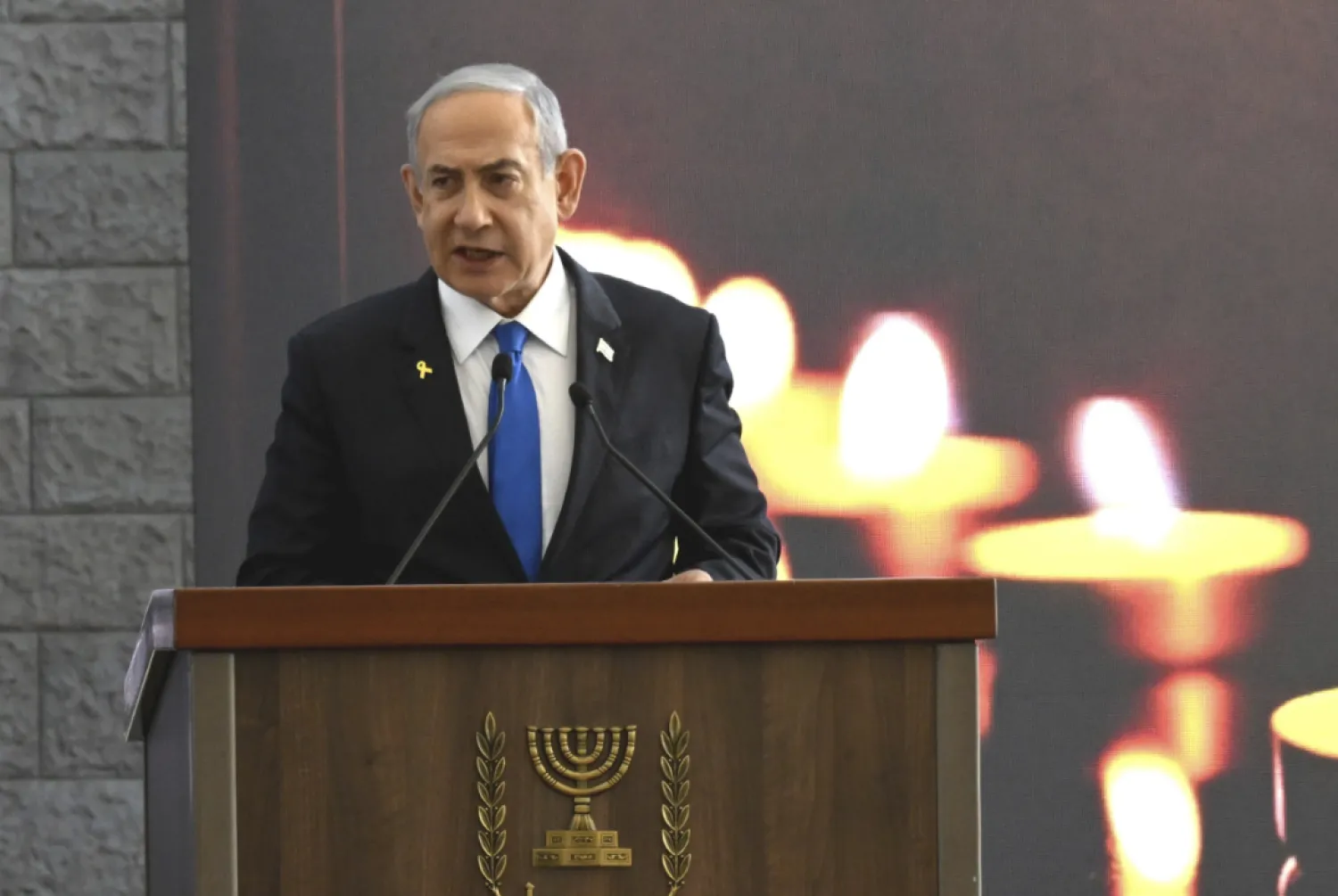
Israeli Prime Minister Benjamin Netanyahu . (Debbie Hill, Pool Photo via AP)
TT

Israel Investigates Leaks that Appear to Have Bolstered Netanyahu as Gaza Truce Talks Stalled

Israeli Prime Minister Benjamin Netanyahu . (Debbie Hill, Pool Photo via AP)

An Israeli court on Sunday was considering whether to lift a gag order on a case surrounding suspected leaks of classified information from an associate of Prime Minister Benjamin Netanyahu. Critics say they were aimed at giving him political cover as Gaza cease-fire talks ground to a halt.

Netanyahu has denied any wrongdoing and says no one from his office has been arrested or is under investigation. He has downplayed the affair and publicly called for the gag order to be lifted, according to The AP.

Israeli media reports say the case concerns the leak of classified information to two European media outlets by an adviser who may not have been formally employed and did not have security clearance, without naming the individual.

Netanyahu said the person in question “never participated in security discussions, was not exposed to or received classified information, and did not take part in secret visits.”

The leaked documents are said to have formed the basis of a widely discredited article in the London-based Jewish Chronicle — which was later withdrawn — suggesting Hamas planned to spirit hostages out of Gaza through Egypt, and an article in Germany's Bild newspaper that said Hamas was drawing out the talks as a form of psychological warfare on Israel.

Israeli media and other observers expressed skepticism about the articles, which appeared to support Netanyahu's demands in the talks and absolve him of blame for their failure.

The articles came out as Netanyahu was calling for lasting Israeli control over the Philadelphi corridor along the Gaza-Egypt border, a demand that was first made public over the summer. Hamas rejected the demand and accused Netanyahu of deliberately sabotaging the talks, which have been mediated by the United States, Qatar and Egypt.

The articles also seemed to provide political cover as Netanyahu faced intense criticism from families of the hostages and much of the Israeli public, who blame him for the failure to reach a deal. The criticism reached a fever pitch in early September, with mass protests and calls for a general strike, after Hamas killed six hostages as Israeli troops closed in on them.

A court document confirmed that an investigation by police, the military and the Shin Bet internal security agency is underway and that a number of suspects have been arrested for questioning. It said the affair poses “a risk to sensitive information and sources" and "harms the achievement of the goals of the war in the Gaza Strip."

The court will decide on Sunday whether to lift a gag order on other details of the case.

The leak led to a scandal at the Jewish Chronicle, where prominent columnists resigned in protest over the discredited articles. The London-based newspaper removed the article in question and others by a freelance journalist, saying it was “not satisfied with some of his claims.”

The Bild article suggested Hamas was not serious about the negotiations and was using psychological warfare to stoke Israeli divisions. Netanyahu cited it in a meeting with his Cabinet after it was published.

He again defended the article in a statement released over the weekend, saying it had “exposed the Hamas methods of exerting psychological pressure from home and abroad on the Israeli government and public by blaming Israel for the failure of the talks to release the hostages.”

Netanyahu has sought to blame Hamas, whose Oct. 7, 2023, attack into Israel ignited the war, for the failure of the talks. Hamas, which is still holding scores of hostages, has said it will only release them in exchange for a lasting cease-fire, a complete Israeli withdrawal from Gaza and the release of a large number of Palestinian prisoners.

Hamas says those demands have not changed following last month's killing of its top leader Yahya Sinwar, as the United States, Egypt and Qatar seek to restart the negotiations.

Netanyahu, often described by critics as image-obsessed, is on trial for corruption in three separate cases, two of which involve accusations that he gave favors to media moguls in exchange for positive coverage.

His office has downplayed the latest affair and accused the judiciary of bias, citing the many other leaks over the course of the war. It has also denied the leak in question had any impact on the cease-fire talks.

“The document only helped the effort to return the hostages, and certainly did not harm it,” Netanyahu's office said in a statement Saturday, adding that he only learned about the document when it was publicized.

His critics say the allegations are far more serious.

Yoav Limor, writing in the pro-Netanyahu daily Israel Hayom, called it “one of the gravest affairs Israel has ever known.”

“The damage it caused extends beyond the realm of national security and gives rise to suspicion that the prime minister’s bureau acted to scuttle a hostage deal, contrary to the war’s objectives.”



US Ambassador Causes Uproar by Claiming Israel has a Right to Much of the Middle East

US Ambassador to Israel Mike Huckabee is seen during an interview in Jerusalem, Wednesday, Aug. 20, 2025.(AP Photo/Ohad Zwigenberg, File)
TT

US Ambassador Causes Uproar by Claiming Israel has a Right to Much of the Middle East

US Ambassador to Israel Mike Huckabee is seen during an interview in Jerusalem, Wednesday, Aug. 20, 2025.(AP Photo/Ohad Zwigenberg, File)

Arab and Muslim nations on Saturday sharply condemned comments by the US ambassador to Israel, Mike Huckabee, who said Israel has a right to much of the Middle East.

Huckabee made the comments in an interview with conservative commentator Tucker Carlson that aired Friday. Carlson said that according to the Bible, the descendants of Abraham would receive land that today would include essentially the entire Middle East, and asked Huckabee if Israel had a right to that land, The AP news reported.

Huckabee responded: “It would be fine if they took it all." Huckabee added, however, that Israel was not looking to expand its territory and has a right to security in the land it legitimately holds.

His comments sparked immediate backlash from neighboring Egypt and Jordan, Saudi Arabia, Kuwait, Oman, the Organization of Islamic Cooperation and the League of Arab States.

Saudi Arabia's foreign ministry described Huckabee's comments as “extremist rhetoric” and “unacceptable,” and called for the State Department to clarify its position on them.

Egypt's foreign ministry called his comments a “blatant violation” of international law, adding that “Israel has no sovereignty over the occupied Palestinian territory or other Arab lands.”

“Statements of this nature — extremist and lacking any sound basis — serve only to inflame sentiments and stir religious and national emotions,” the League of Arab States said.

Since its establishment in 1948, Israel has not had fully recognized borders. Its frontiers with Arab neighbors have shifted as a result of wars, annexations, ceasefires and peace agreements.

During the six-day 1967 Mideast war, Israel captured the West Bank and east Jerusalem from Jordan, Gaza and the Sinai Peninsula from Egypt and the Golan Heights from Syria. Israel withdrew from the Sinai Peninsula as part of a peace deal with Egypt following the 1973 Mideast war. It also unilaterally withdrew from Gaza in 2005.

Israel has attempted to deepen control of the occupied West Bank in recent months. It has greatly expanded construction in Jewish settlements, legalized outposts and made significant bureaucratic changes to its policies in the territory. US President Donald Trump has said he will not allow Israel to annex the West Bank and has offered strong assurances that he’d block any move to do so.

Palestinians have for decades called for an independent state in the West Bank and Gaza with east Jerusalem its capital, a claim backed by much of the international community.

Huckabee, an evangelical Christian and strong supporter of Israel and the West Bank settlement movement, has long opposed the idea of a two-state solution for Israel and the Palestinian people. In an interview last year, he said he does not believe in referring to the Arab descendants of people who had lived in British-controlled Palestine as “Palestinians.”

In the latest interview, Carlson pressed Huckabee about his interpretation of Bible verses from the book of Genesis, where he said God promised Abraham and his descendants land from the Nile to the Euphrates.

“That would be the Levant, so that would be Israel, Jordan, Syria, Lebanon. It would also be big parts of Saudi Arabia and Iraq," Carlson said.

Huckabee replied: “Not sure we'd go that far. I mean, it would be a big piece of land."

Israel has encroached on more land since the start of its war with Hamas in Gaza, which was sparked by the Hamas-led attack on southern Israel on Oct. 7, 2023.

Under the current ceasefire, Israel withdrew its troops to a buffer zone but still controls more than half the territory. Israeli forces are supposed to withdraw further, though the ceasefire deal doesn’t give a timeline.

After Syrian President Bashar Assad was ousted at the end of 2024, Israel's military seized control of a demilitarized buffer zone in Syria created as part of a 1974 ceasefire between the countries. Israel said the move was temporary and meant to secure its border.

And Israel still occupies five hilltop posts on Lebanese territory following its brief war with Hezbollah in 2024.


Libya’s Ramadan Celebrations Tempered by Economic Woes

A family walks on their way to shop for Ramadan decorations ahead of the holy month of Ramadan in Benghazi, Libya, February 16, 2026. (Reuters)
TT

Libya’s Ramadan Celebrations Tempered by Economic Woes

A family walks on their way to shop for Ramadan decorations ahead of the holy month of Ramadan in Benghazi, Libya, February 16, 2026. (Reuters)

Libyans have been enjoying Ramadan with feasts and fireworks -- but soaring prices, a devalued currency and political divisions have left many with little to celebrate.

Fifteen years on from the fall of longtime leader Moammar al-Gaddafi, the country remains split between east and west, while shortages of goods, including fuel, disrupt daily life, despite Libya sitting atop vast oil and gas reserves.

During the holy month of Ramadan, shoppers stock up on treats, as families gather for lavish meals before and after the daytime fast that stretches from sunrise to sunset.

But this year supermarkets have been rationing their goods, while many petrol stations are short of gas. In the capital Tripoli, most ATMs were out of cash this week.

Firas Zreeg, 37, told AFP while weaving through a crowded supermarket that the economy was deteriorating, blaming currency speculators for the fall in the dinar, "which has negative repercussions on our daily lives".

The price of cooking oil has doubled in recent weeks, while meat and poultry prices rose by half.

Refills of gas cylinders, officially priced at 1.5 dinars ($0.24) but often unavailable through state-run distributors, now sell for 75 dinars ($11.85) on the black market and at times more.

- 'Burden on citizens' -

Libya has struggled to recover from the chaos that erupted following the 2011 uprising that toppled Gaddafi.

It remains divided between the Government of National Unity (GNU) based in Tripoli and an eastern administration backed by Libyan National Army (LNA) commander Khalifa Haftar.

The country has largely been stable in recent years although there have been bouts of deadly violence, including the killing of Gaddafi's son and heir apparent Seif al-Islam this month.

With security holding, many Libyans are more focused on their livelihoods.

Last month, the central bank in the western territory devalued the dinar -- the second time in less than a year -- by nearly 15 percent, "aimed at preserving financial and monetary stability and ensuring the sustainability of public resources".

In an address this week, GNU leader Abdulhamid Dbeibah acknowledged that the devaluation had once again "put the burden on citizens".

Hanna Tetteh, head of the United Nations Support Mission in Libya, warned on Wednesday that "poverty and pressure on society [are] increasing".

"The situation, in addition to the fragile security landscape, should be a matter for concern as such conditions can lead to unexpected political and security challenges," she told the UN Security Council.

Libya's other economic problems included the absence of a unified national budget, in light of its political divide, as well as uncoordinated public spending due to parallel state institutions, Tetteh said.

Revenues from the oil industry were also declining, she added, while the central bank has said public spending is growing at an unsustainable pace.

On Tuesday, Libya marked 15 years since the start of the uprising, with fireworks lighting up the sky in Tripoli, but for many Libyans life remains a struggle.

"Minor improvements in security were made over the past three years," Zreeg told AFP, but Libyans are still faced with huge economic challenges.


Libya PM Undergoes 'Successful' Treatment at Heart Hospital

Head of Libya's Government of National Unity (GNU) Abdulhamid Dbeibah. (GNU)
TT

Libya PM Undergoes 'Successful' Treatment at Heart Hospital

Head of Libya's Government of National Unity (GNU) Abdulhamid Dbeibah. (GNU)

Libya's Prime Minister Abdulhamid Dbeibah has undergone "successful" treatment at a heart hospital, his office said Saturday, but his specific ailment was not disclosed.

"I assure you that I am fine, by God's grace," said a statement posted on social media overnight.

The treatment was carried out at a facility in the northwestern Libyan city of Misrata on an undisclosed date, said AFP.

Dbeibah said he later travelled abroad for "additional medical checkups for reassurance", though this was not the primary reason for his trip.

Italian media outlets previously reported he had been admitted to a leading cardiac facility in Milan on Thursday for a general check-up.

"The matter is simply that I underwent some additional medical checkups for reassurance while I was abroad due to a prior external commitment," he said.

"The results confirmed the success of the treatment I received in Libya, praise be to God."

The prime minister leads a UN-recognized government based in Tripoli that controls western Libya, while the country's east is run by another administration backed by military strongman Khalifa Haftar.

Libya has remained divided since chaos erupted following the 2011 Arab Spring uprising that toppled longtime leader Muammar Gaddafi.