Children Brought from Gaza to Heal from War Wounds Become Caught in Another War, in Lebanon

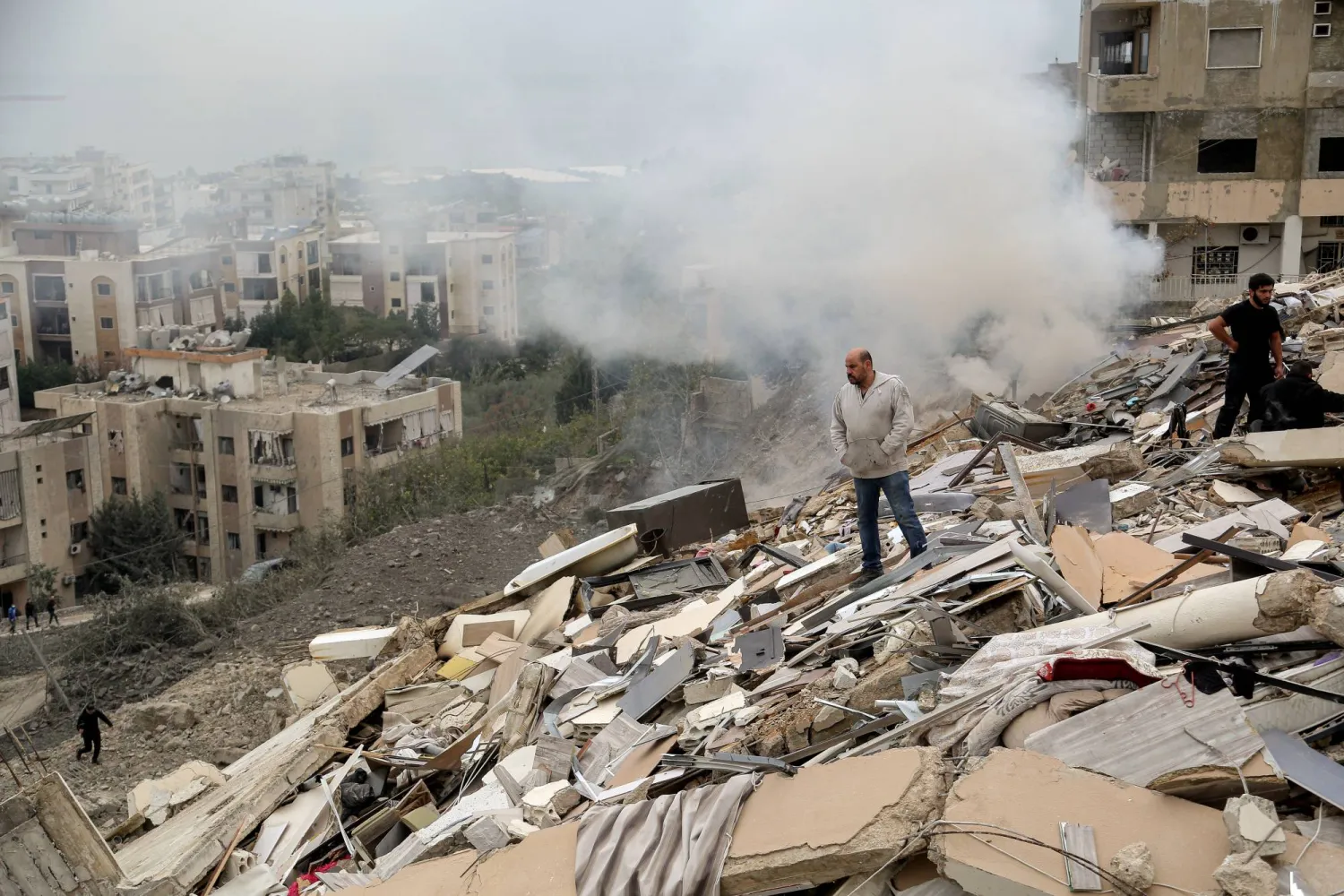
Rescue workers search for victims between the rubble of destroyed a house that was hit in an Israeli airstrike in Baalchmay village east of Beirut, Lebanon, Tuesday, Nov. 12, 2024. (AP Photo/Hassan Ammar)
TT

Children Brought from Gaza to Heal from War Wounds Become Caught in Another War, in Lebanon

Rescue workers search for victims between the rubble of destroyed a house that was hit in an Israeli airstrike in Baalchmay village east of Beirut, Lebanon, Tuesday, Nov. 12, 2024. (AP Photo/Hassan Ammar)

When Zarifa Nawfal’s family arrived in Beirut for her wounded daughter’s surgery, one of the first things she wanted to do was go to the sea. The Mediterranean had been a constant companion at their home in Gaza before the war.
“The moment I smelled the sea, I felt at peace inside — as if I were in Gaza,” she said.
But soon their place of refuge reminded her of home in far more distressing ways, The Associated Press said.
Nawfal’s 7-year-old daughter, Halima Abou Yassine, is one of a dozen severely wounded Palestinian children brought to Lebanon this year for treatment through a program launched by a British-Palestinian surgeon, Dr. Ghassan Abu Sitta.
But months after their arrival, Lebanon is itself embroiled in a war some fear will end in Gaza-like destruction.
In February, Nawfal was staying with her five children and her mother in an apartment in central Gaza. They had been displaced from their home in the north and Nawfal’s husband was missing, likely dead.
The children were filling water containers outside when two missiles struck, Nawfal said. She rushed outside and found Halima, the youngest, lying in the street, her skull cracked open, her brain exposed.
Through her shock, Nawfal said, “I was relieved that her body was in one piece.” In Gaza, blasts often ripped people apart, leaving their loved ones without even a body to bury.
Halima’s brother was unconscious next to her. He was quickly revived at the hospital. But staff at Al-Aqsa Martyrs Hospital confirmed Nawfal’s fears, she said: Halima was dead. Her small body was placed in the morgue.
But as the family was preparing to bury her, the little girl’s uncle noticed faint signs of life, the family said.
Officials at Al-Aqsa hospital could not be reached to confirm the account. But Abu Sitta, who has worked in several Gaza hospitals during the war, said in the chaotic situation it was not uncommon for patients to be misidentified as dead because normal protocols for emergency room examinations were often abandoned.
“Because of the sheer number of cases that would come in with each air raid ... the ambulance staff would take to the morgue immediately those who they thought were dead," he said.
In the days after her daughter was determined to be alive, Nawfal stayed with her, manually pumping oxygen into her lungs. After a week, the little girl began to breathe on her own. Finally, she woke up.
“Some of the doctors cried and said this is a miracle,” Nawfal said.
But they were unable to do more than keep the little girl alive. Her skull was still gaping open, a shard of bone missing. Her brain was beset by infection.
The family was evacuated to Egypt in May. In July, they boarded a plane for Lebanon.
An unlikely refuge
The first of the wounded Palestinian children arrived in Lebanon in May. Five-year-old Adam Afana had nearly lost his left arm in a blast that killed his father and sister. His arm was paralyzed and he needed a complex surgery to correct the nerve damage.
At the time, Lebanon was already embroiled in a low-simmering conflict between Israel and Hezbollah.
The Lebanese militant group began firing rockets across the border into Israel in support of its ally, Hamas, on Oct. 8, 2023, a day after Palestinian militants staged the deadly surprise incursion into southern Israel that sparked the ongoing war in Gaza. Israel responded with shelling and airstrikes.
For months, the conflict in Lebanon was mainly confined to the border area, far from Beirut.
Abu Sitta said he chose Lebanon for the wounded children's treatment because the Mediterranean country has specialists with wide experience treating war injuries.
Lebanon has been through its share of conflicts, including a 15-year civil war that ended in 1990 and a brutal monthlong war between Israel and Hezbollah in 2006, as well as spillover effects from other regional conflicts.
“Even after the end of the wars (in Lebanon), the wounded from Iraq and Syria would come here for that kind of complex and multistage treatment,” Abu Sitta said.
The war that followed them
In July, Halima underwent successful surgery to repair her skull at the American University of Beirut Medical Center.
Nawfal said her daughter has lingering memory problems but is improving with therapy. A chipper, happy-go-lucky child, Halima thrived in Beirut. She swam in the hotel pool, loved to color and played with the other children from Gaza. She walked with her siblings to pick out fruit at the neighborhood produce stand, a straw hat covering the scar on the back of her head.
In mid-September, Israel launched an offensive against Hezbollah. It pummeled wide swathes of Lebanon with airstrikes, including Beirut’s southern suburbs and some sites within the city center.
The children quickly snapped back into wartime habits. They cracked open the balcony's sliding glass doors to prevent the glass shattering from the pressure of a blast and began sleeping in the central sitting room in the family’s hotel suite, away from windows.
Nawfal said some organizations offered to evacuate the family from Lebanon to continue treatment elsewhere, but she “completely refused.”
“Lebanon isn’t just another Arab country or a country we came to for treatment — Lebanon is a sister to Gaza,” she said. “We are like two souls in one body. ... We live or die together.”
Adam Afana's uncle, Eid Afana, said the escalation in Lebanon “reminds us of the beginning of the war in Gaza.” Afana said the sound of airstrikes frightened Adam, who felt the war was pursuing them.
“What we hope for Lebanon is that what happened in Gaza won’t happen here — that the beginning and the ending won’t both be the same,” Afana said.
‘All wars are waged on children’ The Ghassan Abu Sitta Fund halted bringing wounded Palestinian children to Lebanon but continues to treat the existing patients — with some challenges.
Since arriving in Beirut, Adam has undergone a procedure to clear infection from his bones, a neurosurgery and regular physiotherapy sessions. With effort, he can now slightly clench his hand.
But the final operation — a muscle transfer and surgery to repair the damaged nerves to his arm — is on hold.
“There’s just a handful of people who specialize in this globally, and we were expecting one of them to come to Lebanon,” Abu Sitta said. The trip has been delayed by the escalation in Lebanon.
When he first launched the program, Abu Sitta hoped to treat 50 Palestinian children from Gaza at any given time. Unable to bring more patients in, the team is turning its resources to treating Lebanese children.
The numbers of wounded Lebanese children are still far lower than in Gaza. As of last week, Lebanon’s Ministry of Public Health said 192 children had been killed and at least 1,255 wounded since October 2023. In Gaza, more than 13,000 children have been killed and thousands more have been wounded, according to Gaza's Health Ministry.
Abu Sitta said the wounds of children in Lebanon are “identical to the injuries of Palestinian children from Gaza.” Most were wounded while at home. They suffered “crush injuries to the limbs, blast injuries to the face” and often “multiple members of the family killed at the same time,” he said.
“As in Gaza, this war takes its toll on children,” he said. “All wars are waged on children.”



Lebanon Says Two Killed in Israeli Strike on Palestinian Refugee Camp

22 January 2026, Lebanon, Qnarit: People inspect the damage of a building that was destroyed by an Israeli air raid on the southern Lebanese village of Qnarit. (dpa)
TT

Lebanon Says Two Killed in Israeli Strike on Palestinian Refugee Camp

22 January 2026, Lebanon, Qnarit: People inspect the damage of a building that was destroyed by an Israeli air raid on the southern Lebanese village of Qnarit. (dpa)

Lebanon said an Israeli strike on the country's largest Palestinian refugee camp killed two people on Friday, with Israel's army saying it had targeted the Palestinian group Hamas. 

The official National News Agency said "an Israeli drone" targeted a neighborhood of the Ain al-Hilweh camp, which is located on the outskirts of the southern city of Sidon. 

Lebanon's health ministry said two people were killed in the raid. The NNA had earlier reported one dead and an unspecified number of wounded. 

An AFP correspondent saw smoke rising from a building in the densely populated camp as ambulances headed to the scene. 

The Israeli army said in a statement that its forces "struck a Hamas command center from which terrorists operated", calling activity there "a violation of the ceasefire understandings between Israel and Lebanon" and a threat to Israel. 

The Israeli military "is operating against the entrenchment" of the Palestinian group in Lebanon and will "continue to act decisively against Hamas terrorists wherever they operate", it added. 

Israel has kept up regular strikes on Lebanon despite a November 2024 ceasefire that sought to halt more than a year of hostilities with Hezbollah. 

Israel has also struck targets belonging to Hezbollah's Palestinian ally Hamas, including in a raid on Ain al-Hilweh last November that killed 13 people. 

The UN rights office had said 11 children were killed in that strike, which Israel said targeted a Hamas training compound, though the group denied it had military installations in Palestinian camps in Lebanon. 

In October 2023, Hezbollah began launching rockets at Israel in support of Hamas at the outset of the Gaza war, triggering hostilities that culminated in two months of all-out war between Israel and the Iran-backed Lebanese group. 

On Sunday, Lebanon said an Israeli strike near the Syrian border in the country's east killed four people, as Israel said it targeted operatives from Palestinian group Islamic Jihad. 


UN Says It Risks Halting Somalia Aid Due to Funding Cuts 

A Somali trader marks watermelons for sale at an open-air grocery market as Muslims start the fasting month of Ramadan, the holiest month in the Islamic calendar, within Bakara market in Mogadishu, Somalia, February 18, 2026. (Reuters)
TT

UN Says It Risks Halting Somalia Aid Due to Funding Cuts 

A Somali trader marks watermelons for sale at an open-air grocery market as Muslims start the fasting month of Ramadan, the holiest month in the Islamic calendar, within Bakara market in Mogadishu, Somalia, February 18, 2026. (Reuters)

The UN's World Food Program (WFP) warned Friday it would have to stop humanitarian assistance in Somalia by April if it did not receive new funding.

The Rome-based agency said it had already been forced to reduce the number of people receiving emergency food assistance from 2.2 million in early 2025 to just over 600,000 today.

"Without immediate funding, WFP will be forced to halt humanitarian assistance by April," it said in a statement.

In early January, the United States suspended aid to Somalia over reports of theft and government interference, following the destruction of a US-funded WFP warehouse in the capital Mogadishu's port.

The US announced a resumption of WFP food distribution on January 29.

However, all UN agencies have warned of serious funding shortfalls since Washington began slashing aid across the world following President Donald Trump's return to the White House last year.

"The situation is deteriorating at an alarming rate," said Ross Smith, WFP Director of Emergency Preparedness and Response, in Friday's statement.

"Families have lost everything, and many are already being pushed to the brink. Without immediate emergency food support, conditions will worsen quickly.

"We are at the cusp of a decisive moment; without urgent action, we may be unable to reach the most vulnerable in time, most of them women and children."

Some 4.4 million people in Somalia are facing crisis-levels of food insecurity, according to the WFP, the largest humanitarian agency in the country.

The Horn of Africa country has been plagued by conflict and also suffered two consecutive failed rainy seasons.


Hamas Says Path for Gaza Must Begin with End to ‘Aggression’ 

Makeshift tents of displaced Palestinian families among the ruins of their homes at sunset during the holy month of Ramadan in Jabaliya northern Gaza Strip on, 19 February 2026. (EPA)
TT

Hamas Says Path for Gaza Must Begin with End to ‘Aggression’ 

Makeshift tents of displaced Palestinian families among the ruins of their homes at sunset during the holy month of Ramadan in Jabaliya northern Gaza Strip on, 19 February 2026. (EPA)

Discussions on Gaza's future must begin with a total halt to Israeli "aggression", the Palestinian movement Hamas said after US President Donald Trump's Board of Peace met for the first time.

"Any political process or any arrangement under discussion concerning the Gaza Strip and the future of our Palestinian people must start with the total halt of aggression, the lifting of the blockade, and the guarantee of our people's legitimate national rights, first and foremost their right to freedom and self-determination," Hamas said in a statement Thursday.

Trump's board met for its inaugural session in Washington on Thursday, with a number of countries pledging money and personnel to rebuild the Palestinian territory, more than four months into a fragile ceasefire between Israel and Hamas.

Israeli Prime Minister Benjamin Netanyahu has insisted however that Hamas must disarm before any reconstruction begins.

"We agreed with our ally the US that there will be no reconstruction of Gaza before the demilitarization of Gaza," Netanyahu said.

The Israeli leader did not attend the Washington meeting but was represented by his foreign minister Gideon Saar.

Trump said several countries had pledged more than seven billion dollars to rebuild the territory.

Muslim-majority Indonesia will take a deputy commander role in a nascent International Stabilization Force, the unit's American chief Major General Jasper Jeffers said.

Trump, whose plan for Gaza was endorsed by the UN Security Council in November, also said five countries had committed to providing troops, including Morocco, Kazakhstan, Kosovo and Albania.