

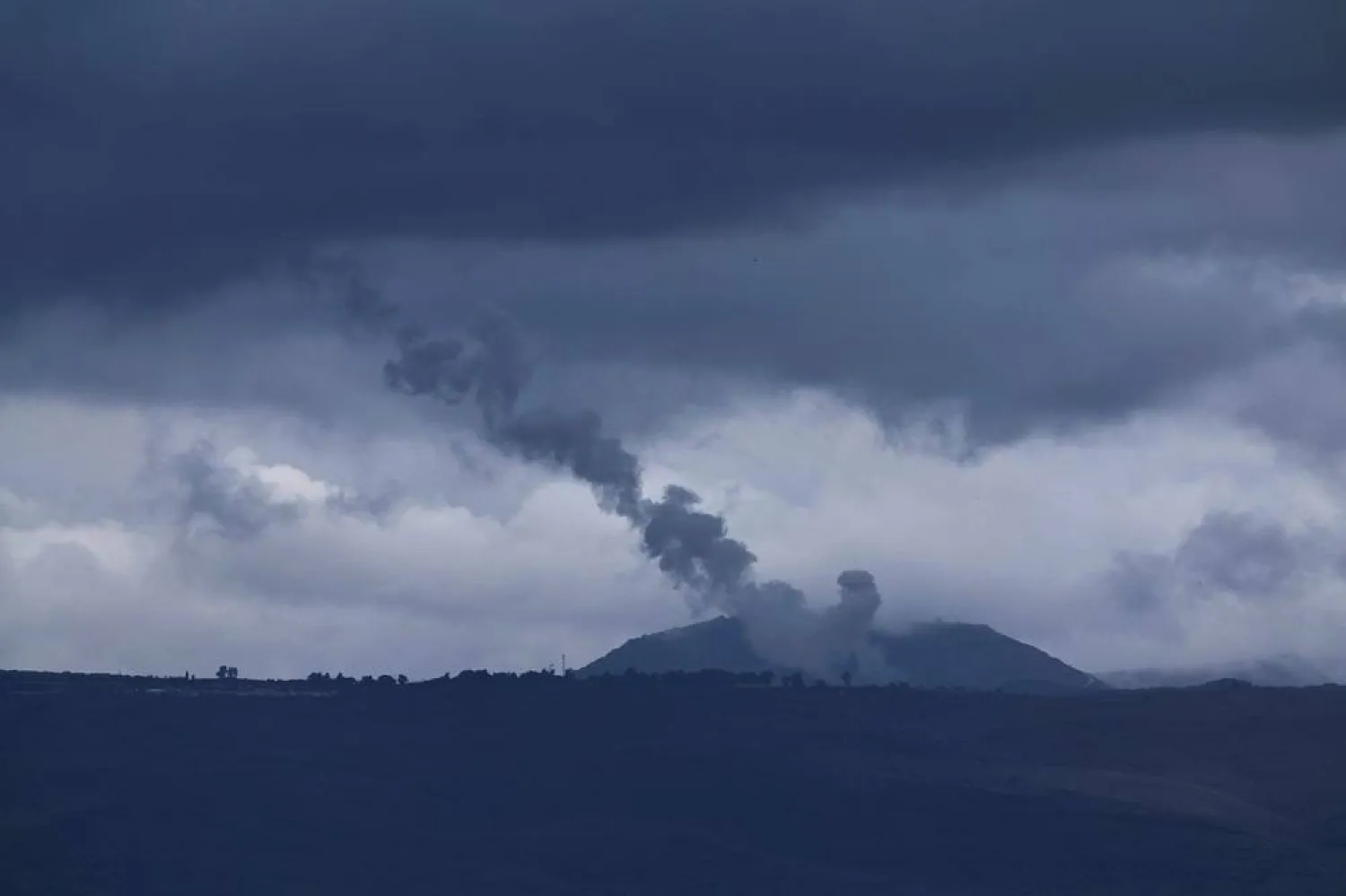

Israel Attempts to Penetrate Second Line of Villages in Southern Lebanon

Trails of Israeli missiles launched towards targets in southern Lebanon, as seen from an undisclosed location in northern Israel, 18 November 2024, amid cross-border hostilities between Hezbollah and Israel. (EPA)
TT

Israel Attempts to Penetrate Second Line of Villages in Southern Lebanon

Trails of Israeli missiles launched towards targets in southern Lebanon, as seen from an undisclosed location in northern Israel, 18 November 2024, amid cross-border hostilities between Hezbollah and Israel. (EPA)

Relative calm prevailed in Beirut’s southern suburbs on Monday after a day of intense Israeli strikes. In the South, Israel also scaled back its air raids as its forces clashed with Hezbollah on the second line of villages that it is trying to penetrate.

Israel is trying to ramp up its pressure on the field hours before US envoy Amos Hochstein is expected to arrive in Beirut where Lebanon and Hezbollah have agreed to a US ceasefire proposal.

On the ground, Israel now controls a first line of villages and is trying to capture the second line, specifically in the western sector through the village of Chamaa and the eastern sector towards al-Khiam.

Khiam witnessed relentless Israeli artillery fire throughout the night. Israel also targeted the towns of Jdeide, Marjeyoun and Bourj al-Mamlouk, reported Lebanon’s National News Agency (NNA).

Hezbollah announced in a series of statements that it had fired rockets at Israeli forces in Khiam on four occasions. The Iran-backed party’s al-Manar television reported that Israeli armored vehicles were moving in the fields of al-Wazzani towards Khiam.

Hours earlier, the Israeli army announced that it had deployed artillery batteries inside Lebanese territory, a first since it intensified its attacks against Hezbollah in October.

Israeli army spokesman Avichay Adraee said the artillery was deployed to provide support for the ground operations as the forces advance towards new goals.

Former deputy chief of staff of operations in the Lebanese Armed Forces retired General Hassan Jouni and founder and CEO of the Institute for Near East and Gulf Military Analysis (INEGMA) Riad Kahwaji agreed that the deployment of the artillery was normal in the field battle.

Jouni told Asharq Al-Awsat that the first line of villages was now under Israeli control through fire, while Kahwaji said they are effectively occupied and now Israel can advance on the second line.

Jouni disagreed on calling it an occupation, saying Israel was controlling it by force. Its military can roam the area, but it still comes under attack. It has also not built any defensive posts that allow it to establish a permanent position in the area.

The deployment of the artillery will not have a major impact on the fighting. Rather, it is aimed at firing deeper in Lebanon, he explained.

In offensive operations, artillery batteries are moved forward as forces advance. This is what Israel is doing. It has moved up to the second line of villages, but does not consolidate its occupation of villages, he said.

The first line will become occupied once Israel seizes control of the second, Jouni went on to say.

As it stands, the army is being met with fierce resistance by Hezbollah on the second line, especially in the Tayr Harfa region and leading to Chamaa.

Chamaa is significant because it lies between two valleys and is the only route to al-Bayyada, whose capture would be a major achievement given its geographic location, Jouni said.

Kahwaji, meanwhile, asserted that the first line of villages has been occupied by Israel, which has allowed it to move on to the second line.

The deployment of the artillery confirms this advance. Moreover, the forces will be stationed around the artillery to defend it, so they would have effectively established a foothold in the area.

On the ground, an Israeli airstrike targeted the main water facility in the southern port city of Tyre, killing two local officials and injuring two others, further compounding southern Lebanon’s worsening water crisis, Lebanon’s state media said.

The attack severely damaged the facility, prompting the Tyre Municipality to urge residents to ration water use until repairs can be made, NNA said on Monday.

Those killed in the attack included Samer Shaghri, a local elected official called a mukhtar who handles residents’ administrative affairs, and Qassem Wehbi, the deputy mayor of Burj al-Shamali, a town east of Tyre.

This strike is part of a broader pattern of bombardments in the 13-month conflict between Hezbollah and Israel that, according to an October 22 UNICEF report, have damaged at least 28 water facilities, cutting off access to safe water for over 360,000 people, primarily in southern Lebanon.

UNICEF’s report quoted Lebanon’s caretaker Minister of Energy, Walid Fayyad, who said, “The ongoing hostilities have inflicted severe damage on Lebanon’s essential services, leaving hundreds of thousands without access to safe water and electricity.”



Türkiye Begins Black Box Analysis of Jet Crash That Killed Libyan Military Chief and 7 Others

Libyan national flags fly at half-mast in Tripoli on December 24, 2025, after the head of Libya's armed forces and his four aides died in a plane crash in Türkiye. (AFP)
TT

Türkiye Begins Black Box Analysis of Jet Crash That Killed Libyan Military Chief and 7 Others

Libyan national flags fly at half-mast in Tripoli on December 24, 2025, after the head of Libya's armed forces and his four aides died in a plane crash in Türkiye. (AFP)

The technical analysis of the recovered black boxes from a jet crash that killed eight people, including western Libya’s military chief, began as the investigation proceeded in cooperation with Libyan authorities, the Turkish Ministry of Defense said Thursday.

The private jet with Gen. Muhammad Ali Ahmad al-Haddad, four other military officials and three crew members crashed on Tuesday after taking off from Türkiye’s capital, Ankara, killing everyone on board. Libyan officials said the cause of the crash was a technical malfunction on the plane.

The high-level Libyan delegation was on its way back to Tripoli after holding defense talks in Ankara aimed at boosting military cooperation between the two countries.

The wreckage was scattered across an area covering 3 square kilometers (more than a square mile), complicating recovery efforts, according to the Turkish Interior Minister Ali Yerlikaya.

A 22-person delegation, including five family members, arrived from Libya early on Wednesday to assist in the investigation.


Lebanese President: We are Determined to Hold Parliamentary Elections on Time

President Joseph Aoun between Prime Minister Nawaf Salam and Speaker Nabih Berri (Lebanese Presidency file photo)
TT

Lebanese President: We are Determined to Hold Parliamentary Elections on Time

President Joseph Aoun between Prime Minister Nawaf Salam and Speaker Nabih Berri (Lebanese Presidency file photo)

Lebanese President Joseph Aoun reiterated on Thursday that the country’s parliamentary elections are a constitutional obligation that must be carried out on time.

Lebanon’s state-run National News Agency quoted Aoun as saying that he, alongside Prime Minister Nawaf Salam and Parliament Speaker Nabih Berri, is determined to hold the elections on schedule.

Aoun also emphasized that diplomatic efforts have continued unabated to keep the specter of war at bay, noting that "things are heading in a positive direction".

The agency also cited Berri reaffirming that the elections will take place as planned, with "no delays, no extensions".

The Lebanese parliamentary elections are scheduled for May next year.


Israel Calls Countries Condemning New West Bank Settlements ‘Morally Wrong’

Newly constructed buildings are pictured in the Israeli settlement of Givat Zeev near the Palestinian city of Ramallah in the occupied West Bank on October 24, 2025. (AFP)
TT

Israel Calls Countries Condemning New West Bank Settlements ‘Morally Wrong’

Newly constructed buildings are pictured in the Israeli settlement of Givat Zeev near the Palestinian city of Ramallah in the occupied West Bank on October 24, 2025. (AFP)

Israel reacted furiously on Thursday to a condemnation by 14 countries including France and Britain of its approval of new settlements in the occupied West Bank, calling the criticism discriminatory against Jews.

"Foreign governments will not restrict the right of Jews to live in the Land of Israel, and any such call is morally wrong and discriminatory against Jews," Foreign Minister Gideon Saar said.

"The cabinet decision to establish 11 new settlements and to formalize eight additional settlements is intended, among other things, to help address the security threats Israel is facing."

On Sunday, Israel's far-right Finance Minister Bezalel Smotrich announced that authorities had greenlit the settlements, saying the move was aimed at preventing the establishment of a Palestinian state.

Fourteen countries, including Britain, France, Germany, Spain and Canada, then issued a statement urging Israel to reverse its decision, "as well as the expansion of settlements".

Such unilateral actions, they said, "violate international law", and risk undermining a fragile ceasefire in Gaza in force since October 10.

They also reaffirmed their "unwavering commitment to a comprehensive, just and lasting peace based on the two-state solution... where two democratic states, Israel and Palestine, live side-by-side in peace and security".

Israel has occupied the West Bank following the 1967 Arab-Israeli war.

Excluding east Jerusalem, which was occupied and annexed by Israel in 1967, more than 500,000 Israelis live in the West Bank, along with about three million Palestinian residents.

Earlier this month, the United Nations said the expansion of Israeli settlements in the West Bank, all of which are illegal under international law, had reached its highest level since at least 2017.