US Intel: Lebanon's Hezbollah Aims to Rebuild Longer Term despite Israeli Blows

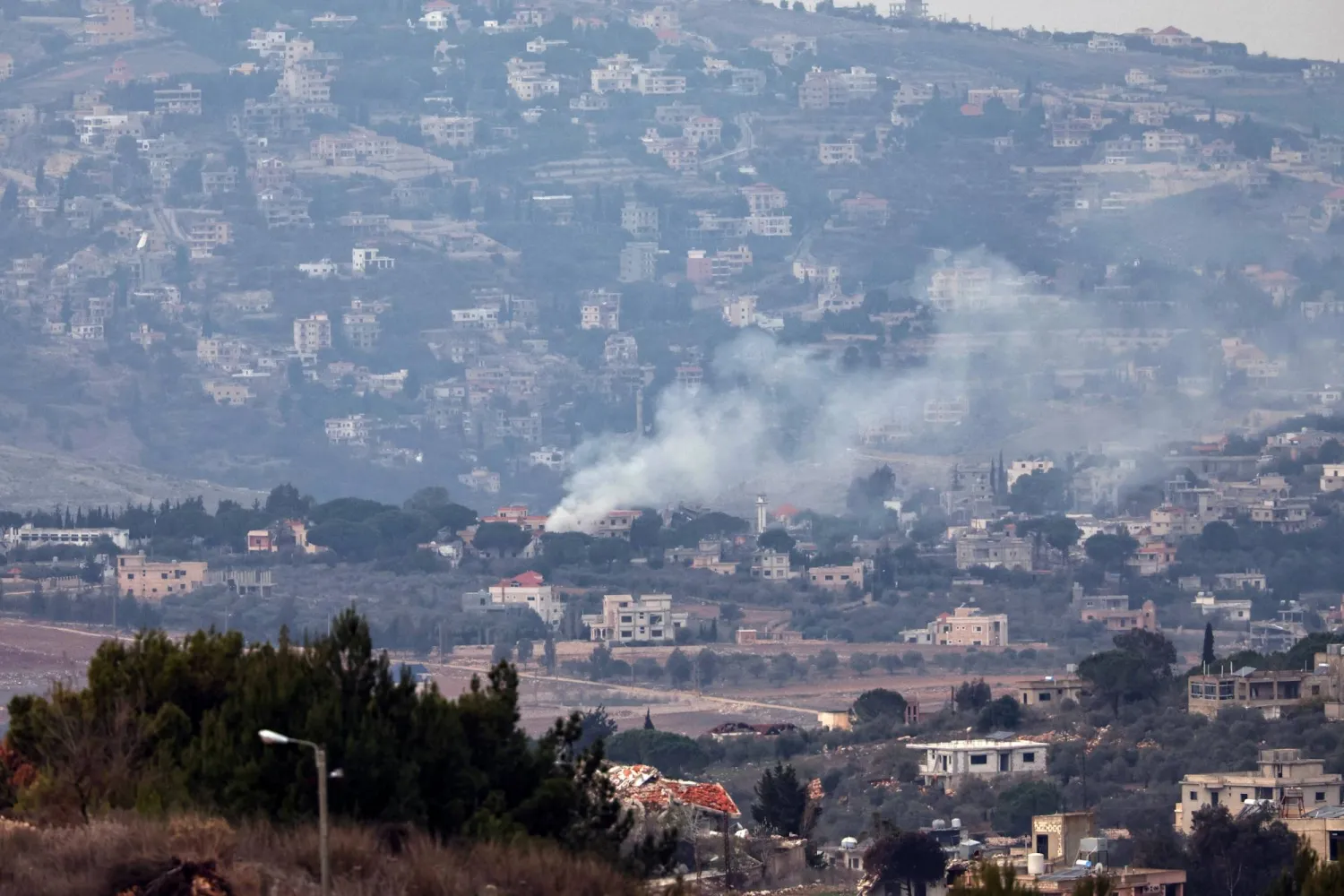
Smoke rises as a result of an Israeli strike next to the south Lebanon village of Hula  as seen from the Israeli side of the border, 04 December 2024. EPA/ATEF SAFADI
Smoke rises as a result of an Israeli strike next to the south Lebanon village of Hula as seen from the Israeli side of the border, 04 December 2024. EPA/ATEF SAFADI
TT

US Intel: Lebanon's Hezbollah Aims to Rebuild Longer Term despite Israeli Blows

Smoke rises as a result of an Israeli strike next to the south Lebanon village of Hula  as seen from the Israeli side of the border, 04 December 2024. EPA/ATEF SAFADI
Smoke rises as a result of an Israeli strike next to the south Lebanon village of Hula as seen from the Israeli side of the border, 04 December 2024. EPA/ATEF SAFADI

Lebanon's Hezbollah has been significantly degraded militarily by Israel, but the Iran-backed group will likely try to rebuild its stockpiles and forces and pose a long term threat to the US and its regional allies, four sources briefed on updated US intelligence told Reuters.
US intelligence agencies assessed in recent weeks that Hezbollah, even amid Israel's military campaign, had begun to recruit new fighters and was trying to find ways to rearm through domestic production and by smuggling materials through Syria, said a senior US official, an Israeli official and two US lawmakers briefed on the intelligence, speaking on condition of anonymity.
It's unclear to what extent those efforts have slowed since last week when Hezbollah and Israel reached a shaky ceasefire, two of the sources said. The deal specifically prohibits Hezbollah from procuring weapons or weapons parts.
In recent days, Israel has tried to undercut Hezbollah's ability to rebuild its military forces, striking several Hezbollah rocket launchers in Lebanon, bombing border crossings with Syria, and blocking an Iranian aircraft suspected of ferrying weapons for the group.
US intelligence agencies assess that Hezbollah is operating with limited firepower. It has lost more than half its weapons stockpiles and thousands of fighters during the conflict with Israel, reducing Tehran's overall military capacity to its lowest point in decades, according to the intelligence.
But Hezbollah has not been destroyed. It still maintains thousands of short-range rockets in Lebanon and it will try to rebuild using weapons factories in neighboring countries with available transport routes, the sources said.
One of the lawmakers said Hezbollah has been "knocked back" in the short term and had its ability to conduct command and control reduced. But the lawmaker added: "This organization is designed to be disrupted."
US officials are concerned about Hezbollah's access to Syria, where Syrian opposition factions recently launched an offensive to retake government strongholds in Aleppo and Hama. Hezbollah has long used Syria as a safe haven and transport hub, taking military equipment and weapons from Iraq, through Syria and into Lebanon through the rugged border crossings.
Washington is trying to pressure Syrian President Bashar al-Assad to limit Hezbollah's operations, enlisting other countries in the region to help, a senior US official said. Reuters reported on Monday that the US is weighing the possibility of lifting sanctions on Assad if he peels himself away from Iran and cuts off weapons routes to Hezbollah.
Hezbollah officials have said the group will continue to function as a "resistance" against Israel, but its secretary general Naim Qassem has not brought up the group's weapons in recent speeches, including after the ceasefire was reached. Sources in Lebanon say Hezbollah's priority is rebuilding homes for its constituency after Israeli strikes destroyed swaths of Lebanon's south and the southern suburbs of Beirut.
The US National Security Council and the Office of the Director for National Intelligence declined to comment on the updated US intelligence.
TRAINING CHALLENGES
Iranian Foreign Minister Abbas Araqchi said last week that Hezbollah had not been weakened by Israel's killing of many of its leaders since January and by its ground assault against the group since early October. He said Hezbollah had been able to reorganize and fight back effectively.
However, US intelligence indicates that Israel has taken out thousands of Hezbollah's missiles in Lebanon, pushing cadres of its fighters back from the border with Israel, the sources told Reuters.
While tracking the exact number of Hezbollah fighters remains a challenge, the intelligence notes that the group will likely face significant training challenges for years to come, the sources said.
US officials say Hezbollah's breakdown points to a growing gap in Iran's military capacity and raises doubts about its ability to use its proxies to attack Israel and its other adversaries in the short term. Iran also backs Hamas militants in the Gaza Strip and the Houthi group in Yemen.
In the past, had Israel considered bombing Iran, it faced the prospect of Hezbollah in Lebanon reciprocating, said a second US official, but with Hezbollah weakened, Israel can attack Iran directly without the same threat to its north.
In Gaza, US intelligence indicates Hamas can only sustain small, guerrilla-style tactics after having lost at least half of its fighters. The Houthis continue to launch missiles and drones from Yemen, but the US has been able to intercept most.
The updated US intelligence - briefed to senior officials and lawmakers in recent weeks - emerges ahead of US President-elect Donald Trump's Jan. 20 inauguration. The US charged an Iranian man last month in connection with an alleged Iranian plot to assassinate Trump. Iran has rejected the accusation.
During his first term in office, Trump embraced a "maximum pressure" campaign on Iran, imposing harsh sanctions on Tehran, its military complex and its most lucrative economic sectors. Trump in 2018 pulled the US out of a 2015 international agreement meant to deny Tehran the ability to build nuclear weapons. In 2020 Trump was responsible for a strike in Iraq that killed top Iranian military commander Qassem Soleimani.



Sisi Says he Values Trump Offer to Mediate Egypt-Ethiopia Dispute on GERD

FILE PHOTO: US President Donald Trump points as he attends a meeting with oil industry executives, at the White House in Washington, D.C., US, January 9, 2026. REUTERS/Evelyn Hockstein/File Photo
TT

Sisi Says he Values Trump Offer to Mediate Egypt-Ethiopia Dispute on GERD

FILE PHOTO: US President Donald Trump points as he attends a meeting with oil industry executives, at the White House in Washington, D.C., US, January 9, 2026. REUTERS/Evelyn Hockstein/File Photo

Egyptian President Abdel Fattah al-Sisi said he valued an offer by US President Donald Trump to mediate ⁠a dispute over Nile River waters between Egypt and Ethiopia.

In a post on ⁠X, Sisi said on Saturday that he addressed Trump's letter by affirming Egypt's position and concerns about the country's water ⁠security in regards to Ethiopia's Grand Ethiopian Renaissance Dam (GERD).

"I am ready to restart US mediation between Egypt and Ethiopia to responsibly resolve the question of 'The Nile Water Sharing' once and for all," Trump wrote to Sisi in the letter that was also posted on Trump’s Truth Social account.

Addis Ababa's September 9 inauguration of GERD has been a source of anger ⁠in Cairo, which is downstream on the Nile.

Ethiopia sees the $5 billion dam on a tributary of the Nile as central to its economic ambitions.

Egypt says the dam violates international treaties and could cause both droughts ⁠and flooding.

Sudan, another ​downstream country, has expressed concern about the regulation and safety of ⁠its own water supplies and dams.

Sudan's army leader Abdel Fattah al-Burhan also welcomed Trump's mediation offer on Saturday.


Kurds Say Sharaa's Decree Falls Short, Syrian Government Forces Enter Deir Hafer

Syrian army convoys enter the Deir Hafer area in the eastern Aleppo countryside, Syria, after the Kurdish-led Syrian Democratic Forces (SDF) announced the handover of the area west of the Euphrates to the Syrian government, 17 January 2026. EPA/AHMAD FALLAHA
TT

Kurds Say Sharaa's Decree Falls Short, Syrian Government Forces Enter Deir Hafer

Syrian army convoys enter the Deir Hafer area in the eastern Aleppo countryside, Syria, after the Kurdish-led Syrian Democratic Forces (SDF) announced the handover of the area west of the Euphrates to the Syrian government, 17 January 2026. EPA/AHMAD FALLAHA

Syria's Kurds on Saturday said a presidential decree recognizing the minority's rights and making Kurdish an official language fell short of their expectations as Syrian government forces entered the outskirts of a northern town.

In a statement, the Kurdish administration in Syria's north and northeast said the decree issued by President Ahmed al-Sharaa on Friday was "a first step, however it does not satisfy the aspirations and hopes of the Syrian people".

It added that "rights are not protected by temporary decrees, but... through permanent constitutions that express the will of the people and all components" of society.

Al-Sharaa’s decree affirmed that Syrian citizens of Kurdish origin are an integral and original part of the Syrian people, and that their cultural and linguistic identity is an inseparable component of Syria’s inclusive national identity.

The decree commits the state to protecting cultural and linguistic diversity and guarantees Kurdish citizens the right to preserve their heritage, arts, and mother tongue within the framework of national sovereignty.

It recognizes Kurdish as a national language and allows it to be taught in public and private schools in areas where Kurds make up a significant proportion of the population.

It also grants Syrian nationality to all residents of Kurdish origin living on Syrian territory, including those previously unregistered, while ensuring full equality in rights and duties.

The decree further designates Nowruz, celebrated annually on March 21, as an official public holiday.

Syrian government forces entered the outskirts of the northern town of Deir Hafer Saturday morning after the command of Kurdish-led fighters said it would evacuate the area in an apparent move to avoid conflict.

This came after deadly clashes erupted earlier this month between government troops and the US-backed and Kurdish-led Syrian Democratic Forces in the city of Aleppo, Syria’s largest.

It ended with the evacuation of Kurdish fighters from three neighborhoods taken over by government forces.

An Associated Press reporter saw on Saturday government tanks, armored personnel carriers and other vehicles, including pickup trucks with heavy machine-guns mounted on top of them, rolling toward the town of Deir Hafer from nearby Hamima after bulldozers removed barriers. There was no SDF presence on the edge of the town.

Meanwhile, the Syrian military said Saturday morning its forces were in full control of Deir Hafer, captured the Jarrah airbase east of the town, and were working on removing all mines and explosives. It added that troops would also move toward the nearby town of Maskana.

On Friday night, after government forces started pounding SDF positions in Deir Hafer, the Kurdish-led fighters’ top commander Mazloum Abdi posted on X that his group would withdraw from contested areas in northern Syria. Abdi said SDF fighters would relocate east of the Euphrates River starting 7 a.m. (0400 gmt) Saturday.

The easing of tension came after US military officials visited Deir Hafer on Friday and held talks with SDF officials in the area.

The United States has good relations with both sides and has urged calm.


US Names Rubio, Tony Blair, Kushner to Gaza Board under Trump's Plan

Palestinians move past the rubble of residential buildings destroyed during the war, in Gaza City, January 16, 2026. REUTERS/Dawoud Abu Alkas
TT

US Names Rubio, Tony Blair, Kushner to Gaza Board under Trump's Plan

Palestinians move past the rubble of residential buildings destroyed during the war, in Gaza City, January 16, 2026. REUTERS/Dawoud Abu Alkas

The White House on Friday announced some members of a so-called "Board of Peace" that is to supervise the temporary governance of Gaza, which has been under a fragile ceasefire since October.

The names include US Secretary of State Marco Rubio, President Donald Trump's special envoy Steve Witkoff, former British Prime Minister Tony Blair and Trump's son-in-law, Jared Kushner. Trump is the chair of the board, according to a plan his White House unveiled in October.

Israel and Hamas signed off on Trump's plan, which says a Palestinian technocratic body will be overseen by the international board, which will ⁠supervise Gaza's governance for a transitional period.

The White House did not detail the responsibilities of each member of the "founding Executive board." The names do not include any Palestinians. The White House said ⁠more members will be announced over the coming weeks.

The board will also include private equity executive and billionaire Marc Rowan, World Bank President Ajay Banga and Robert Gabriel, a Trump adviser, the White House said, adding that Nickolay Mladenov, a former UN Middle East envoy, will be the high representative for Gaza.

Army Major General Jasper Jeffers, a US special operations commander, was appointed commander of the International Stabilization Force, the White House said. A UN Security Council resolution, adopted in mid-November, authorized the board and countries working with it to establish that force in Gaza.

The White House also named an 11-member "Gaza Executive Board" that will include Turkish Foreign Minister Hakan Fidan, the UN special coordinator for the Middle East ⁠peace process, Sigrid Kaag, the United Arab Emirates minister for international cooperation, Reem Al-Hashimy, and Israeli-Cypriot billionaire Yakir Gabay, along with some members of the executive board.

This additional board will support Mladenov's office and the Palestinian technocratic body, whose details were announced this week, the White House said.

Israel and Hamas have accused each other of ceasefire violations in Gaza, where more than 450 Palestinians, including over 100 children, and three Israeli soldiers have been reported killed during the truce.

Israel's assault on Gaza since October 2023 has killed tens of thousands, caused a hunger crisis and internally displaced Gaza's entire population.