


Lebanon Closes All Land Border Crossings with Syria

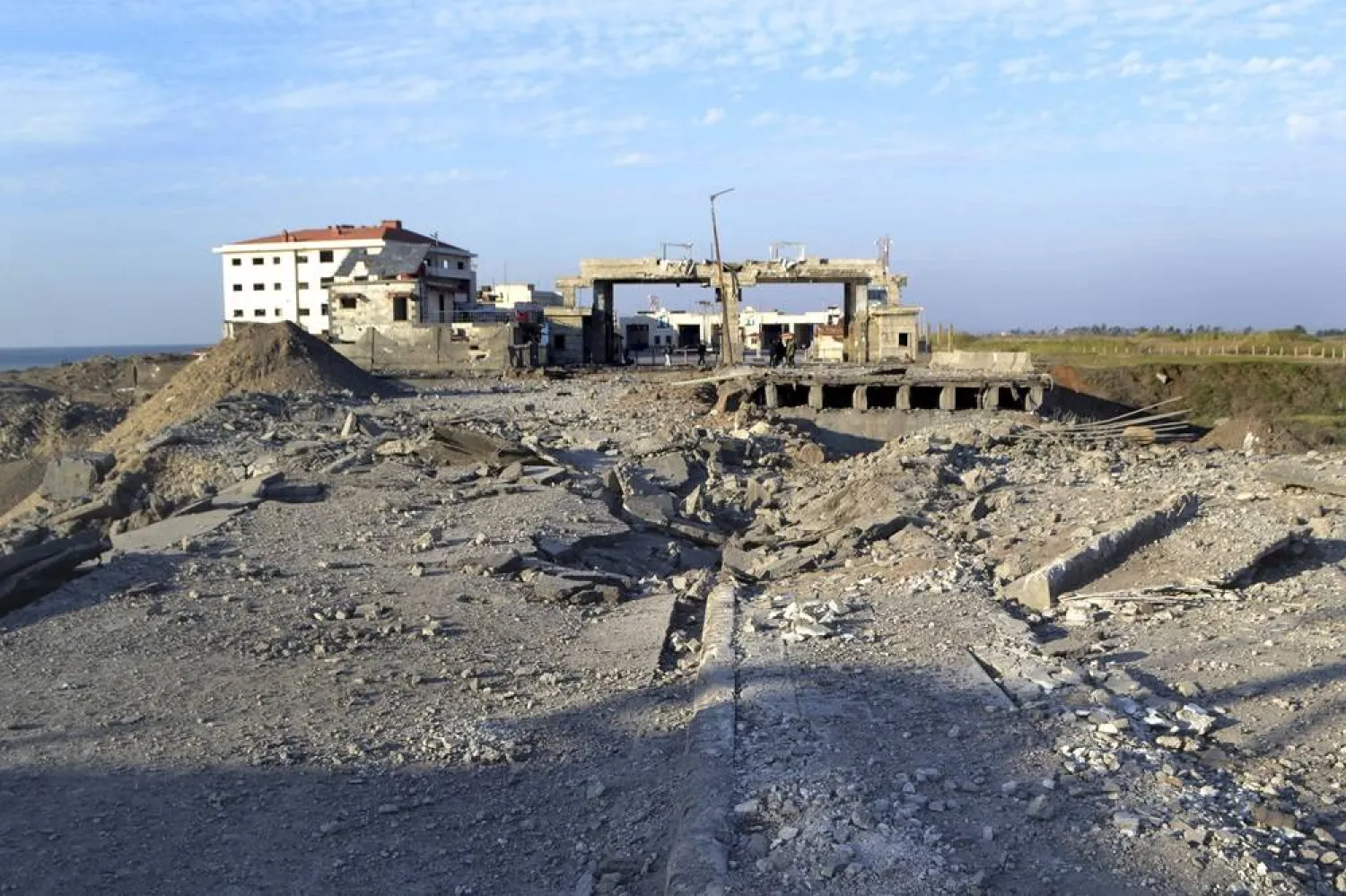
 Destroyed roads are seen at the crossing border point between Lebanon and Syria which hit by an Israeli airstrike, in Arida, north Lebanon, Friday, Dec. 6, 2024. (AP)
Destroyed roads are seen at the crossing border point between Lebanon and Syria which hit by an Israeli airstrike, in Arida, north Lebanon, Friday, Dec. 6, 2024. (AP)
TT

Lebanon Closes All Land Border Crossings with Syria

 Destroyed roads are seen at the crossing border point between Lebanon and Syria which hit by an Israeli airstrike, in Arida, north Lebanon, Friday, Dec. 6, 2024. (AP)
Destroyed roads are seen at the crossing border point between Lebanon and Syria which hit by an Israeli airstrike, in Arida, north Lebanon, Friday, Dec. 6, 2024. (AP)

Lebanon’s General Security Directorate said Friday the country is closing all land border crossings with Syria except for a main one that links Beirut with the Syrian capital Damascus.  

The decision by the security agency in charge of border crossings came hours after an Israeli airstrike damaged the Arida border crossing with Syria in north Lebanon, days after it was reopened.

“Border crossings will be closed until further notice for the safety of travelers,” the General Security said in a statement posted on X.

It said that the only border crossing that will be kept open is Masnaa in Lebanon’s eastern Bekaa Valley.

Lebanon’s state news agency said Friday the airstrike on the Arida crossing caused heavy material damage and cut the road.

The Israeli military said fighter jets attacked the border crossing between Lebanon and Syria, adding that they were used to transfer munitions for Lebanon’s Hezbollah group.  

Separately, Jordan’s Interior Minister al-Frayeh said Friday the Naseeb border crossing with Syria had been closed because of the security situation on the Syrian side.  

He spoke after Syrian opposition activists said opposition groups had captured the main border crossing with Jordan, forcing the Syrian authorities to leave.

Ahmad al-Masalmeh, an opposition activist based in France who covers events in southern Syria, told The Associated Press that local gunmen have captured the Naseeb crossing as well as several other areas in the southern province of Daraa where the uprising against President Bashar al-Assad began in March 2011.  

Syrian troops have evacuated checkpoints in several areas including the villages of Inkhil, Nawa and Jassem, he added.  

Separately, Israel’s military said in a statement it planned to reinforce its forces stationed in the Golan Heights and near the border with Syria.

The statement said it was “monitoring developments and is prepared for all scenarios, offensive and defensive alike.”

Meanwhile, Syrian opposition fighters entered the central towns of Rastan and Talbiseh early Friday just north of the central city of Homs, bringing them closer Syria’s third largest city, an opposition war monitor and pro-government media both reported. The break came a day after opposition gunmen captured the central city of Hama, Syria’s fourth largest.

After 13 years of civil war, Syrian opposition are gaining ground, first taking cities in the country’s north and on Friday entering cities in central Syria.

It comes as opposition groups mount new challenges to Russia- and Iran-backed Syrian forces, including in Aleppo, the country’s largest city. Since Oct. 7, 2023, Israel has intermittently struck areas in Syria seen as strongholds of Hezbollah, the Lebanese group it is at war with in Lebanon.

The advances of the Syrian fighters adds new instability on Israel’s northern border, two months after it invaded neighboring Lebanon. Israel’s defense minister and military chief of staff met to discuss the situation Thursday.

Israeli media reported there is concern in the country’s security establishment that the opposition fighters would advance until they reached the Golan Heights, territory occupied by Israel, gaining control of Syrian weapons stockpiles along the way.

Writing in the Israeli daily Yedioth Ahoronoth Friday, veteran military correspondent Ron Ben-Yishai wrote that Israel may “prefer” to destroy the weapons storehouses so they won’t fall into the hands of the fighters.

Israel seized control of the Golan Heights from Syria in the 1967 Mideast war. Syria has constantly accused Israel of launching attacks against it from territory it occupies in the Golan Heights. Israel has frequently struck Syria over the years.



Yemen Armed Forces Advance in Taiz, Coalition Carries out Operation to Protect Marine Navigation

This image taken from undated video released Monday, Oct. 5, 2026, by the Yemeni government-allied Southern Giants Brigades media office shows its fighters firing a weapon mounted on a pickup truck during clashes with the Iran-backed Houthi group in Dhubab district, Taiz, Yemen. (Southern Giants Brigades Media Office via AP)
TT

Yemen Armed Forces Advance in Taiz, Coalition Carries out Operation to Protect Marine Navigation

This image taken from undated video released Monday, Oct. 5, 2026, by the Yemeni government-allied Southern Giants Brigades media office shows its fighters firing a weapon mounted on a pickup truck during clashes with the Iran-backed Houthi group in Dhubab district, Taiz, Yemen. (Southern Giants Brigades Media Office via AP)

The Yemeni army announced on Tuesday that it has seized control of new positions in the Haifan district, south of the Taiz province, as battles continued to rage across several of the province's frontlines.

Meanwhile, the Coalition to Support Legitimacy in Yemen announced that its naval forces carried out a military operation in the Hodeidah province as part of its objectives to protect the security of maritime navigation in the Bab al-Mandeb Strait.

Coalition spokesperson Major General Turki al-Malki said that a plot for imminent attacks targeting waterways in the southern Red Sea had been thwarted, confirming the destruction of weapons depots, warehouses for booby-trapped boats, and naval mines.

Later, the Coalition announced the destruction of a ballistic missile launched in Sanaa, as well as a warehouse in a mountain storing 20 missiles in Saada.

Saudi Defense Minister Prince Khalid bin Salman had said that the meeting of the Strategic-Political and Defense Committee of the Makkah Alliance for Defense reaffirmed the solidarity of its member states and their unified stance in confronting attacks against Saudi Arabia and holy sites.

The meeting underscored the activation of collective deterrence against these attacks and anyone behind them within the framework of the alliance, he added.

The committee decided to move immediately to the practical implementation of the collective defense commitments and to take the necessary measures to provide the agreed military forces and capabilities and ensure their rapid deployment in the Kingdom, in line with the approved arrangements and the national legislation of the parties, thereby boosting readiness, military integration, and the collective capacity to confront and counter threats.


Israel Puts Military on Alert for Oct 7 Anniversary, Warns Gazans

Residents gather on a hill on October 1, 2026, in Sderot, one of the areas in southern Israel attacked by Hamas three years prior. Oded Balilty, AP
TT

Israel Puts Military on Alert for Oct 7 Anniversary, Warns Gazans

Residents gather on a hill on October 1, 2026, in Sderot, one of the areas in southern Israel attacked by Hamas three years prior. Oded Balilty, AP

Israel's defense minister on Tuesday said he had put the military on high alert before the anniversary of Hamas's October 7, 2023 attack, warning Gazans would pay a "heavy price" if forces were harmed.

The office of Defense Minister Israel Katz said the instruction came "in light of intelligence regarding Hamas's intentions to attempt to carry out attacks and terror operations against our forces in Gaza on that day".

"If, heaven forbid, our forces are harmed, the ones who will pay the heavy price will be Hamas and the population of Gaza -- beyond all proportion," the statement added.

Hamas's October 7, 2023 attack was the deadliest day in Israel's history, resulting in the deaths of 1,221 people, according to an AFP tally based on official Israeli figures.

Militants also dragged 251 hostages into Gaza, 44 of them already dead.

In response, Israel launched a military offensive that has left most of Gaza in ruins and killed more than 74,200 people, according to Gaza's health ministry, which is under Hamas authority and whose figures are considered reliable by the United Nations.

Since a ceasefire was declared last October, Israeli forces have killed more than 1,440 people in Gaza, according to the ministry.

On Monday, during a state ceremony to mark three years since the attack, Israeli Prime Minister Benjamin Netanyahu said there would be "no Hamas rule in Gaza" and vowed to continue targeting anyone who was involved in the attack or who held hostages.


Berri Reins In Hezbollah Campaign against Lebanese Prime Minister

Lebanese Prime Minister Nawaf Salam inspects the Nabatieh Gendarmerie unit last Friday (National News Agency) 
TT

Berri Reins In Hezbollah Campaign against Lebanese Prime Minister

Lebanese Prime Minister Nawaf Salam inspects the Nabatieh Gendarmerie unit last Friday (National News Agency) 

Lebanese Parliament Speaker Nabih Berri has moved to rein in political attacks by his ally Hezbollah against Prime Minister Nawaf Salam, with sources close to Berri telling Asharq Al-Awsat that he pushed for a de-escalation between Salam and a large segment of residents in southern Lebanon.

The shift was reflected in Salam’s visit to Nabatieh on Friday and reinforced in a Sunday interview on NBN, a channel affiliated with Berri’s Amal Movement. Salam reiterated the government’s position on Israel’s withdrawal from southern Lebanon and its commitment to restoring the state’s role and activating its institutions there.

Salam’s meetings Monday offered further signs of a drive to strengthen the state’s presence in the south. He met Berri to discuss political and field developments, pressing social and economic conditions, the outcome of his US visits and his Nabatieh tour and projects launched there, the speaker’s office said.

At the Grand Serail, Salam met Head of Council for the South Hashem Haidar, who briefed him on the council’s work and projects announced during the Nabatieh visit and steps taken to begin them.

Positive signs

Friday’s trip was Salam’s third visit to the south in three months. It was notably coordinated, with Amal MP Hani Qobeissi welcoming him alongside Finance Minister Yassin Jaber, himself from Nabatieh, and Interior Minister Ahmad al-Hajjar. Municipal leaders from Nabatieh-area villages aligned with Hezbollah also joined the reception.

Although Hezbollah’s political representatives were absent, the group issued no statement criticizing the visit or Salam, unlike on previous occasions — a sign of the de-escalation promoted by Berri.

Sources following the visit noted that the tour and meetings “repaired a large part of the relationship between Salam and the people of the region.” They said Hezbollah MP Mohammad Raad, the party’s representative in Nabatieh, was absent because he does not attend social occasions for security reasons. Hezbollah-aligned municipalities took part, while opposition to the visit appeared marginal.

In another sign of de-escalation, Hezbollah MP Hassan Fadlallah said Monday the group supported strengthening the state’s role in the south and having it assume full responsibility, “but that begins with expelling the occupation, stopping the aggression and ending this bulldozing operations and destruction in our villages.”

He urged the state to match words with actions, backed development initiatives in the south and called for the disbursement of a $250 million World Bank loan, part of which is allocated to the region, as well as increased government spending there in the 2027 budget.

Berri consistent with his demands

Unlike Hezbollah, which has attacked Salam in recent months, communication between the prime minister and Berri has continued. Berri has pressed for activating state institutions in the south, securing stability and the ceasefire, enabling residents to return to their villages and providing services to bolster their steadfastness, despite opposing direct negotiations with Israel and having earlier declared the “framework agreement” defunct.

Amal sources told Asharq Al-Awsat that Berri was consistent with his demand for state institutions to be present in the south. Salam’s visit, they said, confirmed the executive authority’s intention to strengthen that presence, making it natural for Amal and its Development and Liberation bloc to “meet it halfway.”

The sources underlined that the visit “soothed the wounds of southerners” and opened the door to a stronger state presence. They also pointed to Salam’s acknowledgment that resources were limited and reconstruction required international support because Lebanon could not undertake it alone.

‘No punishment of any community’

In Sunday’s NBN interview, Salam said: “The state cannot remain in a state of waiting. We must go to the south and to all regions and assume our responsibilities.”

He reiterated the need to stop Israeli attacks, consolidate the ceasefire, secure Israel’s withdrawal from occupied Lebanese territory and work for the release of prisoners.

“When I return for a fourth time to Nabatieh and Tyre, I want to see with my own eyes that water and electricity have been restored, that the contracts we launched are actually being implemented, that schools are being repaired, and that our people are returning and feel safe,” Salam added.

“If I wanted to punish a particular community, I would not personally be following these operations and the response to demands every day.”

Salam stressed that dialogue with all sides remained open, adding that agreed measures now had to be implemented and each side must honor its commitments.

Addressing residents of the south, he said: “You are not alone. The state is with you, beside you and at your service,” citing the presence of security agencies, institutions and services in Nabatieh.