Lebanese and Syrian people shout slogans as they celebrate the ouster of the Assad regime in Damascus, in Beirut, Lebanon, 08 December 2024. (EPA)
Lebanese and Syrian people in Lebanon rejoiced on Sunday at the news of the ouster of Syrian President Bashar al-Assad with celebrations sweeping the majority of the country, most notably in Sunni regions.
Jubilant people took to the streets of the predominantly Sunni neighborhood of Tarik al-Jdide in Beirut and northern city of Tripoli. Similar scenes of joy erupted in the northern region of Akkar and Beirut’s Hamra district.
Songs of the Syrian revolution were played and people rushed to buy sweets to celebrate and handing them out in the streets.
In Tripoli’s Al-Nour Square, locals flocked to chant revolution slogans and hoisted Syrian revolution flags. Gunshots were also fired in the air in celebration.
Similar scenes were reported in the Khaldeh region south of Beirut.
People carry Syrian flags of the opposition as they celebrate the ouster of the Assad regime in Damascus, in Tripoli, northern Lebanon, 08 December 2024. (EPA)
Christian regions also erupted in celebration.
“We have been awaiting this moment of joy. We never thought we were so close to it,” said Miriam Majed Jubeili, describing her happiness at Assad’s ouster.
Miriam’s father was imprisoned for six years in Syria’s notorious Sednaya prison.
She told Asharq Al-Awsat that she shared the jubilation of all of the detainees who were freed by the opposition from Syrian prisons on Sunday.
“Every image of a released detainee reminded me of when I was a child who awaited the release of her father from captivity. I felt that I avenged my father who experienced the oppression of this regime like so many others,” she added.
She wished that her father, who passed away three years ago, could have been alive to witness the downfall of the regime.
The demise of regime revived hopes of Lebanese families whose loved ones have been held in Syrian jails for several years with no news throughout that time of whether they were still alive or not.
Hassan said his father was jailed when he was just five years old. “He has been held in regime jails for 40 years. I will head to Damascus to search for him. Perhaps some of the detainees met him and know something about him,” he said.
Nadim Gemayel, MP and son of the assassinated president-elect Bashir Gemayel, hugs a man, as they celebrate after Syrian opposition fighters announced that they have ousted Syria's Bashar al-Assad, in Beirut, Lebanon December 8, 2024. (Reuters)
In Akkar, people rejoiced by storming the office of the Baath Party. Videos circulated on social media showed youths tearing down a poster of Assad.
Political parties joined in the celebrations. Parties opposed to the regime in Lebanon held a small gathering in Downtown Beirut to remember the Lebanese figures who are widely believed to have been assassinated by Damascus.
In the Chouf region, the Druze heartland in Lebanon, people flocked to slain Druze leader Kamal Jumblatt’s grave to pay their respects. The regime is widely accused of assassinating him.
The Kataeb party called for a gathering in Bikfaya where a march will be held towards the graves of its founder Pierre Gemayel and slain President Bashir Gemayel and minister Pierre Gemayel, both believed to be assassinated by the regime.
Berri to Asharq Al-Awsat: No Point Negotiating with Israel Under Firehttps://english.aawsat.com/arab-world/5268551-berri-asharq-al-awsat-no-point-negotiating-israel-under-fire
FILE PHOTO: Lebanese Parliament Speaker Nabih Berri meets with Italian Prime Minister Giorgia Meloni (not seen) in Beirut, Lebanon October 18, 2024. REUTERS/Mohamed Abd El Ghany/File Photo
Berri to Asharq Al-Awsat: No Point Negotiating with Israel Under Fire
FILE PHOTO: Lebanese Parliament Speaker Nabih Berri meets with Italian Prime Minister Giorgia Meloni (not seen) in Beirut, Lebanon October 18, 2024. REUTERS/Mohamed Abd El Ghany/File Photo
In his first comment on the statement issued by the US Embassy in Beirut, which called on President Joseph Aoun to hold a direct meeting with Israeli Prime Minister Benjamin Netanyahu, Parliament Speaker Nabih Berri told Asharq Al-Awsat that the statement “speaks for itself, and I have nothing to add.”
He added that his response to the president “came in reply to what he said while receiving economic bodies” (in reference to Aoun’s remarks about full coordination with Berri regarding negotiations). This, he said, explains his apology for not attending the meeting that had been scheduled with President Aoun and Prime Minister Nawaf Salam at the presidential palace.
Berri also addressed the extension of the truce for three weeks, brokered by US President Donald Trump, asking: “Where is this truce?” Has Israel stopped leveling towns, demolishing homes, shedding the blood of children, women and the elderly, preventing rescue teams from saving the wounded and transporting them to hospitals, or retrieving those trapped under rubble until they died?
He also pointed to the targeting of medical bodies and paramedics, which led to the killing of dozens of them, questioning whether all these victims were part of Hezbollah’s military infrastructure, as Israel claims to justify the destruction of southern towns.
He said the so-called truce has allowed Israel to press ahead with its aggression and commit unprecedented massacres, without US intervention to compel it to halt hostilities and entrench a ceasefire, particularly since Washington was behind securing the truce extension.
This, he added, obliges it to honor its commitment to the Lebanese and the international community. Otherwise, what is the point of negotiations under Israeli fire? And what would be said to the families of those killed in what he described as Israeli treachery in the south?
Aoun and Berri: divergence, not a rupture
In this context, a parliamentary source following presidential relations said the emerging dispute between Aoun and Berri remains within the bounds of differing interpretations of the US State Department statement.
The source told Asharq Al-Awsat that mediators intervened to cool tensions between the two sides, ruling out any rupture given the difficult and delicate circumstances Lebanon is going through, which require collective efforts, starting with the presidents, to compel Israel to cease fire and entrench it before asking Lebanon to enter direct negotiations, even if indirect talks would be preferable, as the US administration is expected to pursue.
The source added that as long as the three presidents agree on the necessity of halting hostilities ahead of any negotiation track with Israel, the recalibration of positions on the sidelines of the cabinet session helped ease tensions between Aoun and Berri, opening the way for renewed momentum in presidential relations. None of the presidents, the source said, has an interest in the absence of consultation, which is essential to reach a roadmap for handling the negotiations matter.
The source noted that there is no alternative to renewed coordination among the three presidents as long as they adhere to national constants and do not compromise them, as a prerequisite for launching negotiations that cannot be held without being paired with a firmly established ceasefire. This, he said, calls on Trump to intervene with Israel to stop it from escalating its aggression.
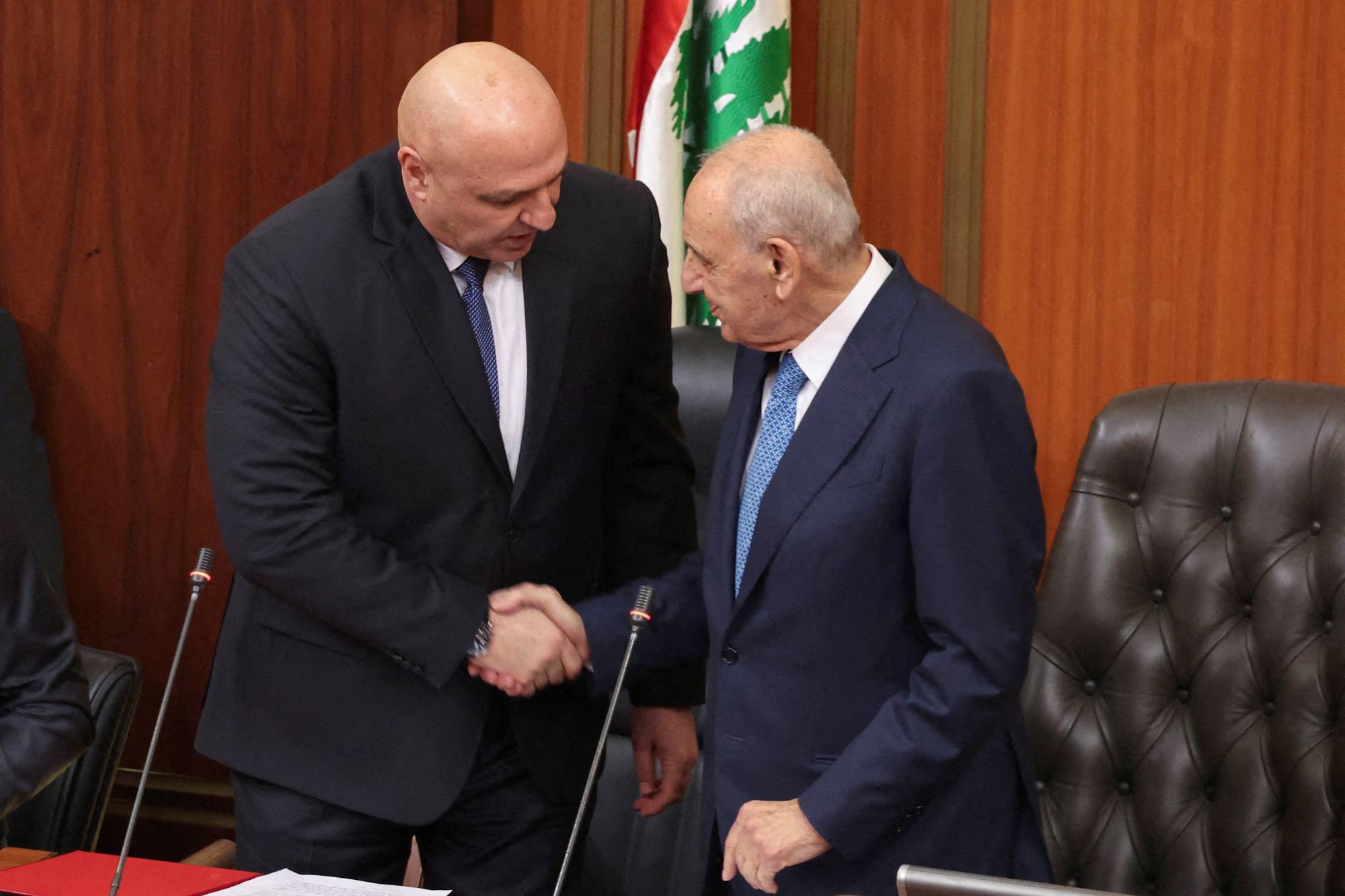
FILE PHOTO: Lebanese Parliament Speaker Nabih Berri shakes hands with Lebanon's army chief Joseph Aoun after he is elected as the country's President at the parliament building in Beirut, Lebanon, January 9, 2025. REUTERS/Mohamed Azakir/File Photo
Berri’s stance on negotiations
The parliamentary source defended Berri’s position, questioning why the US administration has not intervened to compel Israel to implement the ceasefire agreement it sponsored in coordination with France in 2024, which never came into force. Instead, it allowed Israel to continue violating it by expanding its aggression beyond the south to Beirut’s southern suburbs and towns in the Bekaa.
He confirmed that Hezbollah responded to Berri’s position and adhered, to the fullest extent, to the cessation of hostilities, playing, with the party’s authorization, a role in reaching it with the then US mediator Amos Hochstein, under US and French sponsorship. This came, he said, while Israel was given free rein to continue its aggression under the pretext of self-defense through preemptive strikes against what it claims are threats to its northern settlements.
The source said Hezbollah’s commitment to the ceasefire for 15 months, contrasted with Israel’s insistence on violating it, placed it in a difficult position, especially with Washington refraining from pressuring Israel to halt its breaches, leading to an expanded offensive, despite prior commitments to synchronized steps by both sides as a condition for implementing the agreement.
He added that Nawaf Salam’s government, while primarily betting on a diplomatic track to compel Israel to withdraw from the south, faced Israeli defiance of the agreement and continued pressure through fire to force Lebanon to accept its terms.
The three-week truce
The source said the three-week truce remained ink on paper, enabling Israel to turn the south into an open military operations zone, continuing systematic destruction across areas south and north of the Litani River, displacing residents under pressure to evacuate their towns.
He expressed confidence that President Aoun remains committed to his position that securing a ceasefire must come first as a prerequisite for launching direct negotiations between the two countries under US sponsorship, without compromising national constants regardless of pressure.
This position, he added, aligns with his understanding with Berri and Salam, and was reaffirmed in the latest cabinet session when Aoun said negotiations have not yet begun, meaning he rejects any negotiation track before Israel halts its military pressure on Lebanon.
Securing a ceasefire
The source stressed that Aoun will not agree to begin negotiations unconditionally, foremost without a secured ceasefire. From his perspective, US pressure to urgently arrange a meeting with Netanyahu could inflame the domestic atmosphere and raise tensions amid growing disagreements if such pressure is met without guarantees for Lebanon, primarily a ceasefire and the return of displaced people to their villages.
He confirmed his support for Aoun’s preference not to rush into a meeting with Netanyahu, considering the timing premature. Such a meeting, he said, should come as the culmination of an agreement that responds to the national constants upheld by the president, in exchange for ending the state of war between the two countries, with subsequent steps to be addressed later.
He also questioned why the call for Aoun to meet Netanyahu was issued by the US Embassy in Beirut rather than the White House, noting that Aoun raised this matter during his meeting with US Ambassador to Beirut Michel Issa, who had recently returned from Washington, to clarify the reasons behind issuing the statement from the embassy, which he described as unprecedented in the history of relations between the two countries.
Israel’s Death Penalty Law Perpetuates Racial Discrimination, Says UN Watchdoghttps://english.aawsat.com/arab-world/5268466-israel%E2%80%99s-death-penalty-law-perpetuates-racial-discrimination-says-un-watchdog
Protesters hold placards outside the Red Cross offices in Ramallah, in the Israeli-occupied West Bank, on March 31, 2026, during a rally against a bill approved by Israel's parliament that would allow the execution of Palestinians convicted on terror charges for deadly attacks. (AFP via Getty Images)
TT
TT
Israel’s Death Penalty Law Perpetuates Racial Discrimination, Says UN Watchdog
Protesters hold placards outside the Red Cross offices in Ramallah, in the Israeli-occupied West Bank, on March 31, 2026, during a rally against a bill approved by Israel's parliament that would allow the execution of Palestinians convicted on terror charges for deadly attacks. (AFP via Getty Images)
Israel's new death penalty law permitting the execution of Palestinians convicted of deadly attacks perpetuates racial discrimination against them, a United Nations committee said Friday, urging its immediate repeal.
The law amounts to a grave erosion of human rights, the UN Committee on the Elimination of Racial Discrimination said in a statement.
Under the new law, passed by the Israeli parliament in March, Palestinians in the occupied West Bank convicted by military courts of carrying out deadly attacks classified as "terrorism" will face the death penalty as a default sentence.
"The new law is a severe blow to human rights, rolling back Israel's long-standing de facto moratorium on executions since 1962 and expanding the use of the death penalty," the committee said.
The law is "de facto applicable to Palestinians only" and sets a 90-day deadline for executions once a final judgement is rendered, the committee said.
Furthermore, it said Israel should ensure that all Palestinian detainees "are guaranteed their rights to equal treatment before the law, security of person, protection against violence or bodily harm, and access to justice".
The committee also called on Israel to "end all policies and practices that amount to racial discrimination against and segregation of Palestinians".
It said other countries should "ensure that their resources are not used to enforce or support discriminatory policies and practices against Palestinians living in the Occupied Palestinian Territory".
The committee of 18 independent experts monitors adherence to the Convention on the Elimination of All Forms of Racial Discrimination by its 182 states parties.
Under the convention, which came into force in 1969, countries must eliminate racial discrimination, eradicate practices of segregation and guarantee equality before the law without distinction as to race, color, descent or national or ethnic origin.
Israel ratified the convention in 1979.
In March, UN rights chief Volker Turk branded Israel's new law "cruel and discriminatory", warning that applying it in occupied Palestinian territory "would constitute a war crime".
Israel has only applied the death penalty twice: in 1948, shortly after the state's founding, against a military captain accused of high treason, and then in 1962, when the Nazi war criminal Adolf Eichmann was hanged.
Israel has occupied the West Bank since 1967 and violence in the territory has soared since Hamas's October 7, 2023, attack on Israel triggered the Gaza war.
Israeli Authorities Taking 2 Activists Who Led a Gaza-Bound Flotilla to Israel for Questioning https://english.aawsat.com/arab-world/5268460-israeli-authorities-taking-2-activists-who-led-gaza-bound-flotilla-israel
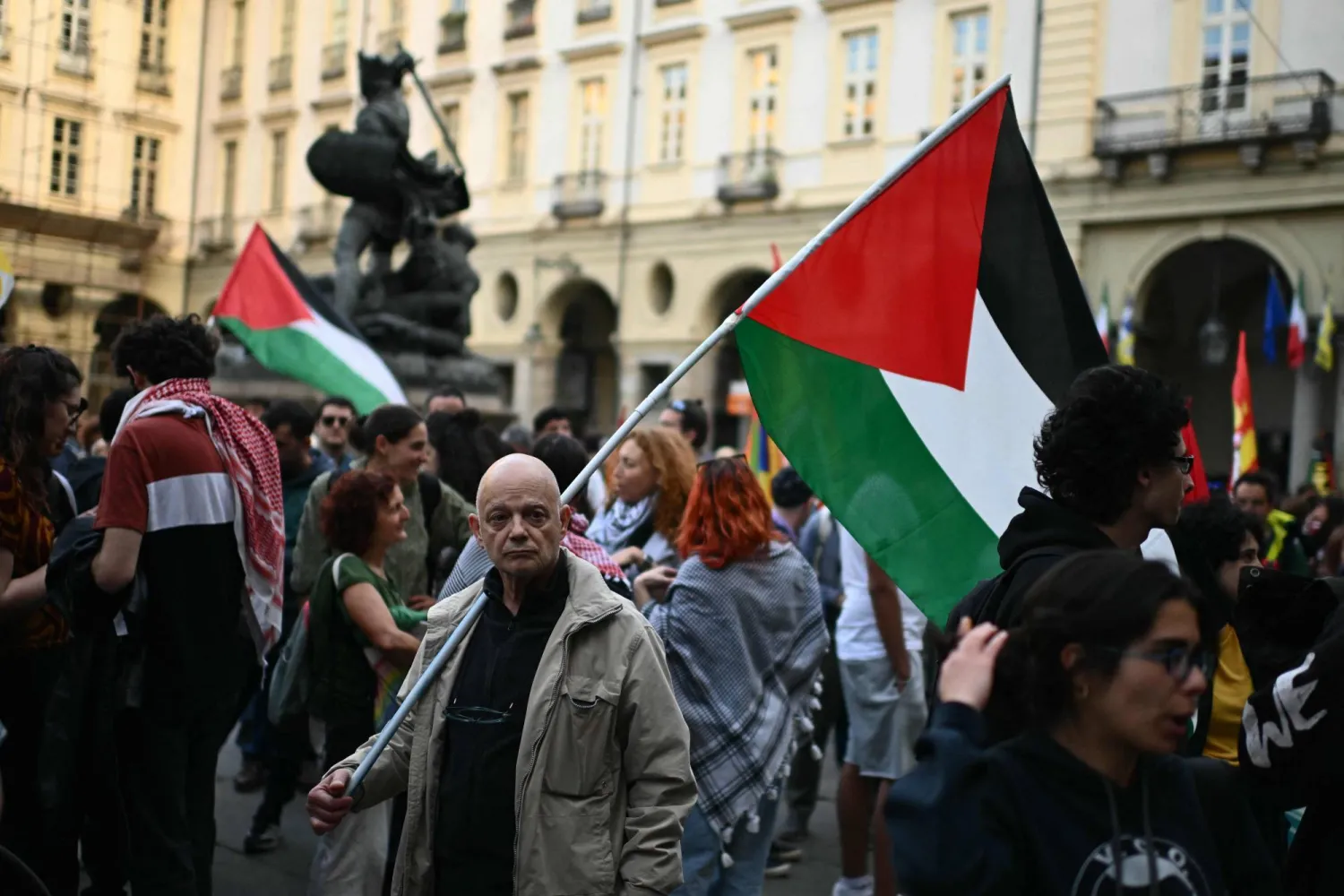
Protesters hold Palestinian flags during a demonstration to condemn the interception of the Global Sumud Flotilla by the Israeli army, in Turin on April 30, 2026. (Photo by MARCO BERTORELLO / AFP)
Israeli Authorities Taking 2 Activists Who Led a Gaza-Bound Flotilla to Israel for Questioning
Protesters hold Palestinian flags during a demonstration to condemn the interception of the Global Sumud Flotilla by the Israeli army, in Turin on April 30, 2026. (Photo by MARCO BERTORELLO / AFP)
Israeli authorities say they are taking two activists who led an aid flotilla bound for Gaza — and who were captured by Israel in international waters of the Mediterranean Sea — to Israel for questioning.
The activists, Palestinian-Spanish citizen Saif Abukeshek and Brazilian citizen Thiago Ávila, were among dozens of activists intercepted by the Israeli navy off the coast of Crete. They are members the Global Sumud Flotilla's steering committee, whose mission was to break Israel's naval blockade and bring some humanitarian aid to the Palestinian territory.
In all, some 20 boats and 175 activists were intercepted by the Israeli navy. Activists said Israeli forces stormed their vessels, smashed engines and detained some of those onboard. The incident occurred hundreds of miles (kilometers) from Gaza and Israel overnight from Wednesday to Thursday.
Israeli officials said they needed to take early action against the flotilla before it reached Israeli waters because of the high number of boats involved.
On Friday the Israeli Foreign Ministry said on X that it was taking the two activists to Israel for questioning, and that Abukeshek was “suspected of affiliation with a terrorist organization” and Ávila was “suspected of illegal activity," without providing evidence.
The Global Sumud Flotilla appealed for international support. “We demand that all governments do all they can to pressure the Israeli regime to release all the illegal abductees," the group said Friday.
The rest of the flotilla participants were released in Crete late Thursday. Of the 53 vessels that had been sailing prior to the interception, 31 reached safe waters and would continue their attempts to “break the illegal siege of Gaza," organizers said.
The flotilla set sail earlier this month from Barcelona, Spain. Organizers have said more than 70 boats and 1,000 people from around the world would be participating, with more vessels joining the original boats as the flotilla sailed east across the Mediterranean.
The Greek foreign ministry said Thursday that it had asked Israel to withdraw its ships from the area and had offered its “good services” for the activists to disembark in Greece and be repatriated.
Protests in solidarity with the flotilla erupted across several capitals including Rome, Athens and Istanbul.
Spain and Brazil have not yet commented on the detention and transfer to Israel of Abukeshek and Ávila. But they said in a joint statement with several other nations late Thursday that Israel's interception of the flotilla and detention of the activists in international waters “constitute flagrant violations of international law and international humanitarian law."
The flotilla’s latest attempt to reach Gaza comes less than a year after Israeli authorities foiled a previous effort by the group. That attempt involved about 50 vessels and around 500 activists, including Swedish climate activist Greta Thunberg, Nelson Mandela’s grandson Mandla Mandela, and several lawmakers.
Israel arrested, detained and later deported the participants, including Ávila, who claimed Israeli authorities abused them while in detention. Israeli authorities denied the accusations.
لم تشترك بعد
انشئ حساباً خاصاً بك لتحصل على أخبار مخصصة لك ولتتمتع بخاصية حفظ المقالات وتتلقى نشراتنا البريدية المتنوعة