

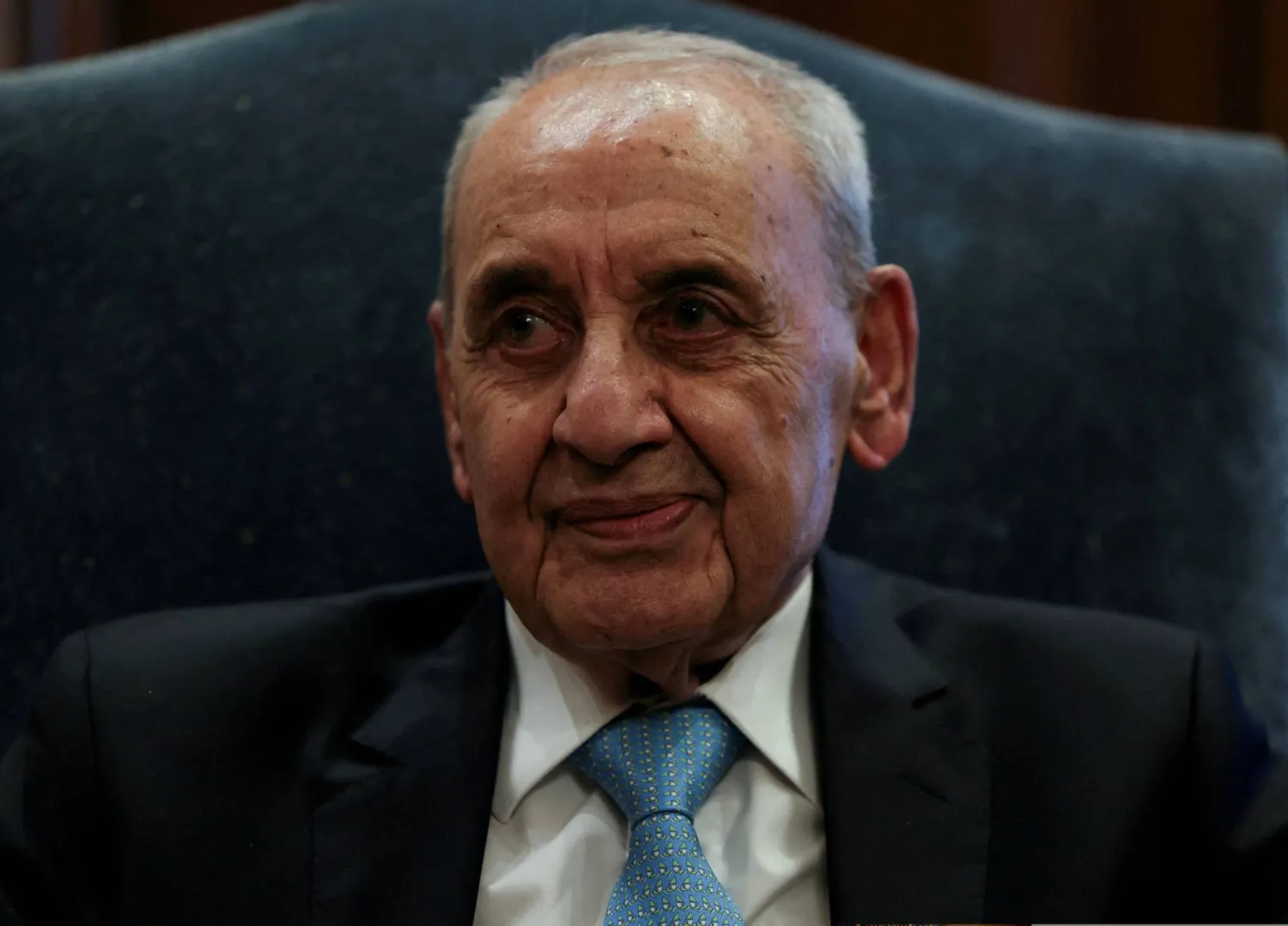

Berri to Asharq Al-Awsat: No Point Negotiating with Israel Under Fire

FILE PHOTO: Lebanese Parliament Speaker Nabih Berri meets with Italian Prime Minister Giorgia Meloni (not seen) in Beirut, Lebanon October 18, 2024. REUTERS/Mohamed Abd El Ghany/File Photo
TT

Berri to Asharq Al-Awsat: No Point Negotiating with Israel Under Fire

FILE PHOTO: Lebanese Parliament Speaker Nabih Berri meets with Italian Prime Minister Giorgia Meloni (not seen) in Beirut, Lebanon October 18, 2024. REUTERS/Mohamed Abd El Ghany/File Photo

In his first comment on the statement issued by the US Embassy in Beirut, which called on President Joseph Aoun to hold a direct meeting with Israeli Prime Minister Benjamin Netanyahu, Parliament Speaker Nabih Berri told Asharq Al-Awsat that the statement “speaks for itself, and I have nothing to add.”

He added that his response to the president “came in reply to what he said while receiving economic bodies” (in reference to Aoun’s remarks about full coordination with Berri regarding negotiations). This, he said, explains his apology for not attending the meeting that had been scheduled with President Aoun and Prime Minister Nawaf Salam at the presidential palace.

Berri also addressed the extension of the truce for three weeks, brokered by US President Donald Trump, asking: “Where is this truce?” Has Israel stopped leveling towns, demolishing homes, shedding the blood of children, women and the elderly, preventing rescue teams from saving the wounded and transporting them to hospitals, or retrieving those trapped under rubble until they died?

He also pointed to the targeting of medical bodies and paramedics, which led to the killing of dozens of them, questioning whether all these victims were part of Hezbollah’s military infrastructure, as Israel claims to justify the destruction of southern towns.

He said the so-called truce has allowed Israel to press ahead with its aggression and commit unprecedented massacres, without US intervention to compel it to halt hostilities and entrench a ceasefire, particularly since Washington was behind securing the truce extension.

This, he added, obliges it to honor its commitment to the Lebanese and the international community. Otherwise, what is the point of negotiations under Israeli fire? And what would be said to the families of those killed in what he described as Israeli treachery in the south?

Aoun and Berri: divergence, not a rupture

In this context, a parliamentary source following presidential relations said the emerging dispute between Aoun and Berri remains within the bounds of differing interpretations of the US State Department statement.

The source told Asharq Al-Awsat that mediators intervened to cool tensions between the two sides, ruling out any rupture given the difficult and delicate circumstances Lebanon is going through, which require collective efforts, starting with the presidents, to compel Israel to cease fire and entrench it before asking Lebanon to enter direct negotiations, even if indirect talks would be preferable, as the US administration is expected to pursue.

The source added that as long as the three presidents agree on the necessity of halting hostilities ahead of any negotiation track with Israel, the recalibration of positions on the sidelines of the cabinet session helped ease tensions between Aoun and Berri, opening the way for renewed momentum in presidential relations. None of the presidents, the source said, has an interest in the absence of consultation, which is essential to reach a roadmap for handling the negotiations matter.

The source noted that there is no alternative to renewed coordination among the three presidents as long as they adhere to national constants and do not compromise them, as a prerequisite for launching negotiations that cannot be held without being paired with a firmly established ceasefire. This, he said, calls on Trump to intervene with Israel to stop it from escalating its aggression.
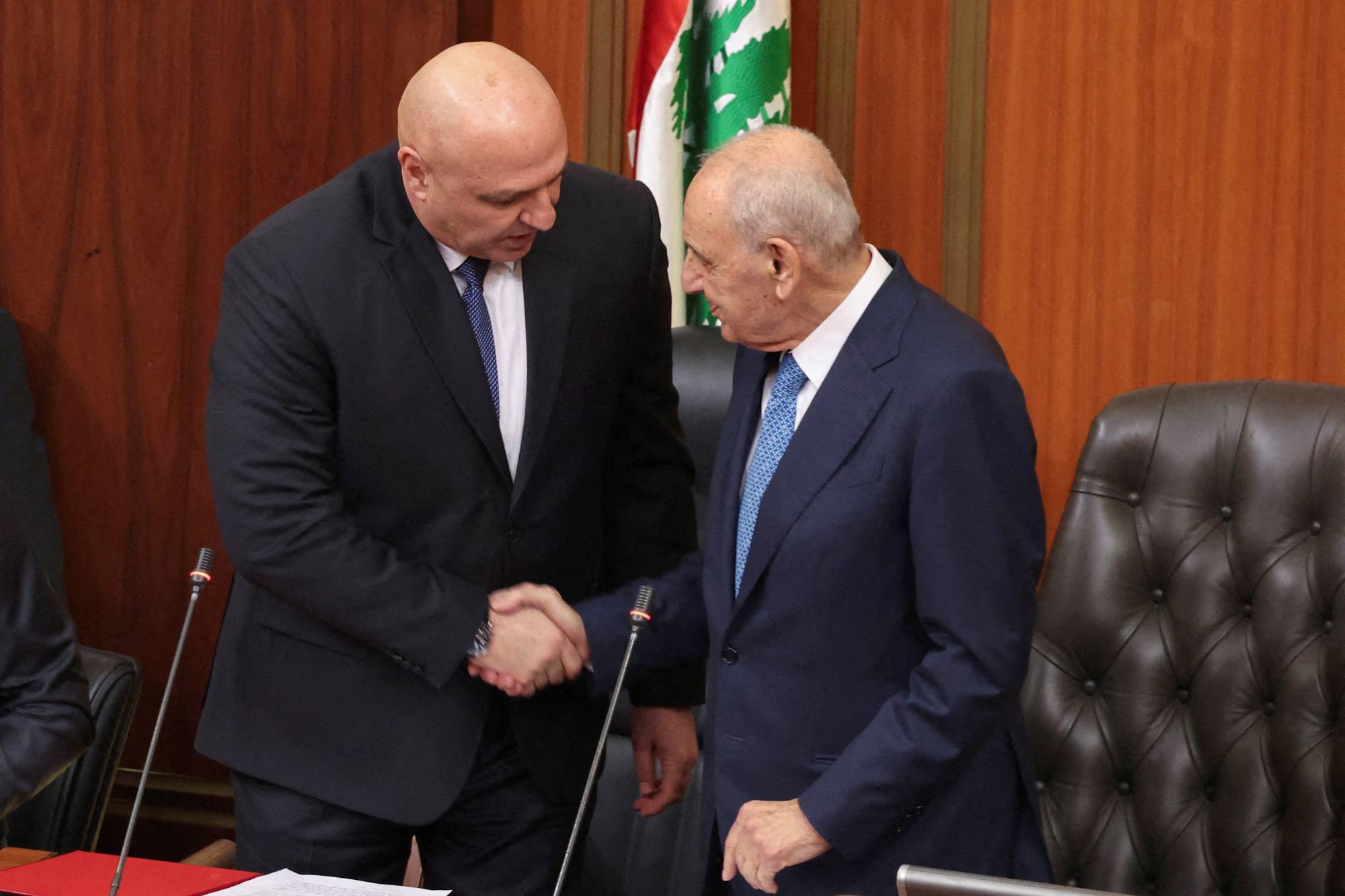
FILE PHOTO: Lebanese Parliament Speaker Nabih Berri shakes hands with Lebanon's army chief Joseph Aoun after he is elected as the country's President at the parliament building in Beirut, Lebanon, January 9, 2025. REUTERS/Mohamed Azakir/File Photo

Berri’s stance on negotiations

The parliamentary source defended Berri’s position, questioning why the US administration has not intervened to compel Israel to implement the ceasefire agreement it sponsored in coordination with France in 2024, which never came into force. Instead, it allowed Israel to continue violating it by expanding its aggression beyond the south to Beirut’s southern suburbs and towns in the Bekaa.

He confirmed that Hezbollah responded to Berri’s position and adhered, to the fullest extent, to the cessation of hostilities, playing, with the party’s authorization, a role in reaching it with the then US mediator Amos Hochstein, under US and French sponsorship. This came, he said, while Israel was given free rein to continue its aggression under the pretext of self-defense through preemptive strikes against what it claims are threats to its northern settlements.

The source said Hezbollah’s commitment to the ceasefire for 15 months, contrasted with Israel’s insistence on violating it, placed it in a difficult position, especially with Washington refraining from pressuring Israel to halt its breaches, leading to an expanded offensive, despite prior commitments to synchronized steps by both sides as a condition for implementing the agreement.

He added that Nawaf Salam’s government, while primarily betting on a diplomatic track to compel Israel to withdraw from the south, faced Israeli defiance of the agreement and continued pressure through fire to force Lebanon to accept its terms.

The three-week truce

The source said the three-week truce remained ink on paper, enabling Israel to turn the south into an open military operations zone, continuing systematic destruction across areas south and north of the Litani River, displacing residents under pressure to evacuate their towns.

He expressed confidence that President Aoun remains committed to his position that securing a ceasefire must come first as a prerequisite for launching direct negotiations between the two countries under US sponsorship, without compromising national constants regardless of pressure.

This position, he added, aligns with his understanding with Berri and Salam, and was reaffirmed in the latest cabinet session when Aoun said negotiations have not yet begun, meaning he rejects any negotiation track before Israel halts its military pressure on Lebanon.

Securing a ceasefire

The source stressed that Aoun will not agree to begin negotiations unconditionally, foremost without a secured ceasefire. From his perspective, US pressure to urgently arrange a meeting with Netanyahu could inflame the domestic atmosphere and raise tensions amid growing disagreements if such pressure is met without guarantees for Lebanon, primarily a ceasefire and the return of displaced people to their villages.

He confirmed his support for Aoun’s preference not to rush into a meeting with Netanyahu, considering the timing premature. Such a meeting, he said, should come as the culmination of an agreement that responds to the national constants upheld by the president, in exchange for ending the state of war between the two countries, with subsequent steps to be addressed later.

He also questioned why the call for Aoun to meet Netanyahu was issued by the US Embassy in Beirut rather than the White House, noting that Aoun raised this matter during his meeting with US Ambassador to Beirut Michel Issa, who had recently returned from Washington, to clarify the reasons behind issuing the statement from the embassy, which he described as unprecedented in the history of relations between the two countries.



Aoun Insists on Ceasefire Before Lebanon-Israel Talks

A billboard depicting Lebanese President Joseph Aoun and sentence reading in Arabic "The decision is up to Lebanon" is seen in the predominantly Christian Ashrafieh neighborhood in Beirut, Lebanon, 01 May 2026. (EPA)
TT

Aoun Insists on Ceasefire Before Lebanon-Israel Talks

A billboard depicting Lebanese President Joseph Aoun and sentence reading in Arabic "The decision is up to Lebanon" is seen in the predominantly Christian Ashrafieh neighborhood in Beirut, Lebanon, 01 May 2026. (EPA)

Lebanese President Joseph Aoun is pushing to lock in a ceasefire and halt Israeli strikes on civilians before Lebanese and Israeli representatives resume bilateral talks in Washington, as Hezbollah continues to vehemently reject the negotiations.

Aoun is under pressure from both sides. The United States is urging direct engagement between Lebanon and Israel, including a meeting between Aoun and Israeli Prime Minister Benjamin Netanyahu. Hezbollah, meanwhile, rejects direct talks outright.

Aoun says diplomacy is the only option to secure a ceasefire, ensure an Israeli withdrawal, and extend state control across all Lebanese territory. But he refuses any meeting with Netanyahu, after rejecting even a phone call with him as part of a US-mediated three-way contact.

Consolidating the ceasefire

Aoun’s push to cement the ceasefire was discussed with US Ambassador to Beirut Michel Issa, hours after the US Embassy said a direct meeting between Aoun and Netanyahu, "facilitated by President Trump, would give Lebanon the chance to secure concrete guarantees on full sovereignty, territorial integrity, secure borders, humanitarian and reconstruction support, and the complete restoration of Lebanese state authority over every inch of its territory -- guaranteed by the United States."

The Lebanese presidency said Aoun met Issa after returning from Washington and reviewed developments, focusing on consolidating the ceasefire and stopping attacks on civilians and civilian facilities, ahead of further Washington talks aimed at securing peace and stability along the border.

Issa reaffirmed the US’s continued support for Lebanon and its institutions. Aoun thanked Washington for its backing.

Prime Minister Nawaf Salam also met Issa to discuss consolidating the ceasefire and negotiations with Israel, the prime minister’s office said.

Sources close to the presidency told Asharq Al-Awsat that a ceasefire and a halt to attacks on civilians and civilian facilities are “the basis for completing negotiations.”

Aoun’s position on a direct meeting “is known and declared,” the sources said. “Anyone who rejected a phone call with Netanyahu will certainly reject meeting him.”

Hezbollah pressure

Alongside US pressure, Aoun faces pressure from Hezbollah, which has vowed to keep fighting Israel in the south, and is holding the state responsible for the path it is taking.

Hezbollah’s Loyalty to the Resistance parliamentary bloc said the authorities’ move toward direct negotiations is “rejected and condemned,” calling it a deviation from national principles, a violation of sovereignty, and a contradiction of the Taif Accord and national consensus.

It said it is “not concerned at all” with their outcomes.

The bloc accused Israel of daily killings of civilians and systematic destruction of border villages, calling them war crimes that will not deter people from defending the country, but instead reinforce support for the resistance- Hezbollah.

It added that such actions should push the authorities to “stop their series of free concessions.”

Geagea

The move toward direct talks with Israel has drawn support from some political forces, led by the Lebanese Forces.

MP Sethrida Geagea said Lebanon’s current phase “cannot tolerate more one-upmanship or populist rhetoric,” which she said has only led to further collapse.

She voiced full support for Aoun’s efforts to end the war through a “clear and explicit negotiating path” aimed at protecting Lebanon and re-establishing the state as the sole authority.


In South Syria, Families Fear for Relatives Seized by Israel

Fifty-three-year-old Syrian Aicha al-Safadi, holds the a picture of her son Hassane Mohammed al-Safadi, with details of when he was detained by Israel as she sits in her house in the southern Syrian village of Beit Jinn, near the Israeli-annexed Syrian Golan Heights and at the foot Mount Hermon, known in Arabic as Jabal al-Sheikh on April 29, 2026. (AFP)
TT

In South Syria, Families Fear for Relatives Seized by Israel

Fifty-three-year-old Syrian Aicha al-Safadi, holds the a picture of her son Hassane Mohammed al-Safadi, with details of when he was detained by Israel as she sits in her house in the southern Syrian village of Beit Jinn, near the Israeli-annexed Syrian Golan Heights and at the foot Mount Hermon, known in Arabic as Jabal al-Sheikh on April 29, 2026. (AFP)

Whenever Fatima al-Safadi hears a knock at the door, she imagines it might be her sons -- among dozens of people Israel has seized from southern Syria and whose fate remains unknown months later.

Mohammed, 40, and Ahmed, 36, were among seven people seized in a nighttime Israeli army incursion into the village of Beit Jinn, southwest of Damascus, in June last year.

Israel's army said it apprehended several alleged members of Palestinian group Hamas accused of planning attacks on Israeli civilians and troops, and transferred them to Israeli territory "for further interrogation".

Syria said a civilian was killed in the incident.

Safadi, 57, has not seen her two sons since.

"Sometimes I hear a knock at the door and I rush to open it, but there is nobody there," she said, holding a picture of her sons close.

"I'm afraid about what has happened... and that they won't be released," she told AFP.

Beit Jinn is located near the Israeli-annexed Syrian Golan Heights and at the foot of Mount Hermon, known in Arabic as Jabal al-Sheikh.

Israel moved its forces into a UN-patrolled demilitarized zone on the Golan after the December 2024 ousting of longtime Syrian ruler Bashar al-Assad and now controls a permanent position at the summit of Mount Hermon.

It has also launched hundreds of strikes on Syria and carries out regular incursions into the country's south, where it demands a demilitarized zone.

Safadi said her joy at Assad's overthrow was overtaken by suffering after her sons were taken.

- 'Incommunicado' -

Along the road leading from Damascus to Beit Jinn, Syrian soldiers with light weapons man checkpoints, while heavy army vehicles previously stationed near Jabal al-Sheikh are gone.

Another resident, Aisha al-Safadi, 53, fought back tears as she spoke of her son Hassane who was among those seized in Beit Jinn last June.

"It's hard because we don't know what's happened to him," she said, kissing one of his photographs.

"I've been counting the days and nights" since he was taken, she said, his three children gathered around her.

"Every day, I say to myself, he'll be released."

She pleaded for the Syrian government to "help in every way possible to get our people released from Israel".

In a report this week, Human Rights Watch said that since Assad's fall, Israeli forces have "carried out frequent ground raids, airstrikes, and other operations in Quneitra, Daraa, and Sweida" provinces in the country's south.

"Israeli forces have also arbitrarily detained Syrian civilians and transferred them into Israel, where they are held without charge and incommunicado," it added.

Last November, the Israeli army said it carried out an operation in Beit Jinn to apprehend suspects from Lebanese group Jamaa Islamiya, a Hamas ally which denied having any activity outside Lebanon.

The operation left 13 Syrians dead and six Israeli soldiers wounded.

- 'Torment' -

In a government building close to a new Israeli military base, Quneitra province official Mohammed al-Saeed said that "the Israeli army has kidnapped more than 50 people" from the region.

Israel "has occupied new lands at a depth between 500 meters (1,640 feet) and one kilometer, over an area of around 240 square kilometers" where its forces have set up temporary checkpoints and stormed homes, he added.

Israel's army told AFP's Jerusalem bureau that in Syria its forces "have apprehended individuals where there was reasonable suspicion of their involvement in terrorist activity against the State of Israel".

"In appropriate cases, continued detention is carried out for preventive security purposes, in accordance with Israeli law and the applicable rules of international law," it said in a statement.

"Detention orders and their duration are subject to judicial review as required by law," it added.

Since ousting Assad, Syria's new authorities have held a series of talks with Israeli officials.

This year, under US pressure, Israel and Syria agreed to establish an intelligence-sharing mechanism as the two countries edge towards a security agreement after decades of hostilities.

In the Quneitra province town of Khan Arnabah, real estate agent Mohammed al-Sayed, 45, recounted with anguish his detention by Israeli forces last year.

"During my 65 days in prison, every moment far from our families, our children, our relatives, was like being besieged," he said.

"Every moment that passed was a torment," he said.

"What about those who have been there for more than a year without any news of their families, and without their families knowing what has happened to them?"


Israeli Police Arrest a Man Suspected of Attacking a Nun Near Jerusalem’s Old City

A nun passes by the last supper room area outside of Jerusalem old city, 01 May 2026. (EPA)
TT

Israeli Police Arrest a Man Suspected of Attacking a Nun Near Jerusalem’s Old City

A nun passes by the last supper room area outside of Jerusalem old city, 01 May 2026. (EPA)

Israeli police said Friday that they arrested a 36-year-old caught on video attacking a nun in the latest incident targeting Christians near Jerusalem's Old City.

Police said the unnamed man was arrested after the attack Wednesday near David’s Tomb — a holy site outside Zion’s Gate on the southern side of the Old City — “on suspicion of a racially motivated attack,” and remained in custody.

Police video showed the nun bruised and the attacker wearing tzitzit, a fringed undergarment worn by some observant Jewish men.

Olivier Poquillon, the director of the French School of Biblical and Archaeological Research, said the nun was a researcher at the school. He called the attack an “act of sectarian violence" in a post on X.

The Old City in Israel-annexed east Jerusalem is a centuries-old walled enclave built atop millennia of history and home to some of the holiest sites for Jews, Christians and Muslims. It is a flash point for tensions as access and ownership to the sites are deeply entangled with the historic and political claims that lie at the heart of the Palestinian-Israeli conflict.

Religious groups have documented a rise in acts of harassment and violence against Christian pilgrims and clergy as well as Palestinian Christian residents, including assaults and spitting, often by ultra-Orthodox Jewish yeshiva students.

Wadie Abunassar, the coordinator of the Holy Land Christian Forum, called attacks targeting Christians a growing phenomenon. He attributed the quick response to the attack on the nun to the fact that it was caught on video.

He said he felt “great anger on the system and great sadness because I feel that this will not end anytime soon.” One of the problems, he said, was the deterrence against such violence.

“Many times in such cases there are no arrests and if there are arrests, sometimes after one or two days, (suspects) are released,” he added. “In some cases, the police do not recommend the prosecution to file charges or to indict them. And in some cases, when there is indictment, the indictment is mild.”

The arrest comes as Israeli treatment of religious minorities is under scrutiny, weeks after police limited access for holiday worship to Muslims, as well as Christians, up to Latin Patriarch Cardinal Pierbattista Pizzaballa.

Israel also drew international criticism after a soldier photographed himself having bludgeoned a fallen statue of Jesus on the cross with an ax in southern Lebanon. Israeli leaders later disavowed the incident and said he would be reprimanded.

“In a city sacred to Jews, Christians, and Muslims alike, we remain committed to protecting all communities and ensuring those responsible for violence are held accountable,” Israeli police said in a social media post about the man arrested for attacking the nun.