


A Lebanese Man Who Spent 32 Years in Syrian Prisons is Welcomed Home

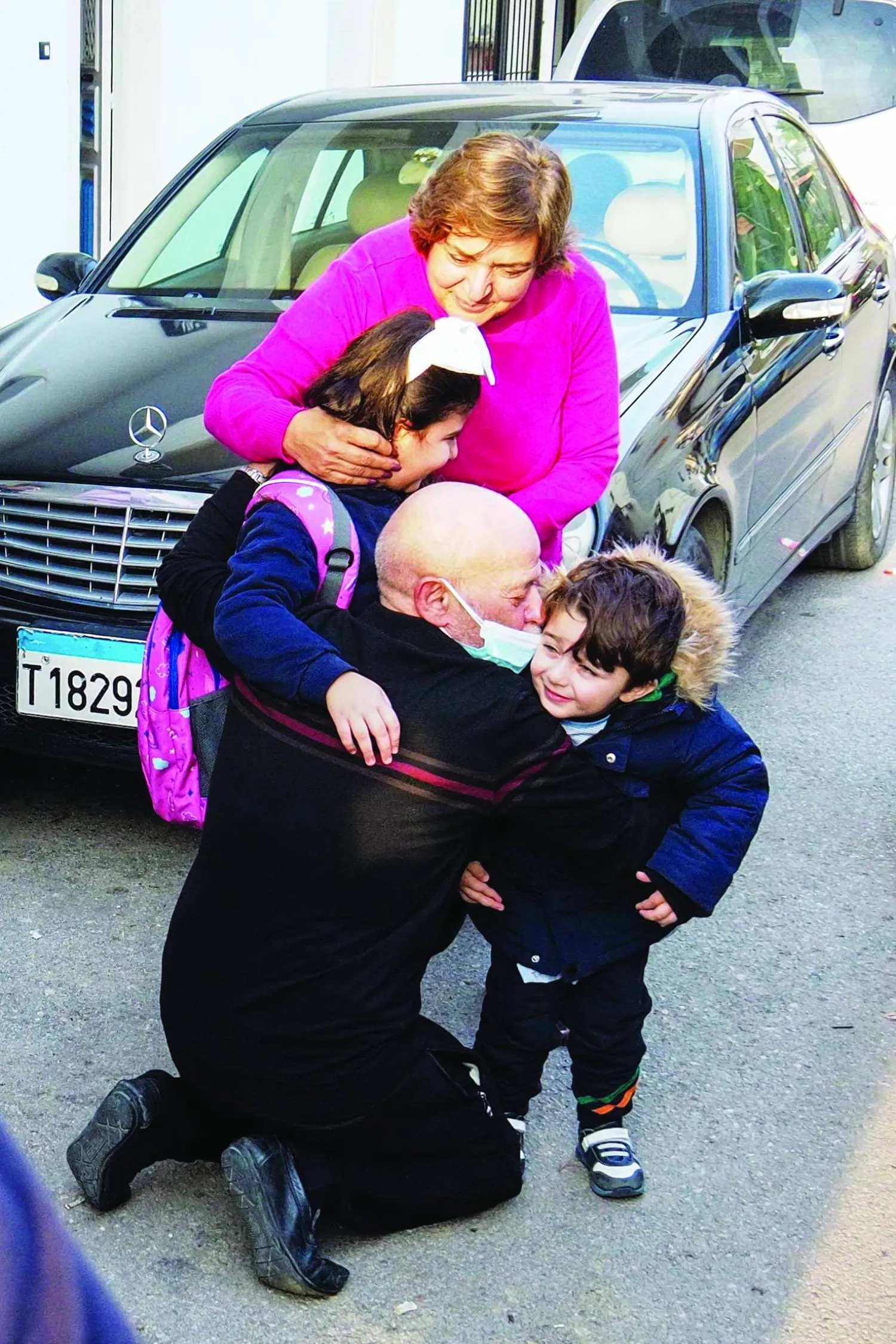
Suhail al-Hamwi (61) hugs his grandchildren in the coastal town of Chekka in northern Lebanon on December 9, 2024, after spending 33 years in a Syrian prison, following the ousting of Syria's President Bashar al-Bashar a day earlier. (Photo by Ibrahim CHALHOUB / AFP)
TT

A Lebanese Man Who Spent 32 Years in Syrian Prisons is Welcomed Home

Suhail al-Hamwi (61) hugs his grandchildren in the coastal town of Chekka in northern Lebanon on December 9, 2024, after spending 33 years in a Syrian prison, following the ousting of Syria's President Bashar al-Bashar a day earlier. (Photo by Ibrahim CHALHOUB / AFP)

Suheil Hamwi spent 32 years in a Syrian prison, and now, after an offensive by the opposition factions that toppled the government of Bashar Assad, he's finally returned to his home in Lebanon.
In 1992, Hamwi worked as a merchant, selling various goods in the town of Chekka in northern Lebanon. On the night of Eid il-Burbara, or Saint Barbara’s Day — a holiday similar to Halloween — a man came to his door to buy some whiskey. Hamwi said he handed his 10-month-old son, George, to his wife and went to his car to fetch the whiskey and make the sale.
As Hamwi approached his vehicle, a car filled with men pulled up, he said, forcing him inside and taking him away, The Associated Press said.
It would be years before his family heard from him again.
Hamwi was one of hundreds of Lebanese citizens detained during Syria’s occupation of Lebanon from 1976 to 2005 and believed to be held in Syrian prisons for decades. On Sunday, freedom came to him and others unexpectedly — prisoners who'd heard rumors about Syria’s opposition forces and their sweeping campaign found that guards had abandoned their posts. Hamwi and other prisoners left, he said, and he would soon be among the first from Lebanon to reenter the country.
“I’m still scared this might not be real,” he told The Associated Press in an interview Tuesday from his home — the same one he left more than three decades ago.
This new reality feels fragile, but, he said, “I found my freedom.”
Years of uncertainty and imprisonment For years after the night of his disappearance, Hamwi’s family didn’t know where he was. It wasn’t until 16 years later that his wife discovered he was imprisoned in Syria. Even then, the reason for his detention remained unclear, Hamwi said.
It took another four years before authorities finally told him the charge, he said: He was detained because he was a member of the Lebanese Forces, a Christian political party that also functioned as a militia during the 15-year Lebanese civil war that ended in 1990. The party fought against Syrian forces and remained opposed to Syria's military presence in Lebanon afterward.
Hamwi said prison interrogations were cryptic.
“They asked for my name, my parents’ names, my age, and where I was from. That’s all,” he said. Then he would be sent back to his cell. “There was no lawyer, no nothing.”
He said he spent his first years in Syria’s notorious Saydnaya prison before being transferred to other facilities, eventually ending up in prison in Latakia. Torture marked his early days behind bars, he added, “but that stopped after a while."
For years, he said, he lived in nearly complete isolation. He was alone in a small cell, surrounded by other Lebanese detainees as well as Palestinians and Iraqis.
In 2008, he said, his wife was able to visit him for the first time. Then she came about once a year.
The door opens to freedom
Last week, there was some buzz in the prison about what was happening outside. “But we didn’t know the dream would reach us,” Hamwi said.
Early Sunday morning, chaos erupted as prisoners discovered the guards were gone.
“The first door opened,” Hamwi said, describing how the opposition stormed the prison and started opening cell gates. “Then others followed. And for those who couldn’t open their gates, they started coming out through the walls.”
The prisoners left “walking toward the unknown,” he said. "And I walked with them.”
Strangers on the street helped guide him back to Lebanon, Hamwi said. He came into the country through the Arida border crossing in northern Lebanon, where his family waited on the other side.
Back home, at last As Hamwi walked through his door, it was his two grandchildren who greeted him.
“This is the first time I met them,” Hamwi later told AP, his voice tinged with disbelief.
In the living room, Hamwi lit a cigarette and took a slow drag. He took in photos of moments he'd missed: George’s graduation portrait; George with his wife; Hamwi's own smiling wife, Josephine, with granddaughter Tala.
Grandson Chris clung to Hamwi's hand, giggling as he called out “Jeddo!” — Arabic for grandpa.
Josephine handed out sweets, her hands steady despite the emotions of the last several days. Outside, neighbors and friends gathered, their voices echoing in the narrow hallway outside his apartment. They sat on chairs in a circle, sharing laughter and memories, as plates of the Arabic sweets and small chocolates were passed around.
“Do you know me? Do you remember me?” one friend asked, shaking Hamwi’s hand. Hamwi paused, studying the man’s face.
“You’re Jean! Yes, you’re Jean,” he said.
Hawmi has visited a hospital for tests to assess the toll of 32 years in captivity. And he has to relearn life outside prison walls.
He hoped one of the best moments was yet to come: his reunion with only son George, an engineer working in the Gulf.
In their first phone call, Hamwi said, George told him the words he'd been longing to hear: “I miss you. I love you. I’m waiting to see you.”



Israeli Reservist Rams Vehicle into Palestinian Man Praying in West Bank

Israeli security forces secure a street as they leave the Palestinian village of Bizariya, in the occupied West Bank, where Israeli authorities demolished the house of a Palestinian man killed in July after he and another man reportedly killed an Israeli settler on the same day, on December 24, 2025. (AFP)
TT

Israeli Reservist Rams Vehicle into Palestinian Man Praying in West Bank

Israeli security forces secure a street as they leave the Palestinian village of Bizariya, in the occupied West Bank, where Israeli authorities demolished the house of a Palestinian man killed in July after he and another man reportedly killed an Israeli settler on the same day, on December 24, 2025. (AFP)

An Israeli reservist soldier rammed his vehicle into a Palestinian man as he prayed on a roadside in ​the occupied West Bank on Thursday, after earlier firing shots in the area, the Israeli military said.

"Footage was received of an armed individual running over a Palestinian individual," it said in a statement, adding the individual was a reservist ‌and his ‌military service had ‌been terminated.

The ⁠reservist ​acted "in severe ‌violation of his authority" and his weapon had been confiscated, the military said.

Israeli media reported that he was being held under house arrest.

The Israeli police did not immediately respond to a Reuters request for comment.

The ⁠Palestinian man went to hospital for checks after ‌the attack, but was unhurt ‍and is now ‍at home.

Video which aired on Palestinian ‍TV shows a man in civilian clothing with a gun slung over his shoulder driving an off-road vehicle into a man praying on ​the side of the road.

This year ​was one of the most violent on ⁠record for Israeli civilian attacks against Palestinians in the West Bank, according to United Nations data that shows more than 750 injuries.

More than a thousand Palestinians were killed in the West Bank between October 7, 2023 and October 17, 2025, mostly in operations by security forces and some by settler violence, according to the UN In ‌the same period, 57 Israelis were killed in Palestinian attacks.


Deadly Blast Hits Mosque in Syria’s Homs, Saraya Ansar al-Sunna Claims Responsibility

Syrian security forces stand inside a damaged mosque after several people were killed in an explosion at a mosque as the Syrian Arab News Agency (SANA) said, in Homs, Syria December 26, 2025. REUTERS/Ali Ahmed al-Najjar
TT

Deadly Blast Hits Mosque in Syria’s Homs, Saraya Ansar al-Sunna Claims Responsibility

Syrian security forces stand inside a damaged mosque after several people were killed in an explosion at a mosque as the Syrian Arab News Agency (SANA) said, in Homs, Syria December 26, 2025. REUTERS/Ali Ahmed al-Najjar

A bombing at a mosque in Syria during Friday prayers killed at least eight people and wounded 18 others, authorities said.

Images released by Syria’s state-run Arab News Agency showed blood on the mosque’s carpets, holes in the walls, shattered windows and fire damage. The Imam Ali bin Abi Talib Mosque is located in Homs, Syria's third-largest city.

SANA, citing a security source, said that preliminary investigations indicate that explosive devices were planted inside the mosque. Authorities were searching for the perpetrators, who have not yet been identified, and a security cordon was placed around the building, Syria’s Interior Ministry said in a statement.

In a statement on Telegram, the Saraya Ansar al-Sunna said its fighters "detonated a number of explosive devices" in the mosque.

The same group had previously claimed a suicide attack in June in which a gunman opened fire and then detonated an explosive vest inside a Greek Orthodox church in Dweil’a, on the outskirts of Damascus, killing 25 people as worshippers prayed on a Sunday.

Several countries, including Saudi Arabia, Jordan and Lebanon, condemned the attack. 


Fuel Shortage Forces Gaza Hospital to Suspend Most Services

The sun sets behind a makeshift tent camp for displaced Palestinians set up in an area of al-Bureij camp, in the central Gaza Strip, Wednesday, Dec. 24, 2025. (AP)
TT

Fuel Shortage Forces Gaza Hospital to Suspend Most Services

The sun sets behind a makeshift tent camp for displaced Palestinians set up in an area of al-Bureij camp, in the central Gaza Strip, Wednesday, Dec. 24, 2025. (AP)

A major Gaza hospital has suspended several services because of a critical fuel shortage in the devastated Palestinian territory, which continues to face a severe humanitarian crisis, it said.

Devastated by more than two years of war, the Al-Awda Hospital in the central Gaza district of Nuseirat cares for around 60 in-patients and receives nearly 1,000 people seeking medical treatment each day.

"Most services have been temporarily stopped due to a shortage of the fuel needed for the generators," said Ahmed Mehanna, a senior official involved in managing the hospital.

"Only essential departments remain operational: the emergency unit, maternity ward and pediatrics."

To keep these services running, the hospital has been forced to rent a small generator, he added.

Under normal conditions, Al-Awda Hospital consumes between 1,000 and 1,200 liters of diesel per day. At present, however, it has only 800 liters available.

"We stress that this shutdown is temporary and linked to the availability of fuel," Mehanna said, warning that a prolonged fuel shortage "would pose a direct threat to the hospital's ability to deliver basic services".

He urged local and international organizations to intervene swiftly to ensure a steady supply of fuel.

Despite a fragile truce observed since October 10, the Gaza Strip remains engulfed in a severe humanitarian crisis.

While the ceasefire agreement stipulated the entry of 600 aid trucks per day into Gaza, only 100 to 300 carrying humanitarian assistance can currently enter, according to the United Nations and non-governmental organizations.

The remaining convoys largely transport commercial goods that remain inaccessible to most of Gaza's 2.2 million people.

- Health hard hit -

On a daily basis, the vast majority of Gaza's residents rely on aid from UN agencies and international NGOs for survival.

Gaza's health sector has been among the hardest hit by the war.

During the fighting, the Israeli miliary repeatedly struck hospitals and medical centers across Gaza, accusing Hamas of operating command centers there, an allegation the group denied.

International medical charity Doctors Without Borders now manages roughly one-third of Gaza's 2,300 hospital beds, while all five stabilization centers for children suffering from severe malnutrition are supported by international NGOs.

The war in Gaza was sparked on October 7, 2023, following an unprecedented Hamas attack on Israel that resulted in the deaths of 1,221 people, most of them civilians, according to an AFP tally based on official Israeli figures.

In Israel's ensuing military campaign in Gaza, at least 70,942 people - also mostly civilians - have been killed, according to the health ministry in the Hamas-run territory.