Israeli Airstrikes Hit Yemen's Capital and Port City after Houthi Attack Targets Israel

A Houthi supporter carries a mock missile during an anti-US and anti-Israel protest in Sana'a, Yemen, 13 December 2024. EPA/YAHYA ARHAB
TT

Israeli Airstrikes Hit Yemen's Capital and Port City after Houthi Attack Targets Israel

A Houthi supporter carries a mock missile during an anti-US and anti-Israel protest in Sana'a, Yemen, 13 December 2024. EPA/YAHYA ARHAB

A series of intense Israeli airstrikes shook Yemen's Houthi-held capital and a port city early Thursday and killed at least nine people, officials said, shortly after a Houthi missile targeted central Israel.
Thursday’s strikes risk further escalating conflict with the Iranian-backed Houthis, whose attacks on the Red Sea corridor have drastically impacted global shipping. The militants have so far avoided the same level of intense military strikes that have targeted the Palestinian Hamas militant group and Lebanon’s Hezbollah, fellow members of Tehran’s self-described “Axis of Resistance.”
The Houthi-controlled satellite channel al-Masirah said that some of the strikes targeted power stations in the capital, as well as the Ras Isa oil terminal on the Red Sea. The channel, citing its correspondent in the port city of Hodeidah, said at least seven people had been killed at the nearby port of Salif, while another two had been killed at the Ras Isa oil terminal.
Others suffered wounds at the Hodeidah port as well, it said.
An Israeli military statement offered no specifics on the targets hit, nor any damage assessment.
“The targets struck by the (Israeli military) were used by the Houthi forces for military purposes,” the statement said. “The strikes degrade the Houthi terrorist regime, preventing it from exploiting the targets for military and terrorist purposes, including the smuggling of Iranian weapons to the region.”
Rear Adm. Daniel Hagari, an Israeli military spokesman, said the strikes hit energy and port infrastructure, which he alleged the militants “have been using in ways that effectively contributed to their military action.”
“Israel will not hesitate to act in order to defend itself and its citizens from the Houthi attacks,” Hagari said.
Houthi-held Hodeidah, some 145 kilometers (90 miles) southwest of Sanaa, has been key for food shipments into Yemen as its decades long war has gone on. There's also longstanding suspicion that weapons from Iran have been transferred through the port.
The strikes happened just after the Israeli military said its air force intercepted a missile launched from Yemen before it entered the country’s territory.
“Rocket and missile sirens were sounded following the possibility of falling debris from the interception,” the Israeli military said. Sirens sounded near Tel Aviv and the surrounding areas, and a large explosion was heard overhead at the time. The Houthis did not immediately claim the missile attack, but said an important military statement would be issued in the coming hours, following a pattern of how they claim their assaults.
Israel previously struck Hodeidah and its oil infrastructure in July after a Houthi drone attack killed one person and wounded 10 in Tel Aviv. In September, Israel struck Hodeidah again, killing at least four people after a militant missile targeted Israel’s Ben Gurion airport as Prime Minister Benjamin Netanyahu was arriving back to the country.
American forces have also launched a series of strikes on the Houthis over nearly a year due to Houthi attacks on shipping in the Red Sea corridor. On Monday, the US military's Central Command said it hit “a key command-and-control facility" operated by the Houthis in Sanaa, later identified as the al-Ardi complex once home to the government's Defense Ministry.
But Israel appears to have carried out Thursday's strikes alone. A US military official, speaking on condition of anonymity to discuss the attacks, said America had no part in them.
The Houthis have targeted some 100 merchant vessels with missiles and drones since the Israel-Hamas war in the Gaza Strip started in October 2023 after Hamas' surprise attack on Israel that killed 1,200 people and saw 250 others taken hostage. Israel's grinding offensive in Gaza has killed over 45,000 Palestinians, local health officials say.
The Houthis have seized one vessel and sunk two in a campaign that has also killed four sailors. Other missiles and drones have either been intercepted by separate US- and European-led coalitions in the Red Sea or failed to reach their targets, which have also included Western military vessels.
The Houthis maintain that they target ships linked to Israel, the US or the United Kingdom to force an end to Israel’s campaign against Hamas in Gaza. However, many of the ships attacked have little or no connection to the conflict, including some bound for Iran.



Israel Strikes Southern Lebanon, Killing 4; Hezbollah Drone Wounds 2 Israeli Soldiers

 Smoke rises in Habboush following Israeli strikes, as seen from Nabatiyeh, Lebanon, May 1, 2026. (Reuters)
Smoke rises in Habboush following Israeli strikes, as seen from Nabatiyeh, Lebanon, May 1, 2026. (Reuters)
TT

Israel Strikes Southern Lebanon, Killing 4; Hezbollah Drone Wounds 2 Israeli Soldiers

 Smoke rises in Habboush following Israeli strikes, as seen from Nabatiyeh, Lebanon, May 1, 2026. (Reuters)
Smoke rises in Habboush following Israeli strikes, as seen from Nabatiyeh, Lebanon, May 1, 2026. (Reuters)

Israel carried out several airstrikes on southern Lebanon on Friday, killing at least four people, while the Hezbollah group said it fired rockets and drones, including one that crashed in northern Israel and wounded two soldiers.

Israel’s military and Hezbollah kept up their attacks despite a ceasefire in place since April 17. The state-run National News Agency reported that the four people were killed in strikes on three southern villages.

Israel’s military on Friday afternoon urged residents of the village of Habboush near the southern city of Nabatiyeh to evacuate, warning that those close to Hezbollah’s facilities would be putting their lives in danger if they stay.

Friday’s exchanges came after paramedics recovered the bodies of five people, including a man and his three sons, from under rubble in the village of Kfar Rumman, also near Nabatiyeh, a day after they were killed.

Lebanon’s National News Agency reported that the five were killed in an airstrike late Thursday on Kfar Rumman. The agency identified those whose bodies were recovered as Malek Hamza and his sons, Ali, Fadel and Hamza. It said the strike also killed a Lebanese soldier. The Lebanese army confirmed that a soldier, Ali Jaber, was killed in the strike.

By Friday afternoon, Hezbollah had issued six statements saying it launched drones and rockets at Israeli military positions.

The Israeli military confirmed that Hezbollah launched an explosive drone that fell in northern Israel near the border with Lebanon.

Israeli media reported a drone strike near Margaliot in northern Israel, saying it caused a localized fire, and that two soldiers were lightly wounded in a separate Hezbollah drone impact in the area.

Despite the war, residents have continued to return to homes in southern Lebanon after being displaced for weeks because of the hostilities.

One of them was Umm Ali Khodor, whose apartment in the southern port city of Tyre was damaged during the previous Israel-Hezbollah war in 2024 and again in the current conflict.

“We were displaced, we rented a house, but as you know the situation is very difficult,” the woman said. “We could not continue so we returned to our home.”

The latest war between Israel and Hezbollah began on March 2, when Hezbollah fired rockets into northern Israel two days after the United States and Israel launched a war on its main backer, Iran. Israel has since carried out hundreds of airstrikes and launched a ground invasion of southern Lebanon, capturing dozens of towns and villages along the border.

Since then, Lebanon and Israel have held their first direct talks in more than three decades. The two countries have formally been in a state of war since the founding of the state of Israel in 1948.

A 10-day ceasefire declared in Washington went into effect on April 17. The ceasefire was later extended by three weeks.

The Health Ministry said Friday that the war's death toll reached 2,618 while 8,094 were wounded.


Berri to Asharq Al-Awsat: No Point Negotiating with Israel Under Fire

FILE PHOTO: Lebanese Parliament Speaker Nabih Berri meets with Italian Prime Minister Giorgia Meloni (not seen) in Beirut, Lebanon October 18, 2024. REUTERS/Mohamed Abd El Ghany/File Photo
TT

Berri to Asharq Al-Awsat: No Point Negotiating with Israel Under Fire

FILE PHOTO: Lebanese Parliament Speaker Nabih Berri meets with Italian Prime Minister Giorgia Meloni (not seen) in Beirut, Lebanon October 18, 2024. REUTERS/Mohamed Abd El Ghany/File Photo

In his first comment on the statement issued by the US Embassy in Beirut, which called on President Joseph Aoun to hold a direct meeting with Israeli Prime Minister Benjamin Netanyahu, Parliament Speaker Nabih Berri told Asharq Al-Awsat that the statement “speaks for itself, and I have nothing to add.”

He added that his response to the president “came in reply to what he said while receiving economic bodies” (in reference to Aoun’s remarks about full coordination with Berri regarding negotiations). This, he said, explains his apology for not attending the meeting that had been scheduled with President Aoun and Prime Minister Nawaf Salam at the presidential palace.

Berri also addressed the extension of the truce for three weeks, brokered by US President Donald Trump, asking: “Where is this truce?” Has Israel stopped leveling towns, demolishing homes, shedding the blood of children, women and the elderly, preventing rescue teams from saving the wounded and transporting them to hospitals, or retrieving those trapped under rubble until they died?

He also pointed to the targeting of medical bodies and paramedics, which led to the killing of dozens of them, questioning whether all these victims were part of Hezbollah’s military infrastructure, as Israel claims to justify the destruction of southern towns.

He said the so-called truce has allowed Israel to press ahead with its aggression and commit unprecedented massacres, without US intervention to compel it to halt hostilities and entrench a ceasefire, particularly since Washington was behind securing the truce extension.

This, he added, obliges it to honor its commitment to the Lebanese and the international community. Otherwise, what is the point of negotiations under Israeli fire? And what would be said to the families of those killed in what he described as Israeli treachery in the south?

Aoun and Berri: divergence, not a rupture

In this context, a parliamentary source following presidential relations said the emerging dispute between Aoun and Berri remains within the bounds of differing interpretations of the US State Department statement.

The source told Asharq Al-Awsat that mediators intervened to cool tensions between the two sides, ruling out any rupture given the difficult and delicate circumstances Lebanon is going through, which require collective efforts, starting with the presidents, to compel Israel to cease fire and entrench it before asking Lebanon to enter direct negotiations, even if indirect talks would be preferable, as the US administration is expected to pursue.

The source added that as long as the three presidents agree on the necessity of halting hostilities ahead of any negotiation track with Israel, the recalibration of positions on the sidelines of the cabinet session helped ease tensions between Aoun and Berri, opening the way for renewed momentum in presidential relations. None of the presidents, the source said, has an interest in the absence of consultation, which is essential to reach a roadmap for handling the negotiations matter.

The source noted that there is no alternative to renewed coordination among the three presidents as long as they adhere to national constants and do not compromise them, as a prerequisite for launching negotiations that cannot be held without being paired with a firmly established ceasefire. This, he said, calls on Trump to intervene with Israel to stop it from escalating its aggression.

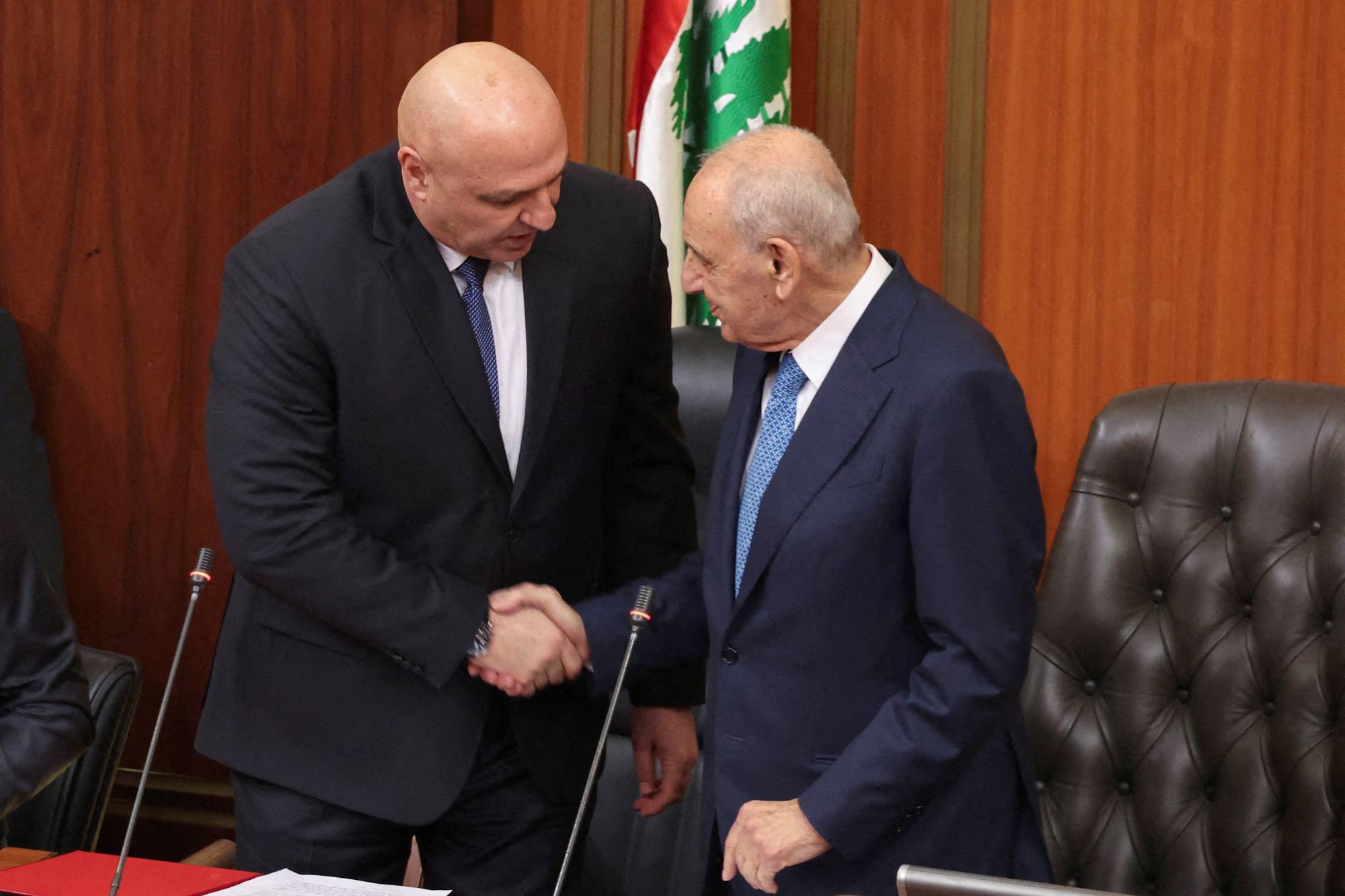
FILE PHOTO: Lebanese Parliament Speaker Nabih Berri shakes hands with Lebanon's army chief Joseph Aoun after he is elected as the country's President at the parliament building in Beirut, Lebanon, January 9, 2025. REUTERS/Mohamed Azakir/File Photo

Berri’s stance on negotiations

The parliamentary source defended Berri’s position, questioning why the US administration has not intervened to compel Israel to implement the ceasefire agreement it sponsored in coordination with France in 2024, which never came into force. Instead, it allowed Israel to continue violating it by expanding its aggression beyond the south to Beirut’s southern suburbs and towns in the Bekaa.

He confirmed that Hezbollah responded to Berri’s position and adhered, to the fullest extent, to the cessation of hostilities, playing, with the party’s authorization, a role in reaching it with the then US mediator Amos Hochstein, under US and French sponsorship. This came, he said, while Israel was given free rein to continue its aggression under the pretext of self-defense through preemptive strikes against what it claims are threats to its northern settlements.

The source said Hezbollah’s commitment to the ceasefire for 15 months, contrasted with Israel’s insistence on violating it, placed it in a difficult position, especially with Washington refraining from pressuring Israel to halt its breaches, leading to an expanded offensive, despite prior commitments to synchronized steps by both sides as a condition for implementing the agreement.

He added that Nawaf Salam’s government, while primarily betting on a diplomatic track to compel Israel to withdraw from the south, faced Israeli defiance of the agreement and continued pressure through fire to force Lebanon to accept its terms.

The three-week truce

The source said the three-week truce remained ink on paper, enabling Israel to turn the south into an open military operations zone, continuing systematic destruction across areas south and north of the Litani River, displacing residents under pressure to evacuate their towns.

He expressed confidence that President Aoun remains committed to his position that securing a ceasefire must come first as a prerequisite for launching direct negotiations between the two countries under US sponsorship, without compromising national constants regardless of pressure.

This position, he added, aligns with his understanding with Berri and Salam, and was reaffirmed in the latest cabinet session when Aoun said negotiations have not yet begun, meaning he rejects any negotiation track before Israel halts its military pressure on Lebanon.

Securing a ceasefire

The source stressed that Aoun will not agree to begin negotiations unconditionally, foremost without a secured ceasefire. From his perspective, US pressure to urgently arrange a meeting with Netanyahu could inflame the domestic atmosphere and raise tensions amid growing disagreements if such pressure is met without guarantees for Lebanon, primarily a ceasefire and the return of displaced people to their villages.

He confirmed his support for Aoun’s preference not to rush into a meeting with Netanyahu, considering the timing premature. Such a meeting, he said, should come as the culmination of an agreement that responds to the national constants upheld by the president, in exchange for ending the state of war between the two countries, with subsequent steps to be addressed later.

He also questioned why the call for Aoun to meet Netanyahu was issued by the US Embassy in Beirut rather than the White House, noting that Aoun raised this matter during his meeting with US Ambassador to Beirut Michel Issa, who had recently returned from Washington, to clarify the reasons behind issuing the statement from the embassy, which he described as unprecedented in the history of relations between the two countries.


Israel’s Death Penalty Law Perpetuates Racial Discrimination, Says UN Watchdog

Protesters hold placards outside the Red Cross offices in Ramallah, in the Israeli-occupied West Bank, on March 31, 2026, during a rally against a bill approved by Israel's parliament that would allow the execution of Palestinians convicted on terror charges for deadly attacks. (AFP via Getty Images)
TT

Israel’s Death Penalty Law Perpetuates Racial Discrimination, Says UN Watchdog

Protesters hold placards outside the Red Cross offices in Ramallah, in the Israeli-occupied West Bank, on March 31, 2026, during a rally against a bill approved by Israel's parliament that would allow the execution of Palestinians convicted on terror charges for deadly attacks. (AFP via Getty Images)

Israel's new death penalty law permitting the execution of Palestinians convicted of deadly attacks perpetuates racial discrimination against them, a United Nations committee said Friday, urging its immediate repeal.

The law amounts to a grave erosion of human rights, the UN Committee on the Elimination of Racial Discrimination said in a statement.

Under the new law, passed by the Israeli parliament in March, Palestinians in the occupied West Bank convicted by military courts of carrying out deadly attacks classified as "terrorism" will face the death penalty as a default sentence.

"The new law is a severe blow to human rights, rolling back Israel's long-standing de facto moratorium on executions since 1962 and expanding the use of the death penalty," the committee said.

The law is "de facto applicable to Palestinians only" and sets a 90-day deadline for executions once a final judgement is rendered, the committee said.

Furthermore, it said Israel should ensure that all Palestinian detainees "are guaranteed their rights to equal treatment before the law, security of person, protection against violence or bodily harm, and access to justice".

The committee also called on Israel to "end all policies and practices that amount to racial discrimination against and segregation of Palestinians".

It said other countries should "ensure that their resources are not used to enforce or support discriminatory policies and practices against Palestinians living in the Occupied Palestinian Territory".

The committee of 18 independent experts monitors adherence to the Convention on the Elimination of All Forms of Racial Discrimination by its 182 states parties.

Under the convention, which came into force in 1969, countries must eliminate racial discrimination, eradicate practices of segregation and guarantee equality before the law without distinction as to race, color, descent or national or ethnic origin.

Israel ratified the convention in 1979.

In March, UN rights chief Volker Turk branded Israel's new law "cruel and discriminatory", warning that applying it in occupied Palestinian territory "would constitute a war crime".

Israel has only applied the death penalty twice: in 1948, shortly after the state's founding, against a military captain accused of high treason, and then in 1962, when the Nazi war criminal Adolf Eichmann was hanged.

Israel has occupied the West Bank since 1967 and violence in the territory has soared since Hamas's October 7, 2023, attack on Israel triggered the Gaza war.