Residents of Syria's Quneitra are Frustrated by Lack of Action to Halt Israeli Advance

Israeli military vehicles in the Syrian city of Quneitra, as seen from the Israeli side of the Israeli-annexed Golan Heights, 13 December 2024. EPA/ATEF SAFADI
TT

Residents of Syria's Quneitra are Frustrated by Lack of Action to Halt Israeli Advance

Israeli military vehicles in the Syrian city of Quneitra, as seen from the Israeli side of the Israeli-annexed Golan Heights, 13 December 2024. EPA/ATEF SAFADI

A main road in the provincial capital of Quneitra in southern Syria was blocked with mounds of dirt, fallen palm trees and a metal pole that appeared to have once been a traffic light. On the other side of the barriers, an Israeli tank could be seen maneuvering in the middle of the street.
Israeli forces entered the area — which lies in a UN-patrolled buffer zone in the Golan Heights that was established by a 1974 ceasefire agreement between Syria and Israel — soon after the fall of President Bashar Assad last month in the country's 13-year civil war.
The Israeli military has also made incursions into Syrian territory outside of the buffer zone, sparking protests by local residents. They said the Israeli forces had demolished homes and prevented farmers from going to their fields in some areas. On at least two occasions, Israeli troops reportedly opened fire on protesters who approached them.
Residents of Quneitra, a seemingly serene bucolic expanse of small villages and olive groves, said they are frustrated, both by the Israeli advances and by the lack of action from Syria’s new authorities and the international community.
Rinata Fastas said that Israeli forces had raided the local government buildings but had not so far entered residential neighborhoods. Her house lies just inside of the newly blocked-off area in the provincial capital formerly called Baath City, after Assad's former ruling party, and now renamed Salam City.
She said she is afraid Israeli troops may advance farther or try to permanently occupy the area they have already taken. Israel still controls the Golan Heights that it captured from Syria during the 1967 Mideast war and later annexed. The international community, with the exception of the US, regards it as occupied.
Fastas said she understands that Syria, which is now trying to build its national institutions and army from scratch, is no position to militarily confront Israel.
“But why is no one in the new Syrian state coming out and talking about the violations that are happening in Quneitra province and against the rights of its people?” she asked.
The United Nations has accused Israel of violating the 1974 ceasefire agreement by entering the buffer zone.
Israeli Prime Minister Benjamin Netanyahu has said troops will stay on "until another arrangement is found that will ensure Israel’s security.” He was speaking from the snowy peak of Mount Hermon, Syria’s tallest mountain known as Jabal al Sheikh in Arabic, which has now been captured by Israeli forces.
An Israeli official, who spoke on condition of anonymity because he was not authorized to comment on the matter, said the military will remain in the area it has taken until it is satisfied that the new Syrian authorities do not pose a danger to Israel.
The new Syrian government has lodged a complaint with the UN Security Council about Israeli airstrikes and advances into Syrian territory.
The country’s new de facto leader, Ahmad al-Sharaa, head of the Hayat Tahrir al-Sham, has also publicly said Syria is not seeking a military conflict with Israel and will not pose a threat to its neighbors or to the West.
In the meantime, residents of Quneitra have largely been left to fend for themselves.
In the village of Rafid, inside the buffer zone, locals said the Israeli military had demolished two civilian houses and a grove of trees as well as a former Syrian army outpost.
Mayor Omar Mahmoud Ismail said when the Israeli forces entered the village, an Israeli officer greeted him and told him, “I am your friend.”
“I told him, ‘You are not my friend, and if you were, you wouldn’t enter like this,’" Ismail said.
Locals who organized a protest were met with Israeli fire
In Dawaya, a village outside the buffer zone, 18-year-old Abdelrahman Khaled al-Aqqa was lying on a mattress in his family home Sunday, still recovering after being shot in both legs. Al-Aqqa said he joined about 100 people from the area on Dec. 25 in protest against the Israeli incursion, chanting “Syria is free, Israel get out!”
“We didn’t have any weapons, we were just there in the clothes we were wearing,” he said. “But when we got close to them, they started shooting at us.”
Six protesters were wounded, according to residents and media reports. Another man was injured on Dec. 20 in a similar incident in the village of Maariyah. The Israeli army said at the time that it had fired because the man was quickly approaching and ignored calls to stop.
The Israeli military did not immediately respond to a request for comment on the Dec. 25 incident.
Adel Subhi al-Ali, a local Sunni religious official, sat with his 21-year-old son, Moutasem, who was recovering after being shot in the stomach in the Dec. 25 protest. He was driven first to a local hospital that did not have the capacity to treat him, and then to Damascus where he underwent surgery.
When he saw the Israeli tanks moving in, “We felt that an occupation is occupying our land. So we had to defend it, even though we didn’t have weapons, ... It is impossible for them to settle here,” al-Ali said.
Since the day of the protest, the Israeli army has not returned to the area, he said.
Al-Ali called for the international community to “pressure Israel to return to what was agreed upon with the former regime,” referring to the 1974 ceasefire agreement, and to return the Golan Heights to Syria.
But he acknowledged that Syria has little leverage.
“We are starting from zero, we need to build a state,” al-Ali said, echoing Syria's new leaders. “We are not ready as a country now to open wars with another country."



Iraq Says Ankara Agrees to Take Back Turkish Citizens Among ISIS Detainees Transferred from Syria 

This handout picture made available by the Iraqi prime minister's office shows Iraq's Prime Minister Mohammed Shia al-Sudani (R) receiving US Special Envoy to Iraq Tom Barrack (L) before attending the signing of agreements between Chevron Corporation and the Basra, Dhi Qar, and North Oil Companies at the government palace in Baghdad on February 23, 2026. (Iraqi Prime Minister’s Press Office / AFP)
TT

Iraq Says Ankara Agrees to Take Back Turkish Citizens Among ISIS Detainees Transferred from Syria 

This handout picture made available by the Iraqi prime minister's office shows Iraq's Prime Minister Mohammed Shia al-Sudani (R) receiving US Special Envoy to Iraq Tom Barrack (L) before attending the signing of agreements between Chevron Corporation and the Basra, Dhi Qar, and North Oil Companies at the government palace in Baghdad on February 23, 2026. (Iraqi Prime Minister’s Press Office / AFP)

Iraq's foreign minister said on Monday Türkiye had agreed to take back Turkish citizens from among thousands of ISIS detainees transferred to Iraq from Syria when camps and prisons there were shut in recent weeks.

Iraq took in the detainees in an operation arranged with the United States after Kurdish forces retreated and shut down camps and prisons which had housed ISIS suspects ‌for nearly a decade.

Baghdad has said ‌it ⁠will try suspects ⁠on terrorism charges in its own legal system, but it has also repeatedly called on other countries to take back their citizens from among the detainees.

Foreign Minister Fuad Hussein told US envoy Tom Barrack in a meeting that Iraq ⁠was in talks with other countries on ‌the repatriation of ‌their nationals, and had reached an agreement with Türkiye.

In ‌a separate statement to the UN Human ‌Rights Council, Hussein said: "We would call the states across the world to recover their citizens who've been involved in terrorist acts so that they be tried ‌in their countries of origin."

The fate of the suspected ISIS fighters, ⁠as well ⁠as thousands of women and children associated with the group, has become an urgent issue since the Kurdish force guarding them collapsed in the face of a Syrian government offensive.

At the height of its power from 2014-2017, ISIS held swathes of Syria and Iraq, ruling over millions of people and attracting fighters from other countries. Its rule collapsed after military campaigns by regional governments and a US-led coalition.


Chad Govt Shuts Sudan Border Until Further Notice 

Children poke their heads and arms through holes in makeshift fabric fences in the strategic opposition-controlled town of Akobo, Jonglei State, on February 12, 2026. (AFP)
TT

Chad Govt Shuts Sudan Border Until Further Notice 

Children poke their heads and arms through holes in makeshift fabric fences in the strategic opposition-controlled town of Akobo, Jonglei State, on February 12, 2026. (AFP)

Chad's government said on Monday it was closing the border with Sudan until further notice, following several clashes between Chadian soldiers and armed groups involved in the civil war across the frontier.

"This decision follows repeated incursions and violations committed by the forces involved in the conflict in Sudan on Chadian territory," Communications Minister Mahamat Gassim Cherif said in a statement, adding that he wanted to halt "any risk of the conflict spreading" to his country.

Sudan's paramilitary Rapid Support Forces have been fighting government troops for almost three years in a conflict that has killed tens of thousands of people and forced 11 million to flee their homes, triggering what the UN says is one of the world's worst humanitarian crises.

The paramilitaries have conducted several operations near the Chad border and at least nine Chadian soldiers have been killed in separate incidents since December.

Monday's statement said Chad "reserves the right to retaliate against any aggression or violation of the inviolability of its territory and its borders".

"Cross-border movements of goods and people are suspended," the text said, adding that "exceptional exemptions" for humanitarian reasons would still be possible.


Report: US Forces to Complete Withdrawal from Syria within a Month 

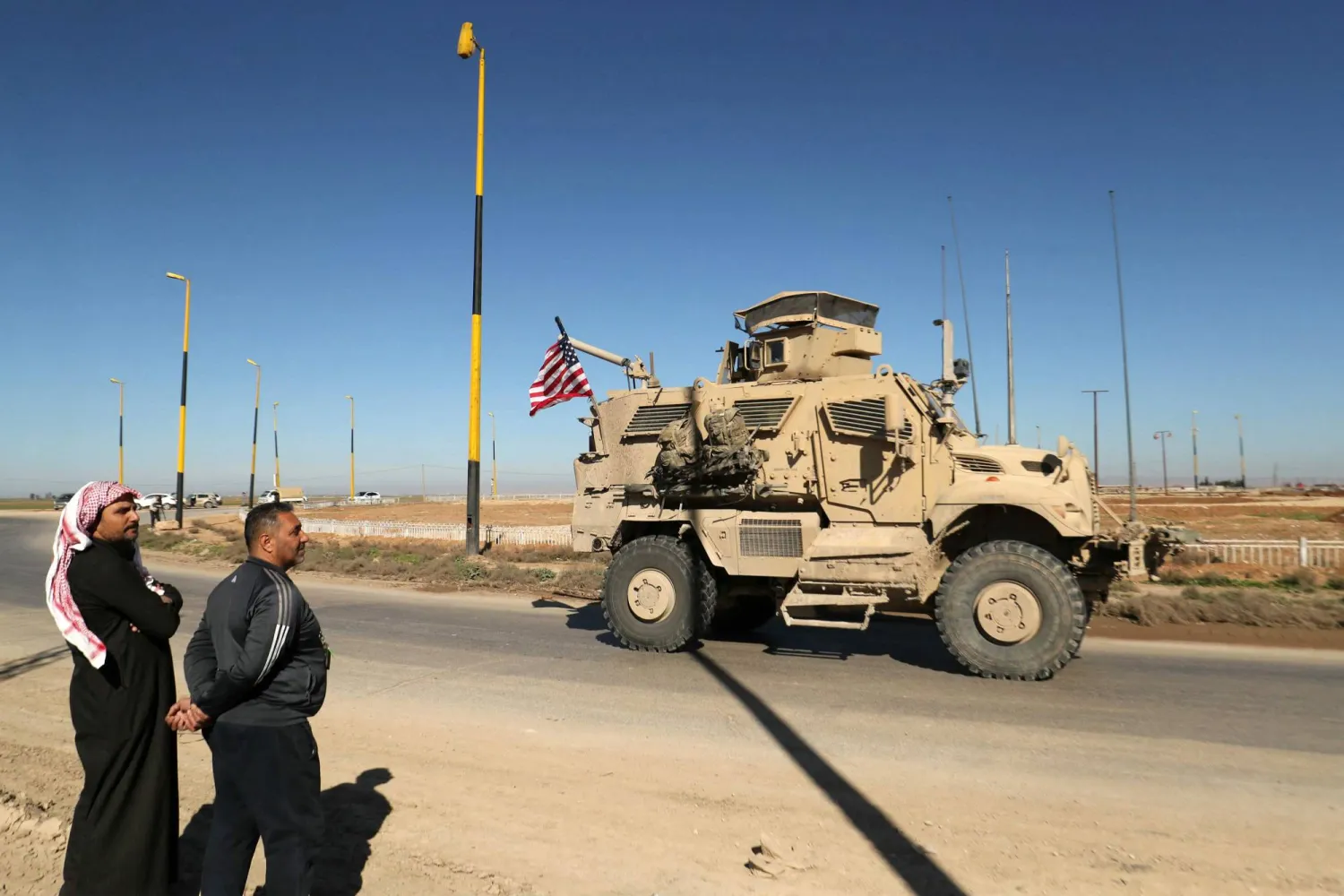
Men watch as a US military mine-resistant ambush protected (MRAP) armored fighting vehicle moves in a convoy along a highway outside Qamishli in Syria's northeastern Hasakeh province on February 23, 2026. (AFP) 
TT

Report: US Forces to Complete Withdrawal from Syria within a Month 

Men watch as a US military mine-resistant ambush protected (MRAP) armored fighting vehicle moves in a convoy along a highway outside Qamishli in Syria's northeastern Hasakeh province on February 23, 2026. (AFP) 

US forces that led the anti-ISIS coalition in Syria started leaving a major base in the northeast on Monday and should complete their withdrawal from the country within a month, sources told AFP. 

The move comes after Kurdish forces, long backed by Washington in the fight against the ISIS group, ceded territory to Damascus and agreed to integrate into the state. 

American forces have already withdrawn from two other bases in the past two weeks, Al-Tanf in the southeast and Shaddadi in the northeast. 

"Within a month, they will have withdrawn from Syria and there will no longer be any military presence in the bases," a Syrian government official said, with a Kurdish source confirming the timeline. 

A third source, a diplomat, said the withdrawal should be completed within 20 days. 

The United States has about 1,000 troops still deployed in Syria. It began withdrawing on Monday from the Qasrak base in the northeast, which is still under the control of Kurdish forces, a Kurdish official who requested anonymity told AFP. 

An AFP team saw a convoy of dozens of trucks, loaded with armored vehicles and prefabricated structures, on a road linking the Qasrak base in Hasakeh province to the border with Iraq. 

Syria's government recently extended its control to the northeast of the country. 

Washington has drawn close to Syria's new authorities since the fall of Bashar al-Assad in late 2024.