


UN Monitoring Lebanon’s Efforts to Form Cabinet Headed by Nawaf Salam

File photo: Secretary-General Antonio Guterres (right) joined Nawaf Salam, Permanent Representative of Lebanon to the United Nations, and others, in a tree-planting ceremony on the grounds of UN Headquarters in New York. (UN)
TT

UN Monitoring Lebanon’s Efforts to Form Cabinet Headed by Nawaf Salam

File photo: Secretary-General Antonio Guterres (right) joined Nawaf Salam, Permanent Representative of Lebanon to the United Nations, and others, in a tree-planting ceremony on the grounds of UN Headquarters in New York. (UN)

UN Security Council members held Monday closed consultations on Lebanon and received an update on the implementation of the cessation of hostilities agreement between Israel and Hezbollah.

The meeting welcomed the January 9 election of former Lebanese Army Commander Joseph Aoun as President and the appointment of a new Prime Minister, Nawaf Salam.

UN Secretary-General Antonio Guterres will travel to Lebanon on Friday for a solidarity visit with the country and its people, his spokesperson announced on Monday during his daily briefing from New York.

Monday’s closed consultations at the Security Council were proposed by France, the penholder on Lebanon.

Special Coordinator for Lebanon Jeanine Hennis-Plasschaert and Under-Secretary-General for Peace Operations Jean-Pierre Lacroix briefed the meeting on the implementation of the November 27 cessation of hostilities agreement between Israel and Lebanon ahead of the expiry of the 60-day deadline outlined in the agreement for the Israeli army to withdraw south of the Blue Line and, in parallel, for the Lebanese army to deploy to positions south of the Litani river.

The announcement of the cessation of hostilities frames the agreement as a set of “understandings” that reflect “steps to which Israel and Lebanon are committed” in order to fully implement Resolution 1701.

Adopted in 2006, Resolution 1701 called for a cessation of hostilities between Israel and Hezbollah based on a series of principles, including the establishment between the Blue Line and the Litani river in Lebanon of “an area free of any armed personnel, assets and weapons” other than those of the government of Lebanon and the UN Interim Force in Lebanon (UNIFIL), as well as “no foreign forces” in Lebanon without its government’s consent.

It also notes that the Lebanese army will begin carrying out several tasks, including dismantling unauthorized infrastructure and confiscating unauthorized arms and related materiel in the UNIFIL area of operations.

According to a 4 January AP article, Israel has “stopped attacking Hezbollah in most areas of Lebanon,” while launching “regular airstrikes” on what it says are Hezbollah sites in southern Lebanon and in the Bekaa Valley.

In a 26 December 2024 statement, UNIFIL expressed “concern at continuing destruction by the Israeli army in residential areas, agricultural land, and road networks in south Lebanon.”

According to media reports, the US is apparently seeking an extension of the 60-day deadline stipulated in the agreement for the respective withdrawal and deployment.

In its statement, UNIFIL urged Israel and Lebanon to utilize the mechanism outlined in the cessation of hostilities agreement to address any outstanding issues.

This refers to a reformulated version of the tripartite mechanism established following the 2006 war between Israel and Hezbollah and then turned into a five-member mechanism that includes France and the US—which chairs the mechanism—and is hosted by UNIFIL.

The revised mechanism is tasked with monitoring, verifying, and assisting in “ensuring enforcement” of the commitments outlined in the cessation of hostilities and Resolution 1701.

UNIFIL’s statement further said that the mission is working closely with the Lebanese army “as they accelerate recruitment efforts and redeploy troops to the south” and that it stands ready to support Israel and Lebanon to meet their obligations, including regarding the absence of any armed personnel, assets or weapons other than those of the government of Lebanon and UNIFIL south of the Litani river, as well as respect for the Blue Line.

During Monday’s closed-door meetings, Hennis-Plasschaert briefed the Security Council on positive developments seen in recent weeks in Lebanon, welcoming the January 9 election of the new President and the nomination of Salam to form the country’s new government.

She said the two developments offer “an opportunity to pave the way for progress towards consolidating the cessation of hostilities and preserving the country’s security and stability.”

Hennis-Plasschaert also urged the formation of a government as soon as possible to follow the caretaker cabinet headed by Najib Mikati.

Presidential Statement

At the time of the closed-door meeting, Council members were negotiating a draft presidential statement circulated by France on January 9.

The draft statement welcomes Aoun’s election and stresses the importance of the formation of a government.

Diplomats told Asharq Al-Awsat the statement also apparently welcomes the cessation of hostilities between Israel and Lebanon and calls for the full implementation of the ceasefire agreement and the respect of Resolutions 1701, 1559 and 1860.

The draft presidential statement was not immediately adopted amid concerns that it would risk complicating de-escalation and compliance with the agreement on the ground.

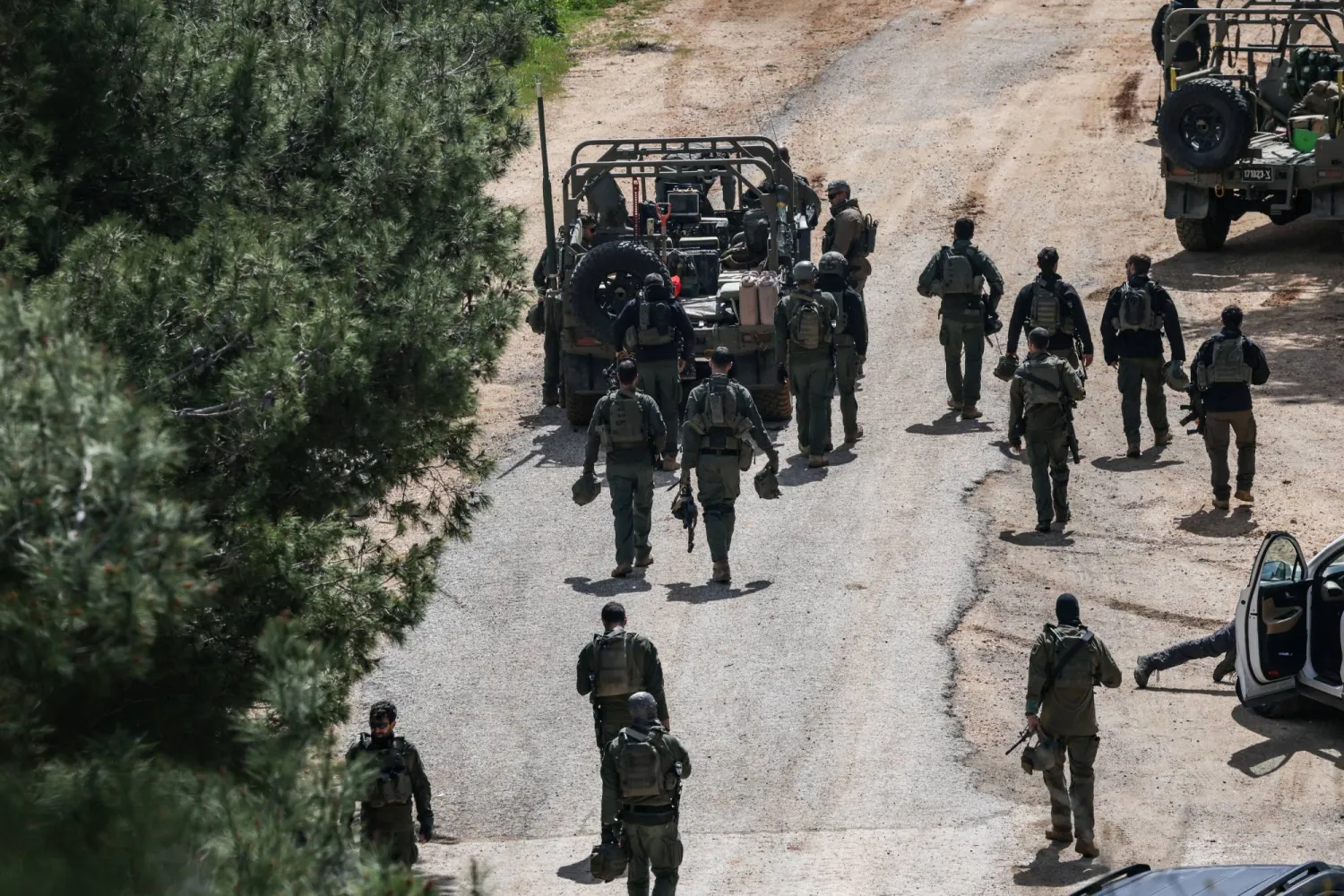


Israel Steps Up Campaign in Lebanon

Israeli soldiers gather on the Israeli side of the border with Lebanon, amid escalation between Hezbollah and Israel, and amid the US-Israeli conflict with Iran, in northern Israel, March 16, 2026. REUTERS/Shir Torem
TT

Israel Steps Up Campaign in Lebanon

Israeli soldiers gather on the Israeli side of the border with Lebanon, amid escalation between Hezbollah and Israel, and amid the US-Israeli conflict with Iran, in northern Israel, March 16, 2026. REUTERS/Shir Torem

The war in the Middle East raged on multiple fronts on Monday, as the US and Israel pummeled military targets in Iran’s capital, Israel stepped up its campaign against Lebanon and Iran retaliated with a drone strike that temporarily shut Dubai’s airport, a crucial hub for travelers.
Massive explosions were heard in Beirut as Israel launched new attacks on the Lebanese capital before dawn, saying it was striking infrastructure related to Hezbollah.

The Israeli army has issued evacuation orders for many neighborhoods in Beirut as well as southern Lebanon. To date, more than 800,000 people have been displaced by Israel’s campaign in Lebanon, The AP news reported.

In southern Lebanon, seven people were killed in Israeli airstrikes, according to authorities and news reports. Lebanon’s state-run National News Agency said two of them were paramedics responding to an earlier strike.

At least 850 people in Lebanon have been killed by Israeli strikes so far.

Not long after Israel’s military announced it had launched new strikes on Tehran, targeting infrastructure, explosions were heard in the Iranian capital and outlying areas.

More details were not immediately available with information coming out of Iran severely limited by internet outages, round-the-clock airstrikes and tight restrictions on journalists.

More than 1,300 people have been killed in Iran so far, according to the Iranian Red Crescent.

Israel has carried out some 7,600 strikes on Iran so far, knocking out 85% of its air defenses, military spokesman Lt. Col. Nadav Shoshani told reporters Monday. It has also destroyed 70% of Iran’s missile launchers, but Shoshani said Israel still has thousands of targets to hit and would continue attacks “for as long as needed.”

In Israel, 12 people have been killed by Iranian missile fire. At least 13 US military members have been killed.


Iraq Hopes to Ship Oil to Türkiye by Pipeline as War Cuts off Exports

Technicians working at the Majnoon oil field in Basra, Iraq. (Reuters)
TT

Iraq Hopes to Ship Oil to Türkiye by Pipeline as War Cuts off Exports

Technicians working at the Majnoon oil field in Basra, Iraq. (Reuters)

Iraq is hoping to ship up to 250,000 barrels of oil per day to a port in Türkiye via a rehabilitated pipeline, its oil minister said, after the US-Israeli war on Iran cut off its main export route.

The amount would be just a fraction of the roughly 3.5 million barrels per day (bpd) that Iraq exported before the conflict, mostly through its southern Basra port and the Strait of Hormuz, where traffic has been severely disrupted by the war.

Authorities want to restore an old pipeline -- out of service for years -- that links the northern Kirkuk oil fields to the Turkish port of Ceyhan, where the oil could be shipped onwards to international buyers.

Oil Minister Hayan Abdel Ghani said late Sunday that the pipeline's rehabilitation is "complete, but there is a 100-kilometer section that needs to be inspected".

Teams will "conduct a hydrostatic test, which is the final phase of the pipeline's rehabilitation", hopefully "within a week", Ghani added, citing an export target of roughly 250,000 bpd.

The pipeline was damaged by the ISIS group in 2014.

Its use, however, requires "contact with the Turkish side and an agreement on logistical and technical issues", said oil expert Assem Jihad.

Initially, Baghdad wanted to send exports to the Ceyhan port via another pipeline that runs through Kurdistan.

But "so far, no agreement has been reached", Ghani said, as relations between the autonomous Iraqi Kurdistan and the federal government in Baghdad have deteriorated.

He acknowledged that "Iraqi oil exports were halted two or three days after the start of the war".

The country is also considering the possibility of transporting 200,000 bpd by tanker trucks, primarily via Jordan and Syria.

Iraq derives more than 90 percent of its revenue from oil.

Experts have warned that without this income, the state -- Iraq's largest employer -- will be unable to pay civil servants' salaries and risks a foreign currency shortage to finance imports or stabilise its exchange rate.


KSrelief Masam Project Clears 908 Mines Across Yemen in One Week

Saudi Arabia, through its humanitarian arm KSrelief, continues its efforts to clear mines in Yemen, enhancing civilian safety and supporting safe and dignified living conditions for Yemenis - SPA
TT

KSrelief Masam Project Clears 908 Mines Across Yemen in One Week

Saudi Arabia, through its humanitarian arm KSrelief, continues its efforts to clear mines in Yemen, enhancing civilian safety and supporting safe and dignified living conditions for Yemenis - SPA

The Project Masam for clearing landmines in Yemen, implemented by the King Salman Humanitarian Aid and Relief Center (KSrelief), removed 908 mines from various areas of Yemen during the second week of March 2026, including three anti-personnel mines, nine anti-tank mines, 890 unexploded ordnance, and six IEDs, SPA reported.

The team conducted clearance operations across several governorates, removing mines, explosive devices, and unexploded ordnance.

In Aden Governorate, it dismantled two anti-tank mines, 215 pieces of unexploded ordnance, and two IEDs.

It also removed one anti-tank mine and seven pieces of unexploded ordnance in Al-Khawkhah District of Al-Hudaydah Governorate; three anti-personnel mines, three anti-tank mines, 513 pieces of unexploded ordnance, and two IEDs in Al-Mukalla District of Hadhramaut Governorate; and one piece of unexploded ordnance in Midi District of Hajjah Governorate.

The number of mines removed in March rose to 2,171, bringing the total cleared since the launch of the Project Masam to 548,123.

Saudi Arabia, through its humanitarian arm KSrelief, continues its efforts to clear mines in Yemen, enhancing civilian safety and supporting safe and dignified living conditions for Yemenis.