


Israeli Military Sets up Roadblocks in Southern Lebanon, Announces It Won’t Withdraw by Deadline

 This picture taken from Lebanon's southern village of Shaqra on January 25, 2025 shows an Israeli army Merkava main battle tank moving along a road at the entrance of the village of Houla along the border with Israel in south Lebanon. (AFP)
This picture taken from Lebanon's southern village of Shaqra on January 25, 2025 shows an Israeli army Merkava main battle tank moving along a road at the entrance of the village of Houla along the border with Israel in south Lebanon. (AFP)
TT

Israeli Military Sets up Roadblocks in Southern Lebanon, Announces It Won’t Withdraw by Deadline

 This picture taken from Lebanon's southern village of Shaqra on January 25, 2025 shows an Israeli army Merkava main battle tank moving along a road at the entrance of the village of Houla along the border with Israel in south Lebanon. (AFP)
This picture taken from Lebanon's southern village of Shaqra on January 25, 2025 shows an Israeli army Merkava main battle tank moving along a road at the entrance of the village of Houla along the border with Israel in south Lebanon. (AFP)

Israel's military Saturday set up roadblocks across border towns and roads in a strategic valley in southern Lebanon, a day before the deadline for it to withdraw from the area under an agreement that halted its war with the Hezbollah group.

The Israeli military, meanwhile, confirmed that it will not complete its withdrawal from southern Lebanon by Sunday as outlined in the ceasefire agreement.

The deal that went into effect in late November gave both sides 60 days to remove their forces from southern Lebanon and for the Lebanese army to move in and secure the area, along with UN peacekeepers. Israel says Hezbollah and the Lebanese army haven’t met their obligations, while Lebanon accuses the Israeli army of hindering the Lebanese military from taking over.

In a statement Saturday, the Israeli military said the agreement is progressing. But it said in some sectors, “it has been delayed and will take slightly longer.”

The Lebanese military has said that they had deployed in areas following Israeli troops’ withdrawal, and in a statement Saturday accused the Israeli military of “procrastinating” in their withdrawal from other areas.

Washington appears to support an extension of this withdrawal phase.

While Lebanese army soldiers are dispersed across the south’s western sector, Israeli troops remained in control of most of the southeastern sector.

Members of the UN peacekeeping mission in Lebanon, known as UNIFIL, said Israeli tanks and bulldozers have unexpectedly moved and set up several roadblocks, apparently in an attempt to prevent displaced Lebanese people trying to return to their villages.

In Mais al-Jabal, peacekeepers from a Nepalese battalion watched in their position along the UN-mandated Blue Line as an Israeli jet flew overhead following the sound of what they said was an Israeli controlled demolition of a building.

There are no residents left in that town and the vast majority of the buildings seen by Associated Press journalists were reduced to rubble or pancaked after intense Israeli shelling and airstrikes, following by clashes during its ground invasion. The few that stood had their walls blown out and are badly damaged. The piles of rubble and debris on the road make it impossible for civilian cars to enter the town that once was home to a few thousand people.

The scene is similar in neighboring towns, including Blida and Aitaroun, where almost all the structures have collapsed into mounds of rubble and no residents have returned.

The peacekeepers tried to appeal for permission to move across the roadblocks, but were not authorized to do so. An AP crew that had joined UNIFIL on patrol was stranded as a result.

“There is still a lot of IDF (Israeli army) activity going on in the area,” said Maj. Dinesh Bhandari of UNIFIL’s Nepalese battalion in Mays al-Jabal overlooking the Blue Line. “We are waiting for the deconfliction and then we will support to deploy the LAF (Lebanese army) in that position.”

When asked about weapons belonging to Hezbollah, Bhandari said they had found caches of weapons, munitions and mines in some structures during their patrols.

Israel says it has been taking down the remaining infrastructure left by the Hezbollah, which has a strong military and political presence in the south. Israel since its ground incursion into Lebanon said it also targeted a tunnel network, and has conducted large-scale demolition of buildings in a handful of border towns.

Lebanese officials have complained that the Israeli military is also destroying civilian homes and infrastructure.

In a call with French President Emmanuel Macron on Saturday, Lebanese President Joseph Aoun pointed to the “destruction of villages adjacent to the southern border and the bulldozing of lands, which will hinder the return of residents to their areas,” according to the state-run National News Agency. France, along with the US, is a guarantor of the ceasefire deal.

Some 112,000 Lebanese remain displaced, out of over 1 million displaced during the war. Large swaths of southern and eastern Lebanon, as well as Beirut’s southern suburbs were destroyed in Israeli bombardments.
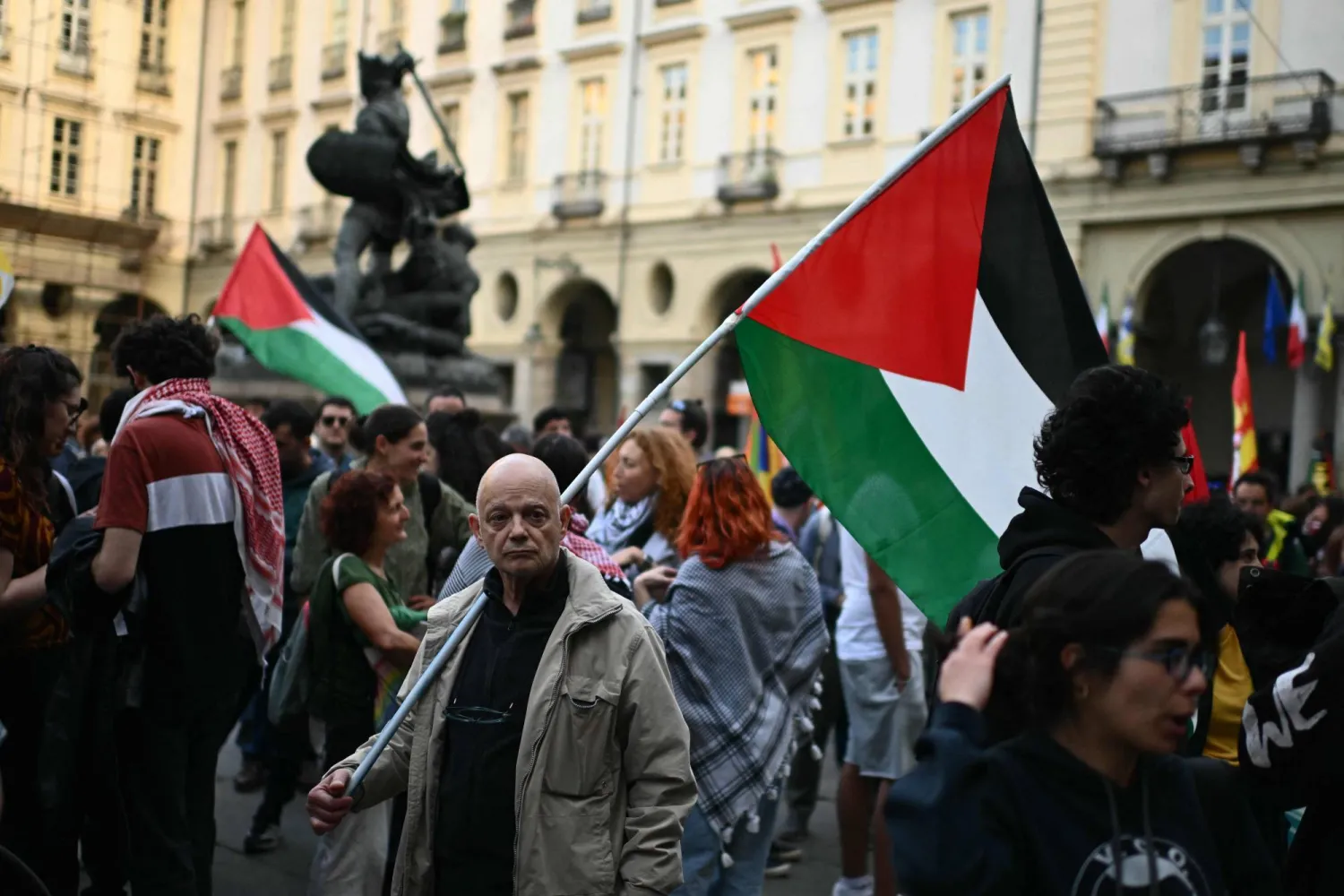



Activists on Gaza Aid Flotilla Detained by Israel Disembark in Crete

Protesters hold Palestinian flags during a demonstration to condemn the interception of the Global Sumud Flotilla by the Israeli army, in Turin on April 30, 2026. (Photo by MARCO BERTORELLO / AFP)
TT

Activists on Gaza Aid Flotilla Detained by Israel Disembark in Crete

Protesters hold Palestinian flags during a demonstration to condemn the interception of the Global Sumud Flotilla by the Israeli army, in Turin on April 30, 2026. (Photo by MARCO BERTORELLO / AFP)

Dozens of activists on a Gaza-bound aid flotilla which was intercepted by Israeli forces in international waters off Crete disembarked on Friday in the Greek island, an AFP journalist saw.

Escorted by Greek coast guards, some 175 activists were taken in four buses to a town whose name was not disclosed by the authorities.

Israel's foreign ministry earlier said around 175 activists had been taken off more than 20 boats on Thursday. Flotilla organizers put the number at 211.

"In coordination with the Greek government, the individuals transferred from the flotilla vessels to the Israeli vessel will be disembarked on a Greek beach in the coming hours," Israeli Foreign Minister Gideon Saar wrote on X late Thursday, thanking Greece "for its willingness to receive the flotilla participants".

Several European governments with nationals among those arrested have called on Israel to free the activists and called its action a flagrant contravention of international law.

But the United States backed Israeli authorities, calling the flotilla a "stunt".

"The United States expects all our allies...to take decisive action against this meaningless political stunt by denying port access, docking, departure and refueling to vessels participating in the flotilla," State Department spokesman Tommy Pigott said.

Initially made up of more than 50 boats, the flotilla's aim, according to the organizers, was to break the blockade of Gaza and bring humanitarian aid to the Palestinian territory, whose access remains largely restricted despite a fragile ceasefire between Israel and Hamas, in force since October.


Trump Congratulates Zaidi on His Nomination to Be Next Iraqi Prime Minister

This handout photograph taken and released by the Iraqi Prime Minister's Press Office on April 28, 2026 shows new prime minister-designate Ali al-Zaidi talking on the phone at his office in Baghdad. (Iraqi Prime Minister’s Press Office /AFP)
TT

Trump Congratulates Zaidi on His Nomination to Be Next Iraqi Prime Minister

This handout photograph taken and released by the Iraqi Prime Minister's Press Office on April 28, 2026 shows new prime minister-designate Ali al-Zaidi talking on the phone at his office in Baghdad. (Iraqi Prime Minister’s Press Office /AFP)

US President Donald Trump congratulated Ali al-Zaidi on his nomination to be next prime minister of Iraq on Thursday, saying that he looked forward to a highly productive new relationship.

Iraq's alliance of Shiite political blocs, the Coordination Framework, on Monday named Zaidi as its ‌nominee for the ‌post of prime minister, a ‌coalition ⁠statement said.

"We wish ⁠him success as he works to form a new Government free from terrorism that could deliver a brighter future for Iraq," Trump said in a post on Truth Social.

"We look ⁠forward to a strong, vibrant, ‌and highly ‌productive new relationship between Iraq and the United ‌States."

Trump also invited Zaidi to visit ‌Washington after forming a government during a phone call on Thursday in which he congratulated him on his nomination, according to ‌a statement from the Iraqi prime minister's media office.

The call reviewed ⁠strategic ⁠ties between Iraq and the US and ways to strengthen cooperation across multiple fields, the statement said, adding that both sides affirmed joint efforts to support regional stability.

Trump had threatened in January to withdraw Washington's support for Iraq if former Prime Minister Nouri al-Maliki was designated to form a cabinet.


Israel Responds to Lebanon’s De-Escalation Demand with More Pressure, Attacks

 A man passes on his scooter in front of a destroyed building that was hit few weeks ago by an Israeli airstrike, in the southern port city of Tyre, Lebanon, Thursday, April 30, 2026. (AP)
A man passes on his scooter in front of a destroyed building that was hit few weeks ago by an Israeli airstrike, in the southern port city of Tyre, Lebanon, Thursday, April 30, 2026. (AP)
TT

Israel Responds to Lebanon’s De-Escalation Demand with More Pressure, Attacks

 A man passes on his scooter in front of a destroyed building that was hit few weeks ago by an Israeli airstrike, in the southern port city of Tyre, Lebanon, Thursday, April 30, 2026. (AP)
A man passes on his scooter in front of a destroyed building that was hit few weeks ago by an Israeli airstrike, in the southern port city of Tyre, Lebanon, Thursday, April 30, 2026. (AP)

Israel responded on Thursday to Lebanon’s demands for de-escalation with more evacuation warnings for southern towns that will increase internal pressure on the Lebanese state.

It issued the warnings even as Lebanese and United Nations proposals have been relayed to Israel over consolidating the ceasefire in the South. At the moment, these efforts appear to have yielded little results save for keeping Lebanese state infrastructure out of Israel’s targets.

UN Special Coordinator for Lebanon Jeanine Hennis-Plasschaert informed on Thursday Lebanese President Joseph Aoun on the outcome of her visit to Israel on Sunday as part of efforts to consolidate the ceasefire.

Informed sources said her visit yielded no initiative. Lebanese ministerial sources told Asharq Al-Awsat that she conveyed “ideas and visions” to Israeli officials over how to consolidate the ceasefire and pave the way for negotiations between Lebanon and Israel.

Her efforts were met with an Israeli escalation with the warnings to southern towns in the Tyre and Nabatieh districts.

Israel has repeatedly said that its operations are solely aimed against Hezbollah, not the Lebanese state. Lebanese sources, however, view the attacks as an attempt to increase pressure against the state. The warnings are leading to the displacement of tens of thousands of people, which is increasing pressure on the state that views direct negotiations with Israel as a solution to the problem.

The “Shiite duo” of Hezbollah and its ally, Amal, are opposed to the talks.

Aoun has through his various diplomatic contacts been urging Israel to commit to the ceasefire that US President Donald Trump extended for another three weeks. Aoun has also been calling for Israel to release Lebanese detainees and withdraw from Lebanese territories.

He met on Thursday with a delegation from the International Federation of Red Cross and Red Crescent Societies. He stressed to it the need for Israel to respect international laws and agreements and cease attacks against civilians, medics, and civil defense, humanitarian, health and relief teams.

Berri and Hezbollah

Meanwhile, differences between Aoun and parliament Speaker and Amal movement leader Nabih Berri over direct negotiations with Israel came to the open on Wednesday.

Telecommunications Minister Charles al-Hage said: “There are no disputes between them over the end goals. The main goals are ending the destruction and killing.”

“Not a single Lebanese person trusts Israel, and so, we need international guarantees, especially ones from the US and Arab countries, led by Saudi Arabia, to ensure that the ceasefire will be respected and consolidated,” he added.

In a statement on Labor Day, which falls on May 1, Berri called on the Lebanese “state, and all of its authorities, and the international community, and its rights and justice organizations, to make Israel immediately cease its attacks.” He also called for an international probe into Israel’s crimes in Lebanon.

Hezbollah, meanwhile, continued its attacks against Aoun over direct negotiations with Israel.

Member of the Iran-backed party’s Loyalty to the Resistance bloc MP Ali Fayyad said the president’s stance is “increasingly alarming because he is promoting American demands, rather than distancing himself from them.”

“Most dangerous is that he is agreeing to them without making a clear objection to allowing Israel freedom of movement even though he has been demanding a ceasefire,” he said in remarks to local radio.

How can a date for the next round of talks be scheduled amid the ongoing Israeli attacks and escalation? he wondered.

He noted that there appears to be “clear confusion in the official Lebanese stance and a lack of transparency. Most dangerous of all is the undisclosed American-Israeli side agreement that has given Israel the green light to act freely against potential threats. Aoun’s statements imply that he has agreed to this.”