

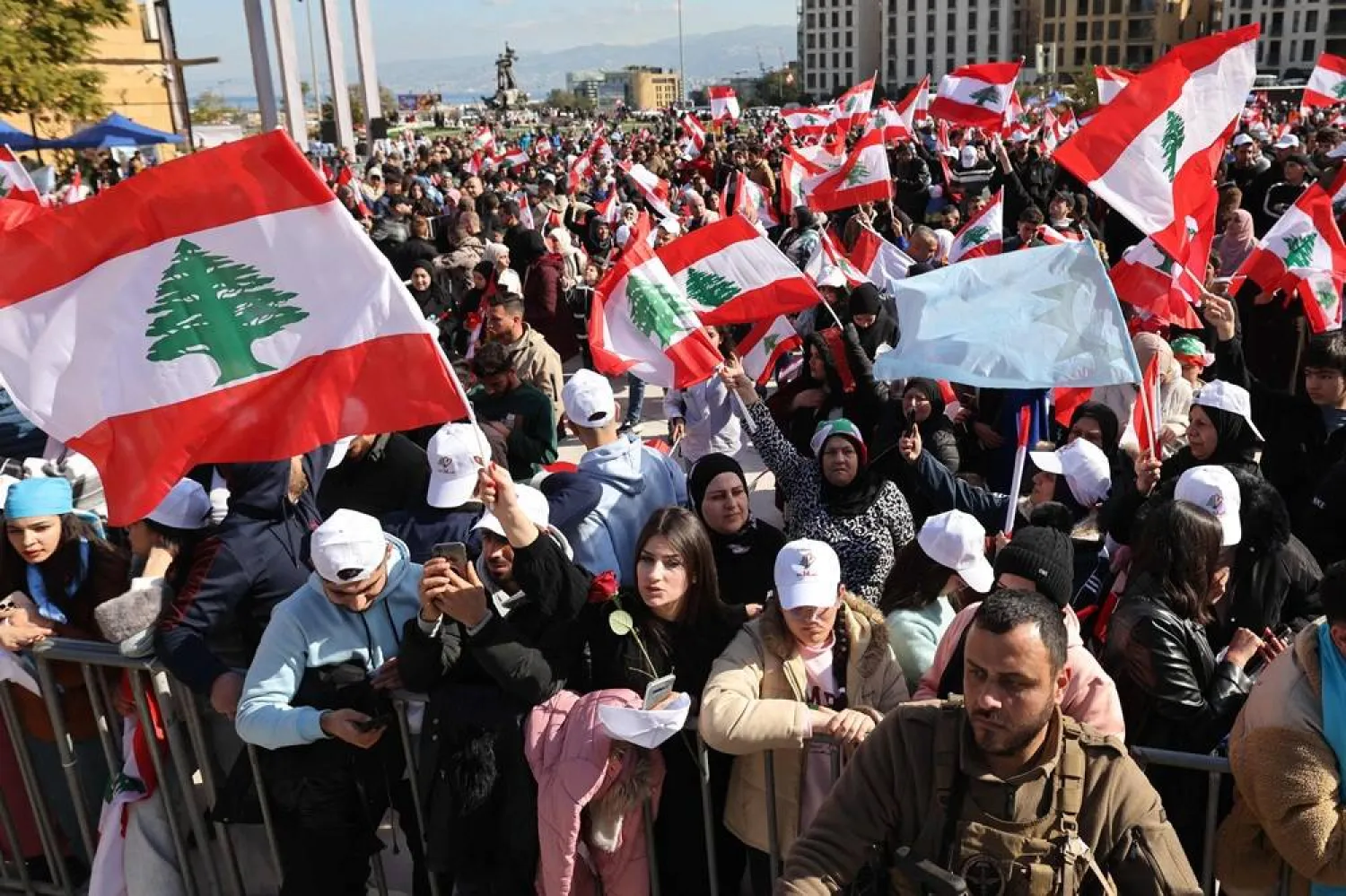

Lebanon Marks 20th Anniversary of Rafik Hariri’s Assassination amid Political Shifts

Lebanese gather in Downtown Beirut to mark the 20th anniversary of the assassination of Lebanon's former Premier Rafik Hariri, on February 14, 2025.  (AFP)
Lebanese gather in Downtown Beirut to mark the 20th anniversary of the assassination of Lebanon's former Premier Rafik Hariri, on February 14, 2025. (AFP)
TT

Lebanon Marks 20th Anniversary of Rafik Hariri’s Assassination amid Political Shifts

Lebanese gather in Downtown Beirut to mark the 20th anniversary of the assassination of Lebanon's former Premier Rafik Hariri, on February 14, 2025.  (AFP)
Lebanese gather in Downtown Beirut to mark the 20th anniversary of the assassination of Lebanon's former Premier Rafik Hariri, on February 14, 2025. (AFP)

Tens of thousands of supporters gathered in downtown Beirut on Friday to commemorate the 20th anniversary of former Lebanese Prime Minister Rafik Hariri’s assassination, which comes amid seismic regional political shifts.

The ousting of Bashar al-Assad in December after 54 years of family rule in Syria marked the fall of a government long accused of orchestrating Hariri’s assassination and other political killings in Lebanon.

Meanwhile, the Lebanese group Hezbollah — whose members were convicted by a UN-backed tribunal for their role in Hariri’s murder — now faces its own turning point following the assassination of its leader, Hassan Nasrallah, in an Israeli airstrike in September. Nasrallah’s funeral is set for February 23.

"This is the beginning of justice. If the justice of the earth did not serve us, no one escapes the justice of heaven," said Hariri’s son, former Lebanese Prime Minister Saad Hariri, as he addressed a huge crowd in the capital Beirut.

"After 20 years, Rafik Hariri’s project is continuing, and those who tried to kill the project, look where they are now," Saad added.

Prime Minister Nawaf Salam, appointed in early February, visited Hariri’s burial site earlier Friday.

"Today, we remember the legacy of the great martyr in serving Lebanon, preserving its national unity, and working for its prosperity," Salam wrote on X. "He was greatly respected in the Arab world and the world, leaving Lebanon with a remarkable moral and political legacy."

Lebanon’s President Joseph Aoun also paid tribute to Hariri, saying on X that Hariri's "national stances were a fundamental building block in strengthening national unity and protecting civil peace."

Hariri was killed on Feb. 14, 2005, when a massive bomb exploded near the St. Georges Hotel, a historic landmark on Beirut’s waterfront. The blast killed 21 other people and injured over 200.

In 2020, a UN-backed tribunal convicted one member of the Iran-backed Hezbollah group and acquitted three others of involvement in the assassination. The Special Tribunal for Lebanon said Salim Ayyash was guilty as a co-conspirator of five charges linked to his involvement in the suicide truck bombing.

None of the suspects was ever arrested or attended court to hear the verdicts.

The assassination of Hariri ignited the "Cedar Revolution," leading to massive protests against Syria’s nearly three-decade political hegemony and military presence in Lebanon, ultimately culminating in the withdrawal of Syrian troops in 2005. The assassination also intensified sectarian divisions within Lebanon and bolstered the political influence of Assad's ally, Hezbollah.

Hopes that Lebanon ‘would unite’  

Buses from across Lebanon arrived early, bringing supporters to downtown Beirut to commemorate the anniversary. Thousands of people filled the streets and waved Lebanese flags and the blue flag of Hariri's Future Movement to songs honoring Hariri's memory.

"After the Syrian and Iranian guardianship ended and the ousting of the Syrian regime, the Lebanese state alone rules us," Mohammad Kanaan told The Associated Press.

"In this square, you expelled Bashar Assad from Lebanon," Saad said during his speech. "And after twenty years of sectarian rule, detention and brutality, the heroic Syrian people rose up and expelled the criminal from Syria."

Another supporter, Ahmad Serhal, said he hoped that "Lebanon would unite" after the departure of Assad. "All the political shifts are for the good of this country. Lebanon is for all the Lebanese, we need to reach an agreement and unite."

"God took revenge upon those who assassinated president Rafik — from ousting Assad, from ousting the system that is allied with Iran," Ahmad Trab said. "We hope for a better future now with Syria."

Israeli withdrawal deadline looms  

The anniversary of Hariri’s death comes just four days before the deadline for Israeli troops to withdraw from southern Lebanon under a ceasefire agreement that ended a 14-month war with Hezbollah in late November. The ceasefire deal also stipulates that Hezbollah must end its military presence south of the Litani River, with the Lebanese Army and UN peacekeepers deploying in the vacated areas.

The pullout deadline, initially set for Jan. 26, was postponed to Feb. 18.

Parliament Speaker Nabih Berri said Lebanon "absolutely rejects" an Israeli proposal to keep troops in five strategic border points after the withdrawal. "It is the responsibility of the Americans to impose (the withdrawal), otherwise they will have caused the biggest setback for the government," he said.

Aoun has also insisted that Israel must adhere to the agreed-upon timeline. During his speech, Saad also emphasized the need for the Israeli army's withdrawal from Lebanon.

Saad addressed the people of southern and eastern Lebanon, regions largely supporters of and influenced by Hezbollah, urging them to seize Lebanon’s golden opportunity while dispelling any perception of being "a force of obstruction."

Renewed Arab engagement  

On Feb. 8, Lebanon formed a new government led by Salam, the first fully empowered administration since 2022. Salam, a former president of the International Court of Justice, was appointed following the election of Aoun in January. The 24-member cabinet includes a mix of technocrats and political figures, representing various sects, including Hezbollah’s allies.

Although Hezbollah did not formally endorse Salam’s appointment, the group negotiated during the government formation process.

The United States has expressed support for the new government, emphasizing the importance of stability and reforms, though opposing Hezbollah’s direct participation in the cabinet. Salam's government now faces Lebanon’s longstanding economic crisis and an urgent need to implement key financial reforms.

The political shift has reopened the door for renewed Arab countries that previously distanced themselves from Lebanon due to the growing influence of Iran and Hezbollah.

The countries are now reassessing their approach, with hopes of reintegrating Lebanon into the Arab fold.



At Least 28 Civilians Killed in Sudan Drone Strikes

Displaced Sudanese families from Kurdufan at a football stadium in the town of Kadugli, south of the region (AP)
TT

At Least 28 Civilians Killed in Sudan Drone Strikes

Displaced Sudanese families from Kurdufan at a football stadium in the town of Kadugli, south of the region (AP)

Two drone strikes in Sudan, one at a market in Darfur and the other along a road in Kordofan, killed at least 28 civilians, health workers told AFP Thursday.

The three-year war between Sudan's army and the Rapid Support Forces (RSF) has seen a recent uptick in near-daily drone strikes that kill dozens at a time.

On Wednesday, a strike hit a market in North Darfur state's Saraf Omra town, killing "22 people, including an infant, and injuring 17 more", one health worker at the local clinic told AFP.

"The drone hit a parked oil truck, which caught fire along with part of the market," said Hamid Suleiman, a vendor at the market, which serves Saraf Omra and the surrounding towns in the remote Darfur area.

Some 800 kilometers (500 miles) east of the RSF's strongholds in Darfur, another drone strike set fire to a truck travelling on a North Kordofan road in army territory.

"Six bodies arrived at the hospital yesterday, three of them charred, in addition to 10 wounded," a medical source at the local hospital in El-Rahad told AFP, blaming the RSF for the attack.

The civilians were travelling between the army-controlled towns of El-Rahad and Um Rawaba.

Drones from both sides have repeatedly attacked Sudan's central east-west highway, which runs through North Kordofan state capital El-Obeid and connects Darfur to the army-controlled east.

Sudan's war has killed tens of thousands and left some 11 million displaced, in the world's largest hunger and displacement crisis.


Guterres Names Envoy for Middle East… Warns of a Wider War

FILED - 14 May 2025, Berlin: United Nations Secretary-General Antonio Guterres holds a press conference at the Federal Chancellery. Photo: Kay Nietfeld/dpa
TT

Guterres Names Envoy for Middle East… Warns of a Wider War

FILED - 14 May 2025, Berlin: United Nations Secretary-General Antonio Guterres holds a press conference at the Federal Chancellery. Photo: Kay Nietfeld/dpa

UN Secretary-General Antonio Guterres on Wednesday named veteran French diplomat Jean Arnault as his personal envoy to support efforts to end the Middle East conflict, saying the “world is staring down the barrel of a wider war.”

Guterres told reporters that he had been in close contact with many in the region and around the world and that a number of initiatives ⁠for dialogue and peace were underway.

“It is time to stop climbing the escalation ladder – and start climbing the diplomatic ladder,” he said in New York.

The UN chief also warned that prolonged closure of the Strait of Hormuz was choking movement of oil, gas, and fertilizer at a critical moment in the global food planting season.

Guterres said ⁠Gulf countries are important suppliers of raw materials for nitrogen fertilizers crucial for developing countries.

“Without fertilizers today, we might have hunger tomorrow,” he noted.

Guterres said UN mediators have offered their services and Arnault would do “everything possible” to support peace efforts.

The UN says Arnault has more than ⁠30 years' experience in international diplomacy focusing on peace settlements and mediation, with a background in UN missions in Africa, Asia, Europe and Latin America.

His most recent assignment was in 2021 as Guterres' personal envoy on Afghanistan and regional issues.

Disrupted fertilizer shipments and soaring energy ⁠prices are threatening to unleash a fresh food-price surge across vulnerable nations, risking a years-long setback just as many were recovering from successive global shocks, UN and other experts warn.

An analysis released by ⁠the UN World Food Programme last week warned that tens of millions more people will face acute hunger if the Iran war continues through to June.


Israel Steps up Assassinations in Gaza

Smoke rises from a displacement camp in Deir al-Balah in central Gaza after an Israeli strike on Wednesday (AFP)
TT

Israel Steps up Assassinations in Gaza

Smoke rises from a displacement camp in Deir al-Balah in central Gaza after an Israeli strike on Wednesday (AFP)

A relative lull hangs over efforts to shape Gaza’s future, as global and regional attention shifts to the US-Israeli war against Iran.

Still, Israel has continued targeting commanders from Hamas’ armed wing, the Al-Qassam Brigades, using intelligence from collaborators and surveillance devices. One such device was recently uncovered in a displacement camp in central Gaza and self-destructed during inspection.

Israel killed Ahmed Darwish, an elite commander in the Central Brigade of the Qassam Brigades, along with his aide Nader al-Nabahin, while a third man was critically wounded. An Israeli drone struck them shortly before midnight on Tuesday into Wednesday near a football field south of the Nuseirat refugee camp in central Gaza.

Field sources told Asharq Al-Awsat that Darwish had survived several assassination attempts during the war. One source said he led an elite unit in the Oct. 7, 2023, attack and captured several Israelis.

Sources said Darwish had recently emerged as a key figure in the Central Brigade after senior commanders were killed, and had been working with others to rebuild the Qassam Brigades.

The Israeli military said it struck Hamas elite operatives during what it described as military training in central Gaza, calling them a threat. Hamas field sources denied this, saying they were gathered normally when they were hit.

Mysterious blast of a surveillance device

A blast struck near a displacement camp in Deir al-Balah in central Gaza before noon on Wednesday, causing no injuries and initially thought to be a drone strike.

Field sources said fighters had found an Israeli surveillance device and tried to dismantle it to access images and recordings. It then self-destructed, possibly due to a malfunction or remote detonation by an Israeli drone.

Hours later, a warplane hit the same site, killing one person and wounding six others, one critically.

Sources said armed factions in Gaza have found several such devices before and during the war, used to transmit live images to drones and Israeli operations rooms.

Israel has stepped up intelligence and operational activity in central Gaza, areas less damaged during the war and hit by fewer ground and air attacks than elsewhere. Hebrew media say the Qassam Brigades have largely retained their strength there.

Repeated strikes on police vehicles

On Sunday evening, the third day of Eid al-Fitr, a drone struck a Hamas-run police vehicle, killing three and wounding others. Field sources said one of the dead was Ahmed Hamdan, an elite field commander in the Nuseirat Battalion of the Qassam Brigades.

The Israeli military did not comment. The strike followed a similar attack days earlier on a Hamas police vehicle that killed at least four people, including prominent Qassam operatives, in central Gaza.

Asharq Al-Awsat monitoring shows that at least 10 field commanders, including company leaders, elite unit commanders, and deputy battalion commanders, have been killed by Israel in the past three weeks in a series of strikes.

Gaza’s Health Ministry says at least 690 Palestinians have been killed since a ceasefire took effect on Oct. 10, 2025, bringing the total death toll since the war began to more than 72,265.

The killings have come alongside continued airstrikes, artillery fire, and demolitions along both sides of the so-called “yellow line,” and bulldozing of remaining homes along the main Salah al-Din road, particularly near Khan Younis and in areas such as Shuja’iyya and Jabalia.

Foiled assassination attempt

Military activity has coincided with operations by armed gangs in areas under Israeli control.

Hamas’ Radea (Deterrence) force said it foiled an attempt to assassinate a resistance commander, arresting two suspects and seizing their weapons and equipment, while two others fled.

It said interrogations revealed details about coordination between armed gangs and Israeli intelligence, which could help dismantle the groups.

Field sources said the target was a senior faction leader. They added that tighter security measures helped thwart the plot. Silenced pistols, cameras, and communication devices with Israeli SIM cards were seized.

Armed gangs have stepped up attacks on faction leaders and senior Hamas government officials. Some attempts have been foiled, while others have succeeded in recent months.